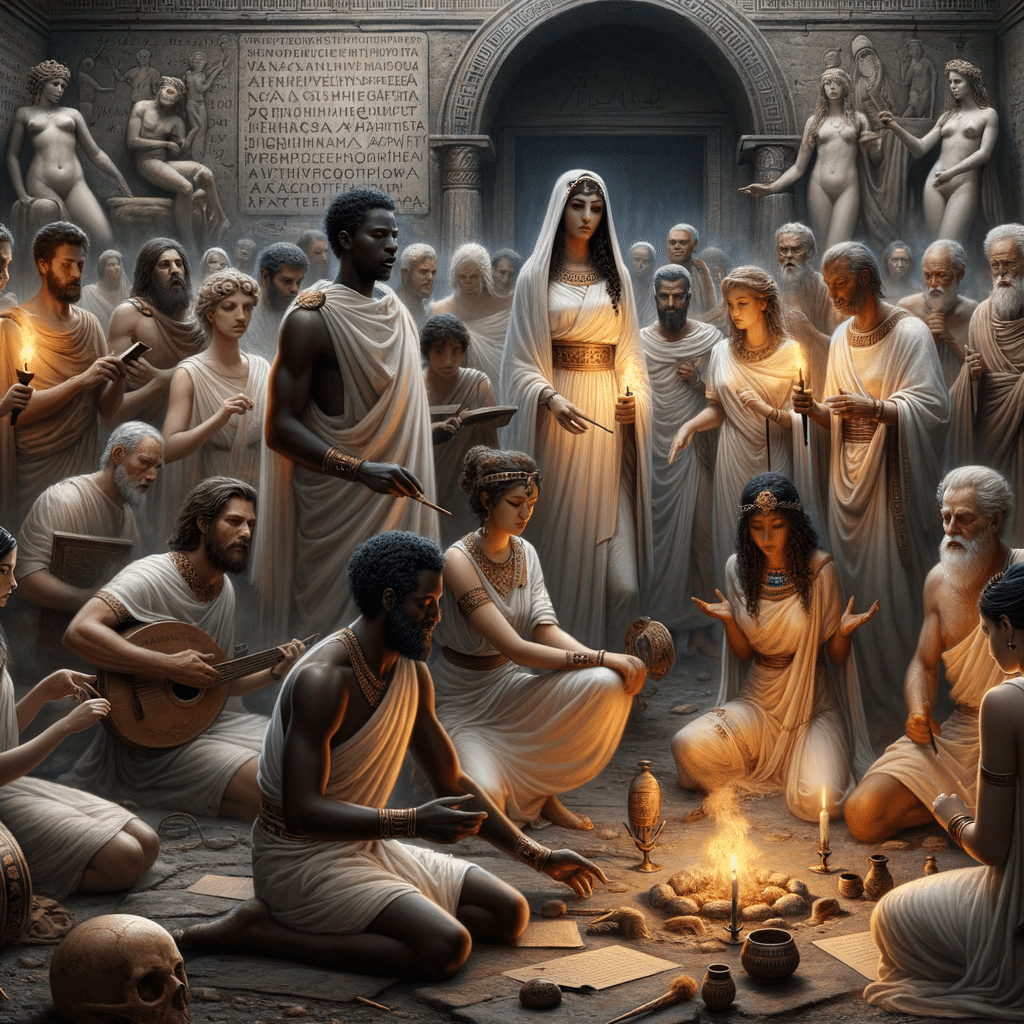
The mysterious rituals known as the Eleusinian Mysteries formed the basis of the spiritual practices of the ancient Greeks, fusing the stories of Demeter and Persephone with the fundamental elements of human life. These complex rites took place in the village of Eleusis, not far from the center of Athens’ culture, and were based on the ideas of the cyclical nature of life and the journey of the human soul. Through Christianity and contemporary cult movements, these secrets have continued to have an impact on the modern world.
The Foundational Myths
The moving story of the harvest goddess Demeter and her daughter Persephone was at the center of these rituals. This tale captured the universal challenges and victories related to life, death, and the prospect of rebirth. The central theme of the story was Demeter’s agonizing quest for Persephone following her kidnapping, which had an impact on the cycles of the natural world and caused it to become barren until her final return brought about renewal.
The details of the Eleusinian Mysteries were fiercely guarded, and participants in the ceremonies were required to swear an oath of silence about them. Due to the shroud of secrecy, many of the ceremonies’ specifics have been lost to history, allowing us to speculate as to the nature of their life-changing experiences.

The Lesser and Greater Mysteries
The Lesser and Greater Mysteries were the two branches of the initiatory path that each had a unique function in the participants’ spiritual enlightenment. As a preface, the springtime Lesser Mysteries concentrated on purification and established the fundamental framework for comprehending the divine narrative and ceremonies. The nine-day Greater Mysteries, on the other hand, took place in the fall and featured a ritualistic retracement of Demeter’s steps as well as ceremonies representing a journey into the underworld (Katabasis) and a subsequent return (Anabasis) that symbolized an enlightened rebirth.
Symbolic Journeys and Societal Impact
The idea that initiates would gain profound understanding of the mystery of life’s transformations, from birth to death and beyond, was central to the Eleusinian Mysteries. The ceremonies reinforced the mythical ascension and fall of Persephone as well as the corresponding changes occurring on Earth by reflecting the agricultural cycle.
Amazingly welcoming, these Mysteries broke down barriers between genders and social classes in the name of spiritual progress by accepting participation from all areas of life. It was a great honor to finish the Mysteries, demonstrating profound respect for Demeter and Persephone.
The Mysteries had a significant impact on the intellectual and cultural life of ancient Greece. The mythological story had an impact on the epic poetry of Homer and Hesiod, as well as the tragic plays of Sophocles and Euripides, which dealt with the universal themes of loss, search, and reunion. Philosophers such as Plato discovered a metaphorical portrayal of the soul’s journey in the Mysteries, which enhanced the philosophical conversation about wisdom, the soul, and the afterlife.
Along with promoting moral introspection and the quest for virtue, these hallowed rituals complemented the Greek ideal of human perfection. In addition, they promoted a pan-Hellenic identity that went beyond regional ties and nurtured a common spiritual legacy among the Greek city-states.
The Eleusinian Mysteries emphasized the crucial connection between God, the natural world, and humanity. Initiates become more cognizant of the cycles of nature and the need for sustainable farming methods as a result of their involvement.

Legacy of the Mysteries
Even though the particular ceremonies of the Eleusinian Mysteries are still shrouded in mystery, their influence endures over the ages. They provide witness to the eternal pursuit of spiritual enlightenment, the eternal search for meaning, and the inherent worth of nature’s equilibrium—themes that are just as pertinent today as they were in antiquity.
The Eleusinian Mysteries, which operate as a link between traditional rituals and modern spiritual activities, have permanently altered the fabric of religious history. These Mysteries, which were once essential to the worship of Demeter and Persephone in classical Greece, are now a prism through which we can study the timeless themes of rebirth, death, and life that are still relevant in contemporary spiritual movements, such as Christianity and new religious movements that are sometimes referred to as cults.
Contemporary Christianity
There are thematic similarities between the Eleusinian Mysteries and modern Christianity because of their focus on the resurrection and life after death. Both the Christian story of Jesus Christ’s death and resurrection and the Eleusinian rites’ tale of Persephone’s descent into and return from the underworld revolve around the theme of death and rebirth. The Christian idea of being “born again,” which refers to a soul transformation and reorientation towards the divine, can be compared to the experience of spiritual awakening and illumination found in the ancient Mysteries.
It is also possible to perceive the ritualistic elements of Christianity as remnants of the old Mysteries, especially in its more liturgical branches like Eastern Orthodoxy and Roman Catholicism. Sacraments, particularly the Eucharist, are thought to bestow grace and establish a channel of communication between believers and the divine, but they are also deep mysteries in and of themselves. The Christian yearning for personal contact with God through these sacraments is paralleled in the Eleusinian initiates’ experience of a profound intimate encounter with the divine.
Modern Cults and New Religious Movements
Although the word “cult” has a lot of negative connotations in today’s world, it may also be used more neutrally to describe emerging religious movements that present alternate spiritual pathways. Many of these societies use elements of the Eleusinian Mysteries, such as metamorphosis, secrecy, and exclusive enlightenment.
Members of these contemporary movements, like the Eleusinian initiates, frequently go through rites of passage or initiation, swearing secrecy regarding the inner workings of the group. Similar to ancient Greece, the promise of a changed condition of being and the attraction of secret knowledge can be strong draws. But although the Eleusinian Mysteries served as a cohesive cultural institution, contemporary cults are frequently outlier movements that occasionally engage in contentious behavior that distances them from the majority of society.
With their profound spiritual and ethical insights, the Eleusinian Mysteries endure the test of time and continue to shape religious philosophy and practice today. Whether through the organized doctrines of Christianity, the exploratory spirit of emerging religious movements, or the individual quest for purpose that is characteristic of the human condition, they serve as a reminder of the common human quest for understanding and connection with something higher than ourselves. We learn more about the sacred’s persistent ability to influence our lives and society, as well as our personal quests for enlightenment, by thinking back on these old customs.
Further Reading
Burkert, W. (1987). Ancient Mystery Cults. Cambridge, MA: Harvard University Press.
Walter Burkert’s work is an indispensable resource for understanding the wider context of mystery cults in the ancient world, including the Eleusinian Mysteries. Burkert is a renowned scholar in Greek mythology and religion, and this book provides a comprehensive analysis of the function and significance of mystery rites in ancient societies. His scholarly rigor and engaging narrative make it a valuable resource for both students and enthusiasts of classical studies.
Mylonas, G. E. (1961). Eleusis and the Eleusinian Mysteries. Princeton, NJ: Princeton University Press.
George E. Mylonas brings an archaeological perspective to the study of the Eleusinian Mysteries, providing insights into the physical remains and the possible interpretations of the rituals performed. As an archaeologist who conducted extensive work at Eleusis, Mylonas offers a detailed description of the site and its artifacts, making this book an essential read for those interested in the tangible aspects of the Mysteries and their historical context.
Kerenyi, K. (1967). Eleusis: Archetypal Image of Mother and Daughter. Princeton, NJ: Bollingen.
Karl Kerenyi’s book delves into the psychological and archetypal dimensions of the Eleusinian Mysteries, particularly focusing on the figures of Demeter and Persephone. Kerenyi, a scholar of classical mythology, explores the symbolism and religious significance of the mother-daughter relationship and its implications for understanding the Mysteries. This book is recommended for readers who are interested in the mythological and psychological interpretations of ancient Greek religious practices.

Leave a Reply