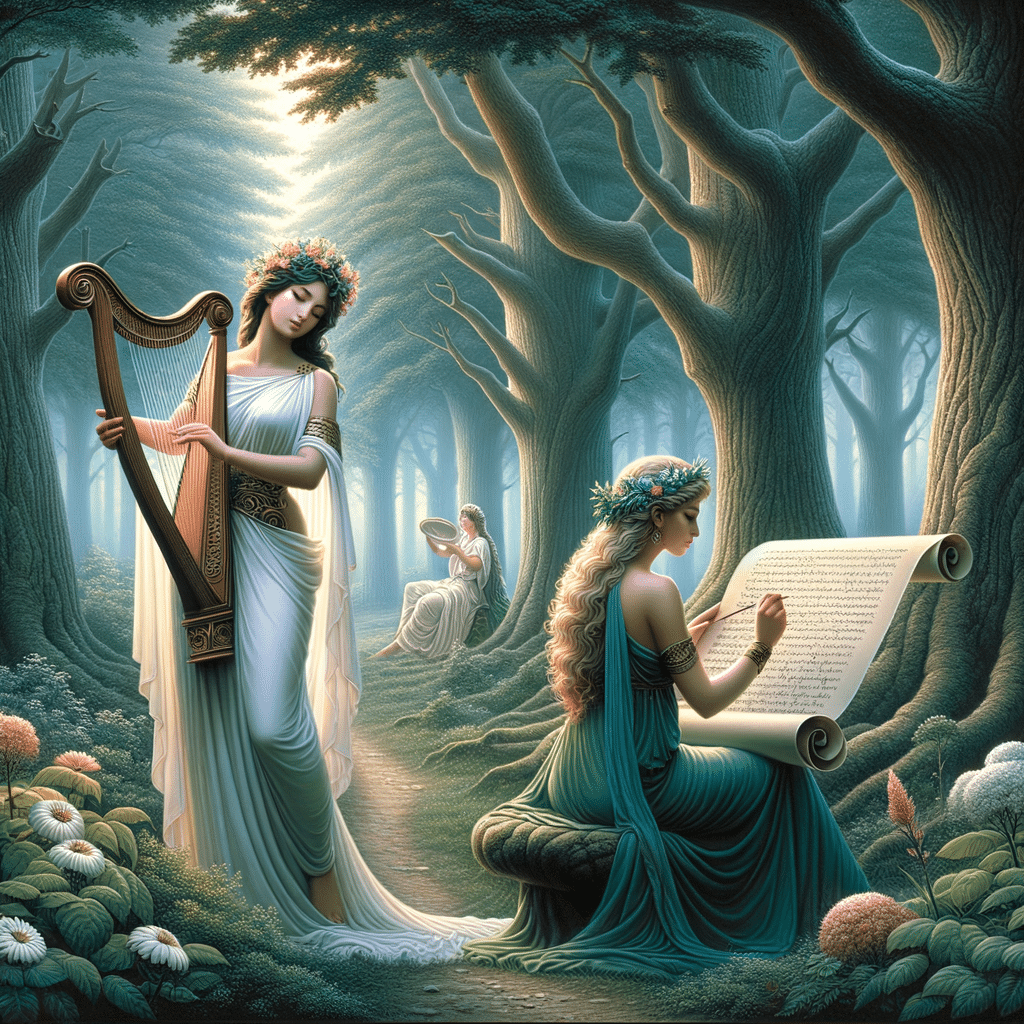
There is a celebration of the Nine Muses in Greek mythology, who are considered to be divine patrons of the arts and sciences. Zeus, the king of the gods, and Mnemosyne, the goddess of memory, are believed to be the parents of these nine daughters. Each Muse represents the spirit of artistic inspiration and wisdom, and they each rule over a specific domain within the universe of creativity and intellectual expression. In modern times, muses have been connected to faeries.

Muses
The Greek pantheon adores the Nine Muses, frequently portraying them as graceful and ethereal characters who inspire musical artists, poets, and other creative types. Everyone generally agrees that the Muses originated the knowledge that shaped the intellectual and cultural life of ancient Greece (Grant and Hazel, 2004). People often associate the Muses with Mount Helicon and Mount Parnassus, two mountains renowned for their sacred springs that served as inspiration sources.
Furthermore, the Muses’ influence went beyond the realm of mythology and into the society of ancient Greece, where they played a pivotal role in artistic and educational endeavors. People dedicated temples and sanctuaries to the Muses and invoked them at the opening of epic poems and other works to guarantee divine inspiration. People considered the Muses as the ultimate source of creativity, and anyone involved in artistic or academic endeavors sought their favor.
The Muses hold a special place in Greek mythology. The goddesses of the arts and sciences, each of whom presides over a distinct realm, are inspirational figures in their respective fields. Calliope, the Muse of Epic Poetry, often depicted holding a writing tablet, inspires poets to create works of epic poetry characterized by grand narratives and profound themes. Nagy (2018) asserts that Calliope’s influence is evident in works like Homer’s “Iliad” and “Odyssey,” exemplifying the pinnacle of epic narrative. Clio, the Muse of History, is the one who encourages the recording and study of historical events. A scroll or a chest of books represents Clio. Greenwood (2015) asserts that the works of pioneers in the field of historical writing, such as Herodotus and Thucydides, bear witness to her impact. The lyre depicts Erato, the Muse of Love Poetry, inspiring poets to explore the depths of love and passion in their writing. Sappho’s lyrical poetry, which captures the intensity of love and want, feels Erato’s presence (Hard, 2003). Sappho’s lyrics depict the intensity of love and desire.
People frequently represent Euterpe, the Muse of Music, with a flute. People say that Euterpe inspires happiness and creativity through the manifestation of musical inventiveness. Morelli & Waanders (2001) assert that her influence was evident in the evolution of musical theory and performance in ancient Greece. The Muse of Tragedy, Melpomene, wears a sad mask and inspires playwrights to explore the depths of human pain and fate. The tragedies of Sophocles and Euripides, which explore topics like catharsis and the concept of destiny, bear witness to her impact (Hard, 2004). The depiction of Polyhymnia, the Muse of Holy Lyrics and Eloquence, in a stance that encourages reflection in the realms of philosophy and religion, is of great significance. Polyhymnia is responsible for the composition of religious hymns, which played an important role in the Greeks’ worship activities (Larson, 2001). People frequently depict Terpsichore, the muse of dance, holding a lyre. She is a source of inspiration for movement and rhythm, and she honors the art of dance. Greece’s ceremonies and festivals demonstrate her influence through the significance of dancing (Kerenyi, 2016).
As the muse of comedy and pastoral poetry, Thalia, who is represented by a comic mask, is the source of laughter and the inspiration for humorous and lighthearted narrative. Hard (2003) asserts that the plays of Aristophanes demonstrate her influence, offering a deeper understanding of the humor and irony inherent in human circumstances. The study of the stars and the universe draws inspiration from the astronomical goddess Urania, often depicted holding a globe and a compass. According to Caruso (2022), both Ptolemy’s astronomical writings and the activities of ancient Greek astronomers in stargazing contain information that reflects Urania’s domain.

Muses and Faeries
Faeries, mostly rooted in Celtic legend, are fantastical creatures often associated with the natural world, magical practices, and enchantment. Their ethereal beauty, as well as their capacity to inspire creativity and wonder, have earned them a well-deserved reputation. It is common practice to portray faeries as evasive and mysterious entities since they live in a world that is similar to our own.
It is generally accepted that faeries and the Muses are both sources of inspiration; therefore, the relationship between the two is mostly symbolic. In contrast to the Muses, which have their origins in Greek mythology and are the embodiment of particular arts and sciences, faeries are more representative of a more universal feeling of magical inspiration. Literature and art frequently portray them as muses in their own right, their alluring presence serving as a source of inspiration for poets, musicians, and artists.
Both mythology and literature heavily emphasize the influence of otherworldly entities. The Muses provide heavenly inspiration to creators, while the mystical and alluring characteristics of faeries inspire their creators. This shared role illuminates the common human desire to seek inspiration and imagination from the outside world.
In spite of the fact that they come from separate cultural traditions, the muses and faeries share a common association with the arts, creativity, and the mystical forces that are the source of human expression. This is where the symbolic parallels between the two groups of beings reside.
Conclusion
The Nine Muses of Greek mythology are perceived as supernatural patrons who foster human creativity. They are therefore considered to be representative of the arts and sciences. Their influence was so significant that it permeated all aspects of ancient Greek civilization, including education, music, and writing. Despite drawing inspiration from faeries and sharing certain thematic similarities, they maintain a unique association with Greek mythical heritage.
References
Caruso, A. (2022). Muses, astronomers, and kings around the hellenistic Mediterranean: a historical synthesis from an iconographic approach. Eidola: International Journal of Ancient Art History: 1, 2022, 9-31.
Grant, M., & Hazel, J. (2004). Who’s who in Classical Mythology. Routledge.
Greenwood, E. (2015). Thucydides and the Shaping of History. Bristol Classical Press.
Hard, R. (2003). The Routledge handbook of Greek mythology: Based on HJ Rose’s handbook of Greek mythology. Routledge.
Kerényi, K. (2016). The gods of the Greeks. Pickle Partners Publishing.
Larson, J. L. (2001). Greek nymphs: Myth, cult, lore. Oxford University Press, USA.
Morelli, A., & Waanders, N. (2001). Portraits of Musicians in Sixteenth-Century Italy: A Specific Typology. Music in Art, 47-57.
Nagy, G. (2018). A re-invocation of the Muse for the Homeric Iliad. Classical Inquiries.


Leave a Reply