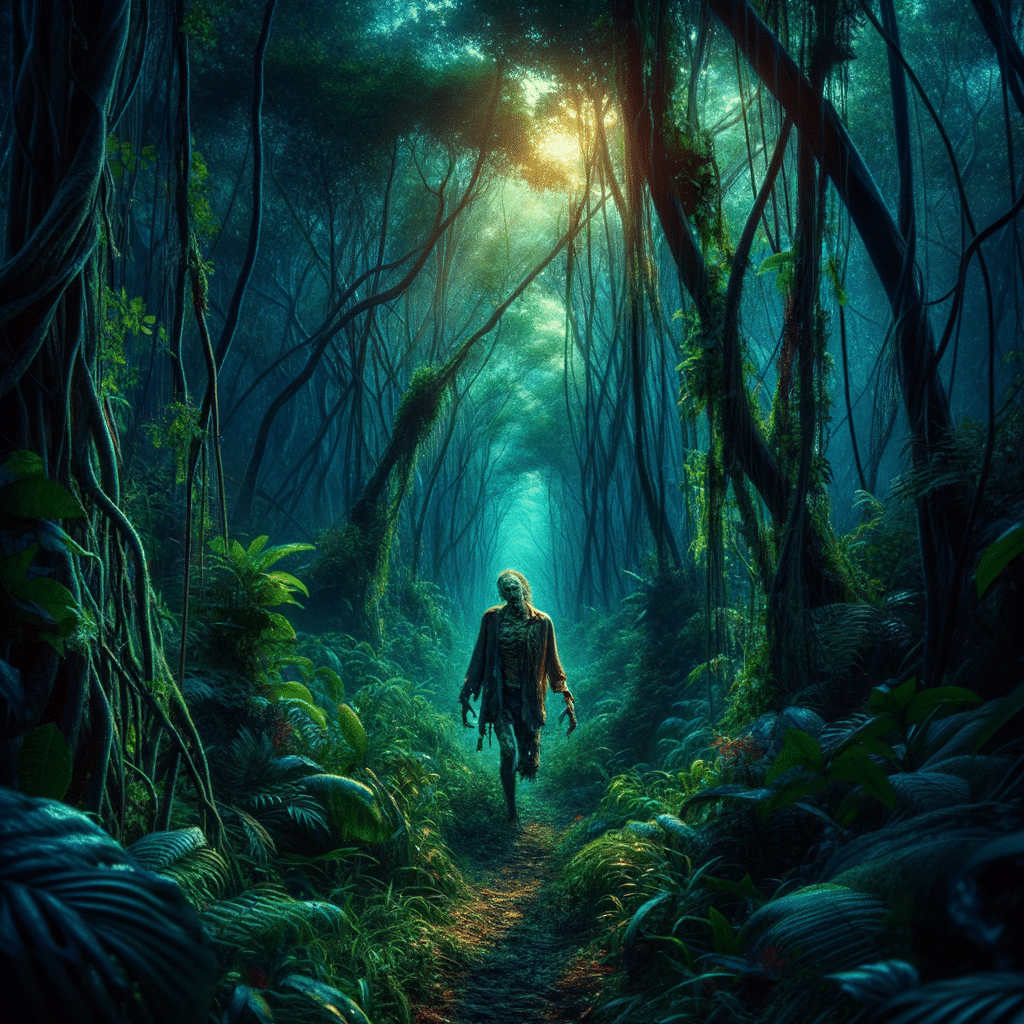
A fascinating and much misunderstood part of Haitian religion and mythology is the existence of zombies associated with Haiti. Although they have their roots in Haiti’s intricate history and cultural traditions, these creatures have managed to capture the imagination of people all over the world. They have evolved from their early Vodou beliefs to become a fundamental component of popular culture. In this paper, we will investigate the concept of Haitian zombies, their relationship to Vodou, the historical backdrop of their existence, and the transformation of these zombies in Western media.

Haitian Zombies
Zombies are not the flesh-eating, undead monsters that are glorified by modern media. According to Haitian legend, zombies existed. Instead, it is thought that they are people who have been brought back from the dead through the use of magical powers, generally by a practitioner of Vodou who is known as a bokor. These zombies are said to be soulless shells of their previous selves, with neither free will nor a sense of personal identity. They are claimed to be completely under the control of the bokor who made them, and they are frequently employed as slave labor on plantations or for other nefarious reasons (Davis, 2000).
It is essential to keep in mind that the creation of zombies is not a common or accepted activity within the Vodou religion. Vodou practitioners and researchers alike regard it as a distortion of the concepts and activities that are associated with Vodou. According to the allegations, the ways that bokors use to make zombies often entail the use of a combination of potent medications that are obtained from both plants and animals. Although the sufferer is brought back to life, they are left in a suggestible and trance-like condition. These chemicals have the ability to produce a state that is similar to death. Though spiritual beliefs play a major role in cultural understanding and fear of zombification, this process has its roots in pharmacology and psychology, not supernatural phenomena.
The position of Bokors in Haitian society is not entirely clear. While they are sometimes sought out for their purported superpowers, they are feared for their reported ability to harm others with magic. On the other hand, practitioners of mainstream Vodou frequently dissociate themselves from bokors, particularly those who are involved in harmful behaviors.
Role of Vodou
Vodou, which is frequently misinterpreted as “voodoo” in Western media, is an essential component in the concept of zombies that are prevalent in Haiti. The religion known as Vodou is a syncretic religion that incorporates aspects of West African Vodun, Roman Catholicism, and indigenous Taíno traditions merged together. Within the realm of Vodou, the production of zombies is regarded as a sort of dark magic, and it is more commonly connected with practitioners of evil than with those who engage in mainstream Vodou activities.
The history of zombies in Haiti is intricately linked to the country’s colonial past as well as slavery’s legacy (Hoermann, 2017). In 1804, Haiti, which had been a French possession known as Saint-Domingue, achieved its freedom as a result of a victorious slave uprising. In Haitian culture, the concept of zombies can be interpreted as a metaphor for the dehumanizing effects of slavery. This anxiety is a reflection of the fear of losing one’s free choice and being forced into eternal servitude. The zombie myth, according to the arguments of some academics, also served as a method of social control. It was used to discourage people from committing suicide among slaves, implying that even death might not be able to free them from their oppressors.
In the practice of Vodou, there is a significant emphasis on preserving links with ancestors’ spirits. There is a connection between this belief system and the concept of zombies, which symbolizes a disruption of the natural cycle of death and rebirth. One interpretation of a zombie is that it is a spirit that is stuck between two worlds, unable to reincarnate or join the ancestors. In Vodou cosmology, it is of the utmost importance to preserve a state of equilibrium between the physical and spiritual realms. A significant disturbance in this equilibrium is represented by the development of a zombie, which highlights the importance of adopting appropriate spiritual practices and showing reverence for the natural order.
The ‘gros bon ange’ (also known as the ‘large good angel’) and the ‘ti bon ange’ (also known as the’small good angel’) are the two souls that are included in the Vodou belief system. It is believed that the ‘ti bon ange’ is the origin of personality, character, and willpower. The ‘ti bon ange’ is thought to be captured during the process of creating a zombie, which results in the individual losing their will and personality. The term “zombification” has been employed as a metaphor for economic exploitation in contemporary contexts, notably in relation to low-wage labor and repressive working conditions. This is especially true in the present context (Degoul, 2011).

Western Zombies
At the start of the 20th century, the idea of zombies from Haiti began to make its way into the mainstream of Western culture. The sensationalized reports by writers and visitors caused this. Many Western readers were first exposed to Haitian mythology and Vodou traditions through William Seabrook’s book The Magic Island, which was published in 1929. This book is considered to be one of the most significant works. Immediately after this, early zombie films such as White Zombie (1932) were released (McAlister, 2012). Despite being extremely wrong and frequently racist in their depictions, these films helped to establish the concept of zombies in popular culture.
There has been a substantial transition from the Haitian origins of zombies to the current perception of these creatures. In Western media, zombies of the modern era are often depicted as reanimated corpses driven by an unquenchable desire for human flesh. The origins of this reinvention may be traced back to the classic film Night of the Living Dead (1968), directed by George A. Romero. This film is responsible for establishing many of the tropes that are associated with zombie storylines today. Examples of societal problems that are frequently used as metaphors include consumerism, conformity, and the spread of disease. These modern zombies are frequently used as models (Thomas, 2010).
Important problems regarding cultural appropriation are brought up as a result of the modification of the Haitian zombie notion shown in Western media. A nuanced component of Haitian folklore has been reduced to a superficial horror stereotype, according to critics, who say that the commercialization of zombies has stripped them of their cultural and historical importance. This appropriation frequently occurs without proper recognition of the concept’s origins or knowledge of the cultural context in which it was developed. As an additional point of interest, the depiction of Vodou in Western media frequently contributes to the perpetuation of damaging stereotypes and inaccurate portrayals of Haitian culture.
Conclusion
Haitian zombies are a rich and nuanced component of mythology that has been influential in popular culture all over the world, but they are also misinterpreted by many people. Zombies have developed in a manner that is significantly different from their initial setting, beginning with their origins in Vodou beliefs and the terrible history of slavery in Haiti and culminating in their transformation in Western culture. Despite the fact that the contemporary interpretation of zombies has given rise to a wide diversity of options for entertainment and storytelling, it is of the utmost importance to acknowledge and respect the original cultural roots of this concept. If we have a better grasp of the genuine nature of Haitian zombies and the significance of their existence, we can appreciate the complexity of Haitian folklore and work toward more respectful and accurate representations of varied cultural traditions in popular media.
References
Davis, W. (2000). Passage of darkness: The ethnobiology of the Haitian zombie. Univ of North Carolina Press.
Degoul, F. (2011). ‘We are the mirror of your fears’: Haitian identity and Zombification. Tr. Elisabeth M. Lore. Better Off Dead: The Evolution of the Zombie as Post-Human. Deborah Christie and Sarah Juliet Lauro (eds.). New York: Fordham UP.
Hoermann, R. (2017). Figures of terror: The “zombie” and the Haitian Revolution. Atlantic Studies, 14(2), 152-173.
McAlister, E. (2012). Slaves, cannibals, and infected hyper-whites: The race and religion of zombies. Anthropological quarterly, 457-486.
Thomas, K. (2010). Haitian zombie, myth, and modern identity. CLCWeb: Comparative Literature and Culture, 12(2), 12.



Leave a Reply