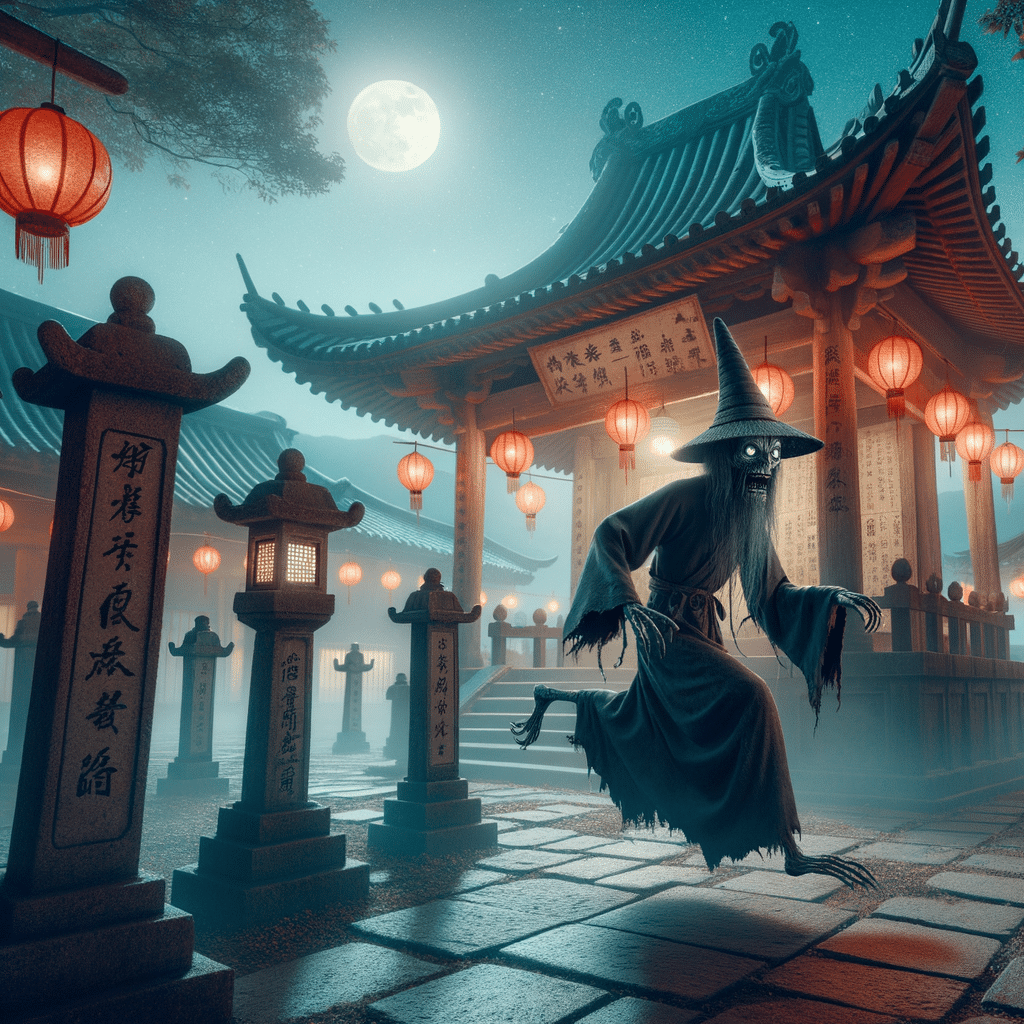
Jiangshi are a fascinating and unsettling aspect of Chinese folklore that have captured people’s imaginations for generations. They are sometimes referred to as Chinese hopping vampires or hopping zombies. These otherworldly beings combine aspects of zombies, vampires, and distinctively Chinese cultural ideas to create a monster that is unlike any seen in the West. Because of their unusual conduct and unique look, Jiangshi have made a lasting impression on Chinese mythology and are still influencing popular culture today.

Description
A Jiangshi has a startling and unnerving appearance. Usually depicted as reanimated corpses, their pale, greenish-white complexions reflect their undead state. Their arms are out in front of them, their bodies hard and inflexible. Perhaps what makes them most famous is their dress: Jiangshi frequently don official Qing Dynasty clothes, complete with a towering hat. The practice of returning dead officials to their hometowns for burial—during which some were believed to reanimate—inspired this formal attire (Ancuta, 2023).
Jiangshi are as strange in behavior as they are in appearance. The unusual way of hopping distinguishes Jiangshi from the elegant, quick motions of vampires in the West. They hop stiffly from place to place, arms outstretched for balance, earning them the moniker “hopping vampires.” People believe that their peculiar movement stems from the rigor mortis that has set in their corpses. Generally, people portray jiangshi as mindless animals driven by an unquenchable thirst for the qi, or life force, of living things. They drain this energy through their victims’ breath, instead of using blood.
The Jiangshi myth has its roots in old Chinese customs and beliefs around death and the afterlife. This concept strongly relates to the idea that improper burial ceremonies could imprison a person’s soul in this world. Certain legends claim that Jiangshi emerge when a person dies far from home, causing their soul to become restless and unable to find peace. In order to perform ceremonies that would direct these straying spirits back to their original location for a dignified funeral, Taoist priests were frequently hired. These ideas eventually blended with other ideas about the paranormal to form the Jiangshi as we know them today (Griffiths, 2015).
Jiangshi Rituals
Taoist priests have traditionally performed a number of rites to prevent the creation of Jiangshi and to guide restless souls toward tranquility. These customs have their origins in Taoist ideas about the nature of the soul and the afterlife, as well as Chinese folk religion. Following the correct burial customs is the most basic form of prevention. This entails choosing a fortunate place for burial, carrying out the proper rituals, and presenting the corpse with the proper offerings.
Taoist priests may conduct ceremonies to guide the soul of a deceased person who passed away far from their home. Priests frequently use talismans, incantations, and symbolic artifacts to construct a path for the soul to follow. Priests may also place coins in the mouth of the deceased. It is believed that this practice either weighs down the body to prevent it from rising or provides the deceased with money to aid them on their journey into the afterlife.
People frequently place special paper talismans engraved with protective symbols and incantations on the body or in a coffin to ward off bad forces and maintain soul peace. The custom of burning joss paper, also known as ghost money, is believed to provide the dead with necessities in the hereafter, thereby reducing the likelihood of them becoming restless and reappearing as Jiangshi.
Priests may carry out rituals for exorcism if there are indications that a body may be reanimating. These usually entail the use of mirrors, peach wood swords, and certain Taoist incantations to drive out evil spirits and soothe restless souls. In certain instances, priests may conduct rites to bind the dead, employing red ropes or particular knots thought to have magical qualities that keep the corpse from rising.
It is possible to carry out cleansing rituals in the vicinity of a death, expelling negative energy with holy water, incense, and certain prayers. These customs highlight the significance of a smooth passage from this life to the next, reflecting the intricate beliefs Chinese society holds on death and the afterlife. The goal is to ensure the deceased’s soul is at peace and not a Jiangshi in the mortal world.
It’s important to remember that these customs might differ greatly based on the geography, regional customs, and personal views and training of the Taoist priest in question. In addition, the rites have changed over time to accommodate shifting social and cultural norms while continuing to serve the fundamental function of guiding and guarding the departed’s souls.

Jiangshi vs. Western Vampires
While both Jiangshi and Western vampires are undead creatures that feed on the living, they differ greatly in a number of ways that are indicative of their separate mythologies and cultural backgrounds. There are multiple ways to contrast these two supernatural entities.
There are notable differences in appearance and movement between Jiangshi and Western vampires. Usually, portrayals of Jiangshi depict them as rigid corpses, clad in elegant Qing Dynasty garments and with greenish-white complexions. They move as a result of rigor mortis by hopping while extending their arms. Western vampires, on the other hand, are frequently depicted as being pale but otherwise having human-like features, with the ability to move with fluidity and even superhuman agility (Lam, 2009).
Another thing that sets them apart is the way they eat. While vampires in the West are known for consuming blood, Jiangshi are believed to inhale their victims’ qi, or life power. This distinction is a reflection of Chinese philosophy and medicine’s cultural emphasis on qi.
These species also have different origins. Jiangshi are sometimes produced when someone passes away distant from home without receiving the customary funeral ceremonies or when a soul is unable to pass far because of an inconvenient death. Depending on the specific legend, the formation of vampires in the West typically involves a vampire biting another vampire or a wicked spell or curse.
Consciousness and intelligence are also different. Typically, depictions of Jiangshi portray them as dumb creatures solely driven by their hunger. Western vampires—especially those portrayed in more contemporary contexts—retain human intelligence and frequently possess improved mental faculties.
Their vulnerabilities and strategies for fending off these monsters mirror their cultural settings. You can use mirrors, special Taoist priestly ceremonies, and talismans to ward off Jiangshi. Christianity has influenced European mythology, as evidenced by the fact that Western vampires are renowned for being susceptible to crucifixes, holy water, garlic, and sunlight.
These monsters play different social roles in their various mythologies. People frequently use Jiangshi legends as a warning about the importance of honoring the deceased and performing proper funeral procedures. Western vampire myths frequently examine issues of forbidden desire, immortality, and the essence of evil, particularly in their later incarnations.
Both have undergone distinct changes in popular culture over time. Jiangshi have continued to present a more unified image, frequently showing up in a combination of humor and horror genres in East Asian culture. In contemporary literature and movies, Western vampires have undergone tremendous metamorphosis, evolving from grotesque predators to tragic romantic creatures and even protagonists.
These variations demonstrate how mythical animals frequently represent the anxieties, convictions, and cultural norms of the communities in which they originated. Both Jiangshi and Western vampires share the fear of the dead rising again to prey on the living, but the details of their stories are unique to the distinct cultural contexts from which they originated (Ng, 2021).
Jiangshi has significantly influenced popular culture in the modern era, particularly in East Asian literature and film. Hong Kong was booming with Jiangshi-themed movies in the 1980s; cult hits like Mr. Vampire (1985) gave rise to multiple sequels and copycats. These movies frequently combined humor, martial arts, and horror to create a distinctive subgenre that became well-known throughout Asia. Jiangshi, a unique and identifiable monster archetype, has recently made an appearance in anime, video games, and even Western culture. Beyond entertainment, their impact may be seen in a variety of artistic expressions, where Jiangshi-inspired fashion and artwork can be found (Guo, 2022).
Conclusion
The eternal allure of Jiangshi is their capacity to evoke both intrigue and terror. These jumping vampires, offering a distinctive Chinese interpretation of the zombie genre, reflect Chinese culture’s views on death, the afterlife, and the paranormal. Jiangshi have always fascinated audiences with their strange appearance and peculiar behavior, drawing from their roots in ancient legend to their current prominence in pop culture. These strange monsters are a tribute to the rich fabric of Chinese mythology and its continued significance in the modern world as they make their way through tales, movies, and video games.
References
Ancuta, K. (2023). Scared Stiff: Jiangshi and Chinese Vampires. In The Palgrave Handbook of the Vampire (pp. 1-21). Cham: Springer International Publishing.
Griffiths, K. (2015). Vampires. Cavendish Square Publishing, LLC.
Guo, M. (2022). Hong Kong vampire films: anxious imaginings of death and illness. Continuum, 36(5), 776-790.
Lam, S. (2009). Hop on Pop. CineAction, 46-51.
Ng, A. H. S. (2021). A Typological Inquiry into Asian Undead Beings, or, Why There Are No Vampires in the East. Preternature, 10(2), 218-248.

Leave a Reply