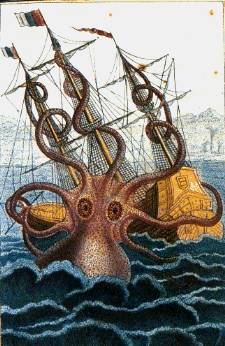
A podcast about the book Sea Monsters Unmasked and Sea Fables Explained can be accessed above. This episode was part of several podcasts generated with Google NotebookLM and is the product of AI.
This podcast is about Henry Lee’s book Sea Monsters Unmasked and Sea Fables Explained. The book aims to debunk popular myths and folklore surrounding sea monsters, particularly the Kraken and the sea serpent, by presenting scientific explanations for these creatures. Lee examines the physical characteristics, habits, and behavior of various cephalopods like the octopus, squid, and cuttlefish, demonstrating how their appearances and actions likely gave rise to these legendary stories. The text relies heavily on eyewitness accounts, scientific observations, and historical records to support its argument that many of these tales are based on real sea creatures, albeit often misunderstood or exaggerated. Lee’s ultimate goal is to replace superstition with scientific understanding, revealing the true nature of these “monsters” and dispelling the myths surrounding them.

[Joe]
Welcome to the Deep Dive. Ever heard those chilling tales about the Kraken, you know, the monstrous beast that could drag entire ships to their doom?
[Tammy]
Oh, absolutely. Myths about giant sea creatures are practically universal.
[Joe]
Exactly. And today we’re diving into the fascinating world of giant squid. We’re separating myth from reality.
[Tammy]
Sounds intriguing. What sources are we drawing on for this Deep Dive?
[Joe]
We’ll be using excerpts from a really interesting book called Sea Monsters Unmasked and Sea Fables Explained. Get ready to have your perceptions of the ocean flipped on their head.
[Tammy]
Flipped on their head. Wow, that sounds promising. Okay, I’m ready.
[Joe]
Okay, so we’ve all heard about the Kraken, right? But what’s truly mind-blowing is that those stories are likely rooted in real encounters with giant squid. This book, Sea Monsters Unmasked and Sea Fables Explained by Henry Lee, does an amazing job of unraveling those connections.
[Tammy]
I see. So we’re talking about taking those fantastical tales and grounding them in some actual scientific observation.
[Joe]
Exactly.
[Tammy]
That’s fascinating. I’m always amazed by how creatures once confined to myths and legends become subjects of scientific study.
[Joe]
It really is incredible.
[Tammy]
So tell me more about what this Henry Lee fellow has to say. How does he connect those old Kraken stories to, well, actual giant squid?
[Joe]
Well, he starts by describing what we know about the anatomy of giant squid. And honestly, it’s like something straight out of science fiction. They’ve got eight arms, two incredibly long tentacles, some even have hooks, a sharp beak, and a jet propulsion system.
It’s wild.
[Tammy]
It does sound a bit like Mother Nature decided to design her own deep sea leviathan. Okay, but let’s talk size for a moment. We know giant squid are big, but how big are we really talking?
[Joe]
Oh, prepare to be amazed. Lee describes specimens found in Newfoundland that were astonishingly large. We’re talking 40, 47, even a mind-boggling 80 feet long.
Can you imagine a creature longer than a school bus lurking beneath the waves?
[Tammy]
80 feet. That’s insane. I knew giant squid were big, but that’s a whole new level of massive.
[Joe]
Right. And there’s another incredible example from the book. Get this.
A single arm housed in the British Museum measuring a whopping nine feet long.
[Tammy]
Wait, just one arm?
[Joe]
Just one. And this wasn’t even one of the longer tentacles.
[Tammy]
Wow. So how big does that mean the entire creature was?
[Joe]
Based on known species, Lee estimates the entire creature could have been 47 feet long. These weren’t just remarkable finds, by the way. They completely changed how we view the ocean and the life within it.
[Tammy]
It’s like finding out those sea monster stories weren’t so far-fetched after all. But I’ve always wondered, how does a creature that’s, well, squid-shaped, end up looking like the serpentine monsters of seafaring tales?
[Joe]
That’s where things get really interesting. Just picture this for a second. You’re on a ship and all you see is the very top of a giant squid breaching the surface, arms trailing behind it.
Can you see how someone might mistake that for a sea serpent?
[Tammy]
I can absolutely see that. Especially if you were already a little bit terrified of, you know, what might be lurking beneath your boat.
[Joe]
Exactly. And remember, they didn’t have our modern understanding of marine biology.
[Tammy]
Right. Right. So are there actual historical accounts that describe these sorts of sightings?
Did people really think they were seeing sea serpents?
[Joe]
Oh, definitely. And the book dives into several of them. Many describe a long serpentine form gliding on the water, mane-like appendages, and something called vertical undulations.
What do you make of that?
[Tammy]
Well, based on what you’ve said about giant squid, those descriptions sound like they could easily line up with how a squid moves and looks at the surface, the trailing arms. They could easily be mistaken for a mane. And the way they propel themselves through the water, using that jet propulsion system, could create a long swell that adds to the illusion of a serpentine body.
[Joe]
You’re exactly right. And in fact, we were just talking about how the appearance of a giant squid could easily lead to those sea serpent myths. But it wasn’t just their shape, was it?
[Tammy]
It wasn’t just their shape. No, there’s more to it than that. Remember how we were talking about the size of these creatures?
[Joe]
Yeah, absolutely. We can’t forget about those gigantic dimensions.
[Tammy]
Well, the book also mentions that Norwegian fishermen used to be absolutely terrified of giant squid. And they had good reason to be.
[Joe]
Really? That’s interesting. What made them so afraid?
Were there any specific encounters?
[Tammy]
There were. And Lee recounts one chilling incident from 1751 in particular. Several people, including the captain of a ship, witnessed a massive sea creature, estimated to be about 60 feet long, attack their vessel.
[Joe]
Sixty feet? Are you serious? That’s almost as long as a bowling lane.
What did they do?
[Tammy]
Well, according to the book, they actually managed to hack off one of its arms.
[Joe]
They fought back against a giant squid. That’s insane.
[Tammy]
Sounds like they didn’t have much choice. These things are powerful. The witnesses described its eyes as huge as dinner plates and a beak that could tear through flesh with ease.
[Joe]
OK, now those kraken stories are starting to sound a lot less like myths and a lot more like real life encounters.
[Tammy]
Right. It really makes you wonder what those sailors must have thought, coming face to face with a creature like that. But, you know, beyond the sheer size and power of giant squid, what I find truly fascinating is how their appearance could be so easily misconstrued.
[Joe]
How so? We’ve already covered how their shape could be deceiving. What else is there?
[Tammy]
Well, the book describes how giant squid have these pigment cells in their skin that allow them to change color almost like a chameleon.
[Joe]
Wait a minute. Are you telling me the giant squid can change color?
[Tammy]
That’s right. It’s an incredible adaptation. It helps them disappear into their surroundings, making them nearly invisible to both prey and potential threats.
[Joe]
So someone already primed to believe in sea monsters sees a shape-shifting, color-changing giant squid. That would definitely cement that belief pretty quickly.
[Tammy]
Exactly. And, you know, it really highlights how our preconceived notions and the way we interpret the world around us can be just as influential as the actual reality.
[Joe]
Speaking of interpretations and misinterpretations, you know that iconic sea serpent sighting from the HMS Daedalus in 1848 that we touched on earlier?
[Tammy]
The one where they thought they saw sea monsters? Yeah, I remember.
[Joe]
Well, let’s delve into that a bit further. What do you say?
[Tammy]
Sure. That sounds interesting. I’d like to hear more about that.
[Joe]
Okay. So for context, the Daedalus was a British warship on a voyage from the East Indies back to England when it encountered this strange creature in the South Atlantic.
[Tammy]
Okay. So what exactly did they encounter? Were they able to give any kind of description?
[Joe]
They were. The captain, Peter McQuay, described a creature about 60 feet in length with a serpentine body. He said the head resembled that of a snake.
He also mentioned it had a mane-like appendage running down its back in this peculiar undulating motion as it moved through the water.
[Tammy]
Hmm. 60 feet long with a mane-like appendage and it moved through the water in an undulating way. Based on everything we’ve discussed about giant squid, it sounds like that description could fit, don’t you think?
[Joe]
I was just thinking the same thing. But back then, there were a lot of skeptics who questioned the sighting, right?
[Tammy]
Oh, I’m sure there were. People love a good mystery.
[Joe]
Exactly. And this was a big one. A lot of scientists at the time dismissed it as a simple misidentification or, you know, even a hoax.
But Captain McQuay always maintained that he and his crew had seen something truly extraordinary. In fact, he actually made these detailed sketches of the creature, which were later published in newspapers and scientific journals. Those sketches fueled the public’s fascination with sea serpents for decades.
[Tammy]
It’s fascinating how a single event like that can capture the imagination for so long. So what’s the consensus today? With all of our modern technology and scientific advancements, have we been able to come up with a more concrete explanation for the Daedalus sighting?
[Joe]
You know, that’s the thing about these historical accounts. We can never truly go back in time and definitively prove or disprove what someone saw. But based on what we know today about giant squid and their behavior, it’s highly, highly likely that what the crew of the Daedalus encountered was, in fact, one of these massive cephalopods.
[Tammy]
It’s incredible to think that a creature as large and powerful as a giant squid could remain such an enigma for so long. It really makes you wonder what else is out there, hidden in the depths of our oceans.
[Joe]
Exactly. It’s amazing, isn’t it? We dove headfirst into this exploration searching for sea monsters.
And what did we find?
[Tammy]
A real-life monster. Well, sort of. The giant squid.
This incredible creature. I mean, it embodies both the sheer power of the natural world and the limitations of what we know, or what we think we know, anyway.
[Joe]
For centuries, these creatures were relegated to the realm of myth and legend. Sailors’ yarn spun around a warm fire. And now, thanks to scientific exploration and, you know, a willingness to kind of peer into those murky depths, we know giant squid are not just real, but they’re even more incredible than anything we could have imagined.
[Tammy]
It really makes you think, doesn’t it? Our exploration today, I mean, it really highlights how we as humans perceive the unknown, how easily our interpretations of what we see can be skewed.
[Joe]
It’s true. We see what we expect to see, right?
[Tammy]
Exactly. And that’s why it’s so important to approach these mysteries with open minds. A healthy dose of curiosity, too, of course.
[Joe]
Absolutely. It reminds us that there’s still so much out there that we’ve yet to uncover. So much that remains a complete mystery, particularly in our vast oceans.
[Tammy]
It really is incredible when you think about it. Our planet, I mean, it’s blanketed by water, and yet we’ve barely scratched the surface when it comes to understanding the deepest, darkest parts of our oceans.
[Joe]
It boggles the mind. What other breathtaking creatures are swimming around down there, hidden in the abyss, just waiting for us to find them?
[Tammy]
The possibilities are endless. That’s what makes all of this so captivating, so awe-inspiring.
[Joe]
Yeah, it always blows my mind. We actually know more about the surface of the moon than we do about the bottom of our own oceans.
[Tammy]
It’s a humbling thought, isn’t it? It’s a powerful reminder that exploration isn’t just about, you know, physically reaching new frontiers. It’s about broadening our understanding, challenging our assumptions, cultivating a deeper appreciation for the natural world in all its wonder.
[Joe]
Well said. So, to everyone listening, if today’s exploration has sparked even just a flicker of curiosity, a thirst for knowledge, that’s fantastic. Let it fuel your desire to learn, explore, ask questions, and never, ever lose that sense of wonder.
[Tammy]
Who knows what you might discover out there.
[Joe]
From tales of ships swallowing krakens to the awe-inspiring reality of giant squid, we hope this deep dive has left you with a sense of wonder, a thirst for knowledge, and a renewed appreciation for the vast and mysterious world we live in. Until next time, keep exploring, keep asking questions, and keep diving into the unknown.




Leave a Reply