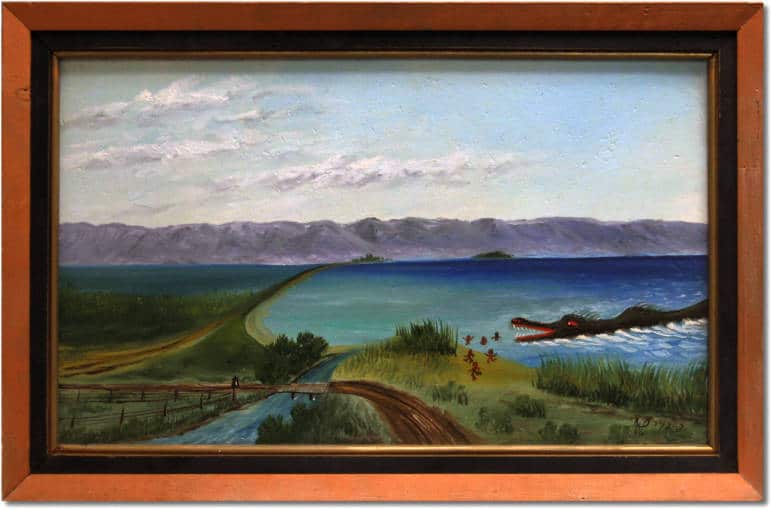
The Bear Lake Monster, a fabled creature believed to inhabit the deep waters of Bear Lake near the Utah–Idaho border, has captivated residents and tourists for over 150 years. This remarkable body of water, known for its distinctive turquoise-blue color and impressive size spanning roughly 20 miles in length and 8 miles in width, provides the perfect setting for such a mysterious tale. It is also likely a hoax.

Description
Traditional reports depict the monster as a huge, serpentine-like creature that is 40–50 feet long, short-legged, has a mouth big enough to swallow a man, and has a body as thick as a barrel. Witnesses have claimed to have seen it travel through the water at amazing speeds—up to 60 miles per hour at times—causing big waves and surface disturbances in the lake. Reports indicate that the animal periodically releases water from its lips and emits loud roaring noises. (Fife, 1948)
Although there have never been any verified deaths, the monster has been known to engage in violent behavior, including attacking boats and swimmers. According to witnesses, it can crawl onto the shore and even move across the water’s surface. It can move in a snake-like undulation, according to some reports, while others say it paddles with its legs.
Joseph C. Rich, a Mormon colonist and the son of apostle Charles C. Rich, first reported the monster story in the Deseret News in 1868. Several Mormon settlers who shared their encounter testimony and reported sightings played a crucial role in the LDS (Latter-day Saints) Church’s involvement. At first, people gave these reports a great deal of credence, especially when well-known Mormon leaders and locals reported seeing the monster (Morrell, 2022).
The LDS Church profoundly influenced the Bear Lake Monster tale in a number of ways. The narrative immediately gained credibility due to its dissemination through reliable Mormon channels. The original account’s creator, Joseph C. Rich, was not your average newspaperman; he was the son of a prominent Mormon colonist and an LDS apostle. His reputation in the neighborhood meant that the Mormon settlers took his remarks seriously.
The Mormon settlement pattern itself quickly disseminated the story. The narrative spread swiftly throughout the Utah Territory because Mormon groups were close-knit, had established communication networks, and shared religious experiences. Mormon publications, especially the Deseret News, primarily disseminated these tales to devoted readers who were inclined to believe their religious group’s news sources.
Most importantly, the legend gained more legitimacy when well-known LDS leaders like Wilford Woodruff—who went on to become church president—took it seriously enough to launch searches for the monster. With the help of these leaders, what would have remained a local folktale became a topic of serious discussion among devoted Mormons.
The monster narrative flourished because of the Mormon culture of the era, which placed a strong emphasis on supernatural encounters and the idea that heavenly and enigmatic events were feasible. This was especially evident when Mormon pioneers were forging their own unique culture in the remote early Utah Territory.

Evolution of Story
From a terrifying monster myth to a more approachable folklore for tourists, the story has changed throughout time. While subsequent stories tend to depict the creature as more mysterious than menacing, early accounts stressed its lethal character. The story’s metamorphosis reflects shifting cultural perspectives and the expanding travel and tourism sector in the area.
Brigham Prescott’s 1868 report of seeing the creature swimming at amazing speeds is one of the most famous sightings. In 1871, Wilford Woodruff, the future president of the LDS Church, led a crew that made an unsuccessful attempt to locate the monster. Throughout the late 1800s, numerous witnesses claimed to have seen the monster, and their accounts are extremely consistent.
When Joseph C. Rich acknowledged in 1888 that he had made up the original stories for amusement and to boost newspaper sales, it became clear that the story was a fake. Misidentified phenomena like wave patterns, floating logs, or huge fish that are native to the lake are examples of natural explanations for sightings. Among other peculiarities, the size and depth of the lake may create optical illusions, leading people to misinterpret them for monsters (Horton, 2019).
Other Lake Monsters
The Bear Lake Monster has certain distinctive features that distinguish it from its cryptozoological brethren, but it also has some intriguing similarities to other lake monster legends. The Bear Lake Monster rose from a cold, deep body of water with unknown depths, much like Scotland’s Loch Ness Monster. However, the Bear Lake Monster’s reported small legs and serpentine body more closely reflect accounts of Ogopogo, the monster of British Columbia’s Lake Okanagan, whereas Nessie is usually characterized as having a long neck and plesiosaur-like flippers (Radford & Nickell, 2006).
Reports of several lake monster sightings, including Lake Champlain’s Champ and Lake George’s Monster, throughout North America coincided with the earliest recorded sightings of the Bear Lake Monster in 1868. Increased newspaper distribution and western expansion during this time period point to a cultural phenomenon rather than random sightings. Bear Lake Monster was said to be violent and menacing, more like Sweden’s Lake Storsjo monster, in contrast to many lake monsters that are characterized as timid or withdrawn. However, Mormon pioneer networks spread its legends, making the Bear Lake Monster unique in its direct relationship to patterns of religious colonization.
Joseph C. Rich’s confession to the hoax sets the Bear Lake Monster apart from other lake monster stories, typically leaving the origins a mystery. Like other lake monster myths, the narrative has endured and developed into a cultural icon for the area in spite of this admission. Nowadays, the Bear Lake Monster plays a big role in both local tourism and culture. Local company names not only incorporate the tale, but also honor it during regional festivals and on merchandise. Children’s books, regional theater plays, and other media presentations have all made adaptations of the story. Even while not many people today think the monster exists, its cultural influence keeps people coming to the area and gives the town a sense of pride and identity (Gabbert, 2022).
Conclusion
The Bear Lake Monster is proof of the persistent influence of legend on regional culture and travel. Even though there is compelling scientific proof that the creature is only the result of creative marketing and imagination, its legacy nevertheless contributes to the Bear Lake region’s rich cultural past. Even disproved myths can retain cultural relevance and economic worth for their communities, as evidenced by the monster’s transformation from a terrifying fable to a cherished symbol of local identity.
References
Fife, A. E. (1948). The Bear Lake Monsters. Western Humanities Review, 2(2), 99.
Gabbert, L. (2022). Monsters, Legends, and Festivals. North American Monsters: A Contemporary Legend Casebook, 298.
Horton, M. (2019). Fantastic Beasts and Where to Print Them: Mapping Monsters in Nineteenth-Century Newspapers. Victorian Popular Fictions Journal, 1(2), 135-146.
Morrell, A. L. (2022). A Nessie in Mormon Country. North American Monsters: A Contemporary Legend Casebook, 171.
Radford, B., & Nickell, J. (2006). Lake monster mysteries: investigating the world’s most elusive creatures. University Press of Kentucky.
Note: Images on this page used with the permission of the USU Merrill-Cazier Library, Special Collections and Archives.

Leave a Reply