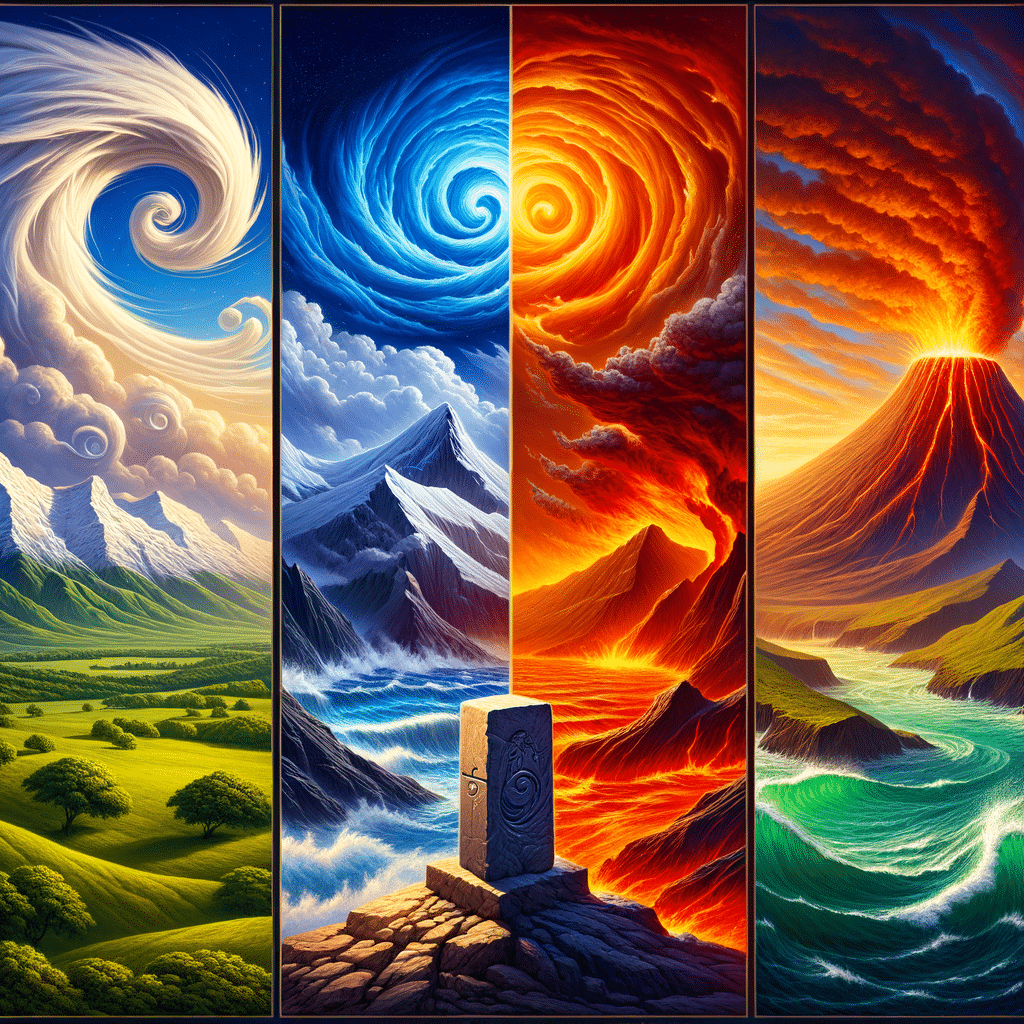
The four traditional elements—fire, water, air, and earth—have had a significant impact on human understanding of the natural world and spiritual ideas throughout history and across cultural boundaries. From ancient philosophical and theological systems, these essential linkages have developed into contemporary spiritual activities, psychological frameworks, and cultural iconography. These are not static and continue to evolve.

Traditional Four Elemental Associations
Fire’s dynamic and transforming nature has historically associated it with the hues of red, orange, and gold. The sun, flames, and the upward-pointing triangle represent fire. Dragons, phoenixes, and lions are frequently associated with the ferocious and potent nature of fire. Greek Hephaestus, Hindu Agni, and Roman Vulcan are examples of ancient fire deities. Fire is a symbol of fervor, change, and inventiveness (Kramer, 2017).
Water reflects the hues of rivers, lakes, and oceans by connecting with blues, silver, and deep greens. Waves, spirals, and the triangle pointing downward are some of its emblems. Dolphins, fish, and serpents often represent water, while deities such as Poseidon, Sedna, and Aegir embody its dominant presence. Water represents emotion, intuition, and flexibility.
The traditional alignment of air elements with yellow, white, and pale blue reflects the sky’s transparency. The main symbols are circles, clouds, and flying birds. Owls, eagles, and mythical animals like sylphs symbolize the characteristics of air. Vayu, Boreas, and Quetzalcoatl are examples of wind gods that illustrate the cultural significance of air. Air is a symbol of freedom, intelligence, and communication (Dominguez, 2021).
Inspired by the hues of soil, vegetation, and stone, earth links incorporate hues such as brown, green, and black. Common earth symbols include mountains, squares, and cubes. Bears, bulls, and wolves frequently symbolize Earth’s steadfast power, while deities like Gaia, Demeter, and Pachamama embody its caring qualities. Earth is a symbol of physical manifestation, stability, and plenty.

East Contrasted With West
Over time, these relationships have changed considerably. While medieval alchemists used the elements in their work, the ancient Greeks and Romans organized them into philosophical frameworks. Eastern customs established distinct yet parallel systems, such as the Chinese Wu Xing, which integrates both wood and metal. The Renaissance influenced modern esoteric traditions by connecting elemental associations to astrology and ceremonial magic (Mayer, 2021).
Each cultural tradition offers a distinct perspective on the underlying forces of nature and existence, and the connections between elements vary greatly among them. Western traditions, rooted in ancient Greek philosophy, commonly use the four elements of fire, water, air, and earth. This system impacted contemporary Western esoteric practices, hermetic traditions, and European alchemy. Frequently, a square or circular pattern groups these components, symbolizing the natural cycle and the equilibrium of opposing forces.
Chinese tradition acknowledges Wu Xing, or the Five Elements/Phases—Wood, Fire, Earth, Metal, and Water. These components operate in a generative and destructive cycle, where each one either increases or weakens the others, in contrast to the Western system. Wood feeds fire, fire generates earth (ash), earth transports metal, metal collects water, and water replenishes wood. This dynamic system is essential to martial arts, feng shui, and Chinese medicine.
While retaining significant indigenous Shinto aspects, Japanese culture adapted and changed the Chinese system. In esoteric Buddhism, the godai system comprises the elements of Earth, Water, Fire, Wind, and Void (or Sky/Heaven). The addition of Void symbolizes the transcendent quality of existence beyond the physical aspects.
In Japanese Buddhism, especially in esoteric lineages, the idea of Void (Kū) refers to a complex intellectual and spiritual principle that transcends basic emptiness. The other elements—Earth, Water, Fire, and Wind—all originate from and transcend void. In Japanese esoteric Buddhism, especially in the Shingon and Tendai lineages, void is the ultimate truth from which all phenomena arise and dissipate. People frequently compare it to the surface of a mirror, which is both empty and capable of reflecting anything.
The Void in the Godai system exhibits several significant characteristics. It stands for possibility and potential prior to actualization. It represents spiritual enlightenment and awareness. It includes nothingness as well as form. It goes beyond dualistic reasoning. It stands for the area where all other components are present and interact.
The concept significantly influenced Japanese martial arts and their traditions. For instance, the concept of Void is associated with the mental state of “no-mind” (mushin), where the practitioner engages in sword fighting without conscious thought or emotional attachment. Traditional Japanese architecture expresses the idea by deliberately using empty space (ma) to establish balance and significance.
Buddhist conceptions of void are very different from Western ideas of absence or nothingness. It symbolizes the interconnectedness of all things and a state of limitless potential rather than absolute negativity. This interpretation aligns with advanced physics concepts about the nature of space and vacuum, where seemingly empty spaces hold immense potential and energy. By setting the Japanese system apart from other elemental systems and providing special insights into the nature of reality and awareness, this element demonstrates the deep influence of Mahayana Buddhist philosophy on Japanese culture (Wang & Wang, 2021).
Hindu traditions frequently use the five elements (Pancha Mahabhuta) of Earth (Prithvi), Water (Jala), Fire (Agni), Air (Vayu), and Ether/Space (Akasha). Each component of this system correlates to distinct chakras and facets of awareness, making it essential to both Ayurvedic treatment and yoga philosophy.
Although Native American customs varied from tribe to tribe, they frequently acknowledge four components that are comparable to the Western system but have distinct connections. Several tribes add a fifth element, Spirit or Sky, and arrange the elements in the Medicine Wheel or Sacred Hoop, connecting them to seasons, life phases, and directions.
The philosophical stances of these systems are where they diverge most. Western cultures often view elements as discrete components of reality. Chinese Wu Xing emphasizes the transforming interactions between elements. Buddhism and Hinduism include several aspects of a holistic spiritual universe. The importance of the elements in preserving the harmony and balance of nature is a common theme in Native American cultures.
Each of these cultural variances offers important insights into how humans relate to the natural world and reflects various approaches to comprehending and engaging with natural forces. Modern practitioners frequently combine these many methods to produce fresh frameworks that respect both conventional knowledge and new insights (Chauran, 2013).
Conclusion
Even today, elemental linkages continue to influence many aspects of culture and religion. Contemporary paganism and New Age traditions frequently use elemental correspondences in ritual and meditation. In order to raise ecological consciousness, environmental movements use elemental symbology. Movies, gaming, and fantasy literature often mention elemental powers in popular culture. While design and marketing use elemental colors and symbols to elicit particular emotional responses, psychology has adopted elemental features into personality typing systems.
Human awareness today strongly ingrains these archaic basic linkages, providing a rich symbolic language to comprehend both human experience and natural forces. The four components show the timeless significance of these ancient symbols in contemporary life by providing a relevant framework for examining the link between humans and the natural environment, whether in spiritual practice, creative expression, or psychological understanding.
References
Chauran, A. (2013). Faeries & Elementals for Beginners: Learn About & Communicate With Nature Spirits. Llewellyn Worldwide.
Dominguez, I. (2021). The Four Elements of the Wise: Working with the Magickal Powers of Earth, Air, Water, Fire. Red Wheel/Weiser.
Kramer, A. (2017). Cultural History of the Four Elements. Ecological Thought in German Literature and Culture, 3-16.
Mayer, T. (2021). Answering the Call of the Elementals: Practices for Connecting with Nature Spirits. Simon and Schuster.
Wang, K., & Wang, K. (2021). Chan Buddhism and Subtle Void. Beauty and Human Existence in Chinese Philosophy, 187-203.

Leave a Reply