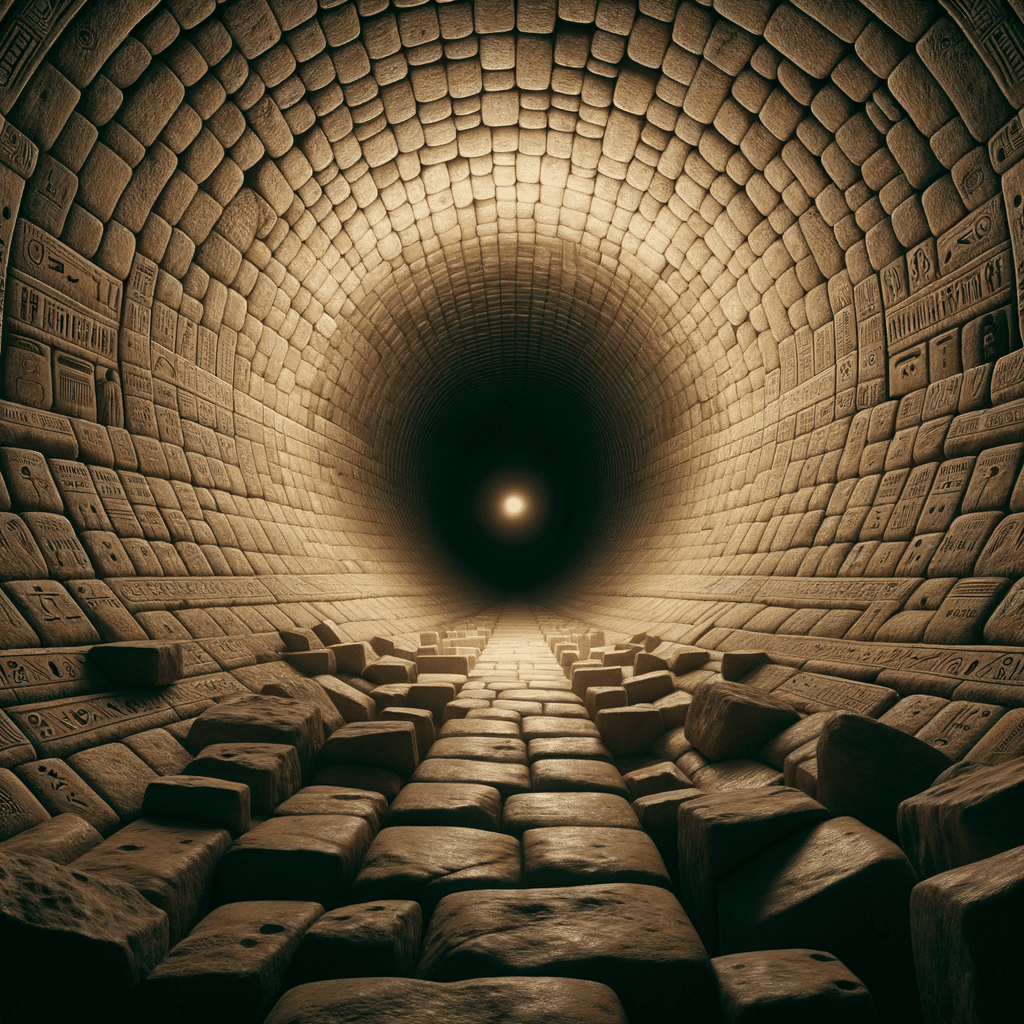
The ancient passageways of the Pyramid of the Sun at Teotihuacan conceal one of archaeology’s most fascinating secrets. The third-largest pyramid in the world, this enormous construction is a testimony to Mesoamerican technical skill, but what’s underneath it has fascinated scholars and fueled decades of conjecture about its actual use and significance. The site has attracted theories, some more problematic than others.

Pyramid of the Sun Tunnels
With a height of 216 feet and a base that is 733 feet on each side, the Pyramid of the Sun dominates the landscape of the ancient city. The building sits atop an intricate network of tunnels that predated the pyramid. The main tunnel, which is about 330 feet long and ends in a distinctive four-leaf clover-shaped set of chambers, travels east to west beneath the core of the pyramid. Found in 1971, the tunnel’s entrance lies approximately 20 feet below the ground, close to the pyramid’s western face.
Although the tunnel system seems to have been established earlier, maybe as early as 100 BCE, construction on the Pyramid of the Sun started approximately 100 CE. Construction of the pyramid occurred in phases, with each successive layer building upon the previous one. The Aztecs discovered Teotihuacan centuries later, but the culture responsible for its construction remains somewhat enigmatic. The Aztecs gave the pyramid its present name, believing it to be a location where the gods convened to arrange the formation of humanity (Sload, 2015).
The tunnel’s odd shape and exact alignment are among its most perplexing features. The main passageway’s exact alignment with the setting sun on particular occasions suggests astronomical importance. Humans have heavily altered the cave system, including the meticulous carving of the four-leaf clover chambers, but the cave system appears mostly natural. Archeological findings reveal that the purposeful covering of the tunnel with rubbish around 200 CE preserved numerous original objects (Manzanilla et al, 1996).
Theories
Several theories have been proposed about the function of the tunnel. Rich offerings like conch shells, jade figures, and obsidian swords have led many researchers to conclude that it was a royal tomb or ceremonial area. Others argue that the tunnel represented a metaphorical underworld in Mesoamerican cosmology, where kings interacted with ancestor spirits. Some academics have suggested that the tunnel served as an ancient observatory or calendar device because of its alignment with astronomical occurrences (Melesio, 2014).
The discovery of large amounts of powdered mica and other minerals in the tunnel has sparked further speculation. Some scholars argue that these materials served ceremonial purposes, while others propose they served practical functions like astronomical observations or water management. The discovery of liquid mercury in similar tunnels at Teotihuacan has further complicated the interpretations of these subterranean rooms.

Aliens in the Tunnels
Alternative scholars, who were especially interested in the enigmatic tunnels beneath the Pyramid of the Sun, started formulating a number of theories in the middle of the 20th century that suggested alien involvement in the creation of Teotihuacan. These suggestions have caught the public’s attention and merit investigation, even though they are still firmly beyond the realm of mainstream archaeology (Hale, 2018).
Proponents of ancient astronaut hypotheses cite several peculiar aspects of the pyramid and its tunnel system. They highlight the structure’s exact astronomical alignments, especially the main tunnel’s amazing accuracy in tracking celestial events. The pyramid’s measurements purportedly incorporate advanced mathematical concepts, such as the precise distance between Earth and the Sun, represented in an intricate ancient numerical system. According to some academics, the tunnel’s geometrical layout and magnetic anomalies resemble patterns discovered at other ancient locations across the Earth, pointing to a shared, potentially alien origin.
The discovery of large amounts of liquid mercury and mica in the tunnels has strengthened these views. Proponents argue that these elements, either as components of an intergalactic communication system or an ancient power system, served technological rather than ceremonial purposes. They mention mercury’s possible use in hypothetical propulsion systems as well as mica’s current use in electrical and electronic applications. It is still challenging to adequately explain these materials’ extraordinary concentrations and their deliberate placement in particular chambers using standard archaeological interpretations.
Some theorists have compared the tunnel’s four-leaf clover-shaped chamber to purportedly ancient depictions of spacecraft or dimensional portals. They speculate that the entire network of tunnels may have functioned as a communication hub or landing location in antiquity. They contend that rather than being sealed for ceremonial reasons, the tunnels may have been purposefully sealed circa 200 CE to hide cutting-edge technology.
The electromagnetic characteristics of the tunnels have also garnered interest. Measurements have revealed unusual electromagnetic anomalies and magnetic readings in several rooms. According to some studies, there could be lingering impacts from antiquated navigational aids or power systems. As proof of sophisticated scientific understanding, they cite the exact direction of the tunnel system and its connection to the Earth’s magnetic field.
Skepticism
However, the scientific community emphasizes that known ancient astrological knowledge, documented Mesoamerican engineering ability, and natural geological processes may account for all of these characteristics. The inclusion of mica and mercury is consistent with the well-established religious rituals of Mesoamerica and the Aztecs, where these substances were symbolic of the underworld. Although remarkable, the astronomical and mathematical alignments are within the proven range of ancient Mesoamerican architects and astronomers.
Critics also point out that proponents of notions about ancient astronauts frequently ignore the wealth of archaeological evidence supporting the slow evolution of Mesoamerican astronomical and architectural knowledge. Tool marks and construction procedures that are compatible with other ancient Mexican sites are among the obvious indications of human construction techniques found in the tunnels and pyramid. We can track the structure’s evolution over several building periods, reflecting changing architectural methods, rather than a single, highly technologically advanced construction event (White, 2013).
Furthermore, the numerous indications of religious and ceremonial use—such as traditional Mesoamerican gifts, burial customs, and architectural symbols discovered throughout the site—contrast with the purported technological uses of certain aspects. The meticulous arrangement of materials and artifacts suggests traditional religious rather than technological reasons, and it is consistent with patterns observed at other Mesoamerican ceremonial sites.
These alternate hypotheses offer creative answers to the puzzles of Teotihuacan, but in the end, they tell us more about the yearning of contemporary humanity to comprehend and establish a connection with our ancient past than they do about the site’s actual history. The outstanding accomplishments of ancient Mesoamerican civilizations, who used their inventiveness, tenacity, and profound understanding of astronomy and mathematics to create one of humanity’s most striking architectural and cultural monuments, are what make Teotihuacan truly remarkable rather than any potential extraterrestrial influence.
The persistence of prehistoric astronaut beliefs about Teotihuacan is a reflection of the site’s ability to evoke astonishment as well as its true mysteries. Even though these hypotheses might not withstand close scientific examination, they have raised public interest in archaeology and ancient civilizations, which has boosted funding for conservation and study initiatives at this exceptional World Heritage Site.
Conclusion
Recent archaeological investigations, using ground-penetrating radar and other contemporary technologies, have discovered other chambers and corridors that remain unexplored. Although accessing these areas is difficult because of centuries’ worth of debris and the necessity to maintain the site’s structural integrity, these findings imply that the tunnel system may be larger than previously believed.
A rare combination of human technical talent and natural cave formations, the tunnels beneath the Pyramid of the Sun continue to be one of archaeology’s most fascinating mysteries. New discoveries constantly uncover new information about this remarkable feat of ancient Mesoamerican architecture, despite the many unsolved issues regarding their precise function and the civilization that built them. As new archaeological methods and technological advancements develop, these enigmatic passages may potentially reveal additional details about their architects and their significance in the ancient world.
References
Hale, C. R. (2018). The Ancient Alien Theory: Part Five. Lulu. com.
Manzanilla, L., López, C., & Freter, A. (1996). Dating results from excavations in quarry tunnels behind the Pyramid of the Sun at Teotihuacan. Ancient Mesoamerica, 7(2), 245-266.
Melesio, L. (2014). The pyramid detectives. Physics World, 27(12), 24.
Sload, R. (2015). When Was the Sun Pyramid Built? Maintaining the Status Quo at Teotihuacan, Mexico. Latin American Antiquity, 26(2), 221-241.
White, C. (2013). Ancient alien evidence examined. Skeptic (Altadena, CA), 18(4), 16-24.






Leave a Reply