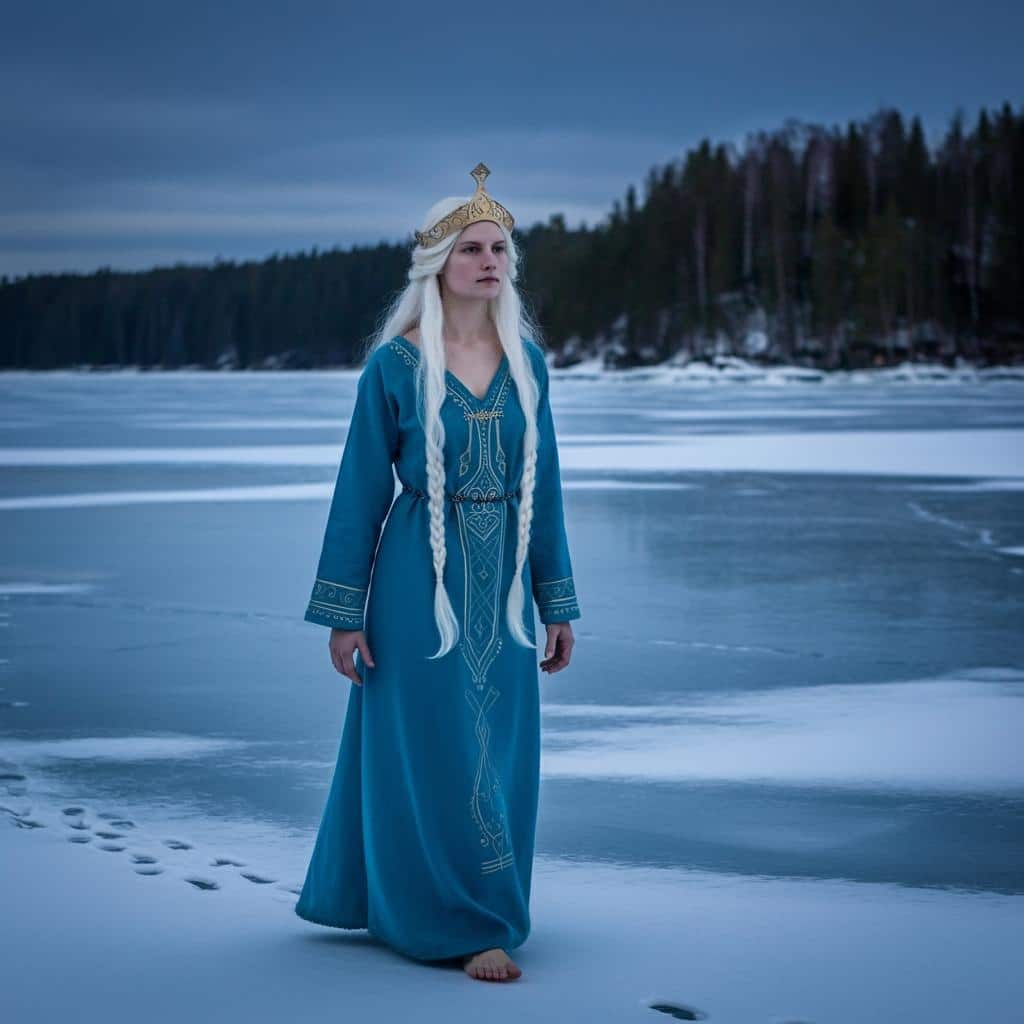
One of the most important figures in Finnish mythology and folklore is Vellamo, the Finnish goddess of lakes, oceans, and water. She represents the protective and occasionally destructive qualities of water as the spouse of Ahti, the god of the depths and waterways, and was vital to ancient Finland’s maritime culture and religious beliefs. She remains relevant today.

Description
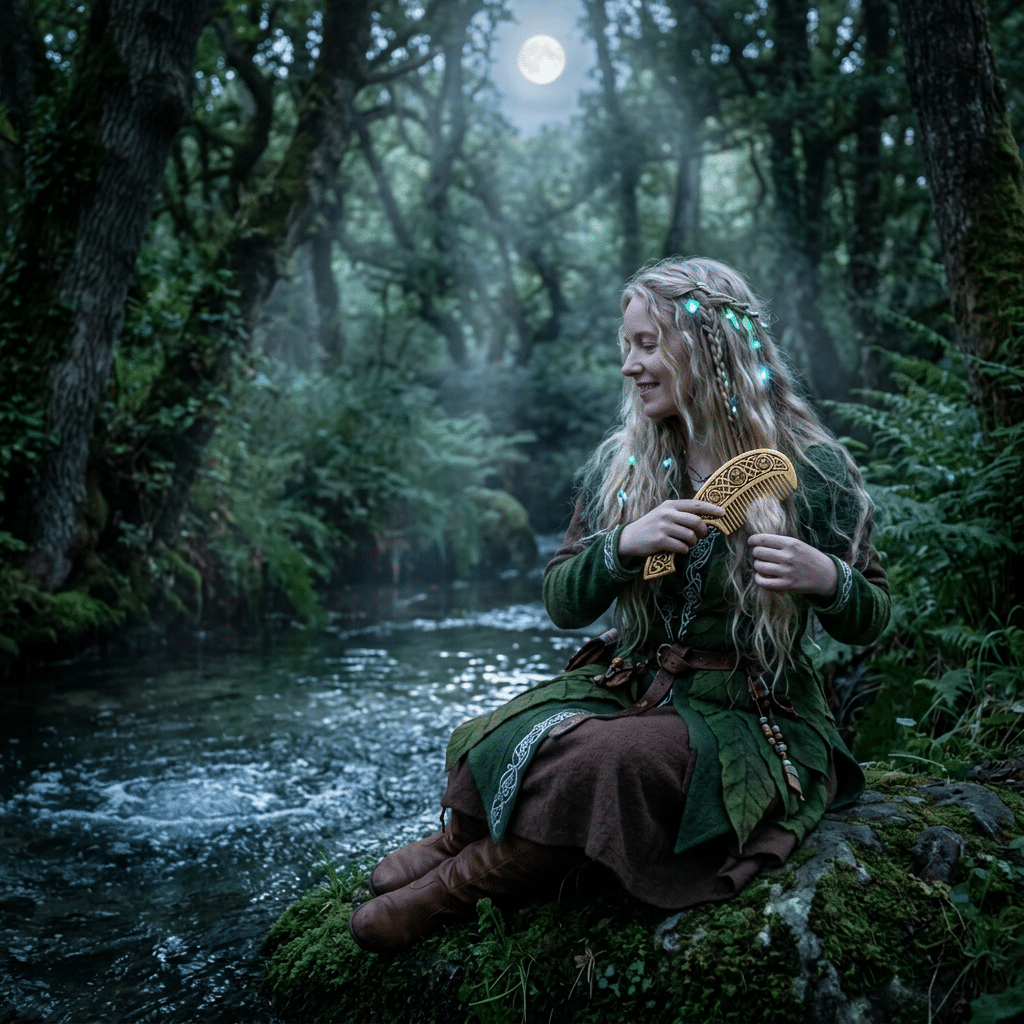
Traditional Finnish mythology portrays Vellamo as a strong, attractive woman with flowing hair the color of sea foam and clothing crafted from waterfall spray. Occasionally, we see her sitting on a rock in the middle of the sea or riding waves, her long hair combed with a golden comb. She appears as a helpful and somewhat erratic divinity in the Kalevala, a compilation of Finnish oral traditions, where this figure grew especially prominent (Auset, 2009).
The goddess had significant control over the seas and their creatures. She was especially significant to fishing villages because she regulated fish movements. Seafarers revered Vellamo for her protection, believing she could influence weather patterns near bodies of water, calm stormy seas, or trigger tempests. As their queen and guardian, she also ruled over the other water spirits and animals (Dorsey, 2020).
Although Vellamo was somewhat subordinate to her husband Ahti, she held a prominent place in the Finnish pantheon. Collectively, they controlled the undersea world of Ahtola. Vellamo symbolized the surface and life-giving qualities of water, while Ahti represented its depths and mysteries. Their partnership symbolized the dual nature of water. Finnish mythology saw water as one of the essential components of creation, making this collaboration essential.
Worship
The rituals and offerings connected to Vellamo’s devotion, intricately woven into Finnish fishing and maritime culture, reflected both practical requirements and spiritual beliefs. While these customs changed throughout time and differed by location, a few essential components never changed. Before embarking on fishing trips, fishermen would often throw silver coins into lakes or the ocean as traditional offerings to Vellamo. Giving something of worth in return for safe travel and plentiful catches was the sign of a reciprocal connection. People frequently put the first fish of any catch back into the water as a sacrifice to the goddess, along with certain prayers or incantations.
Women, in particular, offered strands of hair as more intimate offerings, akin to Vellamo’s association with long, flowing hair. They also frequently offered small servings of food, particularly bread or fish. People usually threw these into the water or set them out at the water’s edge. More ornate contributions may include handcrafted objects such as fishing equipment or wooden boats during significant fishing seasons.
Ritual timing was seen as essential. Offerings were frequently offered at sunrise or sunset, especially as the waters were opening up after the winter ice in the spring fishing season. They also held special observances during the summer solstice, when they believed the Finnish waters to possess greater spiritual force. The Vellamo revered certain cliffs, peninsulas, or small bays as sites where local populations would frequently congregate.
Fishermen would observe ritual quiet and perform certain purification rites prior to significant fishing expeditions. These could involve fasting for a predetermined amount of time or washing with particular herbal mixtures. They carefully considered the moon’s phase and the wind’s direction, believing they would favor Vellamo. Some groups maintained Vellamo stones, which are specific rocks near the sea, where they could offer sacrifices. These locations frequently developed into focal areas for both private and public prayers, acting as organic altars for the goddess’ adoration.

Comparison to Other Pantheons
Comparing Vellamo’s role in Finnish mythology to that of water deities in other cultural traditions reveals intriguing similarities and differences. Vellamo retains unique qualities that represent the special bond between the Finnish people and their water-rich surroundings, even though they share some universal traits with other water gods and goddesses. But there are also many differences (Coulter & Turner, 2013).
Vellamo’s character is very different from Poseidon’s or Neptune’s more aggressive and commanding presence in the Greco-Roman pantheon. Vellamo has a more loving relationship with mankind, concentrating on inland waters and fishing towns, whereas these Mediterranean gods dominate the seas with frequent tidal force, highlighting their control through earthquakes and storms. She is somewhat similar to Poseidon’s wife, Amphitrite, although Vellamo has far more autonomous authority and direct control over marine affairs. Despite her marriage to Ahti, she does not derive her authority from a male counterpart.
The Celtic water gods provide another intriguing analogy. Though they are more closely associated with the Otherworld and magical transformations, Manannán mac Lir and his Welsh counterpart, Llyr, also have a connection to waters, just as Vellamo does. While Celtic water goddesses such as Boann typically associate themselves with specific rivers or wells, Vellamo’s domain encompasses all Finnish waters, ranging from the smallest stream to the largest lake and the ocean. This wider range of influence reflects the interconnection of Finland’s waterways and their vital significance in day-to-day life.
The sea-dwelling couple Ægir and Rán in Norse mythology offer an intriguing counterpoint to Vellamo’s character. Vellamo has a more harmonious relationship with people than Rán, who is notorious for aggressively drowning sailors and gathering the corpses in her net. She is primarily associated with the life-giving qualities of water and effective fishing rather than its destructive potential, though she may be erratic and dangerous when mistreated. This divergence probably exists because the Finnish people had a closer relationship with their many lakes and streams, viewing them as sources of food rather than primarily as threats.
The resemblance to Slavic water creatures such as the Vodyanoy and Rusalkas demonstrates another unique aspect of Vellamo’s personality. Despite the common description of these Slavic entities as spirits or supernatural beings of lesser status than major deities, Vellamo maintains a distinctly divine rank. In contrast to the erratic and frequently hazardous interactions typical of Slavic water spirits, her relationship with humans is typically more benign and organized through appropriate religious observance.
Vellamo’s most notable uniqueness may be her unique ties to Finnish fishing culture and her cordial interactions with human populations. People viewed Vellamo as a collaborator in the successful catching of fish and the safe passage across waters, unlike many water deities who only require placation to avoid their anger. This relationship captures the pragmatic realities of Finnish society, where waterways were vital routes for transport and supplies of food rather than merely obstacles or dangers.
The adoration of Vellamo and her place in Finnish mythology demonstrate a deep comprehension of the interaction between people and their watery environment. Vellamo represents a more nuanced approach that acknowledges both the life-giving and potentially dangerous aspects of water while maintaining a fundamentally cooperative relationship with human worshippers, in contrast to other mythological systems that frequently highlight the dangerous and unpredictable aspects of water deities. She differs from many other water goddesses in this way, which also captures the particular cultural and environmental circumstances of ancient Finland.
Evolution Over Time
The worship of Vellamo dates back to the pre-Christian era, when fishing and maritime trade were important sources of income for Finnish towns. Before going out to sea, fishermen would pray to Mary and make tiny sacrifices in the hopes of ensuring safe returns and successful catches. These tributes frequently included silver coins, fish fragments, or hair strands. People especially adored the goddess in Finland’s coastal areas and around the country’s large lakes, where fishing was the main source of income for the local population (Westin, 2020).
Like many pagan deities, Vellamo worship changed significantly throughout the medieval era when Christianity expanded throughout Finland. Folk beliefs about Vellamo continued to exist in maritime areas, even as formal religious practice shifted to Christian doctrines. Later Finnish mythology occasionally manifests her as a mysterious water spirit or blends her with Christian saints associated with fishing and water, demonstrating her influence (Haggman, 1896).
The way that Vellamo’s worship has changed is a reflection of the larger shifts in Finnish culture. Her function changed from that of an actively worshipped deity to that of a cultural icon and literary character as societies shifted away from a direct reliance on fishing. The various folktales gathered over the ages vividly depict her transformation from a strong goddess to a more enigmatic supernatural entity.
Through a variety of means, Vellamo has seen a resurgence in contemporary interest. Her importance in pre-Christian Finnish religion has received fresh attention as a result of scholarly research on Finnish mythology. Her tale has also served as an inspiration for contemporary Finnish singers, writers, and painters, who have incorporated her into contemporary cultural expressions. Environmental movements have occasionally invoked her as a representation of conserving and protecting water.
Finnish culture continues to reflect Vellamo’s influence through place names, artwork, literature, and contemporary pagan customs. Modern retellings of Finnish mythology mention her and name numerous lakes and coastal locations after her. Although they are mostly based on historical documents and folklore rather than whole traditions, several contemporary Finnish neopagan groups have made an effort to recreate old rituals connected to her worship.
Conclusion
In the modern sense, Vellamo symbolizes the psychological and spiritual components of water in addition to its physical features. She represents both the life-giving qualities of water and its possible hazards, illuminating the complicated relationship between the Finnish people and their water-rich environment. Whether viewed as a cultural icon, a metaphor for nature’s forces, or a genuine deity, Vellamo continues to hold significance in Finnish culture and environmental consciousness.
References
Auset, P. B. (2009). The goddess guide: Exploring the attributes and correspondences of the divine feminine. Llewellyn Worldwide.
Coulter, C. R., & Turner, P. (2013). Encyclopedia of ancient deities. Routledge.
Dorsey, L. (2020). Water Magic. Llewellyn Worldwide.
Haggman, J. W. (1896). The religion of the ancient Finns (Doctoral dissertation, Boston University).
Westin, M. (2020). The Mythical-A study on visual representations of mythical beings of folk religion in ancient Finland (Master’s thesis).

Leave a Reply