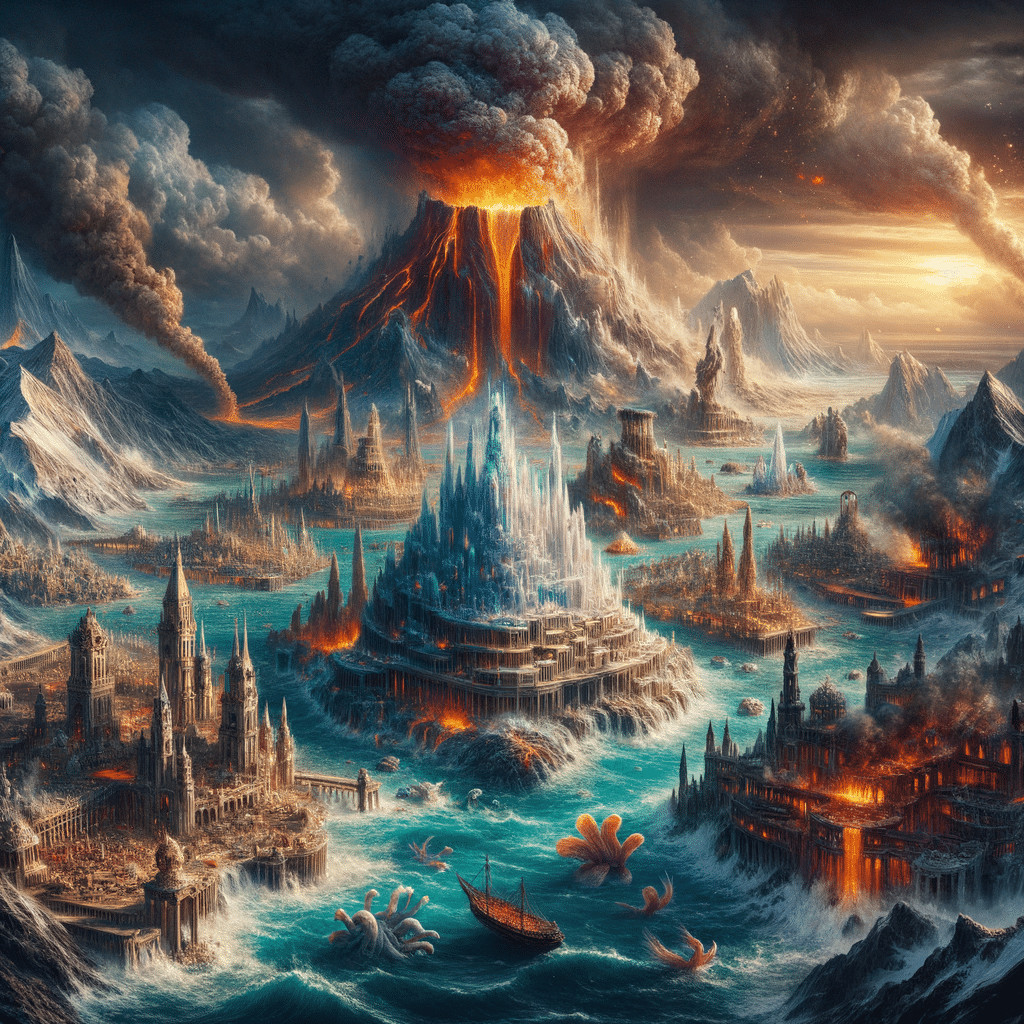
A podcast about the 1882 book Atlantis: The Antediluvian World can be accessed above. This episode was part of several podcasts generated with Google NotebookLM and is the product of AI.
This podcast is about Ignatius Donnelly’s Atlantis: The Antediluvian World, which argues for the historical existence of the lost continent of Atlantis. Donnelly supports his claim by citing parallels between ancient civilizations across the globe, including similarities in mythology, architecture, agriculture, and language. He posits Atlantis as a source of cultural diffusion, explaining similarities between seemingly disparate societies. The excerpt also examines geological and biological evidence that he believes supports the existence of a vast, now-submerged landmass in the Atlantic. Finally, the text includes the full Project Gutenberg license for the work.

[Tammy]
Hey everyone and welcome back for another deep dive. Today, we’re going to be looking into the mystery of Atlantis. You know that legendary lost city that’s just captivated people for centuries?
And we’re going to go beyond just the myth.
[Joe]
Okay.
[Tammy]
And explore the work of a guy who tried to prove Atlantis was a real place.
[Joe]
Interesting.
[Tammy]
Ignatius Donnelly and his book Atlantis, the antediluvian world.
[Joe]
Okay.
[Tammy]
So we’ve got some excerpts from his book ready to go.
[Joe]
Right.
[Tammy]
And we’re going to unpack his arguments and see if he makes a convincing case.
[Joe]
Sounds good.
[Tammy]
What do you, we just jump right in.
[Joe]
Let’s do it.
[Tammy]
First off, how does Donnelly even begin to tackle something like Atlantis? I mean, it’s so mysterious, right?
[Joe]
Well, he starts with the most famous source we have, Plato.
[Tammy]
Okay.
[Joe]
The Greek philosopher wrote about Atlantis around 360 BC.
[Tammy]
Okay.
[Joe]
And he didn’t write about it as a fable.
[Tammy]
Oh.
[Joe]
He presented it as historical fact.
[Tammy]
Wait. So Plato actually thought this was a real place?
[Joe]
That’s what Donnelly argues. Plato described it as this massive island, even bigger than Asia Minor and Libya combined.
[Tammy]
Wow. Okay.
[Joe]
And it was located beyond the pillars of Hercules.
[Tammy]
Oh, the pillars of Hercules. I’m not familiar with that.
[Joe]
Which if you need like a little geography refresher. Is the Strait of Gibraltar.
[Tammy]
Oh.
[Joe]
So we’re talking about a place smack dab in the middle of the Atlantic.
[Tammy]
Okay. So that’s a pretty bold claim already.
[Joe]
Yeah.
[Tammy]
But even if Plato believed it, how does Donnelly back it up? You know?
[Joe]
Yeah.
[Tammy]
Like real world evidence?
[Joe]
Well, that’s where it gets really interesting.
[Tammy]
Okay.
[Joe]
He doesn’t just take Plato at his word.
[Tammy]
Okay.
[Joe]
He dives deep into fields like geology.
[Tammy]
Oh, wow.
[Joe]
Looking for physical clues.
[Tammy]
Yeah.
[Joe]
That a massive island like this could have existed.
[Tammy]
Okay.
[Joe]
And then vanished.
[Tammy]
So he’s looking for like real evidence to support this ancient story.
[Joe]
Right.
[Tammy]
That’s wild.
[Joe]
What kind of geological evidence is he talking about?
[Tammy]
What kind of geological evidence?
[Joe]
Well, take the Mid-Atlantic Ridge, for example. This is a massive mountain range underwater that runs right down the middle of the Atlantic.
[Tammy]
Right down the middle. Okay.
[Joe]
And Donnelly says this could be the remains of that sunken continent.
[Tammy]
Oh.
[Joe]
Like the skeleton of Atlantis is still there.
[Tammy]
Oh, that’s pretty cool.
[Joe]
Just under the waves.
[Tammy]
I like that. That’s a good visual.
[Joe]
He also points to volcanic activity in places like the Azores.
[Tammy]
Okay.
[Joe]
You know those islands in the Mid-Atlantic?
[Tammy]
Yeah.
[Joe]
As evidence of some major like upheavals that happened in the past.
[Tammy]
Okay.
[Joe]
And remember, Plato said Atlantis disappeared in a day and a night.
[Tammy]
Right, right.
[Joe]
So we’re talking about cataclysmic events here.
[Tammy]
Yeah, yeah. That makes you wonder what forces could have been at play back then. And also, wouldn’t volcanic eruptions kind of explain how an island could vanish?
[Joe]
Exactly. And Donnelly cites real world examples too.
[Tammy]
Okay.
[Joe]
Like Graham’s Island.
[Tammy]
Graham’s Island.
[Joe]
It popped up out of the sea near Sicily in the 1800s.
[Tammy]
What?
[Joe]
Yeah. And then disappeared again. So these things show that the Earth’s surface is much more dynamic than we usually think.
[Tammy]
Right. So he’s making a case that this dramatic sinking that Plato described is actually possible. Right.
From a geological perspective.
[Joe]
Geologically speaking, yeah.
[Tammy]
But how does he connect that specifically to Atlantis?
[Joe]
Well, this is where Donnelly gets even more creative. Yeah. He doesn’t just stop at geology.
[Tammy]
Okay.
[Joe]
He also looks at the distribution of plants and animals.
[Tammy]
Really?
[Joe]
You know, flora and fauna on both sides of the Atlantic.
[Tammy]
What could plants and animals possibly tell us?
[Joe]
Well, he noticed similarities between species in the old world and the new world. Okay. Like the cotton plant.
[Tammy]
Okay.
[Joe]
It thrives in the Americas.
[Tammy]
Right.
[Joe]
But it isn’t native to Europe or Africa.
[Tammy]
Okay.
[Joe]
So this suggests to Donnelly that it originated in the Americas.
[Tammy]
Okay.
[Joe]
And maybe spread eastward.
[Tammy]
Interesting.
[Joe]
Via a land bridge or, you guessed it, Atlantis.
[Tammy]
Oh, okay.
[Joe]
Exactly.
[Tammy]
So he’s thinking of Atlantis as like this botanical highway spreading plants across the ocean.
[Joe]
And he makes even bolder connections too.
[Tammy]
Okay.
[Joe]
He suggests that some of our most important domesticated plants.
[Tammy]
Yeah.
[Joe]
Like maize or corn.
[Tammy]
Okay.
[Joe]
Could have originated in Atlantis.
[Tammy]
What?
[Joe]
Yeah. And spread from there. Wow.
He even gets into linguistics a little bit.
[Tammy]
Really?
[Joe]
Looking at words for these plants.
[Tammy]
Okay.
[Joe]
Trying to trace them back to a common source.
[Tammy]
Wow. So he’s connecting geology, botany, even language to build his case.
[Joe]
Trying to build his case.
[Tammy]
That’s pretty awesome.
[Joe]
It’s certainly enough to get people thinking.
[Tammy]
Yeah.
[Joe]
But Donnelly doesn’t stop there.
[Tammy]
Okay.
[Joe]
He digs into archaeology next.
[Tammy]
Really?
[Joe]
Looking at cultural similarities between ancient civilizations on opposite sides of the Atlantic.
[Tammy]
Wow. Okay. Wow.
Okay. Archaeology, huh? What kind of archaeological evidence?
[Joe]
Well, think about this. Yeah. Pyramids and burial mounds.
They pop up on both sides of the Atlantic. Like in Egypt.
[Tammy]
Yeah.
[Joe]
In the Americas.
[Tammy]
Right. Right.
[Joe]
And Donnelly sees these similarities in architecture. Not as just a coincidence.
[Tammy]
Oh, okay.
[Joe]
But as hints of a shared cultural origin.
[Tammy]
Right. Right.
[Joe]
Passed down maybe from Atlantis.
[Tammy]
So he’s saying these ancient cultures weren’t totally isolated, but were connected in some way. Maybe through Atlantis?
[Joe]
Potentially.
[Tammy]
That’s a pretty big idea.
[Joe]
It is. And he goes deeper too.
[Tammy]
Okay.
[Joe]
He looks at specific cultural practices.
[Tammy]
Okay.
[Joe]
Like the Mandan tribe.
[Tammy]
The Mandan tribe.
[Joe]
In North America.
[Tammy]
Okay.
[Joe]
They had this big canoe tradition.
[Tammy]
Okay.
[Joe]
Which sounds a lot like a flood myth.
[Tammy]
Yeah.
[Joe]
Does that remind you of anything?
[Tammy]
Yeah. Like Noah’s Ark. Right.
[Joe]
Exactly.
[Tammy]
Could these flood myths from all these different cultures actually be pointing to a real event?
[Joe]
It’s possible.
[Tammy]
Maybe even the sinking of Atlantis.
[Joe]
It’s a thought provoking idea.
[Tammy]
Yeah.
[Joe]
And there’s these ancient pipes found in Ireland.
[Tammy]
Yeah.
[Joe]
And New Jersey.
[Tammy]
Oh.
[Joe]
They’re strikingly similar.
[Tammy]
Okay.
[Joe]
So how did these seemingly isolated cultures develop such comparable artifacts?
[Tammy]
Right.
[Joe]
Could there have been some kind of contact or exchange across the ocean?
[Tammy]
Wow. Yeah. These connections are getting pretty interesting.
[Joe]
He keeps going too.
[Tammy]
Okay.
[Joe]
He points to similarities in religious practices.
[Tammy]
Okay.
[Joe]
Like sun worship.
[Tammy]
Yeah.
[Joe]
Mummification.
[Tammy]
Wow.
[Joe]
Even marriage customs.
[Tammy]
It’s like he’s making these connections between all these cultures and pointing back to Atlantis as the source.
[Joe]
Yeah.
[Tammy]
It’s a pretty compelling picture he’s painting. But is this all just speculation?
[Joe]
Well, that’s the heart of the debate, right? Some people might dismiss Donnelly’s ideas as just conjecture.
[Tammy]
Yeah.
[Joe]
While others find them really suggestive. He’s piecing together this puzzle with missing pieces.
[Tammy]
Yeah.
[Joe]
Relying on patterns and similarities to fill in those gaps.
[Tammy]
Right. It’s like being a juror in a historical mystery trial.
[Joe]
Exactly.
[Tammy]
You got to weigh the evidence.
[Joe]
And Donnelly doesn’t just present the evidence.
[Tammy]
Okay.
[Joe]
He tries to address counter arguments too.
[Tammy]
Okay. Like what?
[Joe]
Well, skeptics might say that these cultural similarities could have developed independently.
[Tammy]
That makes sense.
[Joe]
Right. No contact between civilizations.
[Tammy]
Yeah. That’s a valid point.
[Joe]
Because humans tend to come up with similar solutions to common problems.
[Tammy]
Exactly.
[Joe]
But Donnelly says that the sheer number and specificity of these similarities makes it unlikely they all arose purely by chance.
[Tammy]
Okay.
[Joe]
He suggests it’s more plausible to see them as evidence.
[Tammy]
Okay.
[Joe]
Of a common source.
[Tammy]
Okay.
[Joe]
A civilization that spread its influence across the world.
[Tammy]
So he’s basically saying there’s just too many coincidences to ignore. Right. And of course that civilization would be Atlantis.
[Joe]
That’s his argument.
[Tammy]
But even if we accept that.
[Joe]
Right.
[Tammy]
How would something so big just disappear?
[Joe]
Right.
[Tammy]
Wouldn’t we have found something more by now?
[Joe]
That’s the question that has baffled researchers for centuries.
[Tammy]
Yeah.
[Joe]
Donnelly speculates that Atlantis might have sunk. So catastrophically.
[Tammy]
Yeah.
[Joe]
That most of its structures and artifacts were destroyed or buried.
[Tammy]
Like a landslide or something.
[Joe]
Yeah. Like under tons of rock and mud.
[Tammy]
Wow.
[Joe]
That would make finding hard evidence pretty challenging.
[Tammy]
Yeah. It would.
[Joe]
And that’s why Donnelly relies so heavily on these clues. Yeah. These echoes.
[Tammy]
Yeah.
[Joe]
And patterns of similarity.
[Tammy]
Yeah. Right.
[Joe]
He’s almost like an archaeologist of ideas.
[Tammy]
That’s a good way to put it.
[Joe]
Digging through these layers of myth and legend.
[Tammy]
Yeah.
[Joe]
Trying to uncover this lost history.
[Tammy]
It’s a really fascinating approach, but I’m wondering.
[Joe]
Yeah.
[Tammy]
If Atlantis was this advanced civilization. Why haven’t we found any written records?
[Joe]
That’s another great question.
[Tammy]
Yeah.
[Joe]
Donnelly speculates that Atlantean writing.
[Tammy]
Okay.
[Joe]
Might have been on perishable materials.
[Tammy]
Right.
[Joe]
Like papyrus or wood.
[Tammy]
Right.
[Joe]
Which would have decayed over time.
[Tammy]
Yeah. That makes sense.
[Joe]
Or their writing system might have been so different from ours. That we haven’t been able to decipher it.
[Tammy]
So it’s possible the evidence is out there. They just haven’t recognized it yet.
[Joe]
Exactly. Think about the Rosetta Stone.
[Tammy]
Yeah.
[Joe]
It took years to crack the code of Egyptian hieroglyphs.
[Tammy]
Right.
[Joe]
Who knows what secrets are hidden.
[Tammy]
Yeah.
[Joe]
In ancient artifacts waiting for the right key.
[Tammy]
It’s like a big treasure hunt. Right. Just waiting for someone to find the map.
[Joe]
But Donnelly doesn’t limit himself to just material evidence.
[Tammy]
Okay.
[Joe]
He also looks at mythology.
[Tammy]
Oh, really?
[Joe]
He suggests that many ancient myths from all over the world.
[Tammy]
Yeah.
[Joe]
Might contain echoes of Atlantis.
[Tammy]
That’s fascinating.
[Joe]
Which myths is he talking about?
[Tammy]
Yeah. Like what specifically?
[Joe]
Well, he starts with the Arabian myth of the Adites.
[Tammy]
The Adites.
[Joe]
These ancient people known for their advanced civilization.
[Tammy]
Okay.
[Joe]
And he hints at a connection to Atlantis. Suggesting that the name itself might have survived.
[Tammy]
Just a name similarity?
[Joe]
A single similarity might be coincidental.
[Tammy]
Okay.
[Joe]
When you start seeing multiple connections, it gets more intriguing.
[Tammy]
Okay.
[Joe]
Donnelly also points to Greek myths.
[Tammy]
Okay.
[Joe]
Particularly the story of the Titans.
[Tammy]
Oh, yeah. The Titans.
[Joe]
Those powerful beings who were overthrown by the Olympian gods.
[Tammy]
Yeah. Yeah.
[Joe]
And Donnelly suggests that the Titans could actually represent the Atlanteans. This powerful civilization that met a similar fate.
[Tammy]
Okay.
[Joe]
He also points to Oceanus.
[Tammy]
Oceanus.
[Joe]
The Titan god of the ocean.
[Tammy]
Right.
[Joe]
As representing this idea of an oceanic origin for the gods.
[Tammy]
Okay.
[Joe]
Which aligns with Atlantis, right?
[Tammy]
Right.
[Joe]
This island empire.
[Tammy]
So he’s seeing these old stories as allegories or real events.
[Joe]
He also draws parallels with recurring themes in Greek mythology.
[Tammy]
Okay. Like what?
[Joe]
This golden age followed by decline.
[Tammy]
Okay.
[Joe]
And a great flood.
[Tammy]
Right.
[Joe]
Could these be symbolic representations of Atlantis?
[Tammy]
Wow.
[Joe]
Its rise and fall.
[Tammy]
It’s like these myths aren’t just stories, but like memories of the past.
[Joe]
And Donnelly even connects Celtic and Irish myths to Atlantis.
[Tammy]
Really?
[Joe]
Suggesting these early settlements. Wow. From Atlantis in those regions.
[Tammy]
Making all these connections.
[Joe]
Yeah. It’s this big web.
[Tammy]
Yeah.
[Joe]
Linking these ancient stories from around the world.
[Tammy]
Yeah.
[Joe]
To this one lost civilization. Okay.
[Tammy]
I’m starting to see how his mind works. It’s like he’s taking these completely different things and putting them together.
[Joe]
Yeah.
[Tammy]
But how does Egypt fit into all this?
[Joe]
Ah, that’s where we get to.
[Tammy]
Yeah.
[Joe]
One of Donnelly’s most controversial claims.
[Tammy]
Oh, okay.
[Joe]
Remember Plato said Atlantis had contact with Egypt.
[Tammy]
Right.
[Joe]
Donnelly takes that a step further.
[Tammy]
Okay.
[Joe]
He proposes that Egypt was actually a colony of Atlantis.
[Tammy]
Is there any evidence to support that?
[Joe]
Well, he points to similarities.
[Tammy]
Okay.
[Joe]
Between Egyptian and Atlantean culture.
[Tammy]
Okay.
[Joe]
As Plato described them.
[Tammy]
Mm-hmm.
[Joe]
Particularly the use of gold and silver.
[Tammy]
Okay.
[Joe]
As sacred metals reserved for the gods.
[Tammy]
So he’s saying the Egyptians got their religious practices from the Atlanteans.
[Joe]
That’s his idea.
[Tammy]
Wow.
[Joe]
He also points out that Egyptian civilization seems so advanced.
[Tammy]
Yeah.
[Joe]
From its very beginning.
[Tammy]
Right.
[Joe]
It’s almost like it sprung up fully formed.
[Tammy]
Yeah.
[Joe]
Which Donnelly attributes to the influence.
[Tammy]
Okay.
[Joe]
Of an older more sophisticated culture.
[Tammy]
Okay. So it’s like he’s saying the Egyptians were students of the Atlanteans.
[Joe]
In a way.
[Tammy]
But if Atlantis was this diverse multicultural place.
[Joe]
Mm-hmm.
[Tammy]
Like he suggests.
[Joe]
Yeah.
[Tammy]
How does he explain all the different races we have today?
[Joe]
Now we’re getting into some interesting territory.
[Tammy]
Okay.
[Joe]
See Donnelly was writing back in the 19th century.
[Tammy]
Okay.
[Joe]
When ideas about race and human origins. Were very different from how we see things now.
[Tammy]
Right.
[Joe]
He used the ancient Egyptian belief.
[Tammy]
Okay.
[Joe]
Of four races.
[Tammy]
Okay.
[Joe]
White, red, yellow, and black. And basically said these four races.
[Tammy]
Okay.
[Joe]
Were all present in Atlantis.
[Tammy]
Right.
[Joe]
And spread out after its destruction.
[Tammy]
So he’s applying those old ideas to Atlantis.
[Joe]
Yeah.
[Tammy]
Even though we know better now.
[Joe]
Right.
[Tammy]
About human variation.
[Joe]
Right. But it’s interesting to see.
[Tammy]
Yeah.
[Joe]
How Donnelly back then.
[Tammy]
Mm-hmm.
[Joe]
Tried to incorporate those ideas. Right. Into his big story of Atlantis.
[Tammy]
Yeah. Makes you think about how our understanding of the past. Yeah.
Is always changing. And we get new information and new perspectives.
[Joe]
Exactly. That’s what makes exploring history.
[Tammy]
Mm-hmm.
[Joe]
So fascinating.
[Tammy]
Yeah. We’re always learning and reevaluating. Always.
So we’ve got geology, botany, archaeology. Even those old ideas about race. Connected to Atlantis.
[Joe]
It’s a lot to take in.
[Tammy]
Yeah. But there’s one more piece to look at.
[Joe]
Oh.
[Tammy]
The Bronze Age.
[Joe]
Ah, yes.
[Tammy]
This is where Donnelly really gets things going.
[Joe]
How so?
[Tammy]
He challenges how we usually think about history.
[Joe]
Okay.
[Tammy]
See, we usually give credit to civilizations like the Phoenicians.
[Joe]
Right.
[Tammy]
For starting the Bronze Age.
[Joe]
For ushering it in. Yeah. Mm-hmm.
[Tammy]
But Donnelly argues that bronze was being used in Europe.
[Joe]
Okay.
[Tammy]
Way before those cultures.
[Joe]
Interesting.
[Tammy]
He points to all those bronze artifacts in Scandinavia.
[Joe]
Okay.
[Tammy]
And says that the knowledge of bronze came from somewhere further north.
[Joe]
Which would line up with?
[Tammy]
Atlantis. Right. He’s suggesting Atlantis was the source of bronze making.
Supplying Europe with this new technology.
[Joe]
Makes you think about all the connections that might have existed back then.
[Tammy]
It really does.
[Joe]
And he goes on to say that the bronze artifacts in the north were different.
[Tammy]
Different how?
[Joe]
They don’t have lead or silver, which were commonly added to bronze in other places.
[Tammy]
So different ingredients, different techniques. Maybe coming from Atlantis.
[Joe]
It’s possible.
[Tammy]
So picture this, Atlantean ships full of bronze tools.
[Joe]
Okay.
[Tammy]
Weapons, ornaments, sailing across the Atlantic.
[Joe]
Right.
[Tammy]
Trading with the people of Europe.
[Joe]
Like a prehistoric version of globalization.
[Tammy]
Yeah.
[Joe]
It’s a great way to put it.
[Tammy]
Donnelly’s vision of Atlantis is one of the super advanced and connected civilization.
[Joe]
Which leads to another point he makes. Okay. He says that lots of the basics of civilization.
Agriculture, metalworking, writing, even marriage.
[Tammy]
Wow.
[Joe]
All came from Atlantis.
[Tammy]
So Atlantis was like this wellspring of knowledge.
[Joe]
That’s what he’s saying.
[Tammy]
The blueprint for all the civilizations that came after.
[Joe]
It’s a big claim.
[Tammy]
It is.
[Joe]
But there’s the proof.
[Tammy]
Right. If Atlantis was so important, shouldn’t we have found more by now?
[Joe]
Exactly.
[Tammy]
Donnelly knows this is a challenge to his theory. But he offers some possible explanations.
[Joe]
Okay. Like what?
[Tammy]
Well, maybe most of Atlantis.
[Joe]
Oh.
[Tammy]
Got destroyed or buried when it sank.
[Joe]
Okay. Makes sense.
[Tammy]
Or their writing was on stuff that decayed.
[Joe]
Oh, right. Like papyrus.
[Tammy]
Exactly. And it’s also possible that we just haven’t figured out their writing yet.
[Joe]
It’s like a code we haven’t cracked.
[Tammy]
Right. So the evidence might be there. We just don’t know it.
[Joe]
Like a big mystery.
[Tammy]
Yeah. Waiting to be solved.
[Joe]
Now, Donnelly doesn’t just talk about material stuff.
[Tammy]
He also talks about how Atlanteans viewed things.
[Joe]
Like what?
[Tammy]
Wealth. Spirituality. He suggests that gold and silver were sacred to them.
Okay. Why does he think that?
[Joe]
He compares it to ancient Peru.
[Tammy]
Okay.
[Joe]
Where gold was connected to the sun god, silver to the moon goddess.
[Tammy]
Interesting.
[Joe]
Donnelly believes Atlantis had similar ideas.
[Tammy]
So those metals weren’t just valuable. They had spiritual meaning.
[Joe]
Exactly.
[Tammy]
Which would explain all that gold and silver that Plato talked about. It wasn’t about being rich. It was about their beliefs.
[Joe]
It was about something deeper.
[Tammy]
That really makes you think about how we see wealth and possessions today.
[Joe]
It does, doesn’t it? It really does. That’s one of the things I find so interesting about Donnelly.
[Tammy]
Yeah.
[Joe]
He’s always questioning things. Exploring different possibilities.
[Tammy]
So we’ve gone through Donnelly’s Atlantis.
[Joe]
Yeah.
[Tammy]
What are the main takeaways for our listeners?
[Joe]
I think the biggest thing is.
[Tammy]
Yeah.
[Joe]
How powerful imagination is. And how captivating this Atlantis story is.
[Tammy]
It really is.
[Joe]
Donnelly shows us how one idea can lead to all these explorations.
[Tammy]
Across all these different fields.
[Joe]
It’s pretty amazing.
[Tammy]
It also reminds us.
[Joe]
Yeah.
[Tammy]
That what we think we know about history can change.
[Joe]
It’s always evolving.
[Tammy]
What might seem impossible today.
[Joe]
Right.
[Tammy]
Could be proven tomorrow.
[Joe]
And Donnelly’s work, even though it’s speculative.
[Tammy]
Yeah.
[Joe]
Makes us think critically about the past. To question what we think we know.
[Tammy]
Right.
[Joe]
And to be open to new discoveries.
[Tammy]
Who knows?
[Joe]
Yeah.
[Tammy]
Maybe we will find proof of Atlantis someday.
[Joe]
Wouldn’t that be something?
[Tammy]
It would change everything.
[Joe]
Until then.
[Tammy]
Yeah.
[Joe]
We have Donnelly’s ideas.
[Tammy]
Right.
[Joe]
And the mystery of Atlantis to keep us thinking.
[Tammy]
That’s a good way to put it. Well, that wraps up our deep dive into Ignatius Donnelly’s Atlantis. The antediluvian world.
[Joe]
Great discussion.
[Tammy]
We hope you enjoyed it.
[Joe]
Yeah, me too.
[Tammy]
Keep exploring. Keep asking questions. And maybe, just maybe, you’ll be the one to solve this mystery.
[Joe]
It’s out there somewhere.
[Tammy]
Thanks for listening, everyone.




Leave a Reply