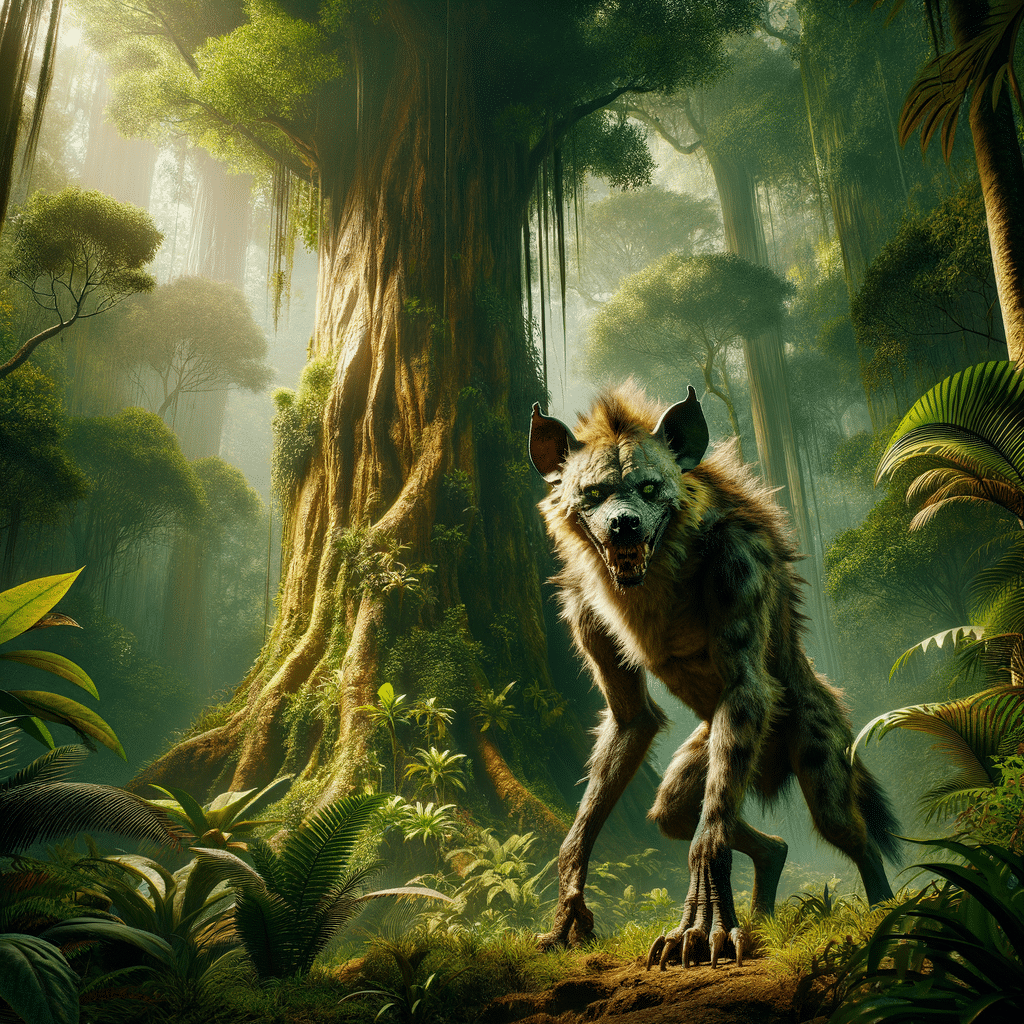
In shapeshifter mythology, the werehyena occupies a special position that sets it apart from its more well-known cousin, the werewolf. Werehyena mythology is mainly from Africa and the Middle East, where real spotted and striped hyenas dwell, in contrast to the popular European werewolf myths. These mythical creatures subvert the conventional Western notion of lycanthropy by fusing distinctively local cultural practices and beliefs.

Description
Werehyenas are characterized as enormous creatures in their altered form, far bigger than wild hyenas and frequently as tall as a human at the shoulder. They still have the strong jaws and characteristic sloping back of their animal counterparts, which allow them to easily crush bones. According to the majority of reports, they have coarse, spotted fur, eyes that sparkle in the light of fire, and the eerie “laugh” that spotted hyenas are known for. In contrast to werewolves, werehyenas frequently display human characteristics like the ability to walk upright and the retention of human eyes, even in their altered form (Byghan, 2020).
Werehyena behavior differs greatly from werewolf mythology. Werehyenas frequently preserve the social structure of their animal equivalents, forming packs and hunting in groups, in contrast to werewolves, who are usually shown as solitary hunters. They are characterized as clever hunters who mix the strength of a hyena with human cunning. Several reports indicate that, in contrast to the mindless fury frequently associated with werewolves, they maintain complete consciousness throughout change.
Werehyena mythology varies greatly by region. In East Africa, especially in Ethiopian folklore, werehyenas are often associated with blacksmiths and other artisans, who are believed to possess the ability to transform at will. According to North African customs, they are more solitary and frequently associated with witchcraft and sorcery. While Middle Eastern stories usually link werehyenas to grave robbing and nighttime activities, West African versions occasionally portray them as humans who create agreements with spirits in order to have the ability to change (Carrion, 2024).
Werehyena legend has changed over time to mirror shifting social norms. Ancient tales frequently depicted them as tribal protectors or guardian spirits, but stories from the colonial era began to portray them as enemies, reflecting the cultural tensions of the time. Contemporary urban legends have transformed these stories, portraying werehyenas as vigilantes protecting neighborhoods from criminals during the night.
Werehyena vs. Werewolf
Despite being shapeshifters, werewolves and werehyenas belong to different mythical lineages with intriguing distinctions and sporadic similarities. Their contrasts reflect the cultural, physical, and biological distinctions between their home places. The two traditions have rather different transformation mechanics. During the full moon, werewolves usually undergo an involuntary transformation, often losing their human consciousness and suffering excruciating pain. Conversely, people typically depict werehyenas as free-will shapeshifters who maintain their human intelligence. While werewolf metamorphosis is usually considered a curse or affliction, certain werehyena traditions describe the transition as a taught talent or inherited aptitude.
There is also a stark variation in the transmission mechanisms. Through bites or scratches, werewolves have historically transmitted their illness, generating a contagious narrative akin to the spread of sickness. People frequently portray werehyena skills as acquired through magical agreements, taught through spiritual rituals, or passed down through family lines. Some cultures link certain occupations or societal roles, especially those of metalworkers and religious practitioners, to werehyena metamorphosis.
The two animals’ social behavior patterns are very different. Human civilization often depicts werewolves as lone hunters, driven by bloodlust, despite their acceptance. Werehyenas frequently establish hierarchical groupings with distinct jobs and responsibilities, maintaining intricate social systems that resemble both human societies and hyena clans. These social characteristics mirror the true tendencies of wolves, which are mostly solitary in many areas, and hyenas, which are extremely gregarious animals with intricate clan systems.
They also maintain distinct relationships with human culture. Werewolf legends typically highlight the tragic aspect of the curse and the werewolf’s battle to save their humanity. Werehyena tales sometimes portray transformation as a kind of luxury or power, albeit occasionally one that is morally dubious. While werewolves are usually social outcasts or secret members, many werehyena stories include shapeshifters who protect their communities or lead normal lives.
Hunting and feeding habits reflect different cultural fears. People typically portray werewolves as indiscriminate killers, preying on people for food or the thrill of a hunt. People frequently associate werehyenas with specific taboo practices, like grave robbing or indulging in forbidden foods. Instead of actively hunting people, some werehyena legends emphasize their function as scavengers or nighttime foragers.
The methods used to protect and defend against these creatures differ significantly. According to European folklore and Christian traditions, werewolves are renowned for being susceptible to silver, wolfsbane, and religious emblems. Usually, people use ceremonial safeguards, particular plants, or local spiritual practices to protect werehyenas. Some traditions suggest using social tactics instead of physical weapons to reason with or discourage werehyenas.

Culture
The mythology of the werehyena, which originated in East and North Africa as well as portions of the Middle East, illustrates a number of important cultural values and social processes. Power dynamics and social hierarchy are major themes in these stories. The complex status of crafters, who were sometimes feared or shunned because of their mysterious knowledge but also valued for their capabilities, is reflected in the identification of werehyena abilities with various professions, especially blacksmiths in Ethiopian folklore. This illustrates how communities saw authority that did not come from established governmental or religious structures (Rose, 2001).
Gender dynamics are important, especially in areas where the matriarchal structure of hyena clans resembled or differed from human social structures. Some customs portray strong women as werehyenas, a representation that mirrors society’s apprehension about women deviating from established norms and its acknowledgement of female power. These tales frequently offered comments on gender conventions and the fallout from defying them (Baynes-Rock, 2015).
The emphasis on deliberate transformation, rather than an uncontrollable curse, reflects cultural ideals about human accountability and the interplay between power and choice. Many cultures portray werehyena skills as a tool for personal benefit or community protection, emphasizing the moral responsibility that comes with power.
Werehyena mythology exhibits significant religious and spiritual syncretism. Stories frequently combine Christian or Islamic aspects with indigenous spiritual beliefs, showing how tribes maintained cultural traditions while adjusting to religious shifts. Werehyenas’ connection to grave robbing and nighttime activities frequently highlights conflicts between more recent religious prohibitions and customs.
These animals also have quite different symbolic connotations in their distinct cultures. Werewolves are frequently used to symbolize the conflict between civilization and the wild or humanity’s battle with its bestial nature. The complicated relationships between various classes or professions within a society, cultural taboos, or social power dynamics are often symbolized by werehyenas. Particularly in societies where the matriarchal structure of hyena clans is similar to or different from human social structures, certain werehyena legends offer commentary on gender roles.
Each creature’s modern interpretation has developed in a unique way. The modern media frequently idealizes werewolves as tragic heroes or misunderstood outsiders. In contemporary renditions, werehyena legends have retained much of their original complexity and frequently function as commentary on power relations and social dynamics. Nonetheless, both animals have gained fresh significance in conversations about society, human nature, and change.
The spread of culture and geography reveals interesting patterns. The traits of werewolf legends became relatively uniform across locations as they expanded broadly over Europe and then to nations that were influenced by Europe. Even though werehyena legends are becoming more well-known worldwide because of contemporary fantasy literature and media, they have stayed more geographically distinctive and have maintained closer ties to regional cultural practices and beliefs.
These variations and parallels demonstrate how the development of shapeshifter legends reflects local animals, cultural values, and social institutions. Both animals symbolize different traditions, each with its own rich cultural importance and symbolism, even if they both express the idea of human-animal metamorphosis (Jennings, 2014).
There are differences between the traditional defenses employed against werewolves and werehyenas. In most cultures, silver has no unique effect. Instead, tribal or religious leaders frequently use certain plants, ceremonial scarification, and protective amulets as preventative methods. In certain places, people believe that calling out the werehyena’s human name will transform it back into a human form.
With the advancement of contemporary studies, perceptions of werehyena legends have changed. According to anthropologists, these stories represented power struggles and social conflicts in primitive communities. In societies where these legends were prevalent, several scholars highlight the importance of the matriarchal structure of hyena packs, frequently linking them to tales of strong women and social outcasts. Legends about werehyenas have recently attracted more interest in fantasy literature and media, especially as authors attempt to delve deeper into shapeshifter mythology outside of the European werewolf tradition.
Conclusion
The rich and intricate mythology found in Werehyena folklore is a reflection of the ecological, social, and cultural settings in which it originated. Werehyena stories place more emphasis on social dynamics, deliberate transformation, and local spiritual practices than the more well-known werewolf legends. These tales, which remain distinct from other shapeshifter myths, provide fresh viewpoints on the interaction between people, animals, and the paranormal as they develop and attract new audiences.
References
Baynes-Rock, M. (2015). Ethiopian Buda as hyenas: Where the social is more than human. Folklore, 126(3), 266-282.
Byghan, Y. (2020). Sacred and Mythological Animals: A Worldwide Taxonomy. McFarland.
Carrion, C. (2024). Freaky Folklore: Terrifying Tales of the World’s Most Elusive Monsters and Enigmatic Cryptids. Wellfleet.
Jennings, P. (2014). Pagan Portals-Blacksmith Gods: Myths, Magicians & Folklore. John Hunt Publishing.
Rose, C. (2001). Giants Monsters and Dragons: An Encyclopedia Of Folklore Legend And Myth. WW Norton & Company.



Leave a Reply