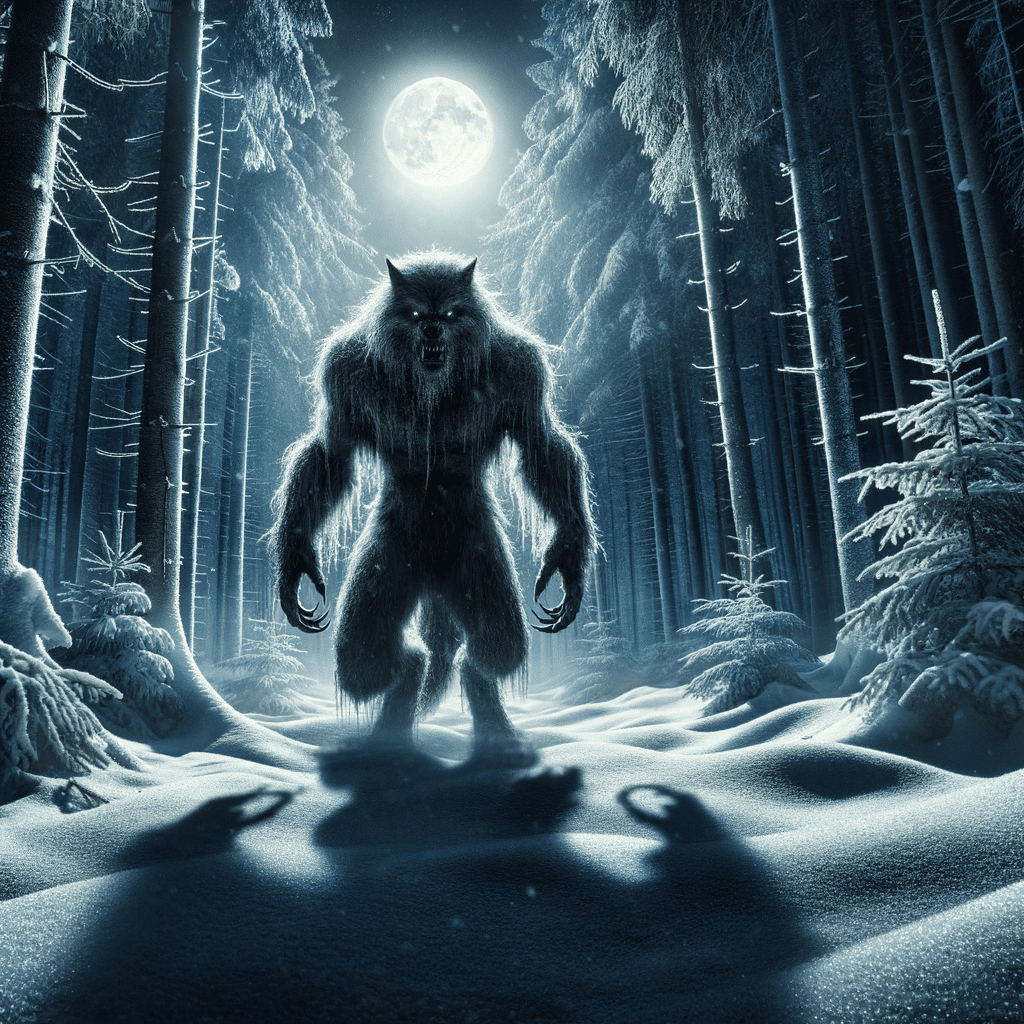
These four dogman and werewolf stories were retrieved from Archives and Special Collections at Michigan State University in East Lansing, Michigan after a series of e-mails. Thanks to the MSU archives staff for help in finding and using these stories.

The Tahquamenon Hunter (Eastern Upper Peninsula, 2019)
I’m 42 years old, and I never imagined that I would be sharing this kind of story. My name is Mike Sorenson. Everyone around here knows me as a level-headed guy, and I have the calloused hands from twenty years of carpentry work to prove it. I was born and raised in Newberry. I learned everything I know about these forests from my father, Old Jim Sorenson, including how to detect weather patterns and track deer. I always valued the flexible hours I got to work during hunting season at Davidson Construction, but that day completely changed everything. The majority of people in this area are familiar with me, either from my employment at the hardware store or from my side project of creating bespoke cabinets. I’m not inclined to fabricate stories or seek attention.
I got into my beat-up Ford F-150 at 4:30 AM and started double-checking my equipment. The temperature was about 35 degrees, which is normal for the UP in mid-October. My favorite spot, which had produced me an eight-point buck the season before, was roughly three miles east of the Lower Tahquamenon Falls. I’d set up a ground blind two weeks earlier, and it was still in the ideal spot, looking out across a natural funnel where deer usually traveled between sleeping and eating regions. When I checked my trail cameras the previous weekend, I noticed a lot of doe activity and some promising bucks passing by.
The walk-in was sufficiently quiet. I followed the fluorescent tacks I had put on trees to indicate my route, using my red headlamp so as not to frighten any deer. Nestled between a dense stand of cedars and a fallen oak, the blind was exactly where I had left it. Around 5:45 AM, which was plenty of time for the morning movement, I settled in. The first few hours were typical; I noticed the typical squirrels and birds becoming active, and I saw a few does with their fawns at first light. Around 8:30, I texted Sarah to reassure her that everything was alright, as I normally did to calm her down.
Around nine in the morning, the woodland fell silent abruptly, as if someone had pressed a mute button. I had just completed my second coffee thermos when I became aware that there was no sound. A strange calm made the hair on my neck stand up, and even the breeze seemed to die. Too heavy to be a deer, the sound of cracking branches preceded the creature’s appearance. The shaking in my hands was so intense that I dropped my Remington 700 as soon as the creature emerged and stood up. I had hung a trail camera on a low-hanging maple tree the week before, so I knew it was approximately eight feet up when the beast’s head almost brushed it.
Every single detail of that thing is still vivid in my thoughts. In addition to being brown, its fur had an oily sheen that was similar to that of a wet dog but darker—almost black in spots. The muscles beneath that fur rippled like a bodybuilder’s but more fluidly and moved in ways that made no sense. Its hands, which I won’t even refer to as paws, featured elongated fingers that resembled claws capable of tearing through a vehicle door. However, the face that haunts me the most is the one in question. It was not merely a wolf’s head on a body; rather, it was a hybrid of a wolf and a human, with a nose that was shorter than that of a typical wolf but significantly longer than any dog I have ever seen. When it did, the teeth that were visible… You’d call it snarling, I suppose. The teeth appeared razor-sharp and had a yellow hue.
After the encounter, which lasted precisely six minutes, I checked the video feature on my phone, which I had successfully activated with trembling hands. Regretfully, the video only captured hazy movement through the blind’s mesh. The creature’s predatory, intelligent eyes seemed to shine from within, bothering me most. Before it left, it made a sound that sounded more like a howl than a roar, but it seemed to reverberate in my chest. It sounded like a wolf howling, something nearly human, and the deepest bass you’ve ever heard. When I think about it, I can still feel that sound in my bones.
The way it moved when it departed was what truly disturbed me. It fell to its knees, but not in the manner of a dog. It moved faster than any human could, more akin to a bear’s crawl. In what felt like two seconds, it had gone about thirty yards before vanishing into the dense undergrowth to the north. Perhaps another minute passed while the crashing sounds grew softer, and then the terrible silence came again.
Too scared to move, I remained in that blind room for two more hours. I had clearly missed my regular check-in time because my phone displayed four missed calls from Sarah. When I had worked up the nerve to go, I prepared my rifle and walked backwards most of the way to my truck. In a muddy area near its original location, I came across traces. Huge, almost fourteen inches long, and clearly marked with claws at the tips of the toes, they resembled wolf tracks. A week later, when I finally plucked up the courage to show my hunting companion Dale the pictures I had taken, the rain had washed them away.
Sarah, my wife, saw the change in me right away. Now that I have sold my ground blinds, I exclusively hunt from higher vantage points in wide fields. I started keeping our German Shepherd, Max, inside at night and added more security lights to the exterior of our remote house. Although my teenage sons still make jokes about “Dad’s monster,” they no longer want me to go hunting with them in the deep woods. Every year as October draws near, I find excuses to put in extra hours and avoid the Tahquamenon trails until it’s snowing.
I still get nightmares, but they’re not the worst part. The sensation is that my woods, which I have known and cherished all my life, are no longer mine. Between here and the falls, I used to be familiar with every route, mountain, and creek crossing. I wonder what else is out there, waiting and watching, while I gaze at those same forests. I occasionally catch myself staring at the treeline when working on a roof in town, and for a brief moment, I believe I see someone peering back. Since then, I’ve heard rumors of further sightings in the UP, either in whispers at the bar or around hunting campfires. I no longer participate in those discussions. It’s preferable to keep some things secret.
The Ann Arbor Academic (Washtenaw County, 2017)
If my colleagues in the Linguistics Department found out that I was publishing this report, they would probably terminate my tenure. My name is Dr. Thomas Whitfield, and I am 51 years old. I had learned to examine, evaluate, and reject everything that lacked empirical support throughout my twenty-three years as a student at the University of Michigan. I became well-known in my profession thanks to my published research on Indo-European language patterns and contemporary dialectical shifts. That was before the night of September 28, 2017, when my entire understanding of reality came under scrutiny.
With two PhD candidates in need of intensive thesis supervision and a new research funding proposal deadline approaching, the semester had been especially taxing. My sanity depended on evening Nichols Arboretum walks. Margaret, my wife, would frequently advise me to locate a walking companion, but I insisted on being alone. The serene seclusion amidst the trees offered the ideal setting for structuring my ideas and preparing lessons. I usually only brought my phone and a tiny digital voice recorder so I could record academic observations.
I had remained in my office past my customary hours that night, grading undergraduate papers until almost ten o’clock. Despite the arboretum’s official closure, as a faculty member with after-hours access rights, I frequently used the paths as a shortcut to reach our Oxford Road home. The main route was well-lit by a waxing gibbous moon, and the cool fall air was pleasant. Margaret would most likely be watching her typical Thursday night television when I got home, according to my watch, which I remember checking at 10:17 PM.
The motion-activated lights along the river path were the first clue that something was wrong. I was unable to identify the source of the activation, but they began to trigger sequentially. At first, my logical mind thought this might have been a deer or coyote because we had seen a lot of urban wildlife that semester. The activation pattern indicated that something was moving parallel to my location, just out of the lights’ reach. My voice recorder came out, and I recall whispering into it, “Possible urban wildlife interaction, north river trail, approximately 10:20 PM.”
The creature that arose from the shadows defies any accepted classification in zoology. Easily seven feet tall, the creature’s proportions suggested a humanoid skeleton, yet its thick, silvery-gray fur seemed to both absorb and reflect the artificial lights in a disconcerting way. Despite having a distinctly canine head, its facial traits implied a level of intelligence that chilled my blood. In particular, the eyes showed a distinctly non-animal awareness.
About forty-five seconds passed during the interaction, yet time seemed to stop in that instant. I can only say that the creature watched me with intelligent curiosity. It cocked its head as if it were absorbing fresh information, yet the motion appeared purposeful, even academic. Its walk, which combined the upright stance of a biped with the flowing elegance of a quadruped, demonstrated a biomechanical impossibility when it moved. My voice recorder captured only my quick breathing and a low, harmonious humming that I was unaware of throughout the actual encounter.
I experienced cognitive dissonance in the immediate aftermath. For what my phone later told me was seventeen minutes, I stood motionless. As soon as I was able to return home, Margaret noticed my pallor and assumed I had contracted the school-wide virus. I allowed her to assume this, taking three days off work to begin a research obsession that ultimately led to healing.
The next few months saw a significant change in my academic concentration. I started adding mythological allusions to my language investigation, paying special attention to Indo-European names for cryptids and shapeshifters. My coworker, Dr. Sarah Chen, subtly hinted that I was suffering from academic burnout when I turned in a paper that linked Proto-Germanic linguistic shift patterns to ancient werewolf stories. The department chair ultimately called me in for a “wellness check” after students complained about my increasingly straying into cryptozoological subjects during historical linguistics classes.
Since then, I’ve gotten in touch with a group of people who have experienced similar things, but I insist that anonymity is necessary for my academic position. I currently keep seventeen notebooks filled with my research in a fireproof safe in my home office. During later (failed) attempts to return to the encounter site, I recorded infrasound frequencies that correspond to sound patterns in old wolf-related mythology. My current fascination with motion-activated cameras and my insistence on placing high-frequency sound deterrents across our property are causes for Margaret’s concern.
The expense of hiring a specialist has been high. My percentage of publications in conventional linguistic journals has decreased by 70%. I can’t go back to my old perspective, but three PhD candidates have asked for alternative advisers, claiming that I have “divergent research interests.” Regardless of the academic repercussions, I feel driven to investigate the gaps in our scientific understanding that the episode has exposed. I occasionally hear that same melodic humming coming from the arboretum’s direction late at night while I’m studying. I now realize that some information comes at the expense of everything you once thought to be true; therefore, I’ve learned to turn off my recording devices and just listen.
The Food Truck Guy (Kent County, 2022)
I’m 35-year-old Tony Ramirez, and I own and operate “Tony’s Street Eats” in Grand Rapids’ downtown. Before you ask, the answer is that I selected this life because I enjoy it, studied business at GRCC, and worked in sales for five years. Before that night in March 2022, I had already worked in sales. Fusion tacos, such as Thai chicken and Korean BBQ, are the specialty of my truck. I made a respectable living parking close to Rosa Parks Circle, and the late-night bar clientele adores it. Because I’m not near downtown after midnight these days, I’m using the past tense.
I used to have the ideal location, sandwiched between four well-known bars, where I could see people stumbling between venues or making their way home. I had regular clients, including some police officers who would stop by for dinner during their night jobs and college students who would visit three times a week. I maintained my truck immaculately, and the health inspector knew me by name. That night, I had to handle everything on my own as my prep cook, Joey, had recently quit to return to school. Importantly, no one else was present to confirm what I witnessed, which exacerbates the situation.
It was around three in the morning on Saturday, March 12. After serving my final customer—a man in a suit who ordered four bulgogi tacos and was hardly able to stand—the bars had cleared out. I recall making $847 that night, which is not unacceptable for a Saturday. The streets were empty except for the occasional Uber driver. The temperature had dropped to around 40 degrees, and the streetlights appeared blurry due to the light mist in the air.
I was disassembling my workstation, doing the standard tasks like scrubbing the flat top and storing supplies. Old-school hip-hop was playing on my Bluetooth speaker, but not too loudly. The first unusual thing I noticed was that the music abruptly stopped, seemingly due to signal interference. Then I noticed a flickering streetlight across from my truck. Before I noticed the scraping sound coming from the alley behind Chemical Bank, I had assumed it was just another electrical problem in downtown.
Despite being 6’2″ and having played defensive line in high school, I’ve intervened in numerous drunken fights outside the truck. However, the creature emerging from that alley moved in a manner unlike anything I’ve ever witnessed. At first, I thought it was a guy in a costume, perhaps a furry or something from a convention, but the way it moved was akin to a hybrid of a wolf and a human, with muscles that defied anatomical logic.
However, the face is what keeps me awake at night; it was not just a wolf’s or dog’s head; it had this expression that was way too human, and when it smiled—Jesus, when it smiled—I saw teeth that looked like they could tear through the side of my truck like it was made of cardboard. This thing was enormous, standing at an effortless eight feet tall when it stood up straight, which it did right under the flickering streetlight. Its fur was this deep black color that seemed to eat the light surrounding it, save for these silver-gray patches on its shoulders and chest.
I had a spatula in my hand, and I remember thinking, “How dumb is that? What am I going to do, flip it like a burger?” The creature tilted its head, and I swear to God, it chuckled—not a human laugh, but a low, rumbling sound that made my bones vibrate—before dropping to its hands and moving. The speed was insane, covering the entire block in a matter of seconds, but not before giving me another look.
The following morning, I saw four perfectly parallel claw marks about six feet up on the side of my truck; I took pictures, but they don’t show how deep they were, and the strange thing is that they haven’t rusted—instead, they remain, as if they were made of a different metal.
My new prep cook, Maria, believes I’m paranoid because I won’t let her take out the trash alone after dark. After that night, I changed everything. I moved my spot up near Bridge Street, where people are always around, and changed my hours to close at midnight. I lost about 40% of my business, but I don’t care. I installed security cameras all around the truck, but they never show anything other than static when I hear those scraping sounds on slow nights.
Grand Rapids isn’t that big, but it feels like there’s this other side to the city that no one talks about. I’ve noticed things like the stray cats disappearing sometimes, the alleys downtown that seem darker than they should be, and occasionally, when I’m cleaning up for the night, I smell this musky smell that’s like wet dog but worse, and I know it’s close by. Other food truck operators have told me about strange things they’ve seen, but no one wants to discuss it publicly. We watch out for each other, share locations, and avoid being alone.
I still love my job, but man, knowledge is a heavy thing. I wonder every time I hear about missing pets or strange noises downtown, and my heart rate goes up every time the streetlights flicker. I now keep a silver knife in my truck; don’t ask me why, but silver just feels right. On some nights when the streets are quiet and the fog rolls in off the river, I catch myself looking down the alleys, wondering if it’s watching back. The issue is that I often mistakenly believe it’s watching back.

The Northern Student (Marquette County, 2023)
Emma Kowalski, a 19-year-old sophomore at Northern Michigan University, was completely sober that night. I had to be sober because I was finishing up a 12-page paper for my Environmental Science class, which was about how mining affects Upper Peninsula ecosystems. What I saw led me to change my major to Folklore Studies, despite my parents’ belief that I was jeopardizing my future.
Around 1:30 AM on November 15, 2023, I was making my way back to my dorm in Spalding Hall from the library’s 24-hour study room. Normally, I would have taken the well-lit path past Jamrich Hall, but construction had blocked it off, so I took a detour past the old Superior Dome and through a small wooded area. The temperature was about 28 degrees outside, and the previous day had brought us our first real snowfall, about three inches of which were already turning into slush.
I was wearing my NMU hoodie and winter boots and carrying my laptop bag. The moon, nearly full, cast a strange blue-white glow on the fresh snow, allowing me to clearly see the tracks, which initially appeared to be wolf prints before changing. I was listening to a true crime podcast on my headphones, but I wasn’t playing it loudly due to safety concerns. Mom had instilled that in me since freshman year.
Over the course of roughly six feet of snow, the wolf prints grew larger and deeper until they abruptly changed into enormous humanoid footprints that were easily twice as large as my winter boots. I’ve studied bear tracks in Outdoor Recreation class, so I know what they look like, but these weren’t bear footprints; they were human feet, but they were enormous and had claw marks at the tips of their toes.
I was standing there taking pictures with my phone when I heard a sound behind me. When I turned around, I saw it about twenty feet away, partially concealed behind a birch tree that suddenly seemed much too small.
At least eight feet tall, the creature had strange grayish-silver fur that seemed to change color in the moonlight. But what truly captivated me were its amber-colored eyes, possessing an intelligence that evoked a sense of study, not predation, but akin to a lab specimen. Its shoulders were enormous, like those of a bodybuilder, but they were disproportionately large, and its hands—paws?—had long fingers with claws that resembled polished obsidian.
My phone was still recording, but when I played it back later, all I got was this strange static and low-frequency humming that made me sick. Then it did something that really confused me: it nodded at me. It acknowledged me with a deliberate, human-like nod, not merely by bobbing its head. Then it spoke, not howling or growling, but speaking nonetheless. The sound resembled the sound of three voices layered on top of each other, and although I couldn’t understand the words, it wasn’t particularly similar to language.
The encounter lasted maybe two minutes, but it felt like hours. The creature never approached me, but it never stopped making gestures with those enormous hands, as if it were trying to explain something. Then it simply turned and walked away, not on all fours, but upright, like a person. Its movements were so deliberate and smooth, and even though it vanished into the darker woods beyond the dome, I swear I could feel it watching me until I returned to my dorm.
Jessica, my roommate, discovered me sitting in the hallway outside our room, crying and trembling, unable to use my key card because my hands were shaking too much. She wanted to call campus police because she believed I had been attacked, but what was I going to tell them—that I had witnessed a werewolf lecture in the woods?
My professors in the History department began to notice my new research focus, and the only person who didn’t look at me like I was crazy when I changed my major was Dr. Anderson, my Folklore Studies advisor now. I spent the next week in the library learning everything I could about Upper Peninsula folklore, including stories from mining communities, lumber camps, and Native American sources that described similar creatures.
My new research focus is on the intersection of traditional ecological knowledge and cryptid sightings in the Upper Peninsula, and I’ve interviewed local Anishinaabe elders who have shared stories that make my encounter seem mild in comparison. The issue arises from the fact that I continue to stroll by that spot almost daily, and despite the disappearance of the tracks by dawn, I’ve uncovered additional ones since then.
My parents think I’m throwing away my future, but I feel like I’m finally studying something real, something important. I’ve started learning Ojibwe in the hopes of better understanding the old stories. Sometimes, when I’m working late in the library, I hear that same three-layered voice carried on the wind. Other times, I find strange symbols carved into trees along the trails—symbolisms that match centuries-old petroglyphs from the area.
Occasionally, during periods of heavy snowfall, I catch glimpses of something moving through the trees at the edge of campus, and sometimes, just sometimes, I think it’s still trying to teach us something—if only we knew how to listen. I still have the original photos of the tracks and the audio recording, though I can’t listen to it without getting migraines. These stories are different from those of people who have had similar experiences werewolf online, but here in the UP, they’re about something older, something that existed long before us and will likely continue to exist centuries after we are gone.



Leave a Reply