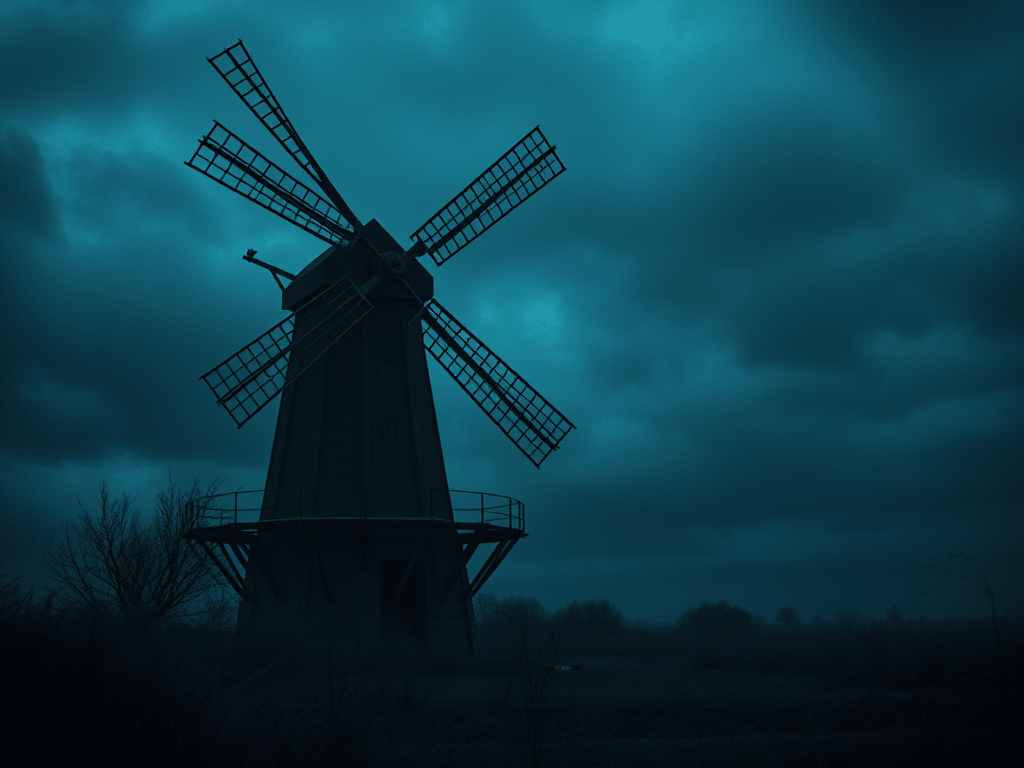
Ghosts and Windmills: Key Points
-
The essay explores the connection between ghosts and windmills, examining how these isolated structures have become associated with supernatural phenomena and how wind’s invisible nature mirrors cultural conceptions of spirits.
-
Windmills possess unique characteristics that make them naturally eerie, including moving shadows, mechanical sounds, and unusual acoustic properties, while their isolation and dangerous working conditions have led to genuine historical tragedies that fuel ghost stories.
-
Famous haunted windmills include the Zaanse Schans mills in the Netherlands with spectral millers and England’s Polegate Windmill associated with a miller’s suicide, demonstrating how individual structures accumulate supernatural narratives.
-
Multiple theories explain windmill hauntings through psychological factors like pareidolia, environmental causes like electromagnetic fields and infrasound, and the hypnotic effects of moving sails on human perception.
-
Cultural symbolism from Don Quixote to Gothic literature has predisposed windmills toward supernatural associations, with modern wind turbines continuing this tradition by generating their folklore and paranormal speculation.
-
The study reveals how humans create meaning through the intersection of natural forces, technology, and cultural narratives, with windmill hauntings serving psychological functions that help communities process history, death, and changing ways of life.

Introduction
How buildings combine with natural forces and supernatural beliefs is an intriguing topic to study when you look at ghosts and windmills together. Windmills have always been in transitional areas of the landscape. They have often been placed alone on hilltops, along the coast, or on empty fields where the wind blows the strongest. For a long time, these remote places have been linked to ghost sightings and other supernatural events. This makes for an interesting link between using wind power mechanically and the spiritual world. With its squeaky wooden frames and rotating sails that move on their own in the dark, the windmill is a great symbol for looking at how the real world of wind energy connects with supernatural beliefs and legends.
In paranormal investigations and ghost stories, wind is special because it is often called the “breath of the unseen world.” Many ghost hunters and paranormal experts say that places they think are haunted have sudden cold drafts or breezes that they can’t explain. They see these changes in the air as signs of a spiritual presence or energy manifesting. The fact that the wind is invisible but has real effects is similar to how people think of ghosts: as intangible forces that can still move things, make noise, and change the physical world. Throughout history, people have linked wind to the soul. For example, the Latin word spiritus means both breath and spirit, and the Japanese idea of kami can show up in natural things like wind. Because of this, wind is a powerful factor in ghost stories. A sudden gust could mean that a ghost is coming or that the dead are whispering in empty rooms.
Historical and Cultural Perspectives on Wind and the Supernatural
There are deep historical roots to the cultural links between wind power and the supernatural. Solari (2019) wrote about the first efforts by humans to use wind power. He drew on many legends and myths from different cultures, such as Chinese, Japanese, and Inuit ones, to explain wind and where it came from. Often, these mythological stories gave wind supernatural powers and saw it as a force linked to spiritual or divine places. Solari’s research also looked at how windmills have changed over time in the Far East and Europe, including the changes in their designs, how they were used, and how they were taxed in the past (Solari, 2019).
Pryke studied the bigger connection between wind, myths, and legends in 2023. He suggested that wind often connected the natural and supernatural worlds without being seen. The author talked about magical beings that were connected to wind in ancient Mesopotamia. The author specifically discussed three wind demons, lillu, lilitu, and ardat lili, who were all associated with strong winds. According to Pryke (2023), windmills have a long history and cultural importance. They were used as early power generators in China, Persia, and medieval Europe. In the Netherlands, they are used for water drainage and community communication.
Windmills are amazing structures that have been used for hundreds of years. Their main purpose is to catch wind energy and turn it into mechanical power that can be used to grind grain, pump water, or make electricity. Traditional windmills have huge towers made of stone or wood that are topped with huge rotating sails or blades that catch the wind. These make unique silhouettes against the sky that have become famous in European settings, especially in places like the Netherlands and Spain. The inside of these buildings is made up of complicated systems of gears, millstones, and wooden shafts that groan and creak all the time while they’re working. The sounds they make can be eerie if you hear them from far away or at night. Millers had to live and work in these buildings, often by themselves, to keep the machines running and make sure the sails were set up to catch the best wind. This created a unique link between people and the structure and the natural forces it captured.
Andrews (2004) gave historical background so that we could see modern wind turbines as the next generation of windmills, which were used to grind food and pump water. In addition, the writer looked into how myths and tales about gods, demons, and other supernatural beings were used to explain natural events like weather patterns in the past (Andrews, 2004). This cultural practice of giving natural forces supernatural power helps us understand how people respond to wind energy infrastructure today.

Hauntings, Architecture, and Psychological Explanations
It’s possible that ghosts and windmills are connected for more than one reason. One reason is that windmills are naturally atmospheric and eerie. Since the sails are always moving, they cast moving shadows on the ground and nearby buildings in patterns that repeat. This can be unsettling to look at, especially at night or during storms. Windmills make mechanical sounds, like the rhythmic whooshing of the sails cutting through the air, the grinding of millstones, and the creaking of old wooden parts. These sounds can easily be mistaken for magical activity. A lot of historical windmills are linked to ghost stories. These stories usually involve millers who died in terrible accidents involving the powerful machinery, and their ghosts are said to still be trapped in the buildings where they worked. Many windmills were built far from towns so they could get clear winds. This meant that the millers and their families often worked alone and in dangerous conditions, which led to both real tragedies and supernatural stories that grew up around these places.
Some windmills around the world have become famous for being haunted, and ghost hunters and people interested in the supernatural go there to see the ghosts. Many people have seen ghostly millers working at the Zaanse Schans windmills in the Netherlands at night, when the mills are empty. They say they saw figures dressed in period clothes moving between the grinding stones and then disappearing into the shadows. In England, the Polegate Windmill in East Sussex has been linked to the ghost of a miller who is said to have hanged himself from the building’s interior beams in the 1800s. Visitors have said they felt watched and that there were strange cold spots near where they think he died. Even though the Old Dutch Mill in Wamego, Kansas, was built in the 20th century as a copy, it has its own ghost stories. Both staff and visitors say they hear footsteps on the wooden stairs and see tools moving on their own in the upper floors, where maintenance work used to be done. These well-known cases show how different windmills get their own unique supernatural reputations. These reputations are based on local history, tragic events, and a buildup of eyewitness accounts that make for gripping ghost stories that last for generations.
Several ideas try to explain why windmills are so common in ghost stories and other supernatural stories, beyond the fact that they look cool. From a psychological point of view, windmills are a place where the strange and the familiar meet. They are like a known human building that becomes strange because it moves on its own and stands alone in the landscape. People who watch windmill sails move all the time may feel hypnotized, which could lead to altered states of awareness or make people more likely to see patterns or figures that aren’t there. Environmental factors also play a part. For example, the electromagnetic fields produced by older windmills, along with the infrasound waves from the rotating sails and vibrating structures, might change how people see and feel things, leading them to experience feelings of unease or presence that they mistake for ghostly encounters. Also, windmills were often used as community landmarks and meeting places in rural areas. They became places where people could talk about local history, sadness, and memories, which is why they are often included in ghost stories and folklore from the area.
Cultural analysis shows that windmills are often linked to the supernatural in writing and art because of where they are placed symbolically. The famous story of Don Quixote tilting at windmills and thinking they were giants made the windmill a sign of delusion and false belief that has been used in Western culture for hundreds of years. In Gothic and Romantic writing, windmills are often the sites of strange encounters and supernatural events. Their stark architecture and mechanical nature contrast with the crazy world of ghosts and spirits while also adding to it. The disappearance of traditional windmills in many countries, which have been replaced by modern wind turbines or left to stand empty, has added to the ghostly associations of these buildings. Ruined or derelict windmills stand as reminders of ways of life that no longer exist, which feeds the supernatural imagination. With their broken sails and falling walls, these abandoned buildings make great scary places in people’s minds because they show how human industry meets natural decay.
Modern investigations into apparently haunted windmills have found some interesting patterns that point to both real, unexplained events and more mundane reasons for reports of ghosts. Researchers who study the paranormal and windmill hauntings have noticed that many stories happen at the same time as certain weather conditions. This is especially true when wind patterns create strange sound effects or when temperature inversions trap sounds and send them in strange directions. Many windmills that are still standing are very old, so they are made of materials and structural parts that naturally make noise and move when they settle, expand, and contract with changes in temperature, or react to wind pressure in ways that modern visitors who aren’t familiar with traditional building methods may find hard to understand. But some inspectors say they have found real strange things happening in windmills, like electronic voices, changes in temperature that don’t match the weather, and strange photos that can’t be explained by normal means. These claims are still debated in both the paranormal study community and the scientific community. Skeptics say that the results could be due to broken equipment, contaminated environments, or confirmation bias.
Spirituality and wind energy are connected in more ways than just windmills. It’s about how people understand nature forces and energies that can’t be seen. Ancient cultures all over the world saw wind as a form of divine or spiritual power. Myths about wind gods, from the Greek Aeolus to the Japanese Fujin, started a long practice of giving air movement consciousness or intention. Today, people who believe in the supernatural often use terms from physics and natural science to talk about spiritual energy. For example, they might say that ghosts are energy patterns or electromagnetic events that interact with the real world. As a machine intended to collect and direct invisible wind energy, the windmill can be used as a metaphor for how forces that can’t be seen can have real effects. This is similar to how ghosts are thought of as invisible beings that can still have an impact on the physical world. This symbolic connection helps explain why windmills keep showing up in ghost stories and other supernatural stories even in places where people no longer use real windmills in their daily lives.
Scientific and Cross-Cultural Dimensions of Wind-Related Phenomena
Another way to understand ghost sightings at windmills is to look at the phenomenon of pareidolia, which is when the brain sees important patterns in random stimuli. The spinning sails cast moving shadows that change constantly, making patterns of light and dark that the human eye may recognize as faces or figures, especially when there isn’t much light or when looking out of the corner of the eye. Depending on the wind speed and state of the structure, windmills make sounds that can range from low-frequency rumbles to high-pitched whistles. The brain can interpret these sounds as speech patterns, which may explain reports of hearing ghostly voices or whispers in windmill locations. Infrasound, which is sound waves below the human hearing barrier, is one of the most intriguing scientific links between wind turbines and supernatural events. Chen and Narins (2012) looked into the connection between the infrasound that wind turbines produce and reports of psychosomatic stress, along with what has been called “wind turbine syndrome” and ghostly events. Their study showed that infrasound exposure is linked to changes in activity in the temporal lobe. This may explain the mental symptoms seen in wind turbine syndrome and the strange experiences people who live near wind farms say they have. The authors talked about a famous “ghost-buster” study that caught continuous infrasound emissions in a place that was said to be haunted. This study found a link between infrasound and apparitions and feelings of presence (Chen & Narins, 2012). These findings show that some supernatural events might have physical causes that have to do with how sound waves affect brain activity.
Also, expecting to see or experience something supernatural at a supposedly haunted place can make people see or feel confusing things as confirmation of their expectations. This is a well-known psychological effect that happens to both casual visitors and dedicated paranormal investigators. These cognitive factors don’t necessarily disprove all paranormal claims about windmills, but they do suggest that a lot of them may have naturalistic answers that have to do with how people think and feel.
Infrasound has effects on the body, but culture and traditional beliefs also affect how people in a community see and react to wind turbines. Kim et al. (2018) looked into how traditional Korean views affect how people in the area think about wind energy infrastructure. The researchers found that the noise and lights from wind turbines made older people remember ghosts or dokkaebi, a Korean folkloric goblin. The experts said that older people in the area turn their dislike of wind turbines into shamanic symbols, even though they know that turbines are machines made by humans. This idea that wind turbines are connected to shamanism is a unique way for people in the area to fight against wind farms that isn’t talked about much in Western discussions about green energy (Kim et al., 2018). This research shows how deeply held traditional views can affect how people today feel about new technology.
Scandinavian myth goes into more detail about the supernatural side of wind-powered buildings. In 2021, Kaplan looked at stories about ghosts interfering with milling. He looked at a story about a windmill owner who asked a local hill-dwelling spirit, or gubbe, if the mill needed to be moved. The study mostly looked at stories about ghosts, like trolls or kvernkall, stopping water mills or scaring the people who worked in them. There are two kinds of stories about supernatural interference, according to Kaplan: those that show the mill as an economic space in the human world and those that show it as a place where humans and wild animals fight (Kaplan, 2021). Through supernatural frameworks, these stories show how communities have dealt with the arrival of new tools in the past.
From an architectural and engineering point of view, windmills have unique structural features that add to their image for having supernatural powers. Most traditional windmills are tall and narrow, which makes a vertical shaft of enclosed space that can act as a resonance chamber, amplifying some sound frequencies and reducing others in ways that can create surprising sound effects. The top of a windmill has to rotate so that the sails are always facing the wind. The cap sits on a bearing mechanism that makes noises as it moves, even when it is well taken care of, giving the idea that something big is moving at the top of the structure. Many windmill towers have spiral staircases that create their own sound effects. These sound effects channel sounds from different levels in confusing ways and make areas where conversations from far away in the building can be clearly heard while close sounds are muffled. Because of the way they are built, windmills really are strange places for sound to travel and behave in strange ways, which explains why some people say they hear voices or strange noises there.
Accidents and deaths that have happened while windmills were in use add a real sadness to the supernatural stories about these structures. The powerful machinery put the millers and their helpers in great danger. People were caught in gears, hit by moving sails, or fell from dangerous heights while repairs or changes were being made, according to historical records. These tragedies at work and the fact that windmill work is often done alone meant that help was often far away when accidents happened, which led to deaths that could have been avoided in places with more people. Real people died in these buildings, and they often died in very violent or sudden ways. Knowing this gives ghost stories a psychological basis that makes them more powerful than stories that are just made up. The historical aspect of windmill hauntings makes them different from ghost stories about purpose-built entertainment venues or modern buildings. It connects them to real human pain and loss in ways that feel more real to people who believe in the supernatural.
Modern progress in wind energy has made it possible to look at the connection between wind power and spiritual beliefs in new ways. This is because more and more modern wind turbines are being installed around the world. These sleek, industrial structures look and work very differently from traditional windmills. They have also started to get their own myths and supernatural connections, with some communities reporting strange things happening in areas with big wind farms. There have been reports of strange lights and sounds, as well as health problems and confusion that some people think are caused by supernatural forces instead of the turbines themselves. The debate over wind farms has made it easy for people to think about supernatural things and for scientists to study how large-scale wind energy infrastructure affects people and the environment. This new aspect of the link between the wind and ghosts shows how supernatural belief can change to new technologies while still keeping with themes from older supernatural stories about windmills.
Conclusion
In the end, studying ghosts and windmills shows us a lot about how people make sense of the world by combining natural forces, technological systems, and cultural stories. Windmills are reminders of how people have long tried to use natural power that they couldn’t see. Similarly, ghost stories show how people have tried to make sense of death, memory, and the lines between material and spiritual life. Even after hundreds of years of scientific progress, the wind is still not fully understood or managed. It is still mysterious enough to serve as a link between the natural and supernatural worldviews. Whether windmill hauntings are real paranormal events, misunderstandings of natural and mechanical processes, or just cultural inventions, they show how people can find meaning and mystery in the daily world. There are still ghost stories about windmills even though the buildings themselves are now historical landmarks. This suggests that these stories serve important psychological and cultural purposes, aiding communities in making sense of the past, expressing their worries, and staying connected to landscapes and ways of life that shape identity even after major changes in material circumstances.
References
Andrews, T. (2004). Wonders of the Air. Bloomsbury Publishing USA.
Chen, H. H. A., & Narins, P. (2012). Wind turbines and ghost stories: the effects of infrasound on the human auditory system. Acoustics Today, 8, 51-56.
Kaplan, M. (2021). Trolls in the mill: The supernatural stakes of waterpower. In Myth, magic, and memory in early Scandinavian narrative culture: Studies in honour of Stephen A. Mitchell (pp. 129-143). Brepols.
Kim, E. S., Chung, J. B., & Seo, Y. (2018). Korean traditional beliefs and renewable energy transitions: Pungsu, shamanism, and the local perception of wind turbines. Energy Research & Social Science, 46, 262-273.
Pryke, L. M. (2023). Wind: Nature and culture. Reaktion Books.
Solari, G. (2019). The wind in antiquity. In Wind science and engineering: Origins, developments, fundamentals and advancements (pp. 7-84). Springer International Publishing.

Leave a Reply