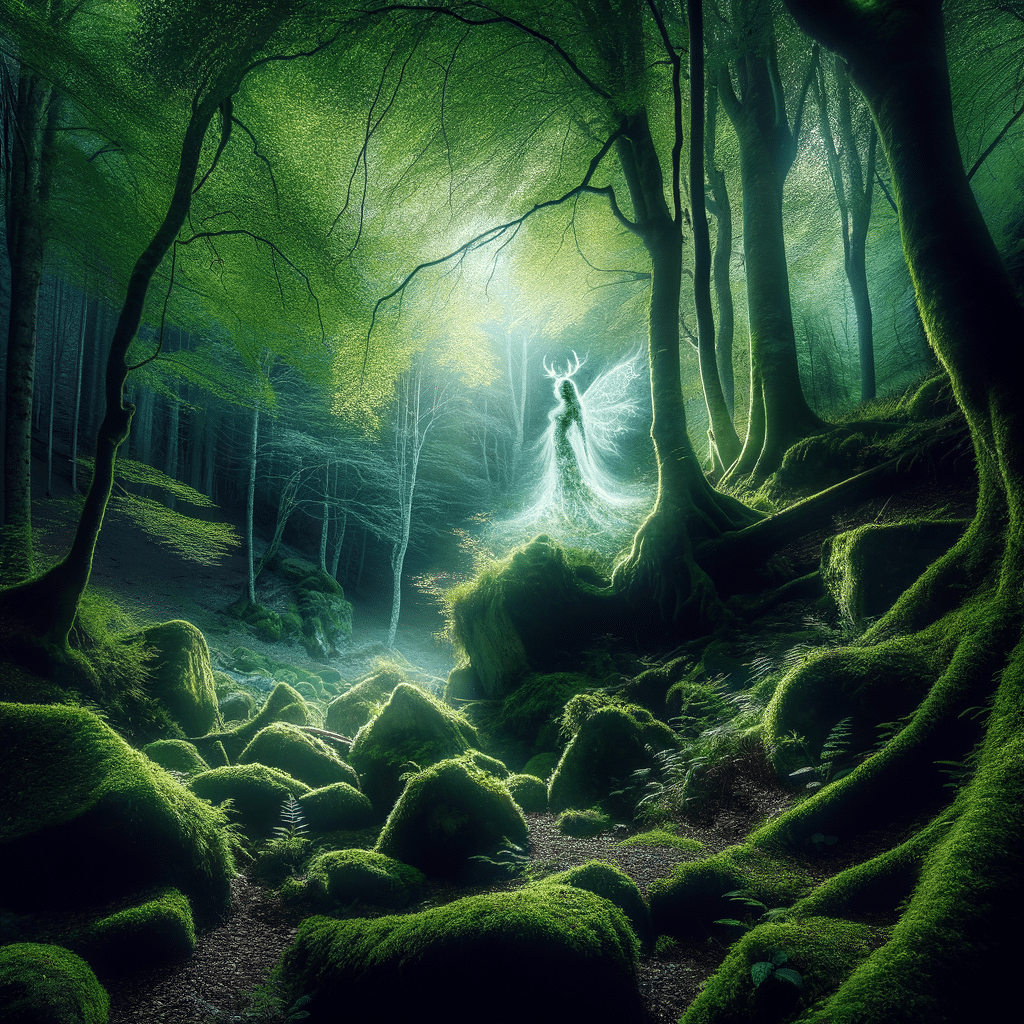
Since our oldest ancestors first went into the woods, forest spirits have captured people’s attention. These enigmatic beings, which appear in mythologies and folklore all around the world, symbolize the complicated relationship that humans have with woods and other natural areas. Our attempt to comprehend and humanize the enigmatic and frequently hazardous wooded settings that encircled historic settlements gave rise to the idea of forest ghosts.

Description
Although some aspects of woodland spirits’ physical characteristics are constant across civilizations, others differ significantly. Many are portrayed as tall, ethereal creatures that fit in perfectly with their surroundings because their bodies are made of bark, leaves, or shifting shadows. They are portrayed in some cultures as small beings, such as the Japanese kodama or European fairies, but in others they are described as enormous beings that dwarf the highest trees. Their shapes frequently change with the seasons, mirroring the shifting forest in which they live (Varner, 2006).
Forest spirits can act in a variety of ways, from helpful protectorship to cunning manipulation. According to the majority of mythology, they are extremely protective of their woodland territories, rewarding those who treat the forest with the appropriate care and punishing those who violate it. These spirits frequently provide direction to lost travelers, bless hunters who only take what they need, and guarantee that the forest’s natural cycles are maintained. They can, however, also mislead travelers, result in unexplained disappearances, and drive intruders insane with spectral illusions and murmurs.
Human interactions with wooded ecosystems have changed over time, and this is reflected in the development of forest spirit mythology. According to ancient animistic beliefs, forests were living beings with numerous spirits dwelling within them, with each tree and grove having its own consciousness. Forest spirits were increasingly isolated from people as agricultural cultures evolved, frequently depicted as enigmatic others that lived in the dwindling wild areas. These spirits grew to symbolize environmental issues and a desire for a closer relationship with nature as industrialization progressed.

Across Cultures
The Green Man of European legend, whose green face adorns numerous medieval cathedrals and contemporary gardens, is one of the most well-known woodland spirits (Curran, 2007). Numerous artistic creations have been influenced by the Greek dryads, lovely nymph-like spirits tethered to individual trees. Russian legends describe the terrifying Leshi, king of all woodland monsters, while Japanese mythology describes kodama, the tree ghosts that reverberate throughout the forest.
Despite having unique cultural traits that represent their origins, forest spirits from many mythologies have things in common. Despite coming from very different cultural backgrounds, Germanic wood-wives, Greek dryads, and Japanese kodama all have a basic affinity for particular trees or forest regions, but their interactions with people and behaviors vary greatly. There is a lot of cultural interpretation involved (Wright, 2005).
In Germanic folklore, moss-people (Moosleute) and wood-wives (Holzfrauen) are usually depicted as reasonably humanoid creatures that may approach humans for assistance with birthing or domestic chores in exchange for useful forest knowledge. This stands in stark contrast to Japanese kodama, which are frequently portrayed as ethereal or changing beings who mainly appear as forest echoes, though they can also occasionally take the shape of tiny, glowing orbs or spirits that resemble trees.
Forest spirits are portrayed in Celtic and Norse mythology as both protectors and possible dangers. In addition to their beauty and strength, the Norse Hulder-folk and Celtic Sidhe (technically faeries) are notorious for their erratic behavior and capacity to ensnare humans in their domain. The Leshi and other Slavic forest spirits, on the other hand, adopt more outwardly menacing traits. They purposefully deceive tourists and enforce rigid forest etiquette by posing as shapeshifters that can grow as large as trees or shrink to the height of grass (Kuusela, 2020).
A more intricate spiritual order is frequently embodied by Southeast Asian woodland spirits. According to Thai and Malaysian legend, certain tree spirits, such as the Nang Mai, live in particular species and must be placated before trees can be felled. Unlike their more secular European equivalents, these spirits are included in official religious beliefs and practices.
The ancestral bond between spirits and the community is frequently emphasized in African forest spirit religions. Many African societies see forest spirits as representations of ancestor spirits that continue to watch over and mentor their offspring, rather than as distinct beings. This contrasts with Native American perceptions, which frequently view forest spirits as autonomous entities that preserve the harmony of nature and ought to be honored as equal co-partners in the natural world.
The distinction between evil and protective spirits is often muddled by Latin American woodland spirits. For example, the Brazilian Curupira is renowned for its ability to mislead tourists with its backward-facing feet while simultaneously protecting forest animals and punishing wasteful hunters. The more distinct functions of spirits in other religions, where entities are frequently classified as either beneficial or detrimental, contrast with this moral ambiguity.
Modern Impact
These many traditions’ modern interpretations have started to converge and change, giving rise to fresh, cross-cultural hybrid conceptions of forest spirits. Even though every mythology retains its own distinctive features, environmental concerns around the world have made forest spirits—regardless of their cultural origins—more and more important as guardians of the natural world. These mythological differences and similarities show how various cultural perspectives have led to varied interpretations of the same natural facts. Whether they transform into shape-shifting tricksters, ethereal dryads, or ancestral protectors, forest spirits represent both culturally particular perspectives on how humans relate to nature and universal human experiences with wooded settings.
Forest spirits have been welcomed and reimagined for contemporary audiences via popular culture. While movies like Pan’s Labyrinth reinterpreted old woodland creatures for modern audiences, Studio Ghibli’s Princess Mononoke introduced kodama and other forest spirits to a worldwide audience. Our contemporary concerns about environmental degradation and our alienation from nature are reflected in the frequent portrayal of forest spirits in video games, literature, and television as either environmental protectors or frightening supernatural powers.
Beliefs about forest spirits have been profoundly transformed and rejuvenated by contemporary environmental movements. They have turned them from strictly mythological beings into potent emblems of environmental care. To address current ecological issues and motivate environmental action, these traditional ideas have been reframed (de Pater, 2024).
The mythology of forest spirits has been used more and more by environmental campaigners to craft gripping arguments for the preservation of forests. The idea of spirits as protectors of the natural world has been modified to symbolize threatened ecosystems, and forest destruction is now seen as both ecological harm and a kind of spiritual aggression. In areas like sections of South America and Southeast Asia where traditional beliefs are still prevalent, this approach has shown especially good results.
The integration of contemporary conservation efforts with traditional spiritual beliefs has been greatly aided by indigenous environmental movements. Since environmental protection and cultural and spiritual preservation are inextricably linked, many indigenous communities have successfully leveraged their cultural ties to forest spirits to safeguard their territories from development and deforestation. In discussions of international environmental policy, this strategy is becoming more and more well-known.
Through an ecological perspective, forest spirit traditions have been resurrected and reinterpreted by neo-pagan and contemporary spiritual movements. These communities frequently create new rituals and practices that highlight the duty of humans to preserve natural areas by fusing old mythology with contemporary environmental science. Their interpretations frequently center on how ecosystems are interrelated, reflecting both ecological knowledge and spiritual beliefs.
Through games, books, and movies that portray forest spirits as defenders of the environment, popular media has strengthened these ties. The idea that woods are hallowed places that need to be protected has become more widely accepted thanks to films like Avatar, which has a spiritual link to nature, and Princess Mononoke, which has overt environmental messages. Environmental degradation is frequently framed in these narratives as a confrontation between material and spiritual values.
Contemporary views of woodland spirits have also been impacted by the growth of ecotourism. In an effort to use old mythology to encourage forest conservation and provide financial incentives for preservation, several communities have started to highlight their traditional spiritual beliefs as part of sustainable tourism programs. This has resulted in an intriguing combination of business, religious, and ecological interests.
There are unexpected similarities between traditional beliefs about forest spirits and the modern knowledge of forests as intricate, interrelated ecosystems. Some have compared the discovery of mycorrhizal networks—often referred to as the Wood Wide Web—that link trees in forest ecosystems to traditional beliefs about forest spirits as interconnected beings that preserve woodland harmony. The blending of spiritual and scientific viewpoints has produced fresh approaches to comprehending and promoting the preservation of forests.
Conclusion
These contemporary environmental interpretations of forest spirits mark a substantial shift from their historical functions. They have evolved into potent symbols in the current environmental discourse, bridging cultural, spiritual, and scientific approaches to forest protection while retaining ties to old beliefs. This change illustrates how conventional spiritual ideas can remain culturally significant while adjusting to contemporary issues.
The persistent allure of forest spirits in human awareness reflects our innate bond with wooded settings and our understanding of their critical significance. In our cultural imagination, these beings keep changing to accommodate fresh issues and viewpoints while preserving their crucial function as go-betweens for people and the natural world. Forest spirits continue to be potent representations of our duty to save and conserve the untamed areas that gave rise to them, even in the face of growing environmental challenges.
References
Curran, B. (2007). Walking with the Green man: Father of the Forest, Spirit of Nature. Red Wheel/Weiser.
de Pater, C. (2024). Spirit in the woods: The grounding of spiritual values in forest management (Doctoral dissertation, Wageningen University).
Kuusela, T. (2020). Spirited away by the female forest spirit in Swedish folk belief. Folklore, 131(2), 159-179.
Varner, G. R. (2006). The mythic forest, the green man and the spirit of nature: the re-emergence of the spirit of nature from ancient times into modern society. Algora Publishing.
Wright, L. (2005). Forest spirits, giant insects and world trees: The nature vision of Hayao Miyazaki. The Journal of Religion and Popular Culture, 10(1), 3-3.

Leave a Reply