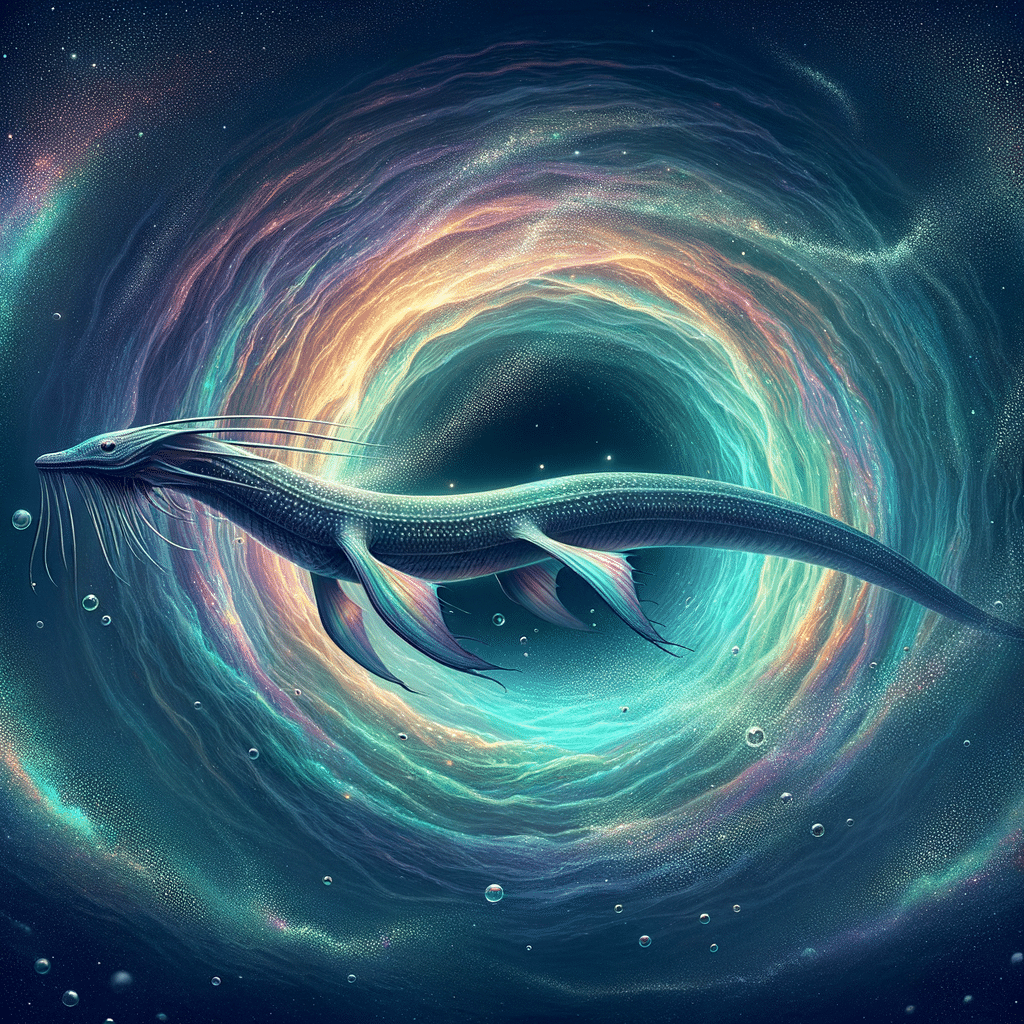
The Loch Ness Monster tale has captivated generations, but could the real Nessie be even more remarkable than previously believed? There are intriguing scientific and cultural ramifications if this mysterious creature turns out to be a time-traveling dinosaur. The irregularity of Nessie sightings and the creature’s seeming capacity to come and go at will could be explained by this unusual notion.

Nessie and Time Travel
People typically describe Nessie as a giant aquatic animal with a small head, long neck, and several humps that protrude above the water’s surface. These characteristics are quite similar to those of ancient sea reptiles, especially the Mesozoic-era plesiosaur family. Witnesses frequently describe a dark-hued creature that is between 20 and 40 feet long and can move quickly across Loch Ness’s waters (Bauer, 2002).
The idea of time travel implies the potential for movement between various points in time and has evolved from pure science fiction into genuine theoretical physics. According to Einstein’s theory of relativity, time is relative rather than absolute, and time travel may be possible due to the existence of wormholes, which are hypothetical passageways through space-time. A number of time travel technologies, such as rotating cylinders of dense matter and cosmic strings, are proposed by modern physics (Arntzenius & Maudlin, 2002).
Nessie’s association with time travel may help explain some of the phenomenon’s perplexing features. The creature’s apparent ability to elude contemporary detection techniques may be the result of its multi-temporal existence. Since the sightings may be of the same creature visiting at different times, this would explain why no breeding population has ever been found in Loch Ness. There may be naturally occurring temporal anomalies in the enigmatic Loch Ness underwater caverns.
Ancient Scottish traditions describe enigmatic whirlpools and unexplained disturbances in the depths of Loch Ness, which contemporary theorists have reinterpreted as possible temporal gates. Glacier movements during the last ice age formed deep trenches and underwater cave systems, resulting in the distinctive geological formation of the loch (Murray & Pullar, 1908). The existence of quantum tunnels or gravitational anomalies has been hypothesized as a result of these natural phenomena.
According to some theories, the loch’s remarkable depth—it can be over 750 feet in certain places—may be home to naturally occurring quantum fluctuations. The loch’s location along geological fault lines and its variations could potentially create conditions similar to those hypothesized for Einstein-Rosen bridges, also known as wormholes. These theories are supported by periodic magnetic abnormalities that have been observed in specific loch locations.
Some experts have interpreted the odd sonar readings and observed visual distortions in certain areas of Loch Ness as possible proof of temporal abnormalities. Some witnesses have reported brief visual distortions that resemble heat mirages but happen in cold seas, while others have reported seeing what appears to be water flowing upward or backward in enclosed columns. According to local legend, these occurrences are referred to as the dragon’s breath.
Ancient Celtic manuscripts mention sacred areas around Loch Ness, where people believed time flowed differently, and accounts exist of people entering caves near the water and emerging years later without aging. Combining these myths with contemporary theoretical physics raises the prospect that the loch could act as a natural meeting point for temporal energy. The consistent pattern of Nessie sightings that correlates with particular astronomical alignments is cited by some proponents of the idea.
The unique electromagnetic readings detected in certain parts of the loch have attracted attention from fringe scientists who study theoretical temporal mechanics. They propose that the depth of the loch, the mineral makeup of the nearby rock, and the steady pressure of the water mass might all combine to produce circumstances that, in theory, could weaken the boundaries between various eras. Though extremely speculative, the concept of naturally occurring time portals offers an intriguing explanation for why Nessie sightings are temporary.
This portal idea could help explain why huge masses that come and disappear for no apparent reason frequently yield inconsistent results from extended sonar sweeps of the loch. In order to explain both its apparent ability to avoid detection and the absence of evidence for a sustained population, the idea proposes that Nessie may not live permanently in the loch but rather travel between time eras using these temporal gateways (Redfern, 2016).
If such portals are real, they probably function on unknowable principles and are erratic and unstable. This may help to explain why Nessie sightings seem to concentrate at particular times and places, which may coincide with moments when these hypothetical gates are momentarily open. These temporal anomalies may be naturally stabilized by the deep trenches and underwater cave systems, which would provide comparatively regular entry and departure sites.
The portal theory, which combines the ancient mythology of Loch Ness with state-of-the-art physics ideas, suggests that our ancestors may have witnessed real temporal events without realizing their scientific nature. Even while this is still very much speculative, it provides a creative framework for comprehending one of the most persistent cryptozoological puzzles in the world.

Skepticism
The scientific community and skeptics strongly refute both the idea of large-scale time travel and the existence of the Loch Ness Monster. Natural occurrences such as big fish, drifting logs, or waves can account for the majority of reported Nessie sightings. Because there aren’t enough food supplies or enough depth for a breeding population of giant marine animals to stay hidden, the loch’s ecosystem just can’t sustain a massive prehistoric monster or community (Siegel, 2024).
Physics presents numerous challenges for time travel on the scale required for a dinosaur’s transit. The paradoxes that would result from such travel would defy basic rules of causality, and the energy requirements would be enormous. Furthermore, if there was a time-traveling dinosaur in Loch Ness, it would have been proven by now thanks to advanced sonar technology and satellite imagery.
Many times, researchers have disproved Nessie-related photos and videos, exposed them as hoaxes, or proved them to be misidentified natural occurrences. The well-known Surgeon’s Photograph from 1934, long regarded as the most convincing proof of Nessie’s existence, eventually turned out to be a hoax, featuring a miniature submarine with a model head and neck attached. Despite the lack of scientific proof, the monster tale provides an economic motive for keeping the mystery alive because it greatly benefits the tourism sector surrounding Loch Ness.
Routine scientific studies of Loch Ness, including thorough sonar mapping and environmental DNA testing, have not discovered any signs of ancient animals or odd temporal occurrences. This research has documented the actual wildlife of the loch, primarily composed of common fish species and various invertebrates. The lack of any tangible proof, fossils, or remnants adds credence to the skepticism regarding the creature’s existence and its putative ability to travel through time.
The Nessie legend’s enduring popularity, particularly when paired with complex notions like time travel, shows how powerful stories may trump scientific facts in the minds of the general public. Skeptics contend that, despite contradictory data, people frequently create and maintain such myths because of their pattern-seeking tendencies and desire to believe in the remarkable.
Popular culture has embraced the concept of dinosaurs in the modern world, from “Jurassic Park” to other science fiction works. Numerous novels, TV series, and motion pictures have popularized the idea of a time-traveling Nessie. Everything from serious scientific debates concerning the nature of time and space to children’s cartoons has been impacted by this view of the Loch Ness Monster (Jylkka, 2018).
Conclusion
Even if the notion that Nessie is a time-traveling dinosaur might seem improbable, it illustrates an intriguing nexus between popular culture, physics, and cryptozoology. This concept presents a unique perspective on one of the world’s most renowned cryptids, connecting the realms of ancient history and modern enigma. Whether or not this explanation turns out to be accurate, it still stimulates artistic creations and scientific discussion, proving the timeless allure of the Loch Ness Monster and the potential of time travel.
References
Arntzenius, F., & Maudlin, T. (2002). Time travel and modern physics. Royal Institute of Philosophy Supplements, 50, 169-200.
Bauer, H. H. (2002). The case for the Loch Ness monster: the scientific evidence. Journal of Scientific Exploration, 16(2), 225-246.
Jylkka, K. (2018). “Witness the Plesiosaurus”: Geological Traces and the Loch Ness Monster Narrative. Configurations, 26(2), 207-234.
Murray, J., & Pullar, L. (1908). Bathymetrical survey of the fresh‐water lochs of scotland: Part XIII.—Lochs of the Ness Basin. Scottish Geographical Magazine, 24(6), 291-310.
Redfern, N. (2016). Nessie: Exploring the Supernatural Origins of the Loch Ness Monster. Llewellyn Worldwide.
Siegel, R. (2024). Loch Ness Uncovered: Media, Misinformation, and the Greatest Monster Hoax of All Time. Astra Publishing House.



Leave a Reply