
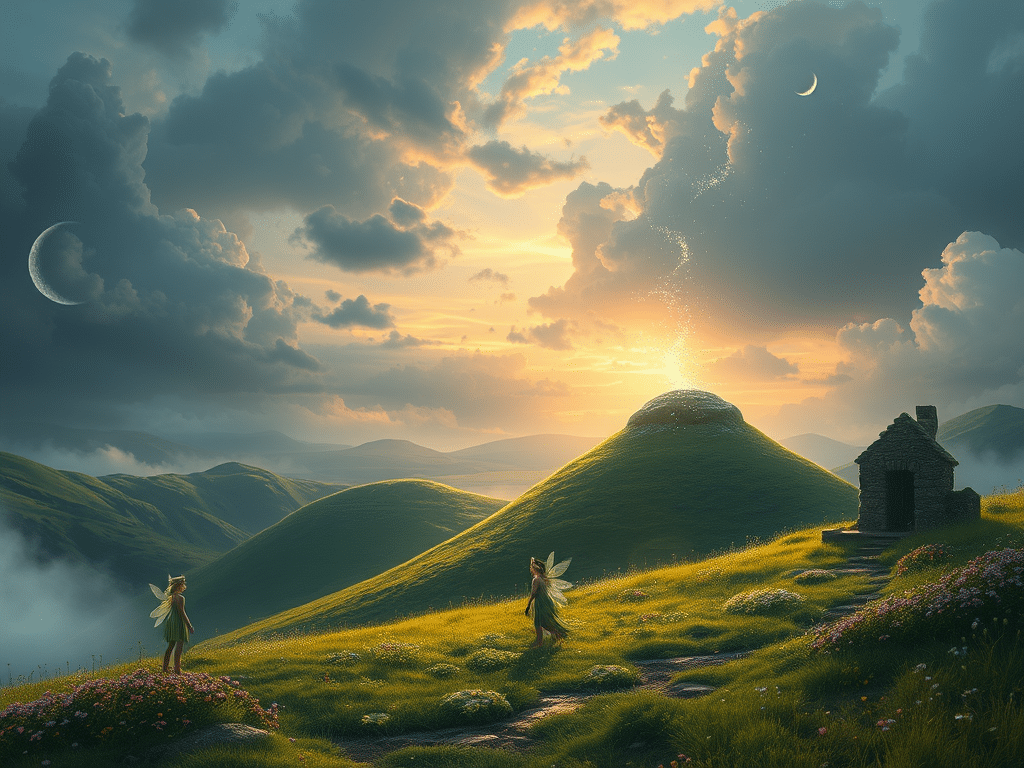
From the depths of Celtic legend, spriggans show up as mysterious woodland creatures that have enthralled people for millennia. Usually connected with Cornwall in southwest England, these supernatural entities protect historic sites and natural environments. Though less well-known than some of their mythological counterparts, spriggans occupy a unique place in folkloric history by combining elements of nature spirits with more sinister impulses. Their continued presence in tales handed down over the years reflects mankind’s complicated relationship with the natural environment and the enigmatic forces thought to occupy far-off wilderness locations.

Overview
Those unfortunate enough to come across spriggans will find their physical appearance especially unique, marked by a hideous and disturbing face that causes terror. Traditionally shown as wizened, gnarled animals like old men, spriggans have excessively big heads covered with wild, untidy hair that mimics twisted roots or branches. Their skin seems to be rough and bark-like, giving one an image of people created from the actual forest itself. Their alleged ability to swell from small size to gigantic proportions at will, transforming from tiny sprites barely taller than a mushroom to towering figures looming ominously among the treetops, is perhaps their most amazing physical attribute. It makes them particularly terrifying defenders of their territory (Miller, 2012).
With many terrible crimes ascribed to these woodland spirits, spriggans have gained a particularly nasty reputation inside Celtic mythology. Renowned for their spiteful nature, they frequently hurt those who violate their turf or fail to show the old sites they protect appropriate respect. Unlike some of their more kind fairy relatives, spriggans have a particularly sinister inclination and clearly enjoy bringing agony and disaster. Their deeds rank them among the more hated creatures in the pantheon of Celtic supernatural entities, ranging from somewhat disruptive shenanigans to actually dangerous activities (Alexander, 2014).
Spriggan Crimes
In traditional belief, child-stealing is maybe the most hated evil connected to spriggans. Under cover of darkness, these monsters were thought to sneak into human houses to kidnap human children, leaving behind their own misshapen offspring—called changelings—in the place of the abducted child. Families were much disturbed by these changeling youngsters, who usually seemed sickly, ill-tempered, and strangely smart above their years. While some claimed spriggans aspired to reinforce their lineages with human vigor, others suggested they just reveled in the suffering this practice caused to human parents. The driving force for such kidnappings varied across various stories. Occasionally, when people suspected actual children with impairments or strange behavior of being fairy substitutes, their sincere historical anxiety led to tragic outcomes (Young, 2013).
Another hated talent in the spriggan’s toolkit of evil is weather control. These entities are commonly blamed for creating terrible storms, especially during harvest season, when such weather could wipe out the food supply for a whole town. Stories tell of spriggans assembling in circles to carry out magical ceremonies meant to call on howling winds, dousing rain, and sometimes catastrophic lightning. Their control over fog and mist had two purposes: it damaged crops with too much moisture, but it also made visitors hopelessly confused in familiar surroundings, occasionally sending them into deadly bogs or over cliff edges. Farmers and sailors especially hated the weather-working ability of spriggans, as their livelihoods and lives relied on favorable conditions that these vengeful spirits could supposedly disturb at their whim (Patterson, 2008).
Agricultural sabotage occupies a prominent position in the inventory of spriggan depravity, mirroring the agrarian communities that inspired these stories. These animals were routinely blamed for milk that would sour without explanation, for blights that would suddenly show up in once-healthy fields, and for cattle that would die or become sick even under appropriate treatment. Some stories have spriggans inhaling toxic air over farms or touching healthy plants with their gnarled fingers to produce instantaneous withering. Their supposed “blasting” of cattle, which causes animals to produce blood instead of milk or to become barren, really terrified me. These agricultural strikes directly impact the survival of rural populations, prompting spriggans to offer simple explanations for the various unpredictable events that could impact farmers in pre-industrial cultures.
The protection of treasure symbolizes a more vague evil since spriggans were said to preserve old hoards buried among the several prehistoric sites of Cornwall and other Celtic areas. Although protection itself seems like a good thing, their techniques were merciless. Stories abound of treasure-seekers struck dead on the spot, afflicted with wasting diseases, or driven crazy after upsetting spriggan-guarded wealth. According to some stories, spriggans would let a treasure hunter view wonderful wealth before turning it into useless leaves, bones, or stones once taken from the spot. Often connected with ancient kings or fairy nobility, the riches they guarded suggested the spriggans were enforcers for more potent supernatural beings. Their disproportionate punishment of human inquiry exposed a basic lack of compassion and a relish in cruel revenge.
Folklore from various countries frequently reports a type of spriggan malice that misleads travelers. Said to be manifesting as flickering lights akin to will-o’-the-wisps, these creatures were supposed to call tired visitors toward what seemed to be friendly cottage lights, only to vanish once the person had been guided far into dangerous territory. Spriggans were supposed to be able to construct complex illusions of paths that didn’t exist or to hide real trails, hence guiding confused wanderers endlessly across progressively hostile terrain. Their deliberate lying often targeted anyone going alone at twilight or after dark, especially those who had neglected to bring protective charms or follow conventional wisdom against fairy meddling. Beyond a simple delight in human pain, this action seems to have no clear goal, which emphasizes the basically evil character assigned to spriggans in traditional belief.
Another sort of spriggan evil recorded over millennia of legend is the stealing and damage of human goods. Unlike domestic brownies or useful household spirits, spriggans came into human homes just to inflict damage. They allegedly broke priceless instruments, made wool ready for spinning, degraded food supplies, and pilfered minor but vital items from homes already impoverished. Stories of spriggans either immediately grabbing bread from children’s hands or contaminating water supplies with dirt or animal excrement are particularly unnerving. Even though these small crimes may not seem like big problems compared to their bigger bad deeds, their repeated acts of sabotage cause real pain for families who don’t have much room for more bad luck. This shows that spriggan behavior was based on cruelty on purpose in ancient beliefs.

Impact
Over millennia of oral history and societal change, spriggan mythology shows a wonderful evolution. Early records from medieval Cornwall show spriggans mostly as protectors of hidden riches and historical sites, especially the many megalithic structures strewn over the Cornish countryside. Like many folklore groups, these nature spirits gained more explicitly negative meanings as Christianity grew throughout the British Isles, progressively considered demons or fallen angels rather than vague natural forces. Though they remained fundamentally wild and possibly dangerous, spriggans had been partially domesticated in literary works by the Victorian era when folklore collecting evolved into a scholarly endeavor. Modern readings of spriggans in popular culture, fantasy fiction, and gaming have further changed them—sometimes reinterpreted as more sympathetic figures reflecting threatened wild areas and ancient knowledge (Sugg, 2018).
Spriggans’ relationship to the larger fairy realm sets them in a convoluted magical hierarchy. Unlike the more sympathetic and attractive fairies of Victorian interpretations, spriggans reflect an older, darker strain of fairy mythology derived from actual folk belief and terror. They have traits in common with other forest creatures, including the green man, wild men of the woods, and several tree spirits recorded in European cultures. In other stories, where spriggans serve as soldiers or guards for fairy royalty while occupying a lower social level, their relationship appears to be somewhat hostile. Their connection to burial mounds and historic sites makes them linked to ancestral spirits and the dead. This gives them a liminal quality that goes beyond simple classification and shows how complicated pre-Christian beliefs were.
The spatial concentration of spriggan lore in Cornwall offers intriguing analysis of regional cultural identity and resistance. Cornwall’s peculiar fairy beings, like spriggans, can be understood as expressions of cultural memory and local individuality, as it kept its language and customs longer than many areas of Britain. Breton folklore features similar entities that reflect the common Celtic legacy of two areas split by the English Channel. With its wild moors, craggy beaches, and many prehistoric sites, Cornwall’s hostile terrain provided the perfect setting for legends of mysterious guardians emerging from the earth. As mining grew vital to Cornish economics and culture, spriggans—who represent how folklore changes to fit new social circumstances—became linked with underground worlds and the hazards miners encounter.
Modern interest in spriggans has exploded with the larger rebirth of ecological consciousness and folklore studies. Occasionally, modern pagans’ and nature spirituality movements include spriggans—representatives of wild, wild nature needing respect and protection. Although their origins and abilities are often creatively reimagined, fantasy literature, movies, and games routinely contain spriggans or spriggan-inspired entities. These contemporary readings often highlight the ecological guardian quality of spriggans, therefore placing them as defenders of threatened wilderness against human invasion. This change shows how old mythological figures could be recontextualized to solve modern problems, reflecting shifting societal views about the natural world and mounting environmental problems.
Conclusion
Spriggans represent the human inclination toward always filling the wild wilderness with creatures that mirror our complicated interaction with the surroundings. From their beginnings in ancient Celtic belief to their role in modern fiction, these odd, twisted beings have changed while keeping their core essence as erratic forces demanding respect. Spriggans still enthrall our imagination as boundary characters between the civilized and wild, seen and invisible, reminding us of the wonder that endures in neglected areas of the terrain. Perhaps the timeless appeal of spriggans in an increasingly sophisticated world resides in their portrayal of wild nature and ancient knowledge—qualities that become more valuable as they become ever less common in our modern reality.
References
Alexander, S. (2014). Fairies: The Myths, Legends, & Lore. Simon and Schuster.
Miller, D. (2012). Supernatural Beings and’Song and Dance’: Celtic and Slavic Exemplars.
Patterson, L. (2008). Drinking from the Fairy’s Thimble. Fourth Genre: Explorations in Nonfiction, 10(2), 31-37.
Sugg, R. (2018). Fairies: A dangerous history. Reaktion Books.
Young, S. (2013). Five Notes on Nineteenth-Century Cornish Changelings. Journal of the Royal Institution of Cornwall, 2013, 51-79,
Leave a Reply