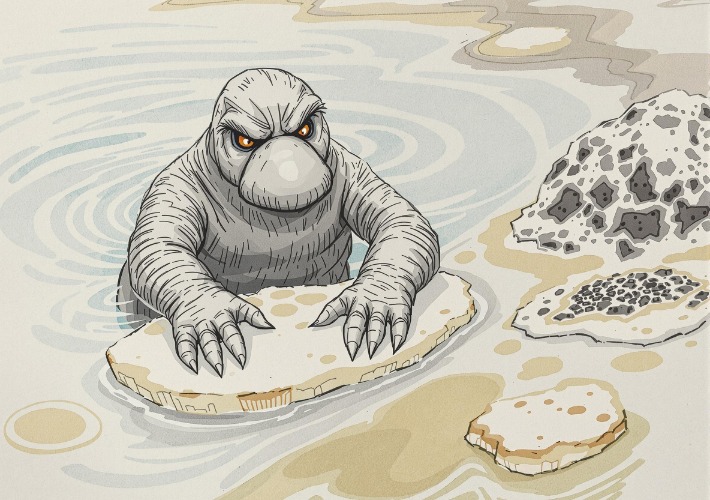
Stories continue of a strange being in the calm waters of Lough Dubh, tucked inside Ireland’s green terrain, one of Ireland’s most intriguing cryptozoological enigmas that defies normal explanation. Known as the Lough Dubh Monster, this odd creature became especially famous after a spectacular encounter in the early 1960s drew worldwide notice to this otherwise calm fishing lake in the Upper Shannon River Drainage. Unlike its more serpentine relatives in other lakes across the globe, the Lough Dubh creature has been described with clearly porcine and rhinoceros-like traits that have baffled naturalists and cryptozoologists for decades. The tale of this odd water beast provides an intriguing look at how eyewitness testimonies, local tradition, and scientific theory interact in the evolution of cryptid beliefs.

Overviews
When schoolmaster Alphonsus Mullaney and his son had an exceptional experience while fishing on the lake, the early 1960s saw the most well-known run-in with the Lough Dubh Monster. Their story says they unintentionally caught something huge that struggled violently against their line, finally exposing itself as a beast roughly the size of a cow or an ass. Claiming the creature was “dark grey in color and covered with bristles or short hair, like a pig,” Mullaney offered a thorough description that sharply contrasted with usual lake monster accounts, saying the creature had “short, thick legs with small ears and a white, pointed horn on the snout.” The Lough Dubh Monster, one of Ireland’s most uniquely described cryptids, has sparked significant discussion over its likely identification because of this odd mix of traits, which at once recalls a wild boar, rhinoceros, and hippopotamus (Newton, 2016).
The spectacular encounter did not finish with a casual glimpse; the creature allegedly battled so vigorously that it eventually broke the fishing line and retreated into the depths of Lough Dubh. Determined to confirm their exceptional encounter, the Mullaneys later went back to the region with a band of armed men to look for the animal, but they discovered no more proof of its presence despite their attempts. This trend, common in cryptid stories everywhere, has fueled both the ongoing enigma and doubt surrounding the Lough Dubh Monster, where a single spectacular encounter is followed by the impossibility of getting physical proof.
The 1960s event was not unique; reports indicate the monster had been spotted in Lough Dubh on prior occasions, with some sources claiming it was last sighted in 1961 alongside two smaller creatures, implying a possible family group. Even more fascinating is the possibility of a larger population of these odd critters spread over Ireland’s many waterways since identical creatures had allegedly been seen in other Irish lakes as early as 1912. These historical narratives imply that whatever the Mullaneys witnessed might be an uncommon but ongoing species rather than a one-time oddity or misidentification, therefore adding chronological complexity to the mythology (Costello, 1974).

Impact
When published in Peter Costello’s popular 1974 book In Search of Lake Monsters, which brought the Irish cryptid into discussion with better-known lake monsters from all across the world, the Lough Dubh Monster drew more attention. Acknowledging the challenge in classifying it among recognized cryptid kinds, cryptozoologist Karl Shuker has labeled the creature an “ultra-mysterious beast” owing to its strange stated characteristics. The Mullaneys’ story describes a creature that resembles a terrestrial mammal that went into the water, unlike the serpentine or plesiosaur-like descriptions common to many lake monsters, making it difficult for those who study unknown animals to classify.
Various explanations have surfaced to account for the Mullaney encounter; biologist Dale A. Drinnon offers what many believe to be the most likely cause: that the “monster” was really a gigantic wild boar that had waded into the lake, maybe drawn by the smell of fishing bait. This explanation covers several facets of the description, particularly the bristly hair, pig-like look, and violent reaction when hooked (Newton, 2016). Described by Mullaney, the “white pointed horn” could have been a noticeable tusk rather than a genuine horn; ivory tusks could seem horn-like to shocked onlookers, particularly under difficult circumstances on a lake.
Though the occurrence seems unlikely in an Irish lake, some have suggested the animal could have been a hippopotamus; other proposed explanations have varied from exotic escapees from private collections to misidentified native fauna. Some cryptozoologists have observed that the description resembles accounts of “water pigs” from areas of the American Midwest, where wild hogs are known to frequent rivers for wallowing and cooling. The contrast is enlightening since wild pigs are known to be able swimmers that easily enter water bodies, thereby maybe clarifying how a mostly terrestrial species might be found in a lake environment (Bracke, 2011).
Over time, local tradition on the Lough Dubh Monster has changed; the monster has been woven into the larger fabric of Irish water creatures and supernatural beings. Unlike the more well-known serpentine kelpies and water horses of Celtic folklore, the porcine traits of the Lough Dubh creature differ somewhat from conventional Irish water monsters. Some folklorists have proposed that the modern stories could be a particular evolution of previous tales, maybe shaped by the real presence of feral pigs in the area at various historical times, rather than a continuous mythological legacy (Radford & Nickell, 2006).
The lake’s popularity as a fishing site means human presence is prevalent enough to cause sporadic strange sightings, but the water body is big enough to hide any residents; therefore, Lough Dubh’s ecosystem has helped to sustain the mystery. The River Suck, which links to the lake, offers a possible route for animals to travel across several water systems, thereby providing a theoretical justification for how cryptid species could materialize and vanish from certain sites across time. Decades of environmental change in the Shannon River Drainage have changed habitats and animal populations, affecting the presence or absence of strange species that could be misinterpreted as monsters.
Despite rational justifications, the Lough Dubh Monster continues to pique interest in Ireland’s cryptozoological pantheon. The specificity of the Mullaney description, which includes aspects that defy established monster archetypes, lends credibility to the story among cryptid enthusiasts. Their later armed quest to locate proof and the fact that the witnesses were respected community members—a schoolmaster and his son—suggest they really thought they had come across something exceptional in the waters of Lough Dubh rather than people chasing attention.
Today, the story of the Lough Dubh Monster is more of a curious anecdote in Irish cryptozoology than a dynamic area of research. Lough Dubh is mostly known to fishing aficionados and dedicated cryptid researchers, unlike Loch Ness, which still attracts frequent expeditions and has a strong tourist economy centered on its monster (Bauer, 1986). Until now, the reported creature’s unusual traits—its pig-like appearance, violent behavior, and unique “horn”—ensure that it will continue to be an intriguing case, challenging simple classification in the study of lake monsters and raising questions about what exactly the Mullaneys encountered in those dark waters in the early 1960s.
Conclusion
Ultimately, the Lough Dubh Monster remains a captivating intersection of natural history, eyewitness testimony, and legend, captivating those drawn to unexplained events. The story illustrates how a single, dramatic encounter can engender enduring mysteries, challenging the ultimate determination of whether the monster was, as Drinnon claimed, an enormous wild boar, another misidentified animal, or an entirely unknown entity. The unusual traits that the Mullaneys described—so unlike usual lake monster descriptions—highlight the variety of cryptid reports even within the small category of lake monsters. Like many cryptozoological enigmas, the Lough Dubh Monster reminds us that our knowledge of the natural world is constantly evolving and that even in well-explored areas like Ireland, the chance of surprise and awe still exists for those who go out onto dark waters.
References
Bauer, H. H. (1986). The enigma of Loch Ness: Making sense of a mystery. University of Illinois Press.
Bracke, M. B. (2011). Review of wallowing in pigs: Description of the behaviour and its motivational basis. Applied Animal Behaviour Science, 132(1-2), 1-13.
Costello, P. (1974). In search of lake monsters. Berkley Medallion.
Newton, M. (2016). Encyclopedia of Cryptozoology: A Global Guide to Hidden Animals and Their Pursuers. McFarland.
Radford, B., & Nickell, J. (2006). Lake monster mysteries: investigating the world’s most elusive creatures. University Press of Kentucky.

Leave a Reply