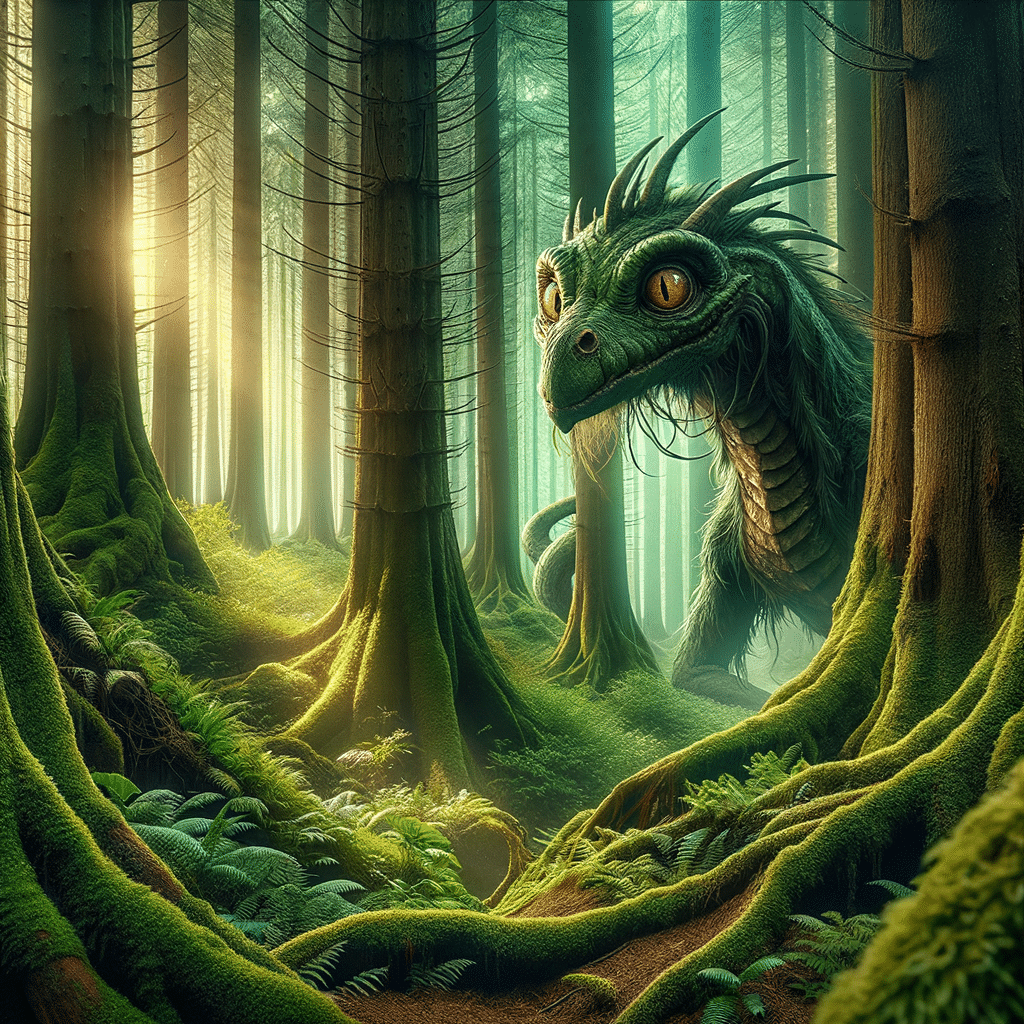
Rich in folklore, the American terrain is home to many beings that have enchanted generations with their strange nature and terrifying looks. Among these fabled monsters, the Snallygaster of Maryland ranks among the most fascinating cryptids to come out of the hills and woodlands of the eastern United States. Since the 1700s, this odd animal with its strange physical traits and predacious behavior has haunted the imaginations of people in Frederick County, Maryland, and neighboring areas. The Snallygaster is an intriguing case study in how folklore changes over time, adjusting to different cultural settings while preserving its ability to evoke both terror and wonder.

Overview
Traditional stories depict the Snallygaster as a frightening chimeric beast that rejects conventional categorization. Witnesses usually report a bird-reptile hybrid with a wingspan of up to 25 feet and a long, pointed beak packed with razor-sharp teeth able to cut human flesh. While some reports speak of tentacle-like appendages hanging under its body, others say its body is serpentine or dragon-like, covered in scales that could seem metallic in particular illumination. Perhaps most unique are the Snallygaster’s eyes, typically characterized as shining with an unnatural light that pierces the darkness, and a single eye in the center of its head, depending on various versions of the story. The creature is frequently depicted with clawed feet powerful enough to carry away livestock or even humans to its mountain lairs (Boyton, 2011).
The behavioral traits ascribed to the Snallygaster mirror its image as a predatory and erratic creature. According to folklore, the creature unexpectedly descends from the heavens to capture its prey, emitting a spine-tingling scream that can be heard for miles. With a particular preference for young children or babies left unattended, the Snallygaster was known to aim for secluded farms, bringing away cattle and sometimes people. Some stories say it would suck victims dry of blood, connecting it to vampire-like traits that strengthened its terrible reputation. Believed to nest in the South Mountains or the Catoctin Mountain range, the beast would emerge cyclically every few decades to harass nearby towns before vanishing again for years at a time.
Early German immigrants who came to Frederick County, Maryland, in the 1700s provide the Snallygaster legend’s beginnings. Tales of the Schneller Geist (meaning “quick spirit” or “quick ghost” in German) carried by these immigrants eventually morphed phonetically into Snallygaster in American English. The early German society developed the legend partly as a means of scaring children and preventing their wandering too far from home into the hazardous forest. Some folklorists claim the Snallygaster was also employed to account for unexplained cattle deaths or strange vanishings. With parents cautioning that the Snallygaster would take away any who misbehaved or strayed too far from safety, the creature became ingrained in the cultural consciousness of the area (Fair, 2013).

Folklore Growth
Particularly in 1909, when newspaper stories started reporting sightings all throughout Maryland, West Virginia, and Ohio, the Snallygaster mythology saw a notable resurgence in the early 20th century. Between February and March 1909, the local Maryland daily Middletown Valley Register ran many front-page articles on the creature describing interactions where the beast reportedly assaulted people and left strange footprints in the snow. Though they effectively revived interest in the lost legendary creature, these sensationalist stories were probably written to increase newspaper sales at a quiet news time. During this time, the descriptions grew more complex; the newspaper stories included information like metal claws, a horse-like tail, and the capacity to spray noxious fumes, paralyzing its victims before the assault (Fee & Webb, 2016).
The Snallygaster myth’s history shows how folklore changes with time and cultural impact. During the Prohibition era, in the 1920s and 1930s, Snallygaster sightings had fascinating links to illicit moonshine operations in the highlands. Some historians believe bootleggers intentionally spread Snallygaster tales to prevent inquisitive townspeople and police from approaching their concealed stills. Rising UFO culture in America had the monster by the mid-20th century, including aspects of flying saucer legend. Reflecting modern concerns and curiosities about the unknown, modern readings occasionally show the Snallygaster as an interdimensional being or perhaps an alien entity. Every age has successfully molded the Snallygaster to reflect their specific obsessions and anxieties.
When the Smithsonian Institution allegedly searched for information on the monster, it came back to national notice in popular culture in the 1970s. Though with a more tongue-in-cheek attitude than the previous reports, local newspapers once more noted sightings. The Maryland Department of Tourism started to welcome the Snallygaster as a regional wonder around this time, therefore realizing its ability to draw tourists drawn to the supernatural and mythology. Since then, the monster has been up in all kinds of media, including books, TV shows on cryptids, and even as namesakes for local companies and craft brews in Maryland. This commercialization changes the mythology from a feared monster to a celebrated regional mascot and cultural identification, hence reflecting yet another phase in its history (Mart & Cabre, 2021).
Alongside creatures like Bigfoot, the Jersey Devil, and the Mothman, the Snallygaster has been included in the larger cryptozoological community in recent decades. Though with contemporary technology such as cameras on smartphones being everywhere, clear proof is still elusive. Cryptozoology fans still collect claimed sightings and look over stories. Some contemporary folklorists see the Snallygaster not as a physical monster but as a symbolic image of the wild, untamed aspects of nature that resist human control and understanding. The legend’s tenacity reflects people’s ongoing interest in the strange and the terrible even in our scientifically educated, technologically sophisticated culture (Goldstein, 2014).
The Snallygaster story provides insightful analysis of how societies generate and sustain folklore customs throughout generations. The monster is a shared cultural touchstone that enhances communal identity, an explanation for otherwise inexplicable events, and a cautionary story to support behavioral limits. Although certain aspects of the creature’s form and behavior have changed with time, its fundamental character as a menacing presence lurking just beyond the borders of civilization has been fairly constant. The Snallygaster’s psychological power originates from its liminal character—neither completely bird nor reptile, neither totally corporeal nor spiritual—embodying the unclear line between the known and unknown realms.
Conclusion
Over three hundred years after its birth, the Snallygaster is a remarkable illustration of American mythology still enthralling people. From its beginnings among German immigrants to its many resurgences and reinterpretations over American history, this legendary creature shows how folklore changes and adapts to stay relevant across shifting cultural settings. From a fearsome beast meant to scare youngsters to a regional cultural icon that attracts visitors and motivates artistic creations, the Snallygaster has changed. Though we have rational justifications and scientific progress, the attraction of beings like the Snallygaster endures in our shared consciousness, implying that maybe our need for mystery and amazement is as basic to our nature as our thirst for knowledge and comprehension.
References
Boyton, P. (2011). Snallygaster: The Lost Legend of Frederick County. Lulu. com.
Fair, S. (2013). Mysteries and Lore of Western Maryland: Snallygasters, Dogmen and other Mountain Tales. Arcadia Publishing.
Fee, C. R., & Webb, J. B. (Eds.). (2016). American Myths, Legends, and Tall Tales: An Encyclopedia of American Folklore [3 volumes]. Bloomsbury Publishing USA.
Goldstein, J. (2014). 101 Amazing Mythical Beasts:… and Legendary Creatures. Andrews UK Limited.
Mart, T. S., & Cabre, M. (2021). A Guide to Sky Monsters: Thunderbirds, the Jersey Devil, Mothman, and Other Flying Cryptids. Indiana University Press.

Leave a Reply