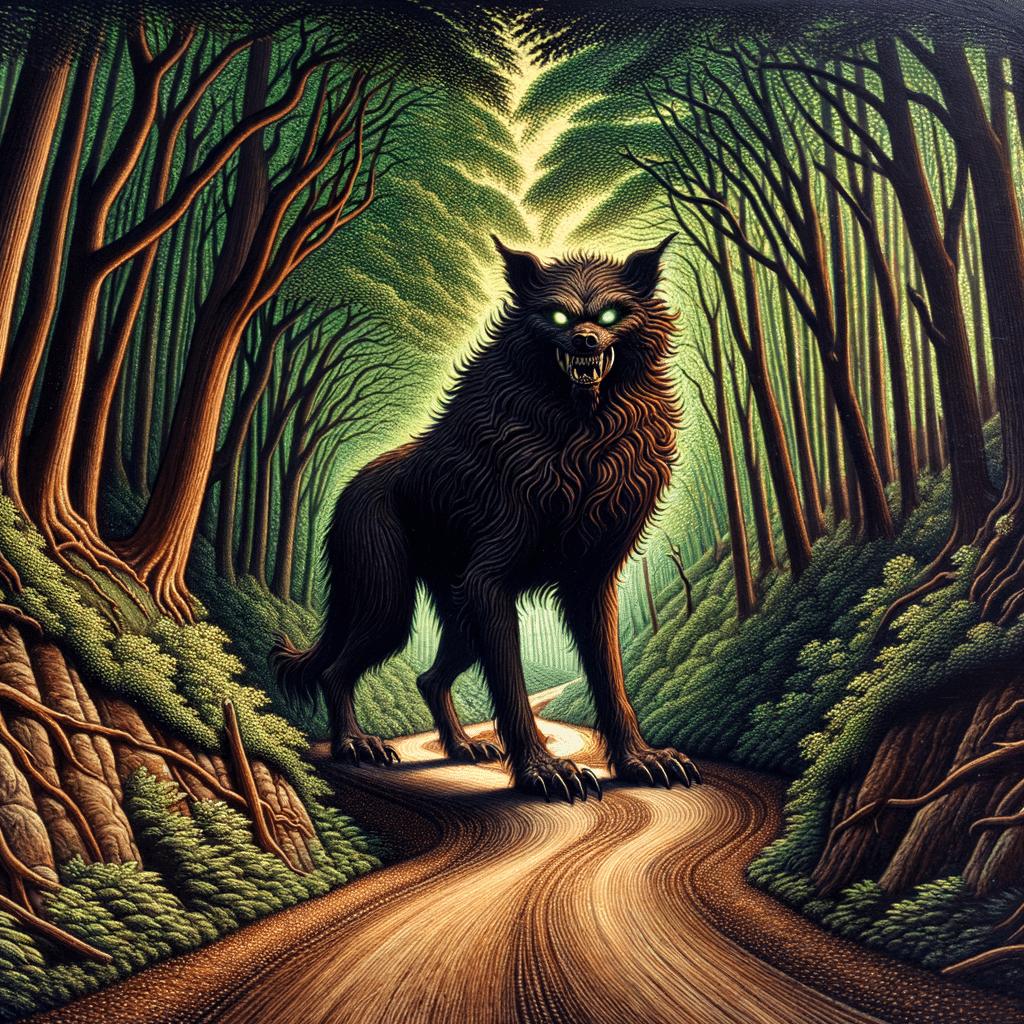
Maryland’s thick woods and fog-covered mountains hide more than just natural marvels; they hide the ghostly shape of a beast that has haunted visitors for years. Known as the Snarly Yow, this phantom black dog has carved out a niche in American mythology from innumerable encounters in the mountain passes of the Appalachian region, especially near South Mountain and Burkittsville. One of America’s most lasting spooky legends, the Snarly Yow is a spirit dog whose terrifying look and alien behavior have captivated and terrified people and visitors for more than two centuries. Reflecting deeper cultural concerns and the human inclination to shape unexplainable events, the story of the Snarly Yow provides an intriguing look into how supernatural beliefs take root and change inside communities by means of oral traditions, written records, and cultural adaptations.

Description
Witnesses describe the Snarly Yow as a huge black dog with frightening characteristics that set it apart from any normal dog. Witnesses regularly describe a creature of exceptional size, sometimes likened to a calf or tiny horse, with a coat of pitch-black hair so dark it appears to suck surrounding light. Its most notable qualities are its eyes, which have been characterized as shining with artificial red or yellow light that cuts through darkness and fog with captivating intensity. While its broad shoulders and strong legs imply a predator of enormous strength, the creature’s mouth is often shown with large fangs able to rip through bone and flesh. While some say the creature has no tracks, verifying its supernatural character, others say its shape can vary and shrink before vanishing completely, hence underlining its otherworldly quality (Fair, 2013).
The Snarly Yow’s behavior sets it apart from both natural predators and traditional ghost stories. Unlike a conventional wolf or wild dog, the ghost hound does not hunt for food; rather, it seems mostly concerned with scaring travelers. Many stories describe the creature’s sudden appearance in the middle of desolate, dark highways, where it maintains its position as horses rear in horror and people freeze in fear. Confronted, physical weapons and bullets glide innocuously through its body; then, with a bone-chilling scream or unsettling laugh, it usually disappears. The Snarly Yow seems especially attracted to night travelers on certain roads, such as the ancient National Road (now Route 40), where it obstructs paths and makes horses frightened. Unlike many supernatural beings, the Yow seldom directly injures people, implying its goal might be more as a harbinger or warning than a bad force, although some witnesses have said its sightings have come before tragic occurrences (Boyton, 2011).
Deeply woven into the cultural tapestry of the mid-Atlantic area of the United States, the Snarly Yow has a folkloric heritage. Early reports go back to German and English immigrants who carried with them European customs of spectral black hounds, such as the British Black Shuck and the German Barghest. In the remote mountain towns of Maryland and Pennsylvania, where the story took on clearly American traits, these cultural imports found rich footing. Early 19th-century records show one of the first sightings when a traveler claimed to have shot his rifle at a huge black dog obstructing his way near South Mountain, only to see in terror the bullet go through the animal without impact. Local oral customs point to even older meetings; Native American stories of spirit animals in the area may have affected the development of the story. With several witnesses saying they had encounters and the tale spreading across the area’s towns, the Snarly Yow had become a mainstay of local folklore by the mid-19th century.

Phantom Dogs in Folklore
Suggesting a clear ancestry that crossed the Atlantic with early settlers, the Snarly Yow closely resembles phantom dogs from European mythology. Like the Black Shuck of East Anglia and the Gwyllgi of Wales, the Snarly Yow appears as an unusually huge black dog with glowing eyes that torments people on isolated roads and trails. Though the Snarly Yow seems less clearly deadly than its British cousins, where folklore frequently asserts that seeing the Black Shuck meant guaranteed death within a year, these spectral hounds across cultures are omens of death or disaster. All these beings have the strange capacity to come and go at will, their shapes are resistant to physical weapons, and their presence is coupled with an atmosphere of supernatural terror that immobilizes observers with horror. The ongoing existence of these comparable stories across several geographical areas reflects the strong psychological influence of the spectral hound archetype in human awareness (Taylor, 2012).
While European ghost dogs usually haunt churchyards, crossroads, and historical routes with obvious ties to pagan or Christian iconography, the Snarly Yow adapted to the American frontier setting, becoming linked with mountain passes and freshly built transportation routes. This change shows a cultural transition from the Old World’s focus on religious borders to the New World’s worry about the hazards of passage over untamed territory. Unlike the Cu Sith of Scottish folklore, which kept clear fairyland links, or the Church Grim of Scandinavian traditions, which protected sacred places, the Snarly Yow evolved a more secular character, concentrating on the dangers of the American wilderness. While the Snarly Yow democratized its hauntings, appearing to travelers regardless of their lineage or social standing, reflecting the more egalitarian character of American frontier society, the Barghest of northern England and the Mauthe Doog of the Isle of Man maintained closer ties to particular families or curses (D’Agostino & Nicholson, 2018).
Its more unclear moral stance sets the Snarly Yow apart from Asian spectral canine traditions, including the Japanese Okuri-inu or Chinese Tiangou. While the Snarly Yow’s objectives are more unclear and its sightings more erratic, Asian phantom dogs frequently have more obvious supernatural roles—either safeguarding those who follow appropriate behavior or punishing those who violate moral standards. Unlike the Cadejo of Latin American legend, which appears in both benevolent white and malicious black forms to guide or mislead travelers, the Snarly Yow provides no dual nature or clear moral lesson beyond maybe caution against night travel. The American phantom dog lacks the shape-shifting complexity of certain European cousins like the Danish Black Dog of Hangman’s Hill, which could change into a range of terrifying forms. Evolving away from these more complicated supernatural frameworks, the Snarly Yow emphasizes the raw encounter between human and supernatural entity in the context of a new nation’s expanding frontier, where the main division was not between good and evil but between civilization and wilderness, therefore representing a uniquely American simplification of older traditions.
Impact
The development of the Snarly Yow legend shows how folklore keeps its fundamental components even as society changes; hence, it adapts to new circumstances. Reflecting the significant religious influences of the time, the phantom dog was frequently viewed in the 19th century as a reflection of the devil or a retribution for moral offenses. With some claiming the apparition came from hallucinations, visual illusions produced by fog in mountain areas, or misidentifications of natural fauna, interpretations changed toward more psychological and scientific explanations as the 20th century advanced. Local author Charles Adams III recorded many Snarly Yow encounters in his collections of area ghost stories in the late 20th century, therefore introducing the phantom dog to a larger audience and reviving interest in the folklore. Internet culture’s growth in the 21st century has changed the legend even more; the Snarly Yow has been spotted in paranormal forums and podcasts and has even influenced aspects of horror literature and movies, proving how digital media can give traditional folklore fresh expression while maintaining its core narrative (Blank & Puglia, 2014).
The persistence of the Snarly Yow story relates to universal human issues that cross particular cultural settings. Existing between the natural and supernatural realms, the phantom dog represents anxiety about the unknown lying beyond the borders of civilization. Its sightings on roads and mountain passes—threshold areas linking many communities—reflect worries about travel and the hazards that could befall people who leave safety behind. The creature’s resistance to physical weaponry reflects the limits of human might when faced with powers beyond intellectual explanation. The Snarly Yow, adapting to reflect modern fears while preserving its core identity as a mysterious black dog that appears unexpectedly, has served as a powerful metaphor for the uncertainties and dangers communities perceive in their surroundings throughout various historical periods (Ocker, 2022).
Conclusion
Modern viewers are still fascinated by the Snarly Yow, which guarantees its place in the pantheon of American mythology next to more well-known stories like the Jersey Devil or Mothman. Local tourism now exploits the myth, with ghost tours in western Maryland emphasizing the phantom dog. Equipped with current gear in hopes of catching proof of the spectral canine, amateur paranormal investigators visit the creature’s reputed haunting grounds. The Snarly Yow reflects the ongoing human desire to tell stories that explain the incomprehensible, whether one sees it as a genuine supernatural event, a psychological representation of group anxieties, or just a delightful campfire story. The shadow of the Snarly Yow will keep prowling the borders between the known world and whatever enigmas lie beyond human knowledge as long as dark routes meander through misty mountains and travelers feel the basic fear of being alone in the wilderness.
References
Blank, T. J., & Puglia, D. J. (2014). Maryland Legends: Folklore from the Old Line State. Arcadia Publishing.
Boyton, P. (2011). Snallygaster: The Lost Legend of Frederick County. Lulu. com.
D’Agostino, T., & Nicholson, A. (2018). Connecticut Ghost Stories and Legends. Arcadia Publishing.
Fair, S. (2013). Mysteries and Lore of Western Maryland: Snallygasters, Dogmen and other Mountain Tales. Arcadia Publishing.
Ocker, J. W. (2022). The United States of Cryptids: A Tour of American Myths and Monsters. Quirk Books.
Taylor, L. B. (2012). Monsters of Virginia: Mysterious Creatures in the Old Dominion. Stackpole Books.
Leave a Reply