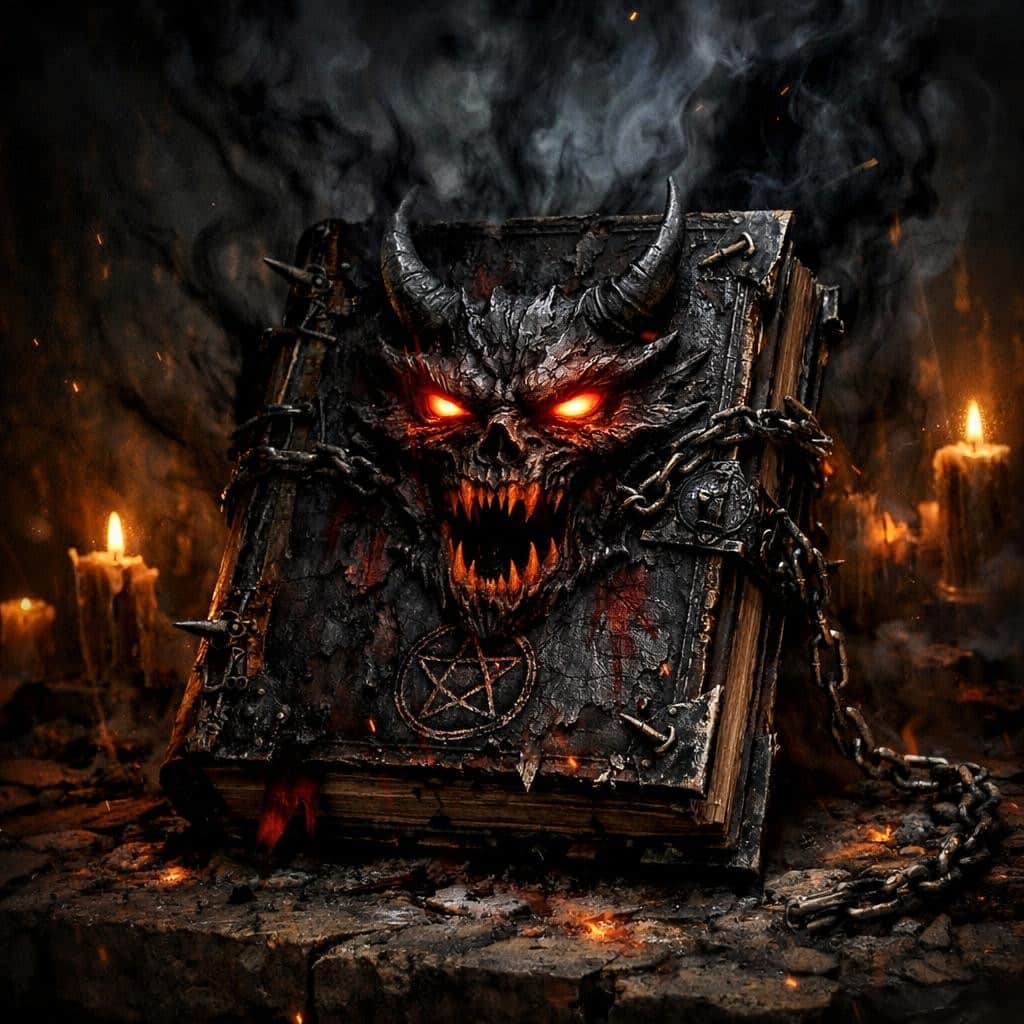
Demon-Possessed Books: Key Points
-
Demon-possessed books are sinister objects in folklore and horror that blur the line between inanimate artifact and living entity, symbolizing the dangers of corrupted knowledge. They often appear ordinary at first glance but reveal unsettling details upon closer inspection.
-
These books may have shifting text, unnatural temperatures, or margins filled with mysterious writing, suggesting an active and malevolent presence within their pages. Their physical traits hint that something conscious resides inside them.
-
Their behavior includes reappearing after being discarded, turning pages on their own, and influencing readers through whispers or dreams. They manipulate emotions and thoughts, driving obsession, despair, or immoral actions.
-
Legends claim they are created through dark rituals, infernal bargains, or intense emotional energy that attracts a demonic entity. In some accounts, demons use human writers as vessels to produce and inhabit these texts.
-
Attempts to destroy them often fail, as fire and simple disposal prove ineffective, and only complex rituals or acts of repentance may sever the bond between spirit and book. Even then, fragments can allow the evil to persist.
-
Symbolically, demon-possessed books represent fears of forbidden knowledge and the consequences of unchecked curiosity. Their lasting cultural impact reflects humanity’s enduring tension between the pursuit of understanding and the risk of moral corruption.

Introduction
The idea of demon-possessed books has interested both horror and folklore readers and writers. These scary words make it hard to tell the difference between things and creatures, which makes it seem like evil powers could taint knowledge. The thought makes me think about how powerful words are, how easily they can change the mind, and how much it costs to be too interested. Their portrayal, actions, origins, and attempts to erase them show why these works endure in cultural memory.
Physical Characteristics and Material Dimensions
Books that are possessed by demons usually have plain covers made of worn leather or faded fabric, and the pages make a noise when you flip them. But if you look carefully, you’ll see some scary things, including ink that stays wet long after it dries, letters that slowly glide across the page, or margins that are filled with writing that wasn’t there before. Some feel warm to the touch, like a faint pulse, while others feel cold and slide between the reader’s fingertips. In many stories, the names vary depending on who’s watching. This reflects worries that aren’t spoken or hopes that aren’t spoken.
The material-literary aspect of demon-possessed literature includes treatises, ritual texts, amulets, and directions for exorcism. These texts function as tools for recognizing demonic influence, suggesting rituals, or incorporating demonology into medical or theological discussions. The spread and categorization of these texts reveal a politics of knowledge that can either facilitate or hinder access to exorcistic or demonological material. The Italian context illustrates the distribution of exorcism books among clergy, which were either suppressed or classified under successive regimes, underscoring the contentious nature of demonology as a resource in state-church politics (Ambrosi, 2019; Seitz, 2022; Walden, 2018).
These books are different from cursed but not active things because of how they act. They keep getting away from being thrown away. They reappear on shelves after being thrown away or burned, and sometimes they even show up near former users. Pages spin by themselves, taking readers to parts that make them feel sad, preoccupied, or full of ambition. In extreme cases, the book talks to people through dreams or whispers in a language that only the chosen victim can hear. Such behavior leads to actions that are immoral and insane.
Origins and Methods of Eradication
Diverse cultures have diverse theories regarding where books possessed by demons come from. Some people think that these books were produced by persons who work in the occult and make bargains with demons for secret knowledge. They sign a blood agreement and capture a spirit inside the pages. Some people claim that demons write the books and then employ people to send them. Some people believe that a manuscript with a lot of anger, misery, or ambition in it could draw in a transitory entity, which would then attach itself to the physical book as a way to enter into the human realm.
Getting rid of a book like that isn’t always easy. Fire is sometimes ineffective because the flames either miss the pages entirely or burn beyond them, leaving the pages untouched along with other items. Religious rituals, such as exorcism and blessings, can be helpful, although stories say that the spirit may be able to escape and find a new host. Some stories indicate that the only way to end the writing is with a last statement that shows sincere remorse or self-sacrifice. This destroys the link between the demon and the thing. But there is still doubt because pieces of a single surviving sheet may be enough for the creature to regain its strength back.

Representations in Fiction and Religious History
People used to conceive of demons and evil characters in horror stories and movies as real, but now they don’t. The Necronomicon by H. P. Lovecraft is probably the most well-known example. People say that the “mad Arab” Abdul Alhazred wrote a forbidden grimoire that can drive people insane by telling them things concerning cosmic entities. In the Evil Dead series, the Necronomicon Ex Mortis is a book that is bound in flesh that calls forth demons as you read it. Such practices lead to possession and disorder. Clive Barker’s made-up grimoires and the many cursed books in gothic literature add to the tradition by revealing that some books not only contain evil knowledge but also actively embody it.
Clergy often gave exorcism instructions to help locate and deal with demons. The impact of these writings extended to the reformation of medicine and the political-religious governance, as they influenced the practices and beliefs of both medical professionals and religious authorities in their approaches to dealing with demonic possession and its implications for society. The distribution of these manuals, together with their subsequent censorship or indexing, illustrates the fluidity of the boundaries of orthodoxy, science, and popular practice throughout the Counter-Reformation in Europe (Ambrosi, 2019; Walden, 2018). In summary, demonological literature, whether medicinal, ceremonial, or exorcistic, served as tools for negotiating legitimacy among rival authorities, including physicians, clergy, and inquisitorial bodies.
Theoretical Interpretations and Cross-Cultural Significance
Scholars and theorists analyze demonically possessed texts via symbolic interpretations. They could be a sign of the terror that comes with dangerous information, especially when it goes against moral or spiritual bounds. Psychologists may interpret them as representations of intrusive thoughts that intensify with capitulation, suggesting that these texts reflect the internal struggles individuals face when grappling with forbidden ideas or beliefs. Historians, however, assert that these events correlate with periods when individuals feared heresy, leading to the prohibition or destruction of certain books. It’s clear that they have changed literature and popular culture. They have influenced horror stories, spawned movies, and made the fight between curiosity and caution even stronger, particularly by shaping narratives that explore the consequences of forbidden knowledge and the supernatural.
The prevalence of exorcism-like practices across several civilizations, including Roman, Jewish, early Christian, and later European, demonstrates that “books of exorcism” can serve as both enduring traditions and incubators for innovative ideas. The demonology and related ritual texts of the Dead Sea Scrolls, along with Hippocratic and amuletic medical writings, show how demonological literature has changed over time and across cultures. It often overlaps with medical texts (epilepsy and bodily affliction) and liturgical formulas (Zellmann-Rohrer, 2021; Valencia, 2024; Sulaiman, 2023). Exorcism materials now appear in many different formats, and many different people read them. For example, these materials include formal church orders, current psycho-medical differential diagnoses, and stories delivered through digital media. This work demonstrates that demon-possessed books are not merely historical artifacts; they continue to be integral to discussions regarding the nature of possession, the efficacy of exorcism, and the distinctions among medicine, religion, and law (Innamorati et al., 2019; Bauer & Doole, 2022; Possamaï & Gower, 2024).
Conclusion
Demon-possessed books persist due to their representation of the duality of knowledge as both illumination and danger. People think of them as intelligent beings who seduce, control, and degrade, while simultaneously showing how worried they are about authority and accountability. The stories of their beginnings and endings illustrate that halting evil is still possible, though not easily erased. The idea of a book that communicates back to its reader will always concern and captivate individuals who are interested in the unknown.
References
Ambrosi, F. (2019). Giovan Battista Codronchi’s De morbis Veneficis ac Veneficiis (1595). Medicine, exorcism and inquisition in Counter-Reformation Italy. Religions, 10(11), 612. https://doi.org/10.3390/rel10110612
Bauer, N., & Doole, J. (2022). The (re)invention of biblical exorcism in contemporary Roman Catholic discourses. Religion and Theology, 29(1-2), 1–33. https://doi.org/10.1163/15743012-bja10030
Innamorati, M., Taradel, R., & Foschi, R. (2019). Between sacred and profane: Possession, psychopathology, and the Catholic church. History of Psychology, 22(1), 1–16. https://doi.org/10.1037/hop0000106
Lovecraft, H. P. (1938). The history of the Necronomicon. Rebel Press.
Possamaï, A., & Gower, R. (2024). Digital exorcism and morality. Journal of Sociology, 61(2), 308–320. https://doi.org/10.1177/14407833241276251
Raimi, S. (Director). (1981). The Evil Dead [Film]. Renaissance Pictures.
Seitz, J. (2022). Clerical exorcists and the struggle for professional status in early modern Venice: Learning, licensing, and practice. Renaissance Quarterly, 75(3), 849–881. https://doi.org/10.1017/rqx.2022.213
Sulaiman, N. (2023). Theatre of exorcism: Evoking the past to control the present. JLS, 3(1), 133–147. https://doi.org/10.25130/jls.3.1.9
Valencia, J. (2024). Influence of the Enochic tradition on Qumran: Reception and adaptation of the Watchers and Giants as a case study. Perseitas, 12, 34–71. https://doi.org/10.21501/23461780.4671
Walden, J. (2018). Exorcism and religious politics in fifteenth-century Florence. Renaissance Quarterly, 71(2), 437–477. https://doi.org/10.1086/698138
Zellmann-Rohrer, M. (2021). Hippocratic diagnosis, Solomonic therapy, Roman amulets: Epilepsy, exorcism, and the diffusion of a Jewish tradition in the Roman world. Journal for the Study of Judaism, 53(1), 69–93. https://doi.org/10.1163/15700631-bja10033




Leave a Reply