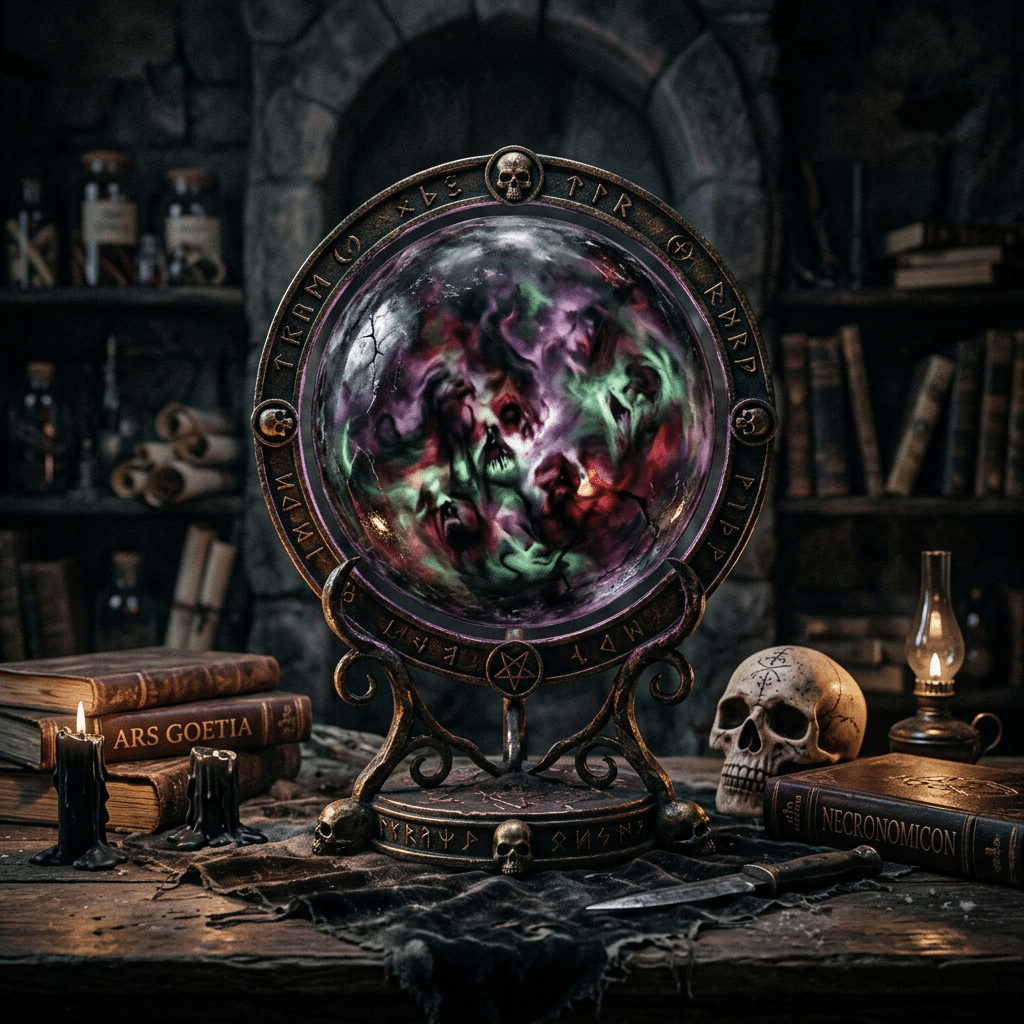
Cursed Crystal Balls: Key Points
-
Crystal balls are polished spheres, traditionally made from quartz or obsidian, that have been used across many cultures for centuries as tools of divination through a practice called scrying.
-
A cursed crystal ball is one that has been deliberately hexed, spiritually contaminated through trauma or repeated misuse, or inhabited by a bound entity, making it a source of harm rather than insight.
-
The effects of a cursed crystal ball on its owner are wide-ranging and follow a consistent pattern in folklore, including nightmares, physical symptoms, psychological deterioration, compulsive behavior toward the object, and the collapse of social relationships.
-
The most dangerous category of cursed crystal ball is believed to contain a trapped human soul, which actively causes harm from within the object and requires spiritual liberation before the ball can be safely dealt with.
-
Several theories attempt to explain the phenomenon, ranging from simple psychological suggestion and the power of belief, to the stone tape theory of psychic imprinting, to the presence of attached spiritual entities within the object.
-
Methods for destroying or neutralizing a cursed crystal ball include physical smashing with iron, disposal in flowing water, burial at a crossroads, and formal banishing rituals, though most traditions warn that physical destruction without spiritual preparation can release the curse rather than end it.
![[[File:Andes In A Crystal Ball (190455783).jpeg|Andes_In_A_Crystal_Ball_(190455783)]]](https://i0.wp.com/connectparanormal.net/wp-content/uploads/2025/08/Andes_In_A_Crystal_Ball_190455783.jpeg?resize=300%2C200&quality=89&ssl=1)
Introduction
The cursed crystal ball is one of the most mysterious and unsettling things in the world of the occult. These relics occupy a peculiar position that straddles the line between being a tool and a menace, as well as an instrument and an entity. They fascinate folklorists, paranormal fans, and historians alike. The notion that a thing intended to unveil the future may possess a perilous and ominous destiny is a conundrum that has endured through ages and civilizations, warranting thorough exploration.
Crystal Balls as Instruments of Divination
Crystal balls are one of many ways to tell the future, figure out what’s wrong with the present, or find out what’s really going on. In academic discourse, crystal gazing is often examined alongside alternative prognostic methods, such as astrology, tarot, tea leaves, Magic 8 Balls, or oracular dreams, as components of a comprehensive “future-making” toolkit utilized by communities to influence both individual and collective futures (Pitts, 2023; Gracida, 2016). This framing acknowledges that divination frequently functions within social practices of anticipation and preparation, rather than as a singular deterministic approach (Rennick, 2021).
At its most basic level, crystal balls are polished spheres composed of different materials, such as quartz, obsidian, glass, and other clear or reflecting materials. Historically, the best and most sought-after ones were made from pure natural quartz crystal, which was valued for its clarity and thought to be able to carry spiritual or metaphysical energy. The shape of the sphere was important because it stood for wholeness, infinity, and the unbroken flow of time. This made it an ideal vessel for visions that went beyond the normal flow of time (Dunwich, 2022).
It is an old practice to look at a reflective or clear surface to have prophetic visions. This technique is called scrying. People who practice this art, commonly termed seers, scryers, or just fortune tellers, would go into a trance or meditative state and quietly fix their eyes on the ball. The practice would let images, symbols, or impressions come to mind. Crystal ball scrying has been recorded throughout medieval Europe, Renaissance courts, and numerous indigenous cultures, with notable personalities such as the Elizabethan magician John Dee, who notably utilized a black obsidian mirror and a crystal “shew stone” for angelic contact. Crystal gazing exists alongside other symbolic systems across cultures, such as hexagrams in Yi studies and codices in Mesoamerican divination. It can also serve as a performative act in legal, social, or religious contexts for purposes like resolving disputes, predicting marriages, or healing communities (Smith, 1989; Gracida, 2016).
In the realm of divination, the crystal ball served not just as a passive surface but also as an active channel between the seer and the unseen. Many traditions said that a real scrying sphere would take in and hold the energy, intents, and psychic impressions of the people who used it over time, making it stronger and more in touch with its owner. This idea that an object can build up spiritual energy over time is precisely what helps us comprehend how a crystal ball could, in some situations, become something much worse than a tool for revealing things.
Non-Western and indigenous cultures also employ crystal balls or crystal-like reflective devices in rituals that blend divination with communal mediation, healing, and social governance. In certain Miskitu traditional courts, divination through mirrors or crystal balls serves as a mediative tool in community justice processes, frequently accompanied by agreements and reconciliatory remedies (Wedel, 2019). In Mesoamerican studies, divinatory calendars and almanacs augment crystal-gazing readings, emphasizing a comprehensive system of prognostication that integrates the symbolic interpretation of crystals with calendrical indicators and social conventions (Gracida, 2016; Boone, 2012).
The Nature and Origins of Crystal Ball Curses
A cursed crystal ball is usually thought of as a sphere that has been intentionally hexed, spiritually polluted by trauma or misuse, or otherwise filled with negative energy that causes undesirable luck, mental distress, or even physical harm to those who own or look into it (Ocker, 2020). Folklore collections from all around Europe and the British Isles spoke about these kinds of items. For example, some balls were supposed to have been used by witches or dark practitioners to cast spells, show scary visions, or capture the souls of people who were about to die. People who owned these cursed things often had dreams that wouldn’t go away, a feeling of being watched, financial ruin, illness, or a succession of strange incidents that stopped only when the ball was destroyed or given away.
There are several ways that a crystal ball could become cursed, and the ways that this happens are completely unique in different cultures and esoteric traditions. Some stories say that a skilled practitioner puts the curse on the object on purpose and with the intention of doing harm, either by writing invocations on it or sealing a malevolent intention inside it through ceremony. In some cases, the curse is thought to come from trauma that has built up over time, like a ball that was present at a death, used during a time of deep anger or sadness, or used over and over again to wish harm on others. Each improper use adds more evil energy to the object until it becomes dangerous to touch (Dean, 2018).
Some legends draw a clear line between different types of crystal ball curses, saying that the curse’s nature and origin define both its specific consequences and how difficult it is to obtain rid of. Many folk traditions believe that a curse that is intentionally put by a living practitioner is more focused and harmful but also easier to remove because it shows a limited human will that may be fought against or worn down. A curse that comes from deep spiritual contamination or the presence of a bound entity, on the other hand, is thought to be much more dangerous and harder to get rid of with normal methods. This is because it doesn’t come from a single person’s intention but from something much older and less predictable, which may involve ancestral spirits or ancient curses that have accumulated over time, making them more complex and resistant to typical removal methods.
In folk culture, the look of a cursed crystal ball has long been a source of interest. Many stories say that truly cursed spheres have strange visual traits that show how hazardous they are. Some accounts suggest that the ball always contains a cloudy or black spot that cannot be removed by cleaning, as if a shadow has permanently settled inside the crystal. Some individuals also experience strange reflections within their bodies that appear to move independently, flashes of color or shape that are only visible to a select few, and shapes that seem to shift and respond to the viewer’s gaze in a manner that no ordinary light trick can explain.
People who have been around a cursed crystal ball for a long time say that the impacts are much worse than just poor luck. This is true across different times and places. Sleep problems are one of the most typical symptoms. They can range from vivid and unsettling nightmares to a complete inability to sleep, as if the object in the home is breaking down the line between waking and dreaming consciousness. Many stories also talk about how the person’s mental and emotional state slowly gets worse. It starts with mild unease and goes through obsessive thoughts about the ball, an irrational need to look into it even though they are scared, and finally a kind of psychological paralysis where the victim feels like they can’t get rid of the object even though they know it’s hurting them.
There have been enough reports of physical ailments linked to cursed crystal balls to make a pattern in the literature on paranormal investigation. People often say they get headaches soon after touching or looking at a suspicious ball. Other common complaints include nausea that can’t be explained, a feeling of cold coming from the object no matter how warm it is outside, and in some extreme cases, temporary visual disturbances that last even after the person has looked away. Several accounts from collectors and antiquarians in the early 1900s talk about people who had these symptoms and thought they were caused by normal things at first. They only later realized that their physical problems started when a certain sphere came into their home or collection.
The social and relational consequences of a cursed crystal ball constitute a less usually examined yet equally important aspect of the mythology associated with these items. Many stories talk about how the owner of a cursed ball becomes more and more alone. This can happen when they push friends and family away by changing their behavior and personality, or when relationships seem to fall apart because of misunderstandings, betrayals, and conflicts that don’t make sense. Some traditions see this social breakdown as a planned part of the curse, not just a side effect. They say that some dark practitioners would curse a ball to break up the community and support networks of the person they were trying to hurt, making them alone and more open to the object’s continued influence.

Historical Documentation and Theoretical Frameworks
Crystal ball curse lore contains a particularly dark aspect that discusses artifacts believed to have been used to capture or hold a person’s soul. The captured spirit is usually the soul of someone who died while looking into the ball or who was intentionally connected to it through a death ceremony. In these stories, the soul that is trapped becomes the one who hurts others, attacking everyone who touches the object out of anger, sadness, or uncertainty. Most occult traditions say that this kind of cursed crystal ball is the most dangerous type. To safely address it, the trapped consciousness must be fully freed from its spiritual bondage, which many practitioners say is a very painful process for everyone involved.
The history of cursed crystal balls is connected to the larger history of persecution and accusation during the European witch trials of the fifteenth through seventeenth centuries in some intriguing ways. Witch trial testimonies frequently cited crystal balls and scrying stones as evidence of malevolent conduct. People who were accused of witchcraft were sometimes charged with utilizing these artifacts to communicate curses or bad visions to their neighbors (Chauran, 2011). Because of this legal and religious background, many of the first written descriptions of cursed crystal balls come from court documents and inquisitorial records instead of favorable occult sources. This provides them a heavy historical weight that purely folkloric accounts don’t necessarily have.
Certain historical individuals or groups are associated with some of the most well-known cursed crystal balls. Some antique dealers won’t sell certain spheres because buyers have returned them with scary stories of what they saw when they looked into them. Museums that have old scrying equipment have sometimes noticed that workers who are supposed to take care of certain exhibits report strange mental symptoms, such as anxiety, hallucinations, or feelings of dread, which some attribute to the influence of the cursed objects. This has led to both derision and serious research by parapsychological experts.
The cursed crystal ball phenomenon is attributed to a variety of factors, some of which are rooted in the supernatural and others in psychology. The ideomotor effect and the power of suggestion are the simplest psychological explanations. If someone is told that an object is cursed, they will unconsciously see normal bad luck as proof, which will put them in a cycle of anxiety and hypervigilance that can really hurt their quality of life. This theory works for many situations, but it doesn’t work for cases where people didn’t know about a sphere’s supposed history before they had problems or where different people who weren’t connected reported the same symptoms.
A second theoretical framework is based on the idea of psychic imprinting, which is also known as the stone tape theory. This theory says that physical objects can take in and then play back strong emotional or psychic energy in the same way that a magnetic tape records sound. From this perspective, a crystal ball employed regularly in rituals of sorrow, rage, or malevolent intent may become imbued with those energies and emit them to adjacent sensitive individuals. Mainstream science does not endorse this concept; yet, it retains popularity among paranormal researchers and offers a framework that seeks to connect subjective experience with objective causality.
A third, more spiritual idea suggests that certain crystal balls can serve as homes for ghosts, beings, or residual consciousnesses that either joined the object during a ceremony or were attracted to it by the psychic charge of its past. People who practice different occult traditions say that these beings can change the dreams, feelings, and choices of people who are in close contact with the object that hosts them for a long time. This hypothesis is the oldest of the three and is the basis for most folk beliefs about cursed objects. It shows how people tend to give meaning and purpose to things that seem to act with purpose beyond chance.
Methods of Removal and Neutralization
Because people think cursed crystal balls are dangerous, it’s expected that many folk traditions and occult practices have come up with ways to get rid of or neutralize them. The most straightforward and frequently recounted method in European folk traditions entails physical destruction, usually achieved by shattering the ball with an iron tool, as iron has historically been linked to safeguarding against supernatural entities and is thought by numerous traditions to interfere with or dissipate spiritual energy. But many people who practice magic say that breaking a cursed ball without the right preparation can let out any evil energy or being that is inside it, which might make things much worse for anyone who is around when it happens.
Because of these concerns, most major occult traditions say that a ritual must be done before any effort at physical destruction. These preparations typically include wrapping the ball in black cloth to prevent its energy from spreading harm while it is being handled, and placing it in a circle of salt, which many cultures view as a method of spiritual purification and protection. Some customs also recommend burning protective herbs such as sage, frankincense, or rue in the area where the destruction will occur. The process makes the location spiritually clean, which practitioners say stops any energy that is unleashed from entering the physical realm.
Another important group of stories about cursed crystal balls involves methods of destruction or removal that utilize water. Many traditions say that flowing water, especially river water or seawater, is a powerful purifying medium that can carry away and neutralize negative spiritual energy. Some accounts say that practitioners throw cursed spheres into rivers, the ocean, or deep natural springs to get rid of them instead of destroying them. The idea behind this method is that the curse is spread out and diluted by the constant flow of water, rather than concentrated and maybe intensified by a dramatic shattering. This makes it a better choice for people who are afraid of what will happen if they smash the object directly.
Burying a cursed crystal ball is another widely recognized method of disposal. Some traditions say that it should be buried near a crossroads, which is a place that has long been linked to the meeting of worlds and the spread of spiritual forces. Some burial customs recommend burying the ball far away from people, wrapping it in iron nails, or placing it in a sealed lead box before interment to ensure that its power lasts forever. Some stories from Appalachian and British folk magic say that you can bury a cursed object with a written petition, a piece of black tourmaline, or a written curse-breaking charm. This is like sealing the object away with instructions for how to keep it in the ground.
But a legend says that a cursed crystal ball must be spiritually cleaned or banished before any other method can be used. People who practice different religions talk about long rituals that include spoken spells, calling on protective spiritual forces, using holy tools, and sometimes even having multiple people work together to overpower whatever energy or being has claimed the object. These more complicated methods show that people think that the most cursed objects are aware of attempts to neutralize them and will fight against being destroyed in both obvious and subtle ways. To get beyond these obstacles, you need to put in a lot of focused spiritual effort.
In the literature on medical and scientific communication, crystal-ball imagery is frequently employed figuratively to address prediction and risk (for instance, forecasting risks in cardiology or immunology) mixed with optimism or doom. These debates clearly distinguish metaphorical “crystal ball” usage from empirical prediction models, highlighting the divergence between metaphorical forecasting and empirically substantiated techniques (Brent et al., 2006; Temporelli, 2020). Western esoteric and literary traditions frequently depict crystal balls as the primary objects of clairvoyant trance or visual projection. These figurative crystal balls frequently foretell futures that seem doomed, contingent upon the author’s intentions with hopes that a curse can be prevented or undone.
Conclusion
The story of the cursed crystal ball lives on because it speaks to something deep about how people relate to things, time, and the unknown. Regardless of whether these narratives are perceived as psychological products, authentic paranormal occurrences, or intriguing cultural myths, they demonstrate a pervasive worry around the instruments employed to transcend the immediacy of the present. The crystal ball promises to show us things, but the cursed crystal ball warns us that some visions and some ways of seeing things come with a cost that the curious and the unwary may not fully realize until it is too late, such as the potential for obsession, misinterpretation, or even personal harm as a result of seeking knowledge that is better left undiscovered.
References
Boone, E. (2012). Marriage Almanacs in the Mexican Divinatory Codices. Anales Del Instituto De Investigaciones Estéticas, 28(89), 71. https://doi.org/10.22201/iie.18703062e.2006.89.2226
Brent, L., Cohen, I., Doherty, P., Feldmann, M., Matzinger, P., Holgate, S., … & Zinkernagel, R. (2006). Crystal-ball gazing − the future of immunological research viewed from the cutting edge. Clinical & Experimental Immunology, 147(1), 1-10. https://doi.org/10.1111/j.1365-2249.2006.03234.x
Chauran, A. (2011). Crystal Ball Reading for Beginners: Easy Divination & Interpretation (Vol. 30). Llewellyn Worldwide.
Dean, L. (2018). The Ultimate Guide to Divination. Quarto Publishing Group USA.
Dunwich, G. (2022). Gemstone and Crystal Magic: A Modern Witch’s Guide to Using Stones for Spells, Amulets, Rituals, and Divination. Red Wheel/Weiser.
Gracida, A. (2016). CASTING MAIZE SEEDS IN AN AYÖÖK COMMUNITY: AN APPROACH TO THE STUDY OF DIVINATION IN MESOAMERICA. Ancient Mesoamerica, 27(2), 461-478. https://doi.org/10.1017/s0956536116000304
Ocker, J. W. (2020). Cursed Objects: Strange But True Stories of the World’s Most Infamous Items. Quirk Books.
Pitts, J. (2023). Does Meta-induction Justify Induction: Or Maybe Something Else?. Journal for General Philosophy of Science, 54(3), 393-419. https://doi.org/10.1007/s10838-022-09620-7
Rennick, S. (2021). Self-Fulfilling Prophecies. Philosophies, 6(3), 78. https://doi.org/10.3390/philosophies6030078
Smith, K. (1989). Zhouyi Interpretation From Accounts in The Zuozhuan. Harvard Journal of Asiatic Studies, 49(2), 421. https://doi.org/10.2307/2719259
Temporelli, P. (2020). Risk scores, atherosclerotic cardiovascular disease and the crystal ball. European Journal of Preventive Cardiology, 28(14), e14-e15. https://doi.org/10.1177/2047487320903157
Wedel, J. (2019). Customary law and the mediation of witchcraft accusations in Eastern Nicaragua. Journal of Legal Anthropology, 3(1), 62-82. https://doi.org/10.3167/jla.2019.030104

Leave a Reply