
What would happen if the reemergence of dire wolves resulted in the creation of dire werewolves?
A revolutionary event has lately changed our knowledge of de-extinction prospects in the domain where scientific progress meets paleontological fact. With Colossal Biosciences Inc.’s recent successful birth of the first dire wolf pups in millennia, the ancient dire wolf (Canis dirus), extinct for around 13,000 years, has leapt from history books into contemporary labs. This film focuses on the creative concept of “dire werewolves”—theoretical hybrids of humans and dire wolves that would be stronger and more significant than the werewolves from stories—and examines what might happen if we successfully bring back these ancient predators. Although the werewolf component stays clearly in fiction, this investigation provides a unique perspective to consider the convergence of paleogenetics, mythology, and the real scientific advances taking place in de-extinction studies.

Dire Wolves
Ranging all throughout North America, including the Montana-Wyoming border region, dire wolves were strong predators who roamed the Americas during the Late Pleistocene epoch. Most of their remains were found at the La Brea Tar Pits near Los Angeles. Ranging over five feet in length and weighing between 150 and 200 pounds, these ancient canids were more solidly constructed than their current gray wolf ancestors, with wider heads, more powerful jaws, and teeth specialized for crunching bone. Published in 2021, genetic studies indicated that dire wolves were not only larger than gray wolves but also a separate lineage that split from other wolf species around 5.7 million years ago, therefore more distantly connected to current wolves than previously believed. For the Colossal Biosciences scientists working on revolutionary resurrection projects, this genetic difference offered both difficulties and possibilities (Anyonge & Roman, 2006).
Though often shown in HBO’s Game of Thrones, these fictitious equivalents only bear faint similarities to their paleontological namesakes. Though the Stark family takes a litter of six orphaned pups in the series’ early episodes, establishing them as living symbols of House Stark itself, George R.R. Martin’s fantasy world depicts dire wolves as extremely rare, giant canines native to the northern areas beyond the Wall. With a few playing important parts in major plot events, these imaginary dire wolves grow to horse-sized size, create supernatural ties with their Stark friends, and show extraordinary intelligence and loyalty throughout the book. Though they ultimately offered a very romanticized and fanciful picture of these prehistoric predators, stressing magical aspects that served story goals instead of biological accuracy, the show’s dire wolves, created from a mix of specially trained Northern Inuit dogs in early seasons and progressively sophisticated CGI in later episodes, captivated viewers’ imaginations. Though much of this common knowledge is tainted by the fictitious representation, their cultural influence via the program has been considerable as public awareness and interest in the true extinct species rise (Lethbridge, 2018).
Appearing in different forms across civilizations as people able to change into wolves or wolf-like creatures, werewolves hold a unique position in world mythology. Traditional European werewolf lore usually describes the transition as happening involuntarily during the full moon, resulting in a being with increased strength, heightened senses, and a primal bloodlust that overpowers human reason. In mythology, the spread of lycanthropy through bites reflects a viral or curse-based contagion mechanism that generates an increasing population of afflicted people. Today’s films and writings have developed on these concepts, adding additional twists, like genetic lycanthropy, the capacity to change voluntarily, and maintaining human awareness while transforming, reflecting how the werewolf represents our struggle with our more primitive impulses (Stebbins, 2017).
The recent cloning of dire wolves by Colossal Biosciences represents a significant advancement in de-extinction research, transforming the concept from a theoretical possibility to a practical reality. To resolve issues arising from using ancient genetic material, scientists have taken genes from gray wolves and combined them with DNA from recovered dire wolves to produce new creatures closely resembling the original dire wolves. Unlike common depictions in HBO’s Game of Thrones, these puppies are the genuine prehistoric species that formerly ruled North American ecosystems rather than the fantastical animals shown in entertainment. These puppies’ birth signifies the end of years of genetic research, cutting-edge CRISPR gene-editing technology, and complex embryology work, demonstrating the growing capabilities of de-extinction science. Though they are not flawless copies of their ancient forebears because of a missing genetic code, these puppies are nonetheless the nearest facsimile of dire wolves to roam the Earth in 13,000 years (Funnell, 2025).

Dire Werewolves
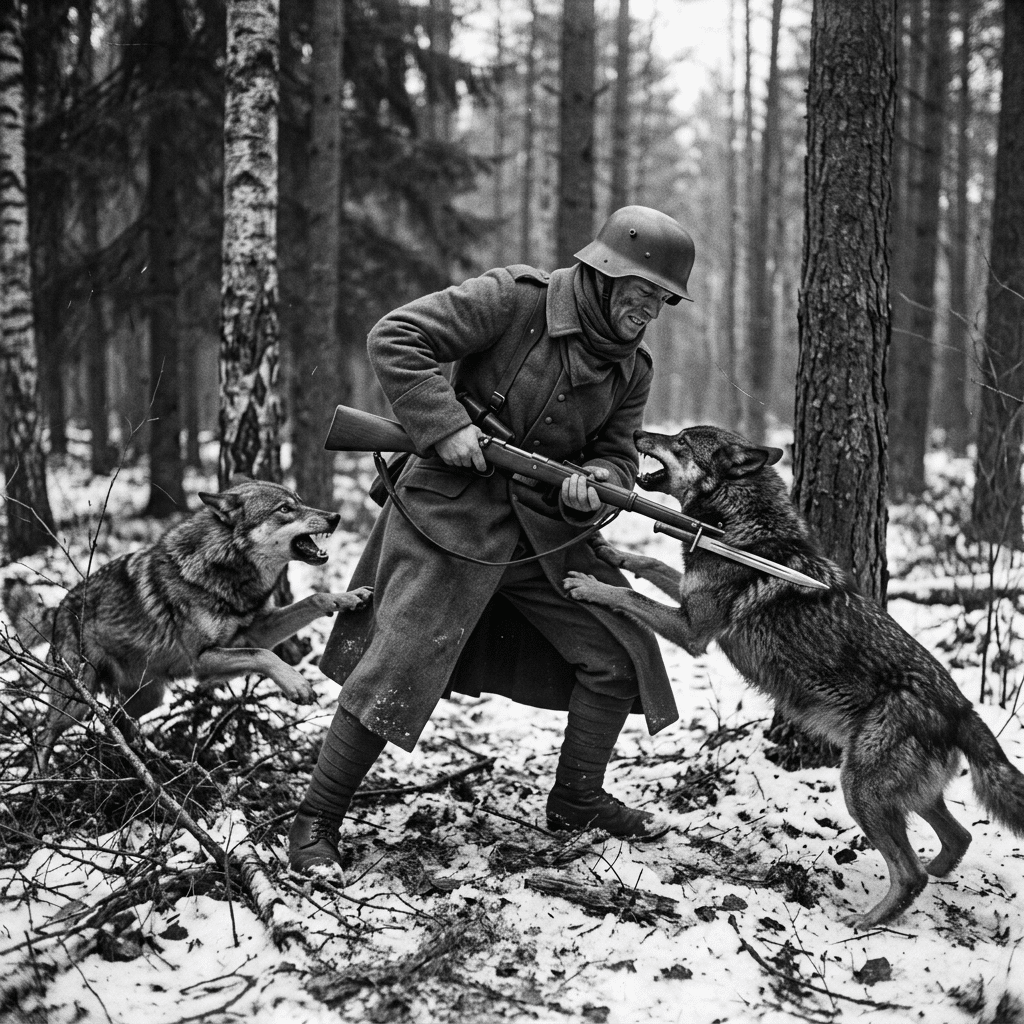
Should we consider the improbable idea that a dire wolf’s bite could pass a changing disease to people? The ensuing “dire werewolf” would surely vary from conventional werewolves in numerous important respects. First, considering the dire wolf’s larger size and more robust structure, a dire werewolf would probably stand taller than typical werewolves, maybe reaching seven to eight feet in height when upright, with correspondingly more heft and strength. The skeletal system would show the dire wolf’s unique adaptations, including a wider cranium, stronger jaw muscles, and specialized teeth able to easily shatter bones. These physical benefits would enable dire werewolves to be especially strong hunters, able to take down game challenging even conventional werewolves.
Apart from physical traits, dire werewolves would probably show behavioral traits mirroring their ancient genetic legacy. Unlike modern wolves (and, by implication, conventional werewolves), which developed as pack hunters specializing in hunting down ungulates, dire wolves seem to have been adapted for confrontational scavenging and prey specialization, possibly making dire werewolves more solitary and territorial. Their hunting techniques could prioritize overpowering force instead of the coordinated pack procedures linked with conventional werewolves. Furthermore, given that dire wolves evolved in the Pleistocene alongside megafauna that no longer exist, dire werewolves may show instinctual behaviors badly suited to the contemporary environment, therefore generating special problems for both the animals themselves and any human populations sharing their territory.
Dire werewolves would probably have completely unique sensory talents than those of their traditional counterparts. Studies indicate that dire wolves had very acute senses geared at seeing and processing carrion, which could mean dire wolves had improved capacity to perceive degradation and frailty in possible prey. While their bigger skulls might include greater auditory systems for better hearing, their larger nasal cavities could offer better olfactory power. These sensory advantages, combined with the general enhancement of human senses during metamorphosis, would turn them into hunters with unparalleled tracking ability, able to locate prey from enormous distances and identify flaws other predators, such as werewolves, cannot perceive.
Compared to conventional werewolf mythology, the social dynamics of a dire werewolf population would probably evolve along unique lines. The fact that dire wolves are genetically different from today’s wolves suggests that dire werewolves might have different social behaviors, possibly leading to stricter social ranks or a tendency to be more solitary. If dire wolves have simpler social structures than modern wolves, dire werewolves might struggle more intensely with the duality of their existence compared to regular werewolves, as their human consciousness finds fewer points of alignment with their animal instincts. More unstable transformations, more psychological suffering for the human host, and maybe more erratic behavior in changed states could all come from this internal struggle.
The mythology surrounding dire werewolves will undoubtedly evolve unique features reflecting their ancient roots and the contemporary technological setting of their reemergence. While conventional werewolves are sometimes portrayed as animals of natural wild strength, dire werewolves could be described as representations of scientific arrogance—beings created in laboratories instead of magical curses. Their link to Colossal Biosciences’ revolutionary work could question the limits between natural and artificial life, therefore positioning them as symbols of humanity’s increasing capacity to control evolutionary processes. Cultural stories could portray them not just as cursed people but as victims of scientific excess, bearing the unintentional effects of resurrection biology in their changed forms. This scientific aspect would bring a clearly modern horror component to the terrible werewolf mythos missing from conventional werewolf literature (Lecouteux, 2021).
Conclusion
Ultimately, while the idea of dire werewolves stays squarely in speculative fiction, Colossal Biosciences’ remarkable accomplishment has unequivocally pushed the scientific truth of dire wolf resurrection into the domain of actuality. The real birth of dire wolf pups using genetic material from their extinct relatives reflects a basic change in our connection with extinction itself, transforming it from an irreversible process to a potentially reversible one. While lacking the mythical transformation of werewolves, these genuine dire wolf puppies provoke serious ethical issues regarding de-extinction, ecological reintroduction, and human responsibility toward creatures we both destroy and restore. Though fanciful, the dire werewolf idea reminds us that our obsession with prehistoric predators reveals a deeper cultural link to the wild world that formed our evolution and still motivates our most basic anxieties and obsessions, even as technological progress gives us unmatched power to reach across time and bring the ancient back to life.
References
Anyonge, W., & Roman, C. (2006). New body mass estimates for Canis dirus, the extinct Pleistocene dire wolf. Journal of Vertebrate Paleontology, 26(1), 209-212.
Funnell, R. (2025, April 14). Dire wolf de-extinction facilitates non-invasive cloning of the world’s most endangered wolf. MSN News. https://www.msn.com/en-us/news/technology/dire-wolf-de-extinction-facilitates-non-invasive-cloning-of-the-worlds-most-endangered-wolf/ar-AA1CwPkR?ocid=BingNewsSerp.
Lecouteux, C. (2021). Mysteries of the Werewolf: Shapeshifting, Magic, and Protection. Simon and Schuster.
Lethbridge, S. (2018). Entangled Agency: Heroic Dragons and Direwolves in Game of Thrones. helden. heroes. héros., 2.
Stebbins, M. A. (2017). The Werewolf: Past and Future (Doctoral dissertation, Virginia Tech).


Leave a Reply