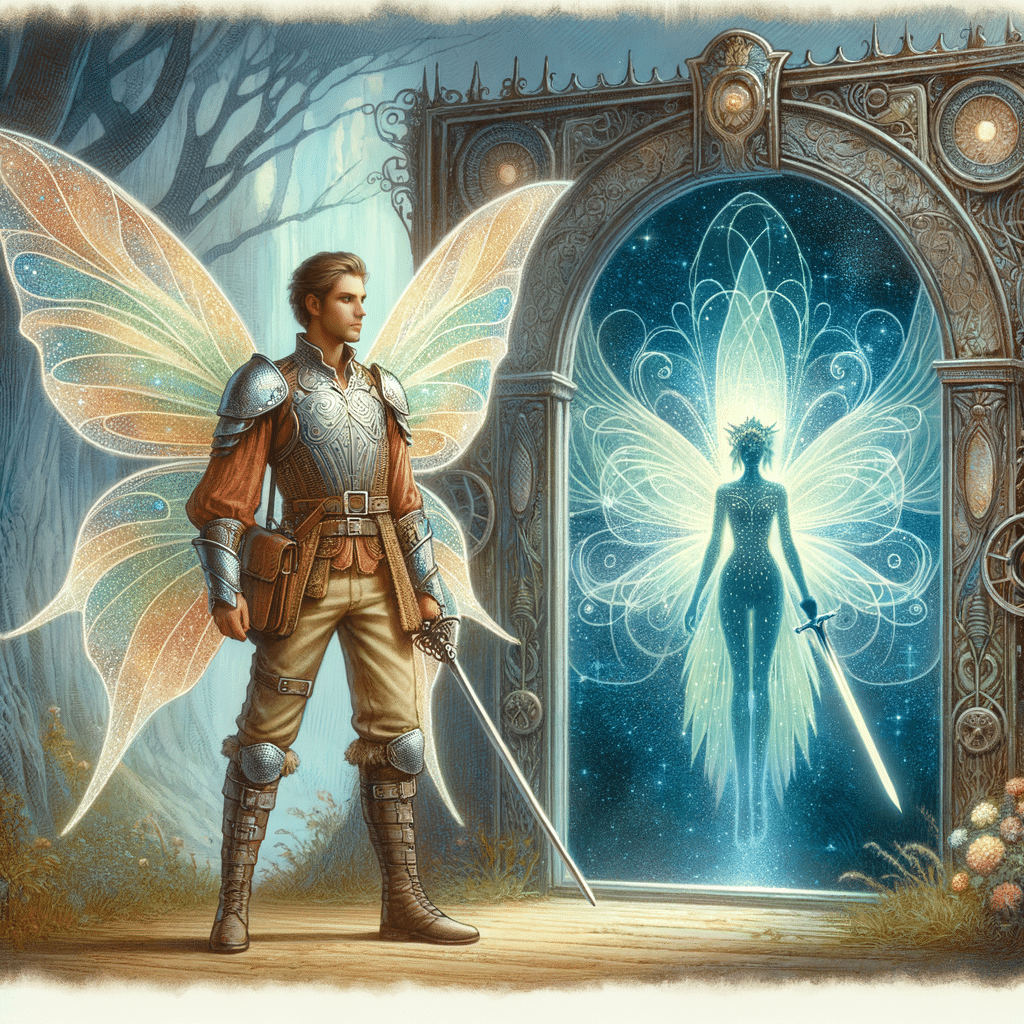
Folklore, mythology, and literature from all over the world and throughout history have included stories about fairies and magical gateways. People have long considered these mysterious species to be small, winged creatures with otherworldly beauty and unpredictable personalities that live on the edge of realms. Portals, whether they are thought of as physical doors, natural structures, or metaphysical portals, are places where the ordinary and the magical, the known and the unknown, and the mortal and worlds beyond meet. There is a deep and complex connection between faeries and these threshold areas. Many stories show these magical beings as protectors, gatekeepers, and guides for people who want to travel between worlds.

Overview
Faeries, also called fae, sidhe, or the fair folk, are difficult to put into groups since they show up in so many different ways in myths from all over the world. In Celtic stories, there are many different kinds of fairies, from tiny pixies and brownies to the royal and terrifying sidhe who ride in a procession on moonlit evenings. The Norse talk about bright and dark elves, and Slavic myths talk about rusalki and leshy who live in forests and waterways. Even though they are entirely different, fairies seem to have certain traits in common: they usually have magical powers, are both kind and cruel to humans, and follow rules and customs that are difficult to understand. Their beauty often hides danger; their gifts often come with hidden charges; and their promises often include hidden traps for people who aren’t careful. This ambiguous quality indicates that these beings exist at the limits of human understanding and emotion (Briggs, 2002).
In folklore and mythology, portals are like liminal spaces, which are the lines that separate different realms or states of existence. These can show up in the real world as stone circles, caves, wells, crossroads, or hollow hills; in time as twilight, midnight, or solstices; or as symbols like mirrors, pools of water, or the line between sleep and wakefulness. These kinds of portals don’t usually stay open all the time; instead, they only work under certain conditions. For example, they might only show up on certain nights, need certain rituals to open, or only be open to those with certain skills or knowledge. The idea of portals shows that people have always believed in worlds beyond our own and have always been interested in what might be beyond what we can see and experience (Conkan, 2014).
The connection between fairies and portals comes from the fact that they are both liminal. Faeries are good guardians for places of transition since they are not altogether divine or mortal, and they are not completely good or bad. In many stories, they guard the doors between realms and decide who can go through them and under what conditions. Fairy rings were believed to be circles of mushrooms where fairies danced in European folklore. People believed that visiting fairy rings was perilous because they could send an unsuspecting traveler to the fairy realm. In Welsh legend, the tylwyth teg lived underground and came out through certain mounds and caves. They were very protective of these entrances and would sometimes lure certain people inside.
Literary works have significantly strengthened the connection between fairies and otherworldly passages. In A Midsummer Night’s Dream by Shakespeare, Puck and the fairies live in a magical woodland where the lines between the fairy world and the human world are very thin, making it possible for them to pass over. In J.M. Barrie’s Peter Pan, Tinker Bell and her fairy friends are closely linked to the way to Neverland, which is “second to the right, and straight on till morning.” Neil Gaiman’s Stardust shows a wall with a gap guarded by watchful villagers. This wall separates the ordinary hamlet of Wall from the magical world of Faerie. These literary depictions add to and strengthen the legendary link between fairies and protecting magical doorways (Baker, 2016).
As guardians of the portals, the fairies often have to test people who want to go through. Various folktales state that individuals who encounter faerie guardians must demonstrate specific traits—such as intelligence, politeness, bravery, or kindness—before they are allowed to enter ethereal worlds. The tests may be clear challenges or subtler encounters, where people show who they are by how they respond to the faeries’ requests or acts. This test shows that only those who are worthy or ready should travel between worlds. Failing these tests can have terrible consequences, such as being stuck in the faerie realm forever, turning into a non-human form, or becoming trapped between worlds forever.

Analysis
Anthropological theories suggest that faerie portal guardians may serve as cultural explanations for how to understand and navigate harmful or unfamiliar environments. Caves, thick forests, and foggy moors were actual physical dangers for people before modern times. Saying that supernatural beings protected them gave people a way to explain disappearances or accidents and warn them. Psychological interpretations see fairies and their portals as symbols of changes in people’s lives, including going from being a kid to an adult, from life to death, or from normal consciousness to altered states. In this perspective, the faerie guardian is a personification of the worries, problems, and possible changes that come with significant life changes (Balee, 2021).
Folklorists say that there are common themes in portal guardian stories from different cultures that suggest they have deeper archetypal meanings. Many mythologies incorporate the concept of a threshold guardian. For example, in Greek mythology, Cerberus guards the underworld, while in Norse mythology, Heimdall guards the rainbow bridge Bifröst. Faeries are a form of guardian that isn’t totally associated with either heavenly order or chaotic destruction. Instead, they symbolize the unclear middle ground of nature itself: they are beautiful yet dangerous, helpful but unpredictable, bound by rules but able to do things that go beyond human moral standards. Because they are in between two clear categories, they are excellent guardians of spaces that are also in between two clear categories (Hume, 2020).
These old links between fairies and portals have become more relevant in modern times. Faerie portal guards are a common theme in modern fantasy books, movies, and games. They take conventional aspects and use them in innovative ways to explore the archetype. In the role-playing game Changeling: The Lost, players move between the human world and hazardous faerie realms across different thresholds that are protected by mysterious fae creatures. These stories have stayed popular over time, which shows that even if we’ve made a lot of progress in technology, people still find meaning in stories about enigmatic borders and the beings that protect them from the outside world. Perhaps the concept of uncharted territories guarded by erratic entities satisfies a profound human yearning for enigma and uncharted possibilities in an increasingly mapped and explicated world.
Conclusion
The link between fairies and portals is a common, enduring theme in stories from all over the world and throughout history. Faeries are naturally the guardians of the boundaries between realms since they are liminal beings themselves. They decide who can pass and when. Their unclear nature—neither completely good nor evil—reflects the unclear nature of transitions, which can be both good and bad. The faerie gate guardian continues to fascinate us, whether we see it as a true belief of pre-modern societies, a psychological symbol of human transitions, or a significant metaphor in modern fiction. In these ancient yet ever-evolving tales, we might recognize ourselves in the characters who find themselves at pivotal junctures, confronting the unfamiliar, and deciphering the enigmatic boundaries that shape our existence.
References
Baker, D. (2016). Within the door: Portal-quest fantasy in Gaiman and Miéville. Journal of the Fantastic in the Arts, 27(3), 470.
Balee, S. (2021). Portals Between Worlds. The Hudson Review, 74(2), 325-336.
Briggs, K. M. (2002). The fairies in tradition and literature. Psychology Press.
Conkan, M. (2014). On the Nature of Portals in Fantasy Literature. Caietele Echinox, (26), 105-113.
Hume, L. (2020). Portals: Opening doorways to other realities through the senses. Routledge.

Leave a Reply