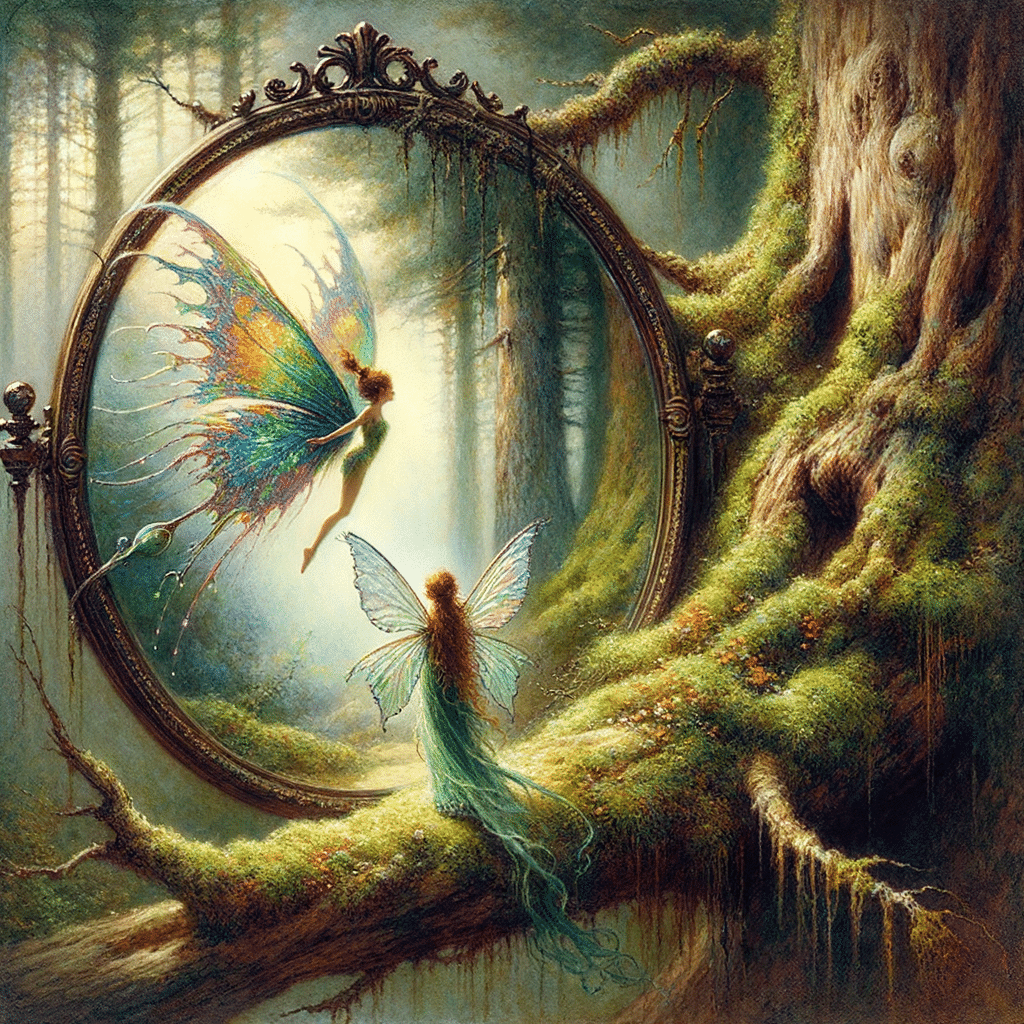
Six Key Points on Fairies and Mirrors
-
Traditional fairies were feared supernatural beings, not adorable, winged creatures.
-
Mirrors were viewed as supernatural portals that could trap souls and reveal truths.
-
Folklore suggests mirrors could trap fairies or serve as pathways between realms.
-
Paranormal theories claim mirrors facilitate fairy crossings through electromagnetic fields.
-
Skeptics attribute these beliefs to psychological disorientation and pre-electric lighting effects.
-
These concepts continue influencing art and spirituality while addressing questions about reality.

Introduction
For hundreds of years, certain things and beings have fascinated people in the dark areas between our world and others. People have long thought that mirrors, with their perfect reflections and strange depths, are doors to other worlds. On the other hand, people believe that fairies reside in a world adjacent to ours and occasionally visit us to converse. When these two subjects come together, they make a fascinating tapestry of folklore, paranormal theories, and cultural beliefs that still exist today, even though we are more skeptical. This essay investigates the connection between fairies and mirrors, analyzing both the captivating folklore and the psychological foundations that continue to make these narratives relevant to us.
Overview
Disney has made fairies into small, winged creatures, but they are actually complex supernatural beings that have been around for a long time. The Fair Folk or Fae were feared and respected in traditional folklore, especially in Celtic traditions. They were powerful beings who could bless or curse people at will. People thought that they looked very different from each other. For example, the sidhe of Ireland looked a lot like humans, while the trolls of Scandinavian lore looked hideous. Their morals were also very different from those of humans. Many cultures believed that fairies could abduct people, particularly children or musicians, and either replace them with changelings or deceive them into thinking they had spent a night in the fairy realm when they actually had not. When they came back, they found that decades had passed in the mortal world. Because fairies were so difficult to understand, people came up with complicated rituals and protections against them (Blamires, 2025).
Over the course of human history, mirrors have also gained many strange connections to the paranormal. Many cultures have found it strange that they seem to show a perfect reflection of the world just beyond the glass. Many cultures believe that mirrors can trap souls. In some places, people still cover mirrors during funerals. The idea that mirrors are doors to other worlds or supernatural realms can be found in Lewis Carroll’s Through the Looking Glass and modern horror movies. People still believe that mirrors can show things that are hidden from the naked eye, like the true form of a vampire, the future through scrying, or ghosts that are always there but not seen. Mirrors are great for supernatural connections because they are in between reality and reflection.
There is a wide range of symbolism, reflection, and metaphor that connects fairies and mirrors, especially in fairy tales. Mirrors are important objects in many cultural stories, and they stand for self-awareness, identity, and change. Mirrors symbolize more than just reflection; they represent deeper psychological concepts associated with individuality and self-realization. Lee, in the realm of analytical psychology, explores how mirrors signify the initial step toward individuation and self-awareness (Lee, 2018).
The connection between fairies and mirrors in folklore makes for a fascinating story thread that runs through many cultures. In many cultures, mirrors were thought to be traps for fairies. The stories said that the Fair Folk would become entranced by their reflections and could be caught or at least slowed down by mirrors placed in the right places. Some stories said that fairies could use mirrors as doors between their world and ours, which is why people used to cover or take down mirrors at night. The stories in which mirrors reveal a fairy’s true nature—showing the glamour (magical disguise) for what it is and exposing a fairy trying to pass as human (O’Connell, 2017)—are especially captivating. Several stories in Celtic folklore recount people’s belief that changelings had replaced their loved ones. They used mirrors to check their suspicions when the fairy couldn’t help but look at its reflection. These stories show how people try to control the fairy world, which is constantly changing.

Analysis
There are a lot of different paranormal theories about these events, from spiritual to pseudo-scientific. Individuals who subscribe to these theories hold varying perspectives on the relationship between fairies and mirrors. Some theorists say that mirrors make electromagnetic fields that make it easier for things like fairies to cross over from one dimension to another. Some people think that mirrors somehow boost psychic energy, which makes it easier to talk to beings from other worlds when they are around. Modern pagans and people who practice different magical traditions sometimes use mirrors in rituals to talk to fairies. They construct intricate mirror-gates from natural materials in an attempt to appease the Fae. Some people even say that certain kinds of mirrors, especially old ones or ones that are in liminal spaces like thresholds or crossroads, are more likely to be fairy portals. These beliefs endure despite the absence of empirical evidence, illustrating the persistent influence of these concepts.
Skeptics, of course, provide more rational explanations for these long-held beliefs. Psychologists cite the disorienting nature of mirrors and the unique experience of perceiving one’s own reflection as potential origins for supernatural associations. They say that reflective surfaces can trick the brain, especially when the light is low or when the person is in a different state of consciousness. These conditions could cause people to mistake normal events for supernatural ones. Folklorists and anthropologists assert that connections to fairy mirrors serve important cultural purposes, such as dissuading children from dangerous places, explaining unusual events, or providing communities with a shared symbolic language. Historical contexts are also important. Before electric lights, mirrors would catch and reflect even the smallest light sources, making movements and glimmers that could be mistaken for fairy activity. These logical explanations don’t make these beliefs less important to culture; they just put them in context.
These interconnected beliefs have a big effect on more than just superstitions; they also affect art, literature, psychology, and even modern spiritual practices. Writers like Shakespeare and Neil Gaiman have used fairy-mirror connections in their work to make stories where reflective surfaces show hidden worlds or true identities. From a psychological standpoint, these beliefs address essential human anxieties regarding identity, perception, and the essence of reality—what we watch in the mirror may differ from others’ observations, prompting inquiries into the dependability of our senses. Carl Jung’s examination of mirrors in connection to the unconscious enriches this discourse, associating the imagery of reflection with profound subconscious mechanisms (Caputo, 2013). In modern spiritual practices, especially those influenced by neopagan or New Age traditions, mirrors continue to be utilized in rituals aimed at connecting with nature spirits or fairy beings. Even for people who don’t really believe in fairies, these traditions are beneficial ways to talk about seeing beyond what you see at first and finding the magic in everyday things. The lasting interest in fairies and mirrors shows that they tap into something deep in the human mind.
Conclusion
In the digital age, our relationship with mirrors and the supernatural beings we think are behind them keeps changing. Smartphone cameras and screens have replaced mirrors in our lives, and stories about digital portals and beings have spread on the internet. But the old connection between fairies and mirrors lives on in new ways, showing how flexible folklore can be. These traditions are useful for helping us understand the lines between worlds, whether we see them as literal accounts of supernatural events or as symbolic representations of human psychology. During our reflections, we may still be looking for signs of something beyond ourselves, something magical that is just out of reach and waiting for people who are willing to look closely enough to identify it.
References
Blamires, S. (2025). The Confessions of Fiona: Mythology and Folklore of the Faeries. Red Wheel/Weiser.
Caputo, G. (2013). Archetypal-imaging and mirror-gazing. Behavioral Sciences, 4(1), 1-13. https://doi.org/10.3390/bs4010001
Carroll, L., & Tenniel, J. (1994). Through the looking glass (p. 224). London: Penguin books.
Lee, Y. R. (2018). Symbolism of mirrors as the first step of individuation and self-awareness. Journal of Symbols & Sandplay Therapy, 9(1), 45-61. https://doi.org/10.12964/jsst.18003
O’Connell, M. (2017). Mirror and veil: the historical dimension of Spenser’s Faerie queene. UNC Press Books.


Leave a Reply