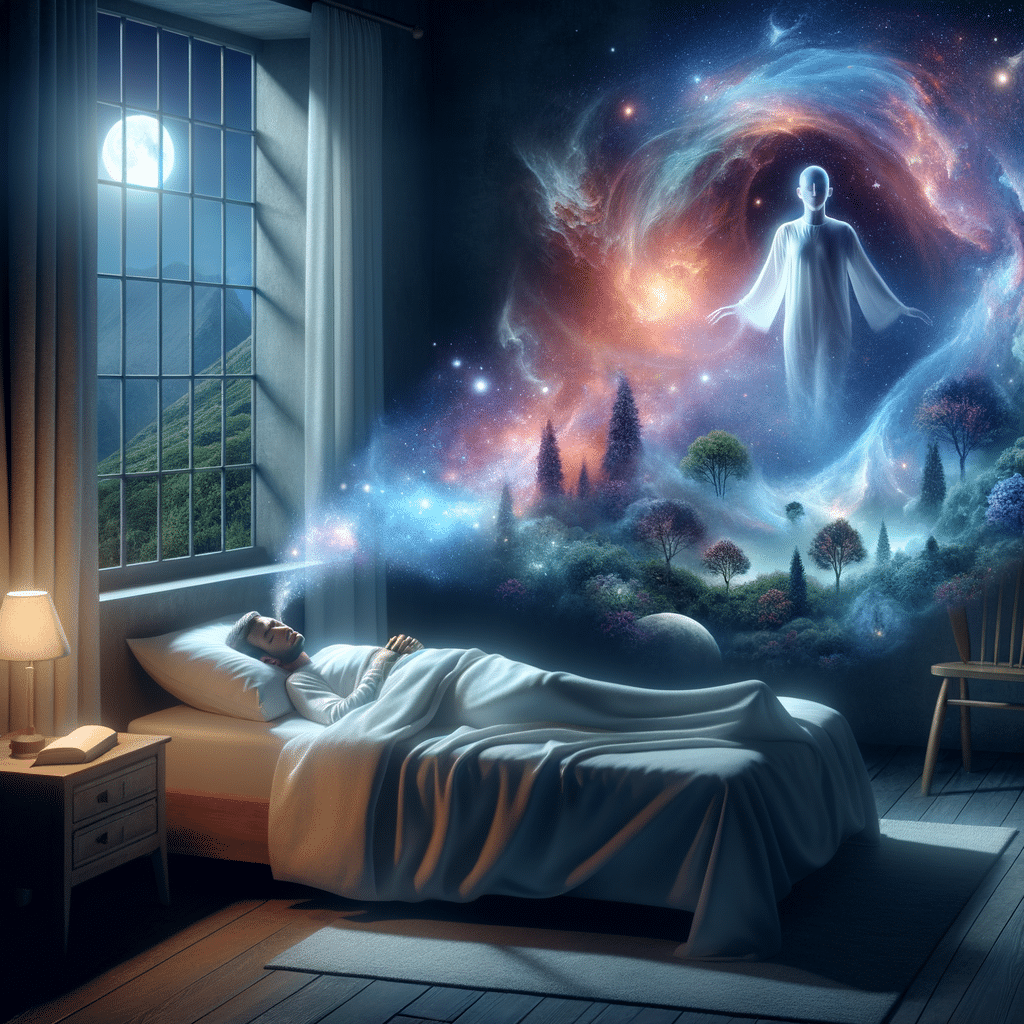
For thousands of years, people have been interested in experiences that seem to go beyond normal consciousness, especially those that happen during sleep or while individuals are in altered states. Astral projection and lucid dreaming are two experiences that challenge our understanding of consciousness and reality. These states are different but related methods of experiencing consciousness beyond typical waking awareness. People who practice or believe in them say they can provide us a glimpse into realms that are beyond our physical limits. People worldwide have written about these experiences and developed various ways to understand and interpret them. Such activity has led to both spiritual practices and scientific research.

Overview
Astral projection is the idea that the mind or astral body may leave the physical body and travel through space on its own. People who practice say they feel like they are floating above their bodies, moving through walls, or even going to faraway places while their bodies stay still. People often say that their astral body is getting ready to detach when they feel vibrations, buzzing sounds, or electrical energy moving through their bodies. People who have experienced astral projection say that their consciousness and perception are heightened, and they claim to be able to see their surroundings with exceptional clarity and from angles that are difficult to reach physically.
Many spiritual and religious traditions discuss astral projection, but each one has its own way of understanding it. The Ka was a spiritual double that could leave the body, according to the ancient Egyptians. In Hinduism, the idea of the subtle body has been discussed for thousands of years and can go beyond physical limits. “Dream yoga” and “consciousness transference” are two Tibetan Buddhist practices that are similar to what people today call “astral travel.” Usually, these religions see astral projection as proof that awareness is separate from the body, which supports beliefs in an afterlife or a reality that goes beyond material existence.
In contrast, lucid dreaming is a state in which the dreamer realizes they are dreaming while still in the dream state. This stage lets them have different levels of influence over the dream’s setting and story. People usually become aware of their dreams when they see signs in them, which are strange or implausible things. Once they realize they are dreaming, dreamers say they can fly, modify their environment, call certain people or things, and do things that are impossible in the dream world. The experience is marked by incredible clarity and mental function that is similar to awake consciousness, even though it happens completely in the mind while sleeping.
Scientists have proven that lucid dreaming is real. In lab trials, lucid dreamers were able to talk to researchers from inside their dreams by moving their eyes. These studies have shown that lucid dreams usually happen during REM sleep and involve more activity in the prefrontal cortex, which is the part of the brain that controls executive processes and self-awareness. Reality testing (regularly questioning whether one is dreaming), keeping dream journals, setting intentions before sleep, and wake-back-to-bed methods, in which people deliberately interrupt their sleep to make their dreams more clear when they go back to sleep, are all modern ways to induce lucid dreams.

Putting Them Together
Some people who practice lucid dreaming think it could be a means to astral projection. They say that the heightened awareness in lucid dreams can be used to help people leave their physical bodies. Techniques that incorporate both lucid dreaming and astral projection usually begin with achieving lucidity, followed by specific visualizations or intentions to transition from the dream state to astral projection. This procedure could mean picturing yourself floating up, going through a portal, or just wanting to leave your dream body behind. People typically say that the transitional experience involves a change in the quality of perception, with astral projection feeling “more real” than even lucid dreams and having its own unique noises or vibrations.
There are many references to experiences that are like astral projection and lucid dreaming in literature and mythology. In Homer’s Odyssey, the goddess Athena sends dream messengers to talk to people. This belief is based on what the ancient Greeks thought about dream consciousness. Around the world, shamanic traditions discuss soul journeys, in which practitioners leave their bodies to go to spiritual or faraway places. The Tibetan Bardo Thodol (Liberation Through Hearing During the Intermediate State) has specific directions for how to navigate your consciousness after you die that are similar to astral projection narratives. Carlos Castaneda’s controversial books from more recent years discuss ways to change how you see things and reach dreaming states that combine lucid dreaming and astral projection.
Modern literature keeps this tradition alive. For example, Robert Monroe’s Journeys Out of the Body gives comprehensive first-person accounts of astral experiences, and movies like Inception look at the idea of manipulating dreams while awake. The fact that these themes are found throughout many different cultures and times shows that they represent universal features of human consciousness, whether they are considered literal travels or symbolic representations of psychological processes. People’s experiences have shaped these cultural manifestations, creating a complex framework of interpretation and method.
Analysis
There are many different scientific explanations regarding these phenomena. Some people who don’t believe them say that both experiences are just hallucinations that happen in the brain. Neurological theories say that the feelings that come with astral projection, such as floating, vibrations, and feeling like you’re beyond your body, are caused by transitory problems with the brain’s body-mapping abilities, especially in the temporoparietal junction. Sleep paralysis is a condition in which a person wakes up but their body stays still during REM sleep. The sensations that people express during this state are quite similar to those that individuals report when they first start to astral project. From this perspective, both events represent different interpretations of unusual yet entirely physical brain states that occur during the transition from sleep to wakefulness.
Some more speculative hypotheses say that awareness might really work outside of the brain in some situations. Some people who study consciousness think that the brain might not be the source of consciousness but rather a receiver or transceiver of it. This approach could let people see things that are beyond their physical limits in certain conditions. Quantum theories of consciousness suggest ways that awareness could go beyond the limits of conventional physics, but these ideas are still quite contentious in mainstream science. Parapsychologists have done tests to try to prove claims of perception during out-of-body episodes. The results have been mixed and disputed, which shows how challenging it is to examine subjective experiences objectively.
Astral projection and lucid dreaming provide us a glimpse into the nature of human awareness and its possibilities. Some people see them as real travels of consciousness beyond the body, while others see them as fascinating things that happen because of how complicated the brain is. These encounters make us question what we think we know about the limits of consciousness and encourage us to look into states of awareness that are beyond the norm. They show that our subjective experience has depths and dimensions that go far beyond what we see and hear every day. Various techniques and practices, developed over time and across cultures, provide access to these realms. These practices can help you learn more about yourself, get new ideas, and grow as a person, regardless of what their ultimate metaphysical position is.
Conclusion
Astral projection and lucid dreaming are two entirely unique states of consciousness that have fascinated people for thousands of years. Science is still studying the neural basis of these experiences, but they are still very meaningful and can change lives. The lines between dreams, visions, and other realities may not be as clear-cut as we think. This conclusion suggests that consciousness itself may be more complex and perplexing than we usually think it is. Whether you see them as spiritual practices, ways to learn about your mind, or just plain curiosity, these unusual states of consciousness keep giving us new ideas about the nature of mind and reality. They make us all wonder what it means to be conscious beings in a universe that is still full of mysteries.
References
Castaneda, C. (1968). The teachings of Don Juan: A Yaqui way of knowledge. University of California Press.
Evans-Wentz, W. Y. (Ed.). (1960). The Tibetan book of the dead: Or the after-death experiences on the Bardo plane (Lama Kazi Dawa-Samdup, Trans.). Oxford University Press. (Original work published 1927)
Homer. (1919). The Odyssey (A. T. Murray, Trans.). Harvard University Press. (Original work published ca. 8th century BC)
Monroe, R. A. (1977). Journeys out of the body. Harmony Books.




Leave a Reply