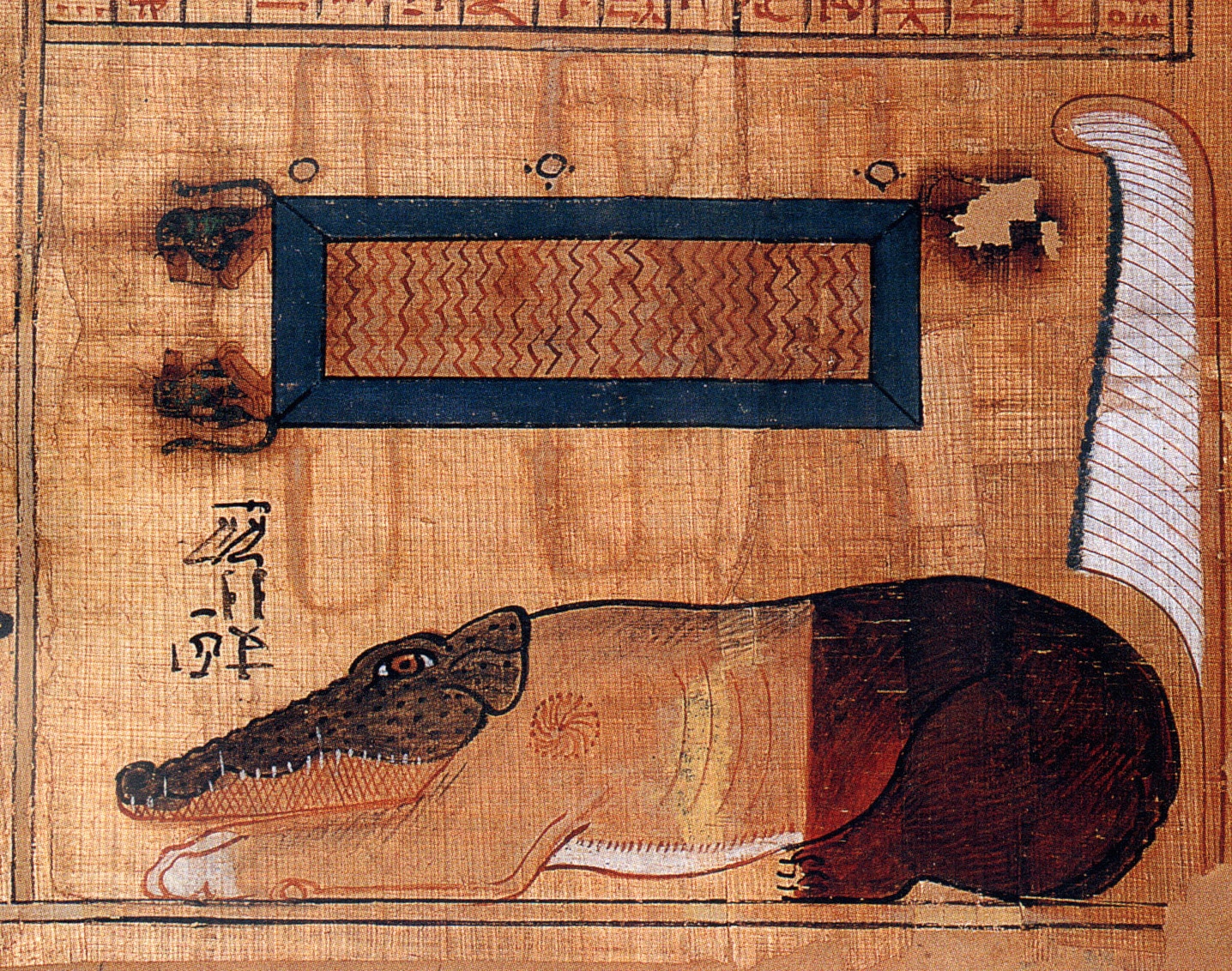
Though not revered as a goddess, Ammit is among the most terrifying and important entities in the enormous pantheon of ancient Egyptian gods and legendary beings. Often called the Devourer of Hearts, Eater of the Dead, or Great of Death, Ammit was significant in the ancient Egyptian view of the afterlife and moral judgment. Ready to devour the hearts of those judged unworthy of eternal life, this terrible being waited in the Hall of Two Truths during the weighing of the heart ceremony. Ammit’s anxiety among the ancient Egyptians mirrored their strong preoccupation with moral behavior during life and their conviction in cosmic justice that would be served even after death.

Overview
Ammit possessed one of the most distinctive appearances in Egyptian mythology, a fusion of traits from Egypt’s three most lethal creatures, symbolizing terror. Usually shown with the head of a crocodile, she represented her violent temperament and link to the Nile’s most dreaded predator. While her back end was that of a hippopotamus, an animal the Egyptians much feared for its erratic and hazardous character, her torso mirrored that of a wild lion or lioness, signifying strength and predatory prowess. Combining the most hazardous features of animals from water, land, and riverbank into one horrific entity that could completely kill not only the body but the soul itself, this hybrid look emphasized Ammit’s function as the ultimate consumer of the unworthy (Ikram, 2015).
Unlike other people in Egyptian mythology, Ammit was a personification of divine punishment and cosmic balance, neither a god to be worshipped nor a demon to be exorcised. She sat patiently in the Hall of Two Truths next to the Ma’at scales, where the heart of the deceased was weighed against the feather of truth, not actively hunting the dead. Should the heart be found heavier than the feather—weighted down by crimes, lies, and wicked acts—Ammit would consume it, so dooming the dead to a second death, permanent and final. Eliminating all prospect of eternal life, this “second death” was total annihilation of the soul, which ancient Egyptians thought a destiny worse than any suffering. Her actions were not bad but rather functional, acting as the last executor of divine justice.
Fundamentally connected to the idea of Ma’at, which stood for truth, balance, and cosmic order, Ammit had a part in the Egyptian dying process. Detailed in the Book of the Dead, the Weighing of the Heart rite saw the deceased’s heart set on one side of a scale opposite Ma’at’s feather. Anubis would supervise the weighing; Thoth, the god of knowledge, would note the outcomes. Should the scales balance, the dead would go to the afterlife having lived a life in line with Ma’at. Conversely, a heart that was heavier than the feather signified a life filled with sin and imbalance; Ammit would consume it, thereby depriving the deceased of eternal life. This procedure underlined the Egyptian conviction that the soul’s everlasting path was directly affected by one’s deeds in life (Ayoub, 2021).

Evolution of Ammit
Unlike other legendary characters, whose folklore originated mostly from popular stories, Ammit’s folklore grew mostly in the setting of Egyptian funerary texts and procedures. Ammit’s greatest visible evidence is in the Book of the Dead, a compilation of spells and directions meant to enable the dead to navigate the afterlife effectively. Though ideas of judgment and punishment in the afterlife predated Ammit, the most obvious representations of her date to the New Kingdom era (approximately 1550-1070 BC). Ammit was a constant presence in funerary art all through Egyptian history, appearing in tomb paintings and on papyri depicting the judgment scene. Unlike other legendary characters who had temples devoted to them or were mentioned in well-known stories, Ammit resided mostly in the domain of eschatological beliefs, where she served as a strong reminder of the repercussions waiting for those who lived unfairly (Siuda, 2024).
Ammit’s myth’s growth over time mirrors shifts in Egyptian religious thought and afterlife ideas. Earlier in Egyptian history, the afterlife was seen mostly as the pharaoh’s domain; common people had little chance for eternal life. As religious ideas democratized, especially during the Middle and New Kingdom eras, the judgment scenario involving Ammit became meaningful to all Egyptians, not just royalty. This change coincided with a growing focus on personal piety and moral conduct as factors deciding one’s destiny after death. Though Ammit stayed a fairly constant presence in this process, the idea of divine judgment kept changing during the Late Period (664-332 BC) as Egyptian religion was affected by foreign cultures. Later, when Greeks and Romans came across Egyptian mythology, they frequently viewed Ammit through their own cultural prism and sometimes drew connections between her and their own underworld monsters like Cerberus.
Ammit’s symbolism went beyond simple punishment to include more general Egyptian ideas of cosmic order and moral conduct. Unlike the Western idea of hell as a place of suffering, Ammit signified a new sort of theological threat—that of nonexistence. For Egyptians, who attached great value to the continuity of life after death, the idea of having one’s heart consumed by Ammit signified the greatest failure. Ammit’s judgment reinforced social norms and moral regulations, therefore motivating ethical conduct during life. Crocodile, lion, and hippopotamus—all physical parts of Ammit—were animals the Egyptians both feared and respected, therefore underlining her function as a natural force of cosmic punishment rather than an arbitrary punisher (Johnson, 2016).
Ammit’s importance in Egyptian mythology has persisted across time, especially in modern readings of ancient Egyptian beliefs and popular culture. Archaeological finds of tomb paintings and funeral papyri have kept her terrifying appearance for contemporary historians to examine, therefore offering insightful analysis of Egyptian ideas of justice, morality, and the afterlife. Though occasionally with simplifications or changes to her original function, Ammit regularly appears in modern works inspired by Egyptian mythology as a symbol of ultimate justice or karmic vengeance. Ammit’s lasting appeal reflects people’s ongoing curiosity about cosmic justice, moral responsibility, and what becomes of the soul after death—issues the ancient Egyptians investigated using the terrifying image of the heart-devouring chimera waiting at the scales of judgment (Wojtala, 2019).
Conclusion
Ammit is a significant component of ancient Egyptian eschatology since she reflects their views on divine judgment, moral responsibility, and the outcomes of people’s choices in life. Though not worshipped or having specific temples, she was of great psychological and spiritual importance in Egyptian society as the last arbitrator of one’s suitability for eternal life and the ultimate deterrent against immoral conduct. While her part in the weighing of the heart ceremony underlined the Egyptian concern for living according to Ma’at—truth, balance, and justice—her terrifying composite form united Egypt’s most deadly animals. Ammit was a strong reminder, via shifting dynasties and changing religious ideas, that in the Egyptian view, the afterlife was not assured but rather earned by righteous living. Failure to live according to divine ideals caused not punishment but total destruction of the soul, a notion still captivating academics and the general population as we strive to grasp ancient views on mortality, morality, and cosmic justice.
References
Ayoub, R. (2021). The 42 Laws of Maat: Ancient Egypt’s Code of Ethics and Moral Guidance.
Ikram, S. (2015). Death and burial in ancient Egypt. American University in Cairo Press.
Johnson, J. V. (2016). Intertwined Demons: The Relationship between Gate Guardians and the Demon Ammit in Nineteenth Dynasty Book of the Dead as Expressed through Synecdoche.
Siuda, T. L. (2024). The Complete Encyclopedia of Egyptian Deities. Llewellyn Worldwide.
Wojtala, M. (2019). The presence of Egypt in pop culture. Egypt Yesterday and today, 87.



Leave a Reply