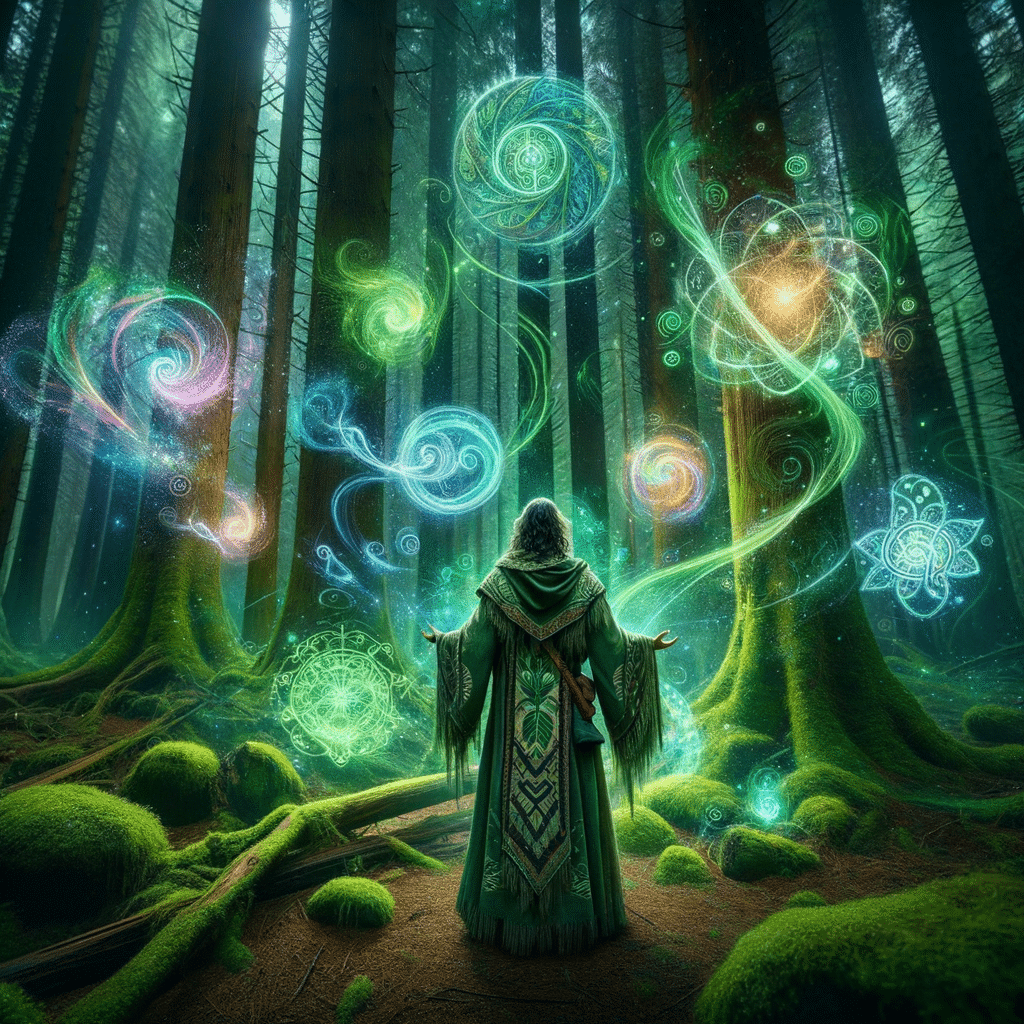
The ancient order of druids is one of the most mysterious spiritual traditions in history. For centuries, incomplete historical records have cloaked their activities in mystery, leading to misinterpretations. One of the most intriguing things about them was that they were said to be able to use elemental magic, which is the ability to control earth, air, fire, and water through ritual and a deep connection with nature. This enigmatic bond between druids and the fundamental elements of nature reveals a complex spiritual framework, illustrating their understanding of the universe and their role as intermediaries between humans and the natural world. A lot is still unknown about what druids really did, but looking at the connection between druidic tradition and elemental magic gives us a lot of information about how ancient Celtic people thought about their relationship with the world around them.

Overview
Around the 3rd century BC, the druids became the educated class in Celtic civilization. They served as priests, judges, healers, teachers, and advisors to tribal leaders in ancient Gaul, Britain, and Ireland. Writers from the past, such as Julius Caesar and Pliny the Elder, wrote about how important druids were. They said that druids were intelligent and needed up to twenty years of instruction before they could completely join their order. Archaeological finds and later medieval Irish manuscripts imply that druids kept oral traditions instead of written records. They passed down their vast knowledge of astronomy, natural philosophy, medicine, and divination through generations of apprentices. Their sacred places were usually in forest groves or near natural features like springs, mountains, and stone circles. These features let them see themselves as protectors of natural knowledge. The druids’ decline started with the Romans taking over and eventually converting to Christianity. The conversion pushed their activities underground and made it much harder to grasp their real traditions (Fitzpatrick, 2007).
Many ancient spiritual traditions worldwide embrace the concept of elemental magic. It is based on the idea that all matter comes from four basic elements: earth, air, fire, and water. This old idea of the elements came before contemporary chemistry and physics. It saw these forces not just as physical things but as spiritual essences that had their own unique traits and energy. Earth stood for stability and fertility, air for intelligence and communication, fire for change and cleansing, and water for intuition and emotional depth. Many cultures before modern times thought that skilled people could control these elements in different ways, such as through ritual, meditation, and sympathetic magic. The effects could be useful (healing, changing the weather, making crops more fertile) or spiritual (predicting the future and communicating with supernatural beings). The basic framework gave ancient humans a complete way to grasp the physical world and the unseen forces that made it come to life (Hopman, 2024).

Druidic Elemental Magic
Historical records and archeological data suggest that druids probably did their elemental work through complex seasonal ceremonies that were scheduled to align with the stars and the cycles of nature. Stone circles and other megalithic constructions in the Celtic culture show that druids had a profound understanding of how the sun and moon moved. The evidence suggests that they used celestial patterns to figure out the best times for elemental activities. They are said to have kept sacred fires going during solstice celebrations, done rituals near healing springs said to have water elemental energies, and held rites at high places to tap into air elements linked to inspiration and vision. Excavations have found ceremonial deposits of meticulously organized things that stand for different elements, like metals, crystals, organic materials, and vessels. The evidence suggests that druids made symbolic arrangements to call on elemental energies. Classical writers said that druids used golden sickles to select sacred plants like mistletoe during certain phases of the moon. This implies that they believed they could harvest specific items from plants when the stars aligned (Wolfe, 2004).
Druidic practice seems to be reciprocity, which means that elemental forces respond to partnership instead of dominance. Later ideas of magic saw practitioners as controlling supernatural powers. Druidic ideas, on the other hand, probably focused on being worthy of elemental assistance by study, purification, and leading a moral life. Old stories say that people had to prepare for a long time before doing big things, such as fasting, bathing in holy springs, and spending time alone in wild locations to get in touch with elemental energies. The druids’ claimed capacity to change the weather, make crops grow, and help people heal probably came from this relational paradigm, in which elements reacted to rites that were done correctly by people who showed the right amount of respect. They probably knew a lot about how nature worked, which let them foresee and seem to control natural events by scheduling their ceremonies to correspond with expected changes. This approach made them seem like masters of elemental forces (Monroe, 2002).
Theoretical reconstructions show that druids may have had a deep awareness of how elements, seasons, directions, and human circumstances were related to each other. Every ceremony would likely consider the complex relationships among these components, creating a comprehensive system in which, for instance, healing might involve balancing the patient’s elemental powers according to the season. Some historians think that druids believed in a fifth element, called spirit or aether, that connected and went beyond the four physical elements and represented consciousness itself. This quintessence may have been reached during rituals when people were in altered states, which could have been caused by meditation, sacred herbs, or music and rhythmic motions. People may have used the intricate knotwork and spiral patterns in ancient Celtic art as visual aids to contemplate these elemental relationships. People may have also utilized them as meditation techniques to understand the interplay of elemental states. Archaeological discoveries of elaborate headdresses, staffs, and ceremonial objects imply even further that druids used unique tools to focus and direct elemental energies during their work.
Analysis
There are a number of different interpretations in modern studies regarding what druidic elemental rituals were like and how widespread they were. The astronomical theory says that druids were mostly scientists of their time. They used what looked like magical rituals as a way to pass on useful information about when to plant crops, how the weather worked, and how to use medicine. Their elemental framework was more like an early classification system than supernatural manipulation. The psychological interpretation suggests that the primary purpose of elemental rituals was to address the psychological needs of the community. Druids acted like early psychologists, using elemental symbols to create meaningful experiences that helped people deal with their collective fears, changes, and grief. According to the spiritual-energetic idea, druids really did engage with subtle energetic forces that modern science hasn’t yet discovered. Their traditions preserved advanced methods for controlling consciousness and natural energies through trained perception and ritual technology. There is probably some truth in each hypothesis, since spiritual traditions from the past usually worked on practical, psychological, and philosophical levels at the same time.
Druidic elemental practice has impacted current spiritual movements, especially modern Druidry, Wicca, and other ecological spiritualities that want to bring back ancient knowledge traditions. Modern practitioners know that there are big gaps in our knowledge of traditional druidic ways, but they use the pieces that are still there to construct systems that honor elemental forces in today’s world. Archaeological finds are providing us new information about possible druidic places and practices. For example, excavations in wetlands have found complex ritual deposits that reflect advanced elemental ceremonies. The lasting interest in druidic elemental magic shows that people still are keen to learn more about how we interact with natural forces and how we might have a meaningful role in ecological systems. As worries about the environment grow, the druidic idea of working with elemental forces in a respectful way is a strong alternative to taking advantage of the natural world (Hughes, 2023).
Conclusion
The druids’ use of elemental magic is a complex ecological philosophy that is hidden behind magical language and ceremony. Their system recognized the basic connection between human groups and natural forces. Trained practitioners acted as mediators, making sure that the two worlds stayed in balance. Even though historical evidence is still patchy and often comes from Roman and Christian sources that are hostile to Celtic spirituality, the picture that is starting to emerge suggests that druids created complex systems for working with elemental energies within cosmological frameworks that were in tune with natural cycles. The druidic tradition teaches us that our ancestors had a deep understanding of how nature works and how people think, even though they didn’t have the scientific language we do today. As modern society deals with an ecological crisis and a lack of spiritual connection to the natural world, the ancient druids’ respect for the elements can help us reconnect with the environment that supports all life.
References
Fitzpatrick, A. P. (2007). Druids: towards an archaeology. Communities and Connections: Essays in Honour of Barry Cunliffe, Oxford University Press, Oxford, 287-315.
Hopman, E. E. (2024). Celtic Druidry: Rituals, Techniques, and Magical Practices. Simon and Schuster.
Hughes, K. (2023). The Book of Druidry: A Complete Introduction to the Magic & Wisdom of the Celtic Mysteries. Llewellyn Worldwide.
Monroe, D. (2002). The 21 Lessons of Merlyn: A Study in Druid Magic & Lore. Llewellyn Worldwide.
Wolfe, A. (2004). Druid Power: Celtic Faerie Craft and Elemental Magic. Llewellyn Worldwide.


Leave a Reply