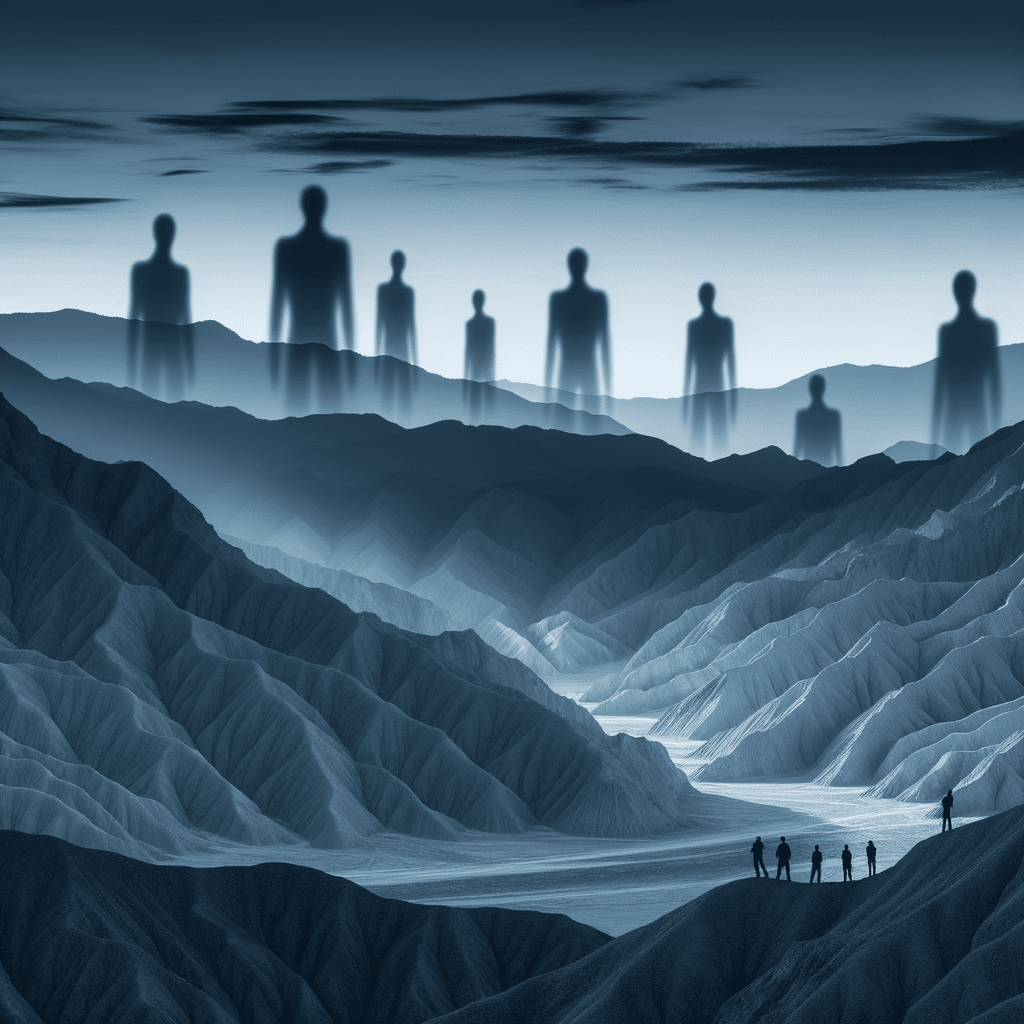
For hundreds of years, people have told stories about strange entities called the Dark Watchers who live along the ridges of California’s Santa Lucia Mountains. When fog drifts in from the Pacific, it covers the peaks in mist. Early Spanish settlers called these mysterious beings Los Vigilantes Oscuros. Reports state that they silently observe visitors from high altitudes across the mountain range. These ghostly sentinels are neither plainly evil nor good, and they have become part of Central California legend. They have inspired painters and writers and sparked debate about how people see things, hallucinate, and search for patterns in the unknown. Their existence is a unique mix of indigenous beliefs, Spanish colonial influence, and modern psychological knowledge that continues to fascinate both locals and visitors.

Overview
People generally describe the Dark Watchers as outlines of impossibly tall figures that appear at dusk or dawn along the ridgelines of the Santa Lucia Mountains. People say that these creatures stand still against the sky and wear wide-brimmed hats or hooded cloaks that make them look even bigger. They might sometimes look like they are seven feet tall or more. Their features are still blurry and hazy, and even people who say they have seen them up close can’t make out any definite facial features. Some stories say they had walking sticks or staffs with them, and their whole bodies looked like a black abyss against the horizon, soaking up the fading light of evening instead of reflecting it (Donohue, 2019).
The way these beings act may be just as scary as how they seem. People say that Dark Watchers stay absolutely still and watch passengers from a distance without getting too close or talking to them. People say they vanish if you look at them or approach. This elusive trait has made them hard to document and has made them legendary. Unlike many other supernatural beings in folklore, the Dark Watchers are generally not considered destructive to people. Instead, they seem to be there to watch over the mountain terrain, like guardians or sentinels. Some people consider them to be guardian spirits instead of evil beings because they don’t do anything (Whitehurst, 2019).
The story of the Dark Watcher probably goes back to before Europeans came to the area. It may have started with the Chumash and Salinan peoples, who lived there for thousands of years before the Spanish came. These native groups have deep spiritual traditions that included believing in spirits of nature and guardian beings tied to certain locations. Spanish missionaries and settlers came to the area in the 18th century and saw similar ideas. They may have even seen strange things in the mountains themselves, which is how the name Los Vigilantes Oscuros came about. The mythology grew stronger during the Mexican and early American periods, when travelers and settlers who crossed the harsh coastal mountains reported seeing the same things. This was especially true during the gold rush, when traffic through the area rose substantially.
Literary references have been crucial in keeping the Dark Watcher mythology alive and well-known. In his 1938 short tale Flight, John Steinbeck, who grew up in the Salinas Valley next to the Santa Lucia Mountain, talked of these beings. Steinbeck’s buddy, poet Robinson Jeffers, also used the Dark Watchers in his work, especially in his poem Such Counsels You Gave to Me. Their popularity made them even more well-known in California culture. These literary adaptations turned what could have been local folk tales into cultural phenomena that are better known, keeping the legend alive throughout times when interest in folklore and supernatural beliefs might have faded (Shillinglaw, 2011).

Analysis
The development of the Dark Watcher myth shows how American society and intellectual thought have changed throughout time. Interest in the Dark Watchers grew again during the counterculture movement of the 1960s and 1970s. Young people were exploring psychedelic experiences and many spiritual paths, and they sometimes used these new ideas to make sense of their experiences in the mountains. The internet has made it possible to collect and compare Dark Watcher sightings recently. Online forums and social media have also enabled witnesses to share their previously isolated stories. The digital preservation and sharing of this mythology have given it fresh life, even though people today are generally less likely to believe in supernatural explanations.
There are valid scientific and psychological explanations for seeing Dark Watchers that are more credible than supernatural ones. The most common explanation is a phenomenon called superior mirage or Fata Morgana, in which the weather makes distant objects look distorted and bigger than they really are. The Santa Lucia Mountains are a place where these weather patterns happen a lot because warm air from the coast meets cool fog from the coast. These optical illusions, along with the psychological phenomenon of pareidolia—the tendency for people to see familiar patterns, especially faces or human forms, in random stimuli—could explain many reported sightings, particularly at dawn and dusk when the light is best for seeing things wrong.
Some cryptozoologists suggest a connection between Dark Watcher sightings and Bigfoot or Sasquatch folklore. They think that both of these things might be evidence of encounters with a new type of hominid. But there are significant differences in how Dark Watchers act, look, and like to live compared to Bigfoot, so this relationship is weak at best. People usually say that Bigfoot is a real creature that leaves behind physical proof like footprints. Dark Watchers are known for their ghostly, otherworldly quality and their tendency to vanish when approached. These diverse traits point to different folk traditions instead of different ways of looking at the same thing.
Another possible reason for hallucinations is the challenging weather conditions that travelers in the Santa Lucia Mountains typically face. Not getting enough sleep, not drinking enough water, being at a high altitude, and being too tired can all cause visual hallucinations, especially in places where fog or low light makes it difficult to see. Ergot fungus may infect grain and make hallucinogenic substances that are similar to LSD. Their presence could have also changed how people wrote about history. Because early settlers would have eaten grain grown in the area, this environmental element could help explain some of the earliest sightings that helped start the legendary tradition.
There are definitely psychological and cultural reasons why Dark Watcher beliefs have lasted for so long. People’s brains naturally look for meaning and story coherence, which is why they often use culturally available frameworks to make sense of things that aren’t clear. This priming effect may make it more likely for those who have heard Dark Watcher stories to think that strange things they see are encounters with these legendary beings while they are in the Santa Lucia Mountains. The mountain range is remote, with often extreme weather and difficult terrain, making it a place where travelers may feel especially insecure and more likely to perceive watchful presences around them.
People have different ideas about the Dark Watchers of the Santa Lucia Mountains. Some think they are optical illusions, hallucinations, or misunderstood natural occurrences, while others think they are real supernatural beings. They are a great illustration of how landscape shapes folklore and how folklore shapes how we see the outdoors. The fact that people keep seeing these shadowy creatures shows that they fulfill some deeper psychological or cultural need, maybe because they represent the feeling of being watched by forces we don’t comprehend when we go into the wild. Despite our ability to map the world with satellites and maintain constant connectivity, these mysteries persist. Their existence shows that we still want to be amazed and that some parts of human experience are still hard to fully explain scientifically.
Conclusion
Not only do the Dark Watchers inhabit the physical ridgelines of the Santa Lucia Mountains, but they also occupy the boundary between the known and the unknown, between scientific rationalism and folkloric tradition. Folklore is not just a remnant of more superstitious times; it is a living tradition that changes with society, adding new ways of explaining things while keeping the core elements that speak to all people. Their ongoing presence in California’s cultural landscape serves as a reminder of this. Whether we perceive them as shadows, spirits, or optical illusions, the Dark Watchers remain vigilant from their elevated positions. They are silent witnesses to our ongoing interest in the mysteries that lie just beyond our understanding. Even when we are logical, we are still drawn to the shadowy figures that seem to watch us from just beyond the reach of certainty.
References
Donohue, C. (2019). In Search of the Dark Watchers: Landscapes and Lore of Big Sur With field sketches and paintings.
Jeffers, R. (1938). Such counsels you gave to me. In The selected poetry of Robinson Jeffers. Random House.
Shillinglaw, S. (2011). A Journey into Steinbeck’s California. Roaring Forties Press.
Steinbeck, J. (1938). Flight. In The long valley (pp. 45-62). Viking Press.
Whitehurst, P. (2019). Haunted Monterey County. Arcadia Publishing.
Leave a Reply