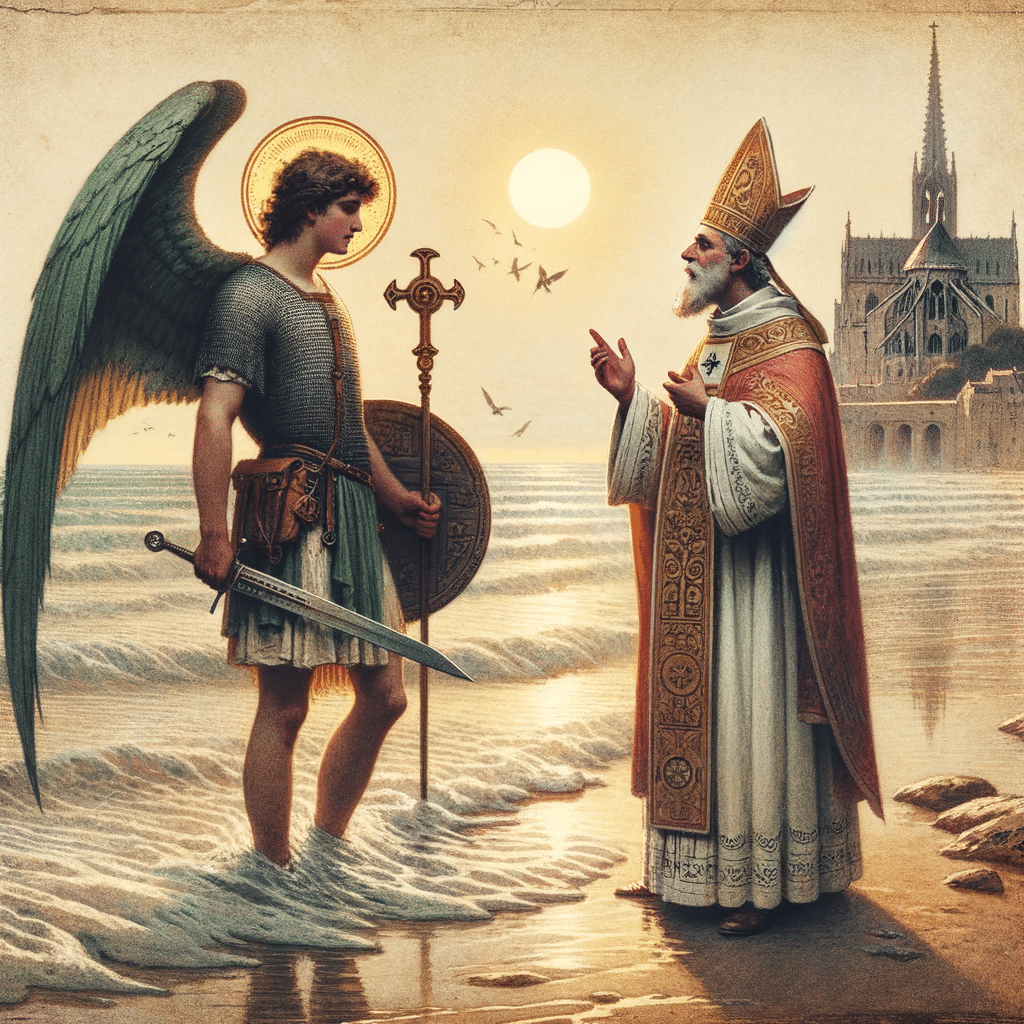
Rising from hazy waters, the ethereal form of Mont-Saint-Michel has enthralled pilgrims and visitors for more than a millennium, a monument to both human architectural creativity and divine inspiration. Topped by an abbey honoring one of Christianity’s most potent spiritual entities, the Archangel Michael, this wonderful island paradise off the coast of Normandy stands among the most stunning instances of medieval religious architecture in Europe. This holy mount’s relationship with its celestial patron combines religious dedication, architectural genius, and supernatural lore to create a setting where the line separating heaven from earth seems to dissolve. Mont-Saint-Michel has stayed a constant monument of supernatural protection and the continuing belief in celestial intervention in human affairs through millennia of political instability, war, and shifting religious attitudes.

Angelic History
With its amazing walls separating the holy from the mundane worlds, Mont-Saint-Michel physically demands enormous respect. Built between the 13th and the 16th centuries, these enormous stone defenses ring the whole island and resisted many sieges over the Hundred Years’ War, hence earning Mont-Saint-Michel its reputation as an indestructible fortress. Rising to 15 meters high in some areas, the walls feature remarkably conserved defensive towers, gatehouses, and battlements. As pilgrims and guests ascend on their trek to the abbey at the rocky summit, the Grande Rue, the principal thoroughfare, winds upward past these defenses, guiding them in their physical expression of the spiritual journey they intend to accomplish (Adams, 1986).
Beginning in 708 AD, Mont-Saint-Michel’s revered history starts with Bishop Aubert of Avranches reporting a sequence of miraculous visits from the Archangel Michael. The origin myth goes that Michael visited Aubert three times, telling him to create a sanctuary on the rocky islet then known as Mont Tombe. The archangel supposedly placed his finger into Aubert’s skull as the bishop hesitated, marking the priest of the validity of the vision. The first archangel’s shrine was built by 709, and shortly after, Benedictine monks founded a community that would grow to be the great abbey complex seen today. Mont-Saint-Michel’s strategic location, isolated at high tide but reachable at low tide, reflected the archangel’s function as a mediator between heaven and earth, hence reinforcing the spiritual value of the monument (Smith, 2004).
Michael is supremely important in Christian theology as the commander of God’s celestial army and the guardian of the faithful against evil forces. In Hebrew, his name begs the rhetorical inquiry, “Who is like God?” —a challenge to Satan’s pride and revolt. Unlike other archangels, Michael appears in several religious books, including the Bible, where the Book of Daniel defines him as the defender of Israel, and the Book of Revelation shows him leading heaven’s army against the dragon, usually understood as Satan. Michael is further assigned by Christian tradition four main roles: fighting against Satan, saving the souls of the faithful from the power of the enemy, working as the champion of God’s people, and calling human souls from earthly existence to their celestial judgment. Standing guard between the known world and the enigmatic ocean beyond, Michael’s theological qualities made him the ideal patron for a fortress-like refuge set at the edge of the continent (Steiner, 1994).

Mont-Saint-Michel
Mont-Saint-Michel’s architectural development shows both symbolic statements of Michael’s celestial power and pragmatic adaptations to its demanding surroundings. Built between the 11th and 16th centuries, the beautiful Romanesque abbey church replaced the pre-Romanesque church built in the 10th century, with its spire rising 155 meters above sea level adorned with a statue of the archangel. The La Merveille (The Marvel) building complex, below the church, epitomizes Gothic architecture with its graceful refectory and cloister that seem to defy gravity as they hang to the rocky mount. Builders included angelic images and ideas connected to Michael’s celestial qualities—including swords, scales for weighing souls, and dragon symbolism reflecting his triumph over Satan—into this architectural evolution. Under Michael’s careful gaze, the whole architectural complex reflects a medieval cosmology in stone; the settlement at the foot depicts the terrestrial realm, the abbey structures symbolize the celestial sphere, and the church spire points toward heaven (Popescu, 2009).
Many narratives of paranormal events at Mont-Saint-Michel have been ascribed to the archangel’s continuous presence at his dedicated shrine. Over the ages, pilgrims and monks have documented unusual lights floating above the spire, taken as Michael’s fiery sword monitoring his territory. English soldiers trying to seize the mount during the Hundred Years’ War reportedly saw angelic troops showing up on the ramparts alongside the French defenders, leading to their terrified retreat. More recent guests have reported experiences of invisible presences in the abbey church, especially around the Michael statue, and inexplicable cold spots traversing the cloisters during prayer times. Mont-Saint-Michel stayed inexplicably unharmed by German forces throughout World War II, despite intense bombardment in the nearby area, therefore supporting local beliefs that the archangel still extends his mystical protection over the holy peak (Lepetit, 2014).
Beyond Christian history, the folklore of Mont-Saint-Michel combines pre-Christian ideas about holy high sites and Celtic mythology. The island was known as Mont Tombe before Christian arrival, most likely in reference to old funeral customs or the Celtic respect of elevated locations as doors to the Otherworld. Local stories claim that the archangel’s choice of this specific site marked the Christianization of an already holy pagan sanctuary, where the boundary between realms was seen especially as thin. Stories of phantom monks proceeding along the causeway under the direction of a brilliant figure said to be Michael himself have been passed down among bay fishermen on stormy evenings. Folklore revolves around the quicksand around the summit, which has claimed many lives over the ages. They are the territory of supernatural guards who defend the path to the holy island, drowning those with bad intentions while safely leading actual pilgrims to shore.
Analysis
Anthropological investigation of Michael’s ongoing belief in his presence at Mont-Saint-Michel points to an interesting case study in the continuation of hierophany—the expression of the sacred inside the physical world. Reinforcing ideas of divine guardianship, the mount’s natural solitude, dramatic tides, and towering silhouette form an atmosphere ideally fit for spiritual encounters. Reflecting society’s requirements for supernatural protection in uncertain times, cultural historians remark that Michael’s religion acquired special importance in Europe during times of external peril, like Viking invasions and later Muslim expansion. For border outposts like Mont-Saint-Michel, which defined the boundary of the Christian realm, the archangel’s combat skills made him a perfect spiritual guardian. Psychological studies further imply that the mount’s liminal position—neither wholly land nor sea—causes a cognitive disturbance that can increase visitors’ sensitivity to transcendent experiences, therefore supporting the continuation of paranormal reports over several historical periods.
Mont-Saint-Michel’s transforming ability resides not only in its architectural grandeur but also in the religious rituals it inspired over its lifetime. Traveling great distances to visit the sanctuary, medieval pilgrims braved quicksand and erratic tides in search of the archangel’s benning or healing. Seeking Michael’s intercession in their military battles and political activities, kings and nobles lavished liberally on the monastery. Manuscripts created in the scriptorium of the monastery disseminated the cult of the archangel throughout medieval Europe, impacting comparable mountainside sanctuaries devoted to Michael in England, Spain, and Italy. Local defenders shielded Mont-Saint-Michel from the worst excesses of anti-clerical sentiment, therefore attesting to the great cultural commitment to the location that transcended changing political ideas even during the French Revolution, when religious institutions all throughout France faced annihilation.
Attracting over three million tourists yearly to witness the transcendent beauty of this sanctuary between earth and sky, Mont-Saint-Michel today stands both as a UNESCO World Heritage Site and an important center of spiritual pilgrimage. Even if modern guests approach the site with different degrees of religious belief, many of them report experiencing an otherworldly presence that goes beyond basic aesthetic pleasure. The modern Benedictine community, which resumed monastic life at the abbey in 1966, maintains the spiritual essence of the site despite its popularity as a tourist destination by continuing the centuries-old custom of daily prayers and liturgical celebrations honoring the archangel. Efforts at environmental preservation to uphold the mount’s island status against silt reflect not only ecological issues but also a cultural awareness of the symbolic significance of preserving Mont-Saint-Michel’s liminal position between terrestrial and marine realms—a physical embodiment of Michael’s function as mediator between heaven and earth.
Conclusion
Beyond simple historical curiosity, Archangel Michael’s legacy at Mont-Saint-Michel reflects mankind’s annual obsession with the junction of the divine and the earthly. Through wars, revolutions, and changing religious sensitivities, this remarkable sanctuary has stayed spiritually potent while adjusting to new cultural settings. Like their medieval forebears, modern tourists who find in this holy mount a site where conventional boundaries disintegrate and the possibility of heavenly encounter seems tantalizingly real find resonance in Michael—warrior, protector, and psychop. Guised as a masterwork of medieval architecture, a monument to human spiritual aspiration, or the residence of a celestial guardian, Mont-Saint-Michel remains one of the most potent symbols of humanity’s ongoing search to close the distance between heaven and earth, driven by the fiery sword of the archangel who still watches over his island sanctuary.
References
Adams, H. (1986). Mont-Saint-Michel and Chartres. Penguin.
Lepetit, P. (2014). The esoteric secrets of Surrealism: Origins, magic, and secret societies. Simon and Schuster.
Popescu, A. (2009). Sacred space, architecture of wonder Le Mont Saint Michel. Caietele Institutului Catolic, 37-48.
Smith, K. A. (2004). Footprints in stone: Saint Michael the Archangel as a medieval saint, 1000–1500. New York University.
Steiner, R. (1994). The Archangel Michael: His Mission and Ours. SteinerBooks.


Leave a Reply