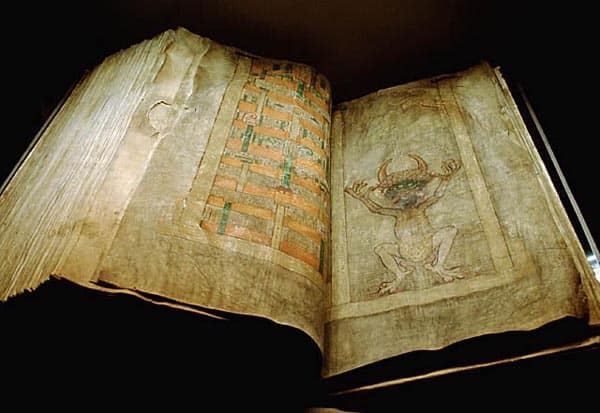
Among the most mysterious and strikingly beautiful medieval manuscripts in existence is the Codex Gigas, sometimes known as the Devil’s Bible. Designed in the early 13th century, this enormous book has enthralled academics, historians, and the general public with its grand scale and sinister stories of its production. The sheer presence of the book alone provokes wonder. Weighing about 165 pounds and consisting of 310 pages crafted from the skins of more than 160 animals, the book requires at least two people to lift it; not only its size but also the enigmatic circumstances of its production, its remarkable full-page depiction of the devil, and the odd history of the document have earned it a sinister nickname and secured its place in both academic study and popular mythology.

Description
Without its magical connotations, the physical qualities of the Codex Gigas make it a wonderful item. The biggest known medieval book in existence is almost three feet tall and weighs as much as a full person. Along with numerous other books, including Flavius Josephus’s Antiquities of the Jews, Isidore of Seville’s Encyclopedia, several medical works, and other historical documents, the volume comprises the whole Latin Vulgate Bible on parchment pages derived from calfskin or donkey skin. The book seems to have been penned by a single scribe in a consistent manner, which makes the work especially unique—a feat that would have needed great dedication and many years of careful labor. The most well-known picture in the book, a stunning full-page portrayal of the devil with his distinctive horns, claws, and forked tongue, is starkly opposite a full-page picture of the Heavenly City, so illustrating the cosmic fight between good and evil (Raven, 2020).
The Codex Gigas originated in the Benedictine abbey of Podlažice in what is now the Czech Republic. While the exact dates remain unknown, historical accounts indicate the book’s production in the early 13th century. What is known is that, driven by his passion for occult and esoteric topics, the book later found inclusion in Emperor Rudolf II’s imperial library at Prague. Following their looting of Prague in 1648 during the Thirty Years’ War, Swedish soldiers stole the manuscript as war booty and kept it in the Royal Library in Stockholm, where it still resides today. The trip of this enormous tome across Europe, surviving wars, fires, and the passage of time, adds to its mystique and has helped preserve both the actual book and the traditions surrounding it.

Paranormal Connections
The supernatural mythology connected with the Devil’s Bible mostly revolves around the narrative of its genesis. The most well-known myth is that a monk who had been sentenced to be walled off alive for violating his monastic vows wrote the book. Desperate to escape this penalty, the monk swore to produce a book including all human knowledge and praising the monastery—all in one night. The despairing monk sold his soul to the devil in return for aid finishing the book as midnight drew near and the hopelessness of his work became clear. The devil completed the book and, as a sort of signature, included the arresting portrait of himself that lends the book its name. This story, with its Faustian aspects of forbidden knowledge and dealings with the devil, captures medieval fears about sin, damnation, and the attraction of forbidden knowledge exactly (Avrin, 2010).
Over the years, more paranormal assertions have gathered around the Codex Gigas. Some think the book has magical qualities or concealed occult information outside what its pages show. Others assert that those who own or study the book too attentively suffer from calamity; they cite past tragedies that coincided with the book’s ownership transfers. Stories of enigmatic events happening in the book—such as lights dimming, odd sounds, or inexplicable anxiety—also abound. The book’s enormous scope itself has encouraged supernatural conjecture; some argue that no common person could have created such a work without divine or demonic help. The book’s menacing physical appearance and the dramatic devil picture that seems to look straight at viewers have heightened these paranormal connections (Sjökvist, 2024).
Analysis
More pragmatic explanations for the Codex Gigas and its production come from scholarly study. Paleographic and codicological research points to the manuscript’s most likely creation by a single scribe during a 20–30 year career of committed labor rather than a supernatural overnight success. The remarkable consistency in handwriting and picture style supports this notion. Although rare, the inclusion of the devil portrait is not entirely uncommon in medieval ecclesiastical art, which often depicted evil powers as warnings to the devout. Along with religious items, the medical and scientific books indicate the thorough nature of monastic libraries rather than anything nefarious or banned. As part of the folklore that inevitably gathers around odd objects, historians note that the legend of the book’s demonic genesis most certainly developed decades after it was published.
Various hypotheses about the Codex Gigas suggest several possible creation and usage scenarios. Although this view is still held by a minority, some academics believe that the book was created collaboratively by several scribes who meticulously copied in a consistent style. Others speculate that the monastery might have commissioned the book as a renowned display item to showcase its wealth and knowledge. There are ideas that the single-minded attention needed to produce such a work could have been a kind of monastic discipline or devotion, pursued as a spiritual exercise rather than a punishment. Regarding the devil picture, art historians point out that it might have been used for religious education to provide a striking visual depiction of evil to counter divine goodness. Embedded in the theological and intellectual life of medieval Europe, these interpretations show the Codex Gigas as a wonderful but finally human accomplishment (Brooke-Hitching, 2023).
The conflict between historical study of the Devil’s Bible and supernatural tales reflects larger trends in our interpretation of past objects. Modern interpretations of mystery and the supernatural sometimes find a canvas in the medieval era, with its rich religious symbolism and worldview so different from our own. The Codex Gigas shows how physical artifacts gather layers of meaning beyond their intended use at this junction of verifiable history and creative legend. From a scholarly standpoint, the very characteristics that make the work outstanding—its scope, consistency, and thoroughness—are the same ones that inspire supernatural conjecture. This dynamic between historical research and legend continues to shape the public’s perspective of the Devil’s Bible and related objects.
Conclusion
Finally, the Devil’s Bible is still a wonderful junction of medieval workmanship, religious history, and ongoing mythology. Although scholarly study reveals a book of remarkable human achievement—probably reflecting decades of painstaking work by a committed scribe—the legends surrounding the Codex Gigas still inspire the imagination and reflect deeper cultural anxieties about forbidden knowledge and supernatural powers. Now meticulously kept in Sweden’s National Library, the enormous tome is evidence of the heights of medieval knowledge as well as the ability of narrative to turn everyday objects into symbols loaded with significance (French & French, 2003). Approached as a remarkable artifact of medieval book production or as the center of centuries-old supernatural legends, the Devil’s Bible still captivates every new generation to consider the limits between human achievement, religious devotion, and the perpetual human curiosity with the strange and the forbidden.
References
Avrin, L. (2010). Scribes, script, and books: the book arts from antiquity to the Renaissance. American Library Association.
Brooke-Hitching, E. (2023). The Madman’s Gallery: The Strangest Paintings, Sculptures and Other Curiosities from the History of Art. Chronicle Books.
French, S., & French, T. (2003). Tillsammans: co-operation among art libraries in Sweden. Art Libraries Journal, 28(1), 32-40.
Raven, J. (Ed.). (2020). The Oxford illustrated history of the book. Oxford University Press.
Sjökvist, P. (2024). Looted Libraries, Looted Books: The Swedish Case. Brill.



Leave a Reply