Summary: Ouija Boards and Portals
-
Ouija boards are divination tools popularized in the 1890s during the Spiritualist movement.
-
Paranormal portals are believed to be thin boundaries where entities cross between dimensions.
-
Many believe Ouija boards function as portals through which spirits can enter our world.
-
Psychological effects may explain both Ouija movements and portal experiences.
-
Both concepts have heavily influenced horror media, reflecting cultural anxieties about death.
-
Their enduring appeal reveals humanity’s desire to connect with realms beyond our understanding.

Introduction
People have always tried to discover ways to talk to the world beyond our physical existence. The Ouija board is one of the most well-known and debated technologies that people say can connect the living and the dead. This mystical board game, featuring a moving planchette and an alphabet-covered surface, has fascinated both skeptics and believers for generations. At the same time, the idea of paranormal portals—doorways that are said to link our world with other dimensions or spiritual realms—has been around for a long time and in many cultures. It is typically connected to the use of divination tools like the Ouija board.
Overview
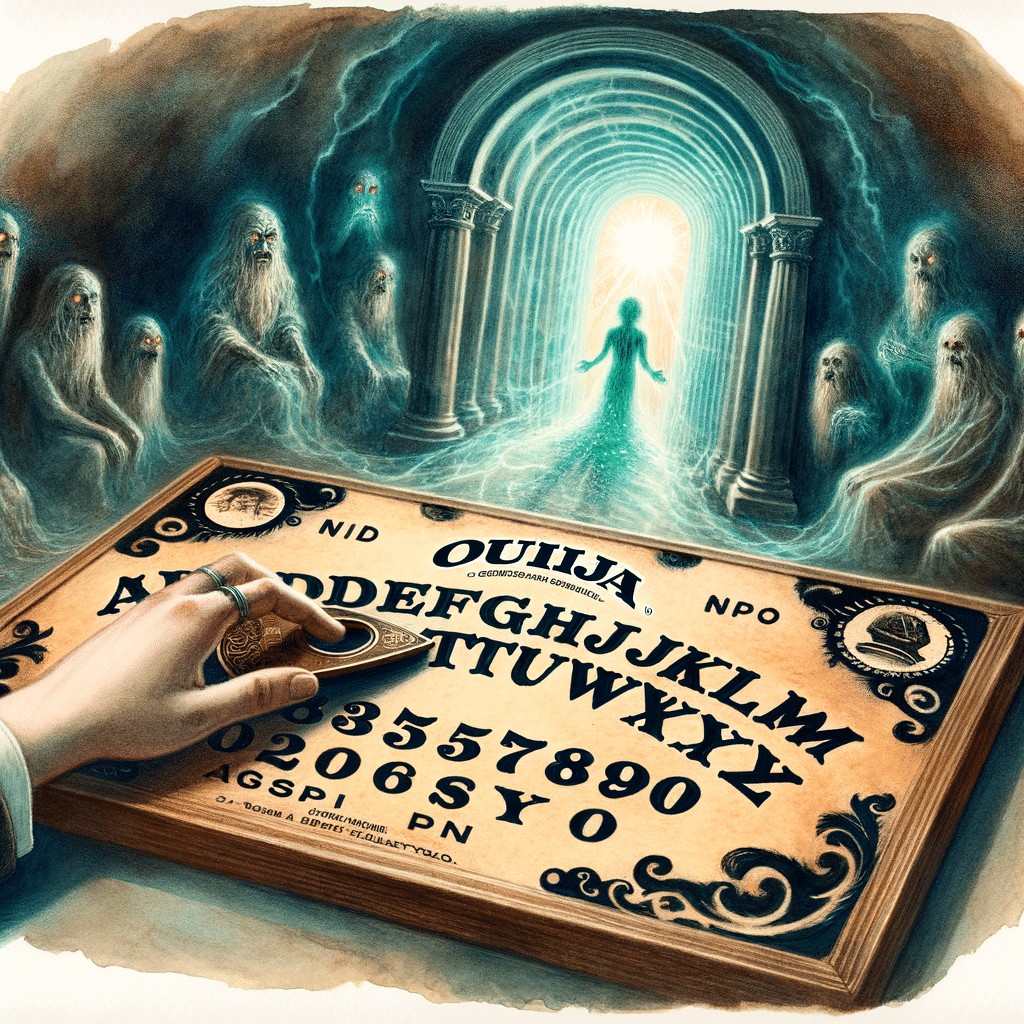
A talking board, spirit board, or Ouija board is a flat board with letters, numbers, and simple words like “yes,” “no,” and “goodbye” on it. A heart-shaped planchette moves on its own, spelling out messages from ghosts or other beings. When several individuals touch the planchette at the same time, it moves. This creates an air of mystery because no one person claims responsibility for guiding it. This simple yet powerful design hasn’t altered much since it was first sold, which is why it is still an iconic part of paranormal culture, even if technology has improved in other areas of entertainment and communication (Myrick, 1999).
The Ouija board has its roots in the Spiritualist movement of the late 1800s, when Americans were genuinely interested in the idea of being able to talk to the dead. Businessman Elijah Bond filed the name “Ouija” as a trademark in 1890. He combined the French and German words for “yes” to make it seem intriguing. Talking boards had been around before this. During World War I, the board became quite popular as families who had lost loved ones in the war tried to communicate with them. William Fuld bought the rights to the board in 1892 and became the main maker. His company’s design is the one we know today. By the 1960s, the board had gone from being a serious instrument for spiritualists to a parlor game manufactured by Parker Brothers (now Hasbro). However, many people still used it to talk to spirits (Cole, 2024).
Paranormal portals represent a distinct yet connected concept within supernatural beliefs. They are places or things that are said to be gateways between our world and other dimensions, spiritual realms, or parallel universes. People often describe these portals as locations where the barrier between worlds is thin, facilitating easier transitions between realms compared to other locations. Some well-known examples are Sedona’s energy vortexes, which are naturally occurring sites; the “stairway to hell” in an Italian church, which is an architectural feature; or even closets or mirrors in your own home that seem to go to other places. Many paranormal investigators think that electromagnetic field changes, temperature decreases, and other quantifiable occurrences can be used to find these gateways, but scientific proof is still hard to come by (Hume, 2020).
Ouija boards and paranormal portals are similar because they are both thought to be ways to communicate with the other world. Many people who practice or are interested in the paranormal believe that using a Ouija board not only allows one to communicate with ghosts, but also creates a door or portal that allows other beings to enter our world. Many stories about Ouija sessions that ended poorly, in which people report strange occurrences in their homes after using the board, have reinforced this belief. The ritualistic nature of Ouija sessions—typically held in dimly lit rooms with candles and formal invocations—resembles techniques employed by those seeking to access spiritual portals through alternative methods, indicating a conceptual connection between these traditions despite their unique development.

Analysis
From a psychological standpoint, both Ouija boards and the notion of portals engage intrinsic human aspirations to comprehend the hereafter and to perceive the possibility of exerting control over or gaining entry to these enigmatic domains. The ideomotor effect, an involuntary muscle movement that happens when attention is directed elsewhere, provides a physiological rationale for the movement of the Ouija board absent supernatural influence. Participants unintentionally guide the planchette toward anticipated letters, thereby generating the semblance of spiritual communication. Many portal experiences can also be explained by psychological phenomena, such as pareidolia (seeing patterns in random stimuli) or the power of suggestion in settings that are ready for paranormal events. But these explanations don’t usually satisfy people who have had strong personal encounters with either occurrence.
Ouija boards and gateway ideas have had a big effect on culture that goes beyond just personal experiences. They have made their way into entertainment and popular culture. Many horror movies, such as The Exorcist, Ouija, and Insidious, use these devices as story points, which adds to their image as hazardous tools that can release evil forces. This depiction has fueled religious opposition to Ouija boards, especially among Christian groups who see them as possible portals to demonic possession instead of harmless ways to talk to dead loved ones. The pervasive anxiety and curiosity around these ideas show that people are still worried about death, the hereafter, and things that are beyond their control, even if we live in a civilization that is quite sophisticated in technology (Hodge, 2026).
In the digital age, people talk about these ideas in new ways. For example, online groups share Ouija board encounters and portal sightings on social media, creating new folklore in real time. There are already virtual reality games and apps that make Ouija sessions seem real. There are also famous paranormal investigative shows that use scientific-looking tools to look for gateways. Even though these traditions have varied over time, the basic questions they answer about being human have not changed: What happens after you die? Is it possible to talk to people who have died? Are there places we can’t see? These existential inquiries perpetuate fascination in Ouija boards and paranormal portals, securing their status in our cultural consciousness irrespective of their scientific legitimacy (Schmidt, 2025).
Conclusion
Ouija boards and paranormal gateways are long-lasting examples of how people have tried to understand and connect with the unseen world. Whether regarded as authentic spiritual instruments, psychological phenomena, or cultural relics, they reflect our intrinsic aspiration to surpass the confines of perceived reality and forge relationships with entities beyond our individual existence. As we continue to make scientific and technical progress, these ideas change instead of going away. This shows that our interest in possible ways to get to other worlds is a core part of being human. The essential significance of Ouija boards and paranormal gateways may not reside in their actual ability to connect us to other dimensions, but rather in what our enduring confidence in such possibilities indicates about our fears, hopes, and existential inquiries.
References
Cole, D. (2024). Speak of the Devil: A History of the Ouija Board. University of Delaware.
Hodge, B. (2026). A History of Ouija: Myths and Misconception. In Ouija (pp. 4-12). Routledge.
Hume, L. (2020). Portals: Opening doorways to other realities through the senses. Routledge.
Myrick, J. M. (1999). Belief and custom surrounding the Ouija board (Doctoral dissertation, Memorial University of Newfoundland).
Schmidt, K. (Ed.). (2025). Ouija: Conjuring American Popular Culture. Taylor & Francis.



Leave a Reply