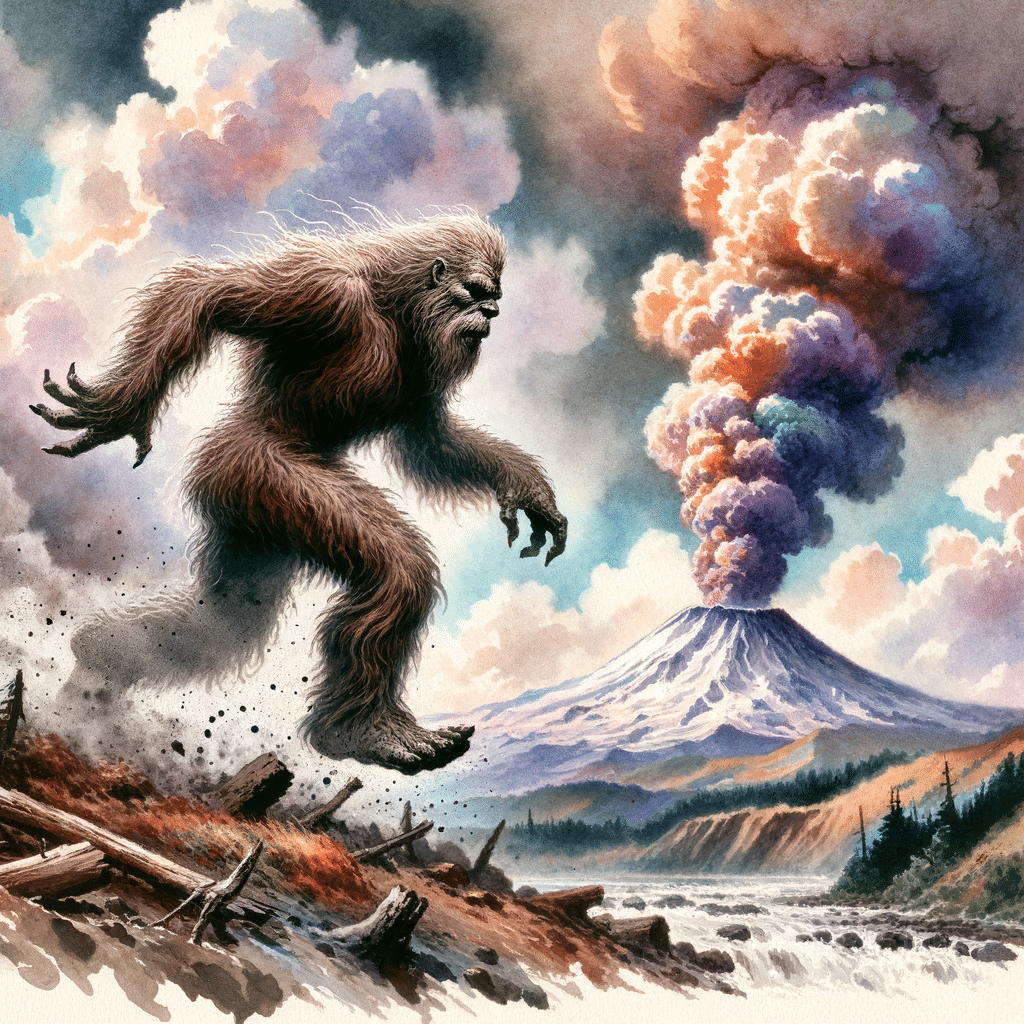
Six Key Points about the Mt. St. Helens Bigfoot Legend
-
After the 1980 Mt. St. Helens eruption, witnesses allegedly observed government officials recovering and transporting Bigfoot bodies.
-
Sasquatch folklore has deep indigenous roots in the Pacific Northwest, creating cultural context for these stories.
-
The eruption’s chaos and extensive government response created conditions where normal activities could be misinterpreted.
-
Specific accounts include a worker seeing guarded Bigfoot remains and a civilian spotting a hairy body in a military helicopter.
-
Official denials through FOIA requests are viewed as either evidence of cover-ups or confirmation no such events occurred.
-
The logistical impossibility of keeping such discoveries secret and the lack of evidence suggest these accounts are folklore, not fact.

Introduction
Few stories in American legend are as captivating as the one about the supposed recovery of Bigfoot bodies from Mount St. Helens after its terrible explosion in 1980. This strange novel story mixes cryptozoology, political conspiracy, and natural tragedy into a gripping tale that lives on in the shadows of Pacific Northwest legend. Scientists and officials say these claims are just made up, but believers point to specific witness accounts, suspicious government actions, and the alleged use of military personnel to guard and transport these strange remains as proof that something truly amazing happened in those Washington woods after nature went crazy.
Overview
Bigfoot, sometimes known as the sasquatch, has been a part of Pacific Northwest folklore for hundreds of years. People say it is a huge, bipedal monster that stands between seven and nine feet tall and is coated in thick reddish-brown or black hair. Witnesses usually say that the creature has a strong, muscular form with broad shoulders, a prominent brow ridge, and feet that are up to 24 inches long. This feature is the attribute that gives the monster its name. Local tribes have their own stories about the monster, which they say lives between the human and spirit worlds. People say that the creature discharges off a strong, musky smell that many people say they can’t forget. Its claimed actions range from watching people with curiosity to territorial displays like knocking on wood and screaming sounds that can be heard over thick woodlands (McLeod, 2009).
Mount St. Helens, located in Washington’s Cascade Range, stands as a testament to the immense power of nature. It has impacted the Pacific Northwest’s physical landscape and cultural character. Before it erupted, people commonly called the symmetrical stratovolcano the “Fuji of America” because its cone, which was 9,677 feet above sea level, looked like a beautiful snow-covered mountain. Indigenous people thought it was sacred for thousands of years. The Klickitat tribe called it “Louwala-Clough,” which means “smoking mountain,” while the Cowlitz and Yakama tribes had their own names and traditions about the summit. The mountain had been shaking and releasing steam for weeks before it had a huge lateral blast on May 18, 1980. Its northern face collapsed in the biggest landslide ever recorded, which caused an eruption that killed 57 people, flattened 230 square miles of forest, and lowered the mountain’s height by 1,314 feet in just a few moments (Decker & Decker, 1981).
Linda Coil Suchy’s book Who’s Watching You?: An Exploration of the Bigfoot Phenomenon in the Pacific Northwest (2018) tells the story of a worker named Bradshaw who was put in charge of a certain pile of dead animals that were found after the eruption. According to reports, this pile was covered with tarps and guarded by armed U.S. National Guard troops who were told not to let anyone get close. According to the story, when the tarps were ultimately taken off to get ready for shipment, Bradshaw was shocked to see several Sasquatch remains, some of which were badly burned and others that looked mostly whole. Bradshaw was told not to talk about what he saw, and the remains were put in a big cargo net, lifted into a truck, and covered with tarps before being taken away from the scene.
Another story in the same book backs up this strange story. It talks of a citizen in Spokane who said they saw a big, double-rotor helicopter—probably a military Chinook—flying very low, maybe 100 to 150 feet above the ground. This witness said that the plane was carrying a cargo net with what looked like at least three Bigfoot bodies in it. Despite the gray volcanic ash covering the bodies, the hairy limbs were easily visible. People who believe in Sasquatch say that this sighting, which happened after the eruption, is proof of a coordinated government effort to get rid of Sasquatch remains from the disaster area before they could be found by the public or documented by independent researchers.
The stories about Bigfoot sightings have grown throughout the years since the explosion, especially in tiny logging towns and communities around the Mount St. Helens National Volcanic Monument. When researchers tried to confirm these claims by making Freedom of Information Act requests, they got what many people think were predictable dismissive responses. Officials said, “There were no documented reports of big foot [sic] or sasquatch carcasses and there were no projects to attempt to locate and/or recover any bodies.” For those who believe, this denial only adds to their suspicions that something is being hidden. For skeptics, this suggests that there is no reliable evidence to support the claims. The stories really took off when the internet became popular. Cryptozoology forums and conspiracy websites rapidly disseminated these stories, prompting the creation of digital art depicting the alleged helicopter recoveries.

Analysis
There are several hypotheses on why these stories keep coming again, some of which are simple misunderstandings and others that have to do with deeper psychological needs. Some folklorists say that the legend started with real emergency activities that were misunderstood by people who were far away. Others argue that the shock of the eruption facilitated the spread of strange stories. There is a lot of evidence that military troops help in disaster response, but this legend has changed the way we perceive their presence to suggest more mysterious reasons. Psychologists assert that conspiracy theories aid individuals in comprehending and organizing situations beyond their control, particularly in the aftermath of disasters. The Bigfoot recovery story could be a way for people in areas that rely on the forests that were destroyed by the eruption to cope with their grief.
When you look at the practical problems that would come up if you tried to keep such recoveries secret during a massive crisis response with hundreds of workers, volunteers, scientists, and media people, it’s clear that such a conspiracy would be impossible. Wildlife management experts say that even normal retrieval of animal remains following natural catastrophes follows established procedures for documentation and scientific analysis. This makes the alleged unusual treatment of some bodies even more suspect from a procedural perspective. It would be very difficult to keep secrets between all the agencies that were involved in the Mount St. Helens reaction, such as the U.S. Forest Service, FEMA, state disaster management, scientific study teams, and military support units. In addition, even though scientists have been studying the area where the bomb happened for decades, no verifiable Bigfoot specimens have been formally recognized. This is despite the fact that biological surveys have indicated that life is returning to the area that was destroyed (Fitch, 2013).
Scientists and government officials always say that these stories are myths and not history. They make this claim because there is no tangible evidence that Bigfoot exists, nor is there any organized effort to find their remains. When faced with specific stories like the ones in Suchy’s book, officials usually point out that there isn’t any supporting documentation, photographic evidence, or several independent witnesses that would ordinarily be present with unusual finds. Volcanologists said that even though they had seen signals that an eruption was coming, the exact timing and terrible nature of the lateral blast surprised even experts. This made it nearly impossible to plan recovery activities aimed at specific species. Wildlife experts say that animals showed no signs of a planned evacuation before the eruption (Lewis & Bartlett, 2024).
Conclusion
The story of Bigfoot’s recovery from Mount St. Helens is still a fascinating mix of natural disaster, cryptozoology, and conspiracy thinking in American folklore. These stories show how complicated our relationship is with the wilderness, government authority, and the unknown. Some people see them as fun campfire stories, others see them as a psychological response to disaster, and still others see them as a real alternate history. The truth behind these stories is like the Sasquatch itself: it disappears into the misty forests of the Pacific Northwest whenever it is put to the test. Science informs us that such recoveries could not have occurred without leaving a significant amount of evidence. The legend, on the other hand, speaks to something very human: our constant hope that there are still mysteries to be found in the vastness of our remaining wild places and that they may be protected by powers greater than ourselves.
References
Decker, R., & Decker, B. (1981). The eruptions of Mount St. Helens. Scientific American, 244(3), 68-81.
Fitch, M. E. (2013). Paranormal nation: Why America needs ghosts, UFOs, and bigfoot. Bloomsbury Publishing USA.
Lewis, J., & Bartlett, A. (2024). The shape of Bigfoot: transmuting absences into credible knowledge claims. Cultural Sociology, 17499755241264879.
McLeod, M. (2009). Anatomy of a Beast: Obsession and Myth on the Trail of Bigfoot. Univ of California Press.
Suchy, L. C. (2018). Who’s watching you: An Exploration of the Bigfoot Phenomenon in the Pacific Northwest. Crypto Editions.



Leave a Reply