The Sluagh: Key Points
-
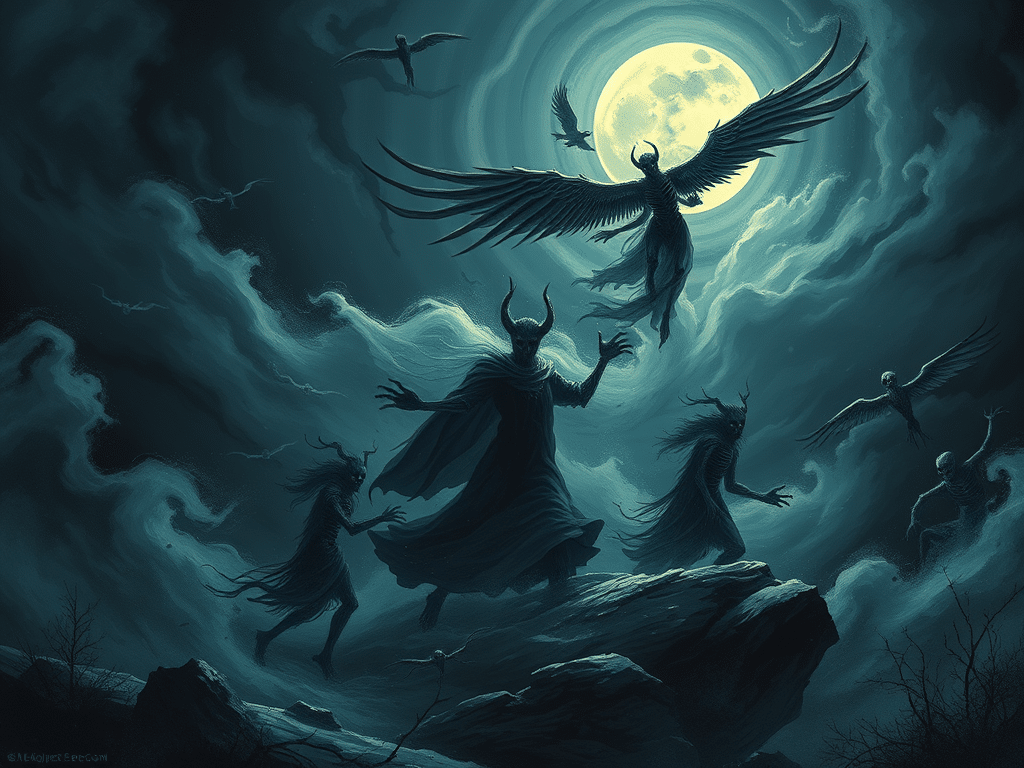
The Sluagh are malevolent spirits from Scottish and Irish folklore that travel in swarms through the night sky from the west, described as shadowy, skeletal figures.
-
One theory identifies them as restless spirits of sinful dead people condemned to wander eternally, serving as a Christian-influenced moral warning about evil deeds.
-
An alternative view positions them as members of the evil unseelie fairy court, ancient inhuman entities rather than fallen human souls.
-
The Sluagh were believed to enter through western windows to steal souls of the dying, leading to the practice of keeping such windows closed.
-
Scholars suggest the legends personified disease and harsh winters while serving social functions through protective rituals and community values.
-
The Sluagh profoundly influenced Celtic architecture and deathbed practices and remain in modern culture as genuinely frightening examples of dark fairy folklore.

Introduction
The Sluagh, a scary figure from Scottish and Irish folklore, is one of the scariest ideas in Celtic mythology. People say that these evil spirits roam the skies in restless groups, looking for souls to take and hurt. The Sluagh are different from many other fairy creatures in that they make people truly afraid. They represent the dark side of supernatural belief that was common in Celtic culture. The fact that their name comes from the Gaelic word for “host” or “crowd” shows that they are a group and that they make people terrified. To understand the Sluagh, you need to look into the rich history of folklore that has kept these stories alive for hundreds of years.
Overview
The Sluagh are said to be shadowy, skeletal figures that fly through the night sky in large groups, especially from the west, which Celtic people thought was a sign of death and the otherworld. People say they move like a winter storm, with strange winds and unsettling sounds that make people feel cold. People who told traditional stories said they heard the beating of many wings, otherworldly screams, and the rustling of many bodies passing overhead in the dark. In the Scottish Highlands and Ireland, people kept their western windows shut when someone was dying, fearing the Sluagh would enter. People thought that these spirits were especially active when someone was sick or dying. They would hover near people who were about to die, waiting to take their souls (McKay, 1931).
A leading hypothesis regarding the Sluagh characterizes them as the agitated spirits of the sinful deceased, whose earthly misdeeds were so egregious that they could attain solace in neither heaven nor hell. This interpretation posits that the Sluagh are eternally condemned to wander, perpetually deprived of rest or redemption for their malevolence in life. This belief shows how medieval Christianity changed Celtic folklore by looking at old pagan ideas through the lens of sin, damnation, and divine judgment. The notion that the Sluagh were formerly human imparts a profoundly tragic aspect to their horror, implying that any individual who lived immorally may join their ranks upon death. This theory was a strong moral deterrent in traditional communities, warning people that doing undesirable things in life could lead to an eternity of torment (Maclean, 1959).
The other interpretation puts the Sluagh firmly in the Unseelie Court, which is the evil side of the fairy folk in Celtic mythology. The unseelie were always hostile to humans and loved to cause pain and chaos. The Seelie Court, on the other hand, could be unpredictable but was sometimes kind. This view says that the Sluagh are not souls of dead people but rather ancient beings that have always lived in the dark corners of the world. In the oldest and most dangerous sense of the word, they are faeries—creatures of wild magic and primal evil that existed before humans had any moral ideas. This interpretation aligns with the pre-Christian understanding of fairies as potent, erratic entities of nature, rather than the diminutive, whimsical creatures of later folklore. The Sluagh, as evil faeries, show how scary the natural world and its supernatural beings can be.

Analysis
Celtic mythological figures, such as the Sluagh, embody profound cultural narratives that have shaped both historical interpretations of mythology and the contemporary literary canon. These supernatural beings often depict people’s interactions as extremely dangerous. For instance, the fairies, also known as “trooping fairies,” are frequently associated with the sluagh. They can be found in many stories about the Tuatha Dé Danann, a mythical race that is the source of modern fairy tales. This link shows how these kinds of myths still have an effect on Irish culture, which still inspires writers and scholars (Miller, 2012; Ullah, 2022).
Scholars and folklorists have formulated diverse theories to elucidate the origins and enduring prevalence of Sluagh legends across Celtic territories. Some researchers propose that the Sluagh myth may have originated as a personification of disease, particularly plague and epidemic illnesses that traversed communities like an invisible, lethal wind. The link to storms and severe weather could be a sign of the real dangers of harsh winters in Scotland and Ireland, which brought hunger, cold, and death to people who were already weak. Some people believe that the Sluagh stories were important for society because they warned people not to sin and helped them understand sudden, unexplained deaths or the emotional pain of grief. People kept their western windows closed because they were afraid of spirits, but it also helped keep homes warm by keeping out cold winds. These theories do not undermine the authentic belief our ancestors had in the Sluagh; instead, they highlight how folklore integrates practical knowledge, moral guidance, and supernatural interpretation.
The resurgence of interest in the sluagh and other Celtic motifs during the Celtic Revival, which aimed to revive and recontextualize traditional Irish themes and folklore, is another example of this. W. B. Yeats and other important people were a big part of this movement, which wanted to bring back the Celtic heritage that had been lost because of British colonialism. Yeats acknowledged the significance of folklore not merely as cultural artifacts but as dynamic narratives that infused modern existence with meaning and emotional depth (Fowler, 2023; Cox, 2010; Ullah, 2022). He highlighted the “thirst for unbounded emotion” in folklore, framing it not only as myth but as an essential component of Irish identity (Ullah, 2022).
Creative interpretations and retellings of Celtic myths, particularly those involving the sluagh, aid in bridging the divide between the ancient and the contemporary. For example, literature from the Celtic Revival, which took mythic traditions very seriously, still influences how people today perceive these folkloric elements and also critiques social norms. This interaction shows how Celtic folklore, and the sluagh in it, can be used to tell stories that explore bigger ideas about life, morality, and the human experience (Miller, 2012).
Sluagh legends had a profound and lasting effect on Celtic culture, especially in Ireland and the Scottish Highlands. They changed everything from architecture to deathbed rituals. The fear of the Sluagh affected how homes were built and arranged. Families thought carefully about where to put windows and made sure they had ways to keep dying loved ones safe from spiritual attacks. When someone was about to die, people would gather in their communities to keep watch. The intent was to comfort the dying person and their family, but it was also to protect them from the Sluagh through prayer, protective charms, and the presence of many souls working together to protect them. These practices forged robust communal ties in periods of loss, converting personal sorrow into collective defiance against supernatural malevolence. Believing in the Sluagh had a profound effect on people’s minds. It meant that death was not just an end but a time when evil forces could take a soul for eternal torment.
Conclusion
People today are still interested in the Sluagh. They show up in modern fantasy books, games, and other media as examples of truly scary fairy tales. The fact that they have lasted so long in popular culture shows that there is something primal about their idea of a group of hungry spirits always roaming the line between life and death. Unlike many other folkloric creatures, the Sluagh have not undergone cleansing or romanticization over time. They still have their dark side, reminding us that fairy tales can have unhappy endings and magical beings can wish us ill. The Sluagh represent the dark side of Celtic mythology, demonstrating the existence of real evil forces within the supernatural realm that require respect, avoidance, and protection. In a time when most people don’t keep their western windows closed at night or are afraid of the strange sounds of the wind, the Sluagh are still there to show how complicated our ancestors’ spiritual beliefs were and how they tried to understand and protect themselves from the mysteries of death and the darkness beyond.
References
Cox, L. (2010). Current debates: new religion(s) in ireland ‘alternative spiritualities, new religious movements and the new age in ireland’ conference report, nui maynooth, 30–31 october 2009. Irish Journal of Sociology, 18(1), 100-111. https://doi.org/10.7227/ijs.18.1.6
Fowler, J. (2023). An orchestrated awakening: latent irish-ness at the heart of yeats’s seminal work. CEA Critic, 85(3), 211-216. https://doi.org/10.1353/cea.2023.a912097
Maclean, C. I. (1959). Traditional beliefs in Scotland. Scottish Studies, 3.
McKay, J. G. (1931). Scottish Gaelic Parallels to Tales and Motifs in” Béaloideas”, Vols. I and II. Béaloideas, (Uimh 2), 139-148.
Miller, D. A. (2012). Supernatural beings and ‘song and dance’: celtic and slavic exemplars. Studia Celto-Slavica, 6, 101-112. https://doi.org/10.54586/vojo4470
Ullah, S. (2022). Crime of men, punishment of nature and voice of the irish: a study on w. b. yeats’ ‘the curse of the fires and of the shadows’. Journal of Critical Studies in Language and Literature, 3(6), 1-6. https://doi.org/10.46809/jcsll.v3i6.171

Leave a Reply