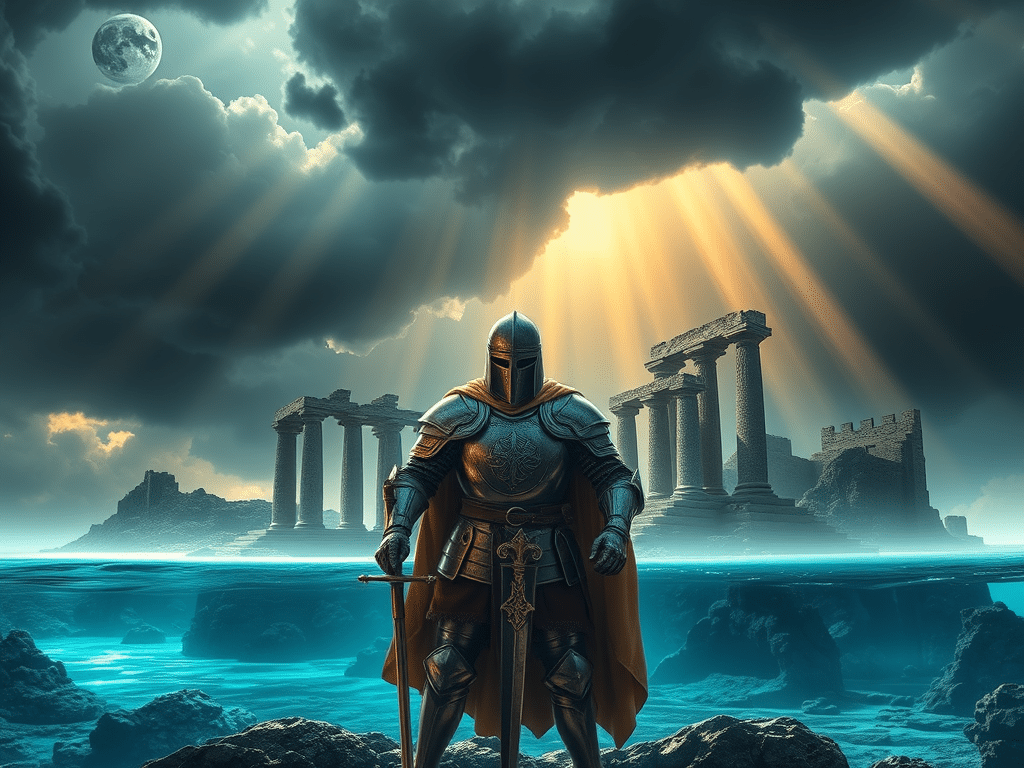
Knights Templar and Atlantis: Key Points
-
Most scholars consider Plato’s description of Atlantis, around 360 BC, as a philosophical allegory rather than a historical fact.
-
The Knights Templar was a powerful medieval military order founded in 1119 AD whose sudden suppression in 1307-1314 created enduring mysteries about hidden treasure and escaped knights.
-
Theories from the nineteenth and twentieth centuries claim Templars discovered Atlantean knowledge beneath the Temple Mount, which explained their wealth and power.
-
Historians dismiss these theories as unsubstantiated, asserting that Templar accomplishments can be elucidated through established medieval history, and that such assertions arose significantly after the pertinent eras.
-
These theories have significantly influenced popular culture and esoteric movements despite academic rejection, revealing tensions between scholarly and popular historical interpretation.
-
The connection’s enduring appeal reflects human needs for hidden meaning rather than historical reality, serving as symbols for contemporary concerns projected onto the past.

Introduction
The story of Atlantis and the historical mystery of the Knights Templar are two of the most famous mysteries that have fascinated people for hundreds of years. Atlantis is only a myth and a philosophical allegory, while the Knights Templar was a real military order in the Middle Ages. However, some writers and theorists have tried to combine these two stories into one big story about hidden knowledge and lost civilizations. Even though there isn’t any solid historical evidence for this link, it has become very popular in pop culture and alternative history circles. This story presents an intriguing case study on how individuals interpret fragments of the past. Part of the appeal of connecting these two topics is that they both have a mysterious quality and the exciting idea that ancient knowledge may have been kept and passed down through secret channels over thousands of years.
Overview
Plato, a Greek philosopher, wrote about Atlantis in his dialogues Timaeus and Critias around 360 BC. He asserted that Atlantis was a formidable island nation, existing nine thousand years prior to his time. Plato said that Atlantis was a technologically advanced civilization with many natural resources, beautiful buildings, and a strong military that had taken over most of the Mediterranean world before being defeated by ancient Athens (Donnelly, 2006). People said that the island sank into the ocean in just one day and night of terrible destruction, which was punishment from the gods for the Atlanteans’ pride and moral decay. Most classical scholars have long thought that Plato’s Atlantis was a philosophical tool rather than a historical account. They see it as a warning story meant to show his ideas about the best way to run a government and the dangers of wanting to be an empire. Still, the story has led to many efforts to locate the lost civilization, with suggested places ranging from the Caribbean to the Mediterranean, from Antarctica to the middle of the Atlantic Ocean.
Over the course of ancient and medieval history, the idea of Atlantis changed from Plato’s original story into a symbol of lost golden ages and lost knowledge. Some ancient writers talked about Atlantis, but most of them saw it as an allegory rather than a real event, understanding that Plato made up the story for philosophical reasons. During the Middle Ages, when most classical knowledge was kept in monastic libraries and Islamic centers of learning, people still knew about Atlantis, but only people who were well-read and knew Plato’s works. New theories about the authenticity of Atlantis emerged as a result of the Renaissance’s renewed interest in classical texts. Some scholars tried to link it to biblical accounts of the Flood or to new lands found in the Americas. Medieval cosmology and geography, constrained by the contemporary knowledge, fabricated a world in which uncharted territories and vanished civilizations appeared entirely credible, fostering a cultural disposition that would subsequently be amenable to theories linking ancient enigmas with medieval structures.
The Knights Templar was formed in 1119 AD as a Catholic military order to protect Christian pilgrims on their way to the Holy Land during the Crusades. They came from very different historical circumstances. The order started out small, with only nine founding knights. They established their headquarters on Jerusalem’s Temple Mount, believed to be the location of Solomon’s Temple. Over the next 200 years, the Templars became one of the most powerful groups in medieval Europe. Donations enabled them to amass wealth, establish an early form of international banking, and garner respect as fierce warriors who adhered to strict monastic rule. Their white mantles with red crosses on them became symbols of Christian military strength, and their fortified commanderies and preceptories could be found all over the world, from England to the Holy Land. People in the past admired and suspected the order because they quickly became rich, had access to secret places in Jerusalem, and were known for being mystical (Haag, 2010).
The Knights The Templar’s dramatic fall in the early 1300s set off centuries of rumors and stories that would eventually connect them to Atlantis in people’s minds. King Philip IV of France ordered the mass arrest of Templars across his kingdom on Friday, October 13, 1307. He accused them of heresy, idol worship, and other crimes in what was mostly a politically motivated effort to take their wealth and power. While under torture, some Templars confessed to the charges, but modern standards of justice render these confessions highly unreliable. Pope Clement V finally disbanded the order in 1312. In 1314, Jacques de Molay, the last Grand Master, met his fiery demise at the stake in Paris. It is said that he cursed both the king and the pope as he died. The sudden and violent end of such a powerful group, along with stories of lost Templar treasure and knights who fled to unknown places, left a hole that speculation and myth rushed to fill over the next few hundred years.

Atlantis and the Templar Knights
Folklore linking the Knights Templar to Atlantis mostly came about in the 1800s and 1900s. It used the mysterious nature of both subjects to come up with more and more complex theories. Some authors suggested that the Templars, while excavating beneath the Temple Mount, unearthed ancient documents or artifacts that harbored knowledge from Atlantis, somehow preserved through the ages. According to these theories, the lost civilization hid advanced scientific and spiritual knowledge in texts or objects in Jerusalem. Survivors of Atlantis who impacted ancient Middle Eastern civilizations may have brought these items to Jerusalem. People say that the Templars used this old knowledge to become rich and powerful, keeping it safe from people who didn’t know about it. Other versions say that the Templars found maps to Atlantis or learned that people who had survived the lost civilization had set up colonies in the New World. These stories elucidate the purported pre-Columbian European expeditions to America and the peculiar disappearance of Templar treasure following their suppression.
The Templars’ historical context, mainly linked to Christian crusading, has led to several theories about what happened to them and what their legacy will be. Pope Clement V’s decision to disband the Templars in 1312 AD has sparked a lot of speculation about the hidden treasures and knowledge they may have had. Some scholars say that the Knights Templar were mostly a military and religious group, while others say that they also learned about theology and metaphysics, which is why they are linked to mystical aspects of ancient civilizations like Atlantis (Nicholson, 2010).
These theories frequently amalgamate aspects of various historical enigmas and unconventional archaeology, resulting in intricate narratives that traverse millennia and numerous continents. Supporters say that the advanced design of some ancient monuments and technologies is proof of Atlantean influence. They believe that esoteric traditions, secret societies, and mystery schools kept the knowledge of the lost civilization alive until it reached the Templars in the Middle Ages. People sometimes see the order’s interest in sacred geometry, their ability to build Gothic cathedrals, and their financial innovations as examples of how ancient Atlantean knowledge was used instead of how it was developed in the Middle Ages. Some authors have posited that the Templars escaped to Scotland or the Americas following their suppression, transporting Atlantean artifacts or knowledge and founding clandestine lineages that endure to this day. These narratives frequently blend authentic Templar events with conjectures about ancient texts, peculiar archaeological discoveries, and the symbolic interpretation of Templar artwork and structures.
The idea of Atlantis, which Plato’s dialogues helped spread, has been used in history to examine the use of allegory to show lost knowledge or advanced civilizations. Scholars argue that Atlantis could have provided a forum for discussing contemporary moral and ethical issues (Kühne, n.d.). The particulars of Atlantis—its location, composition, and demise—remain ambiguous and are predominantly viewed through mythological perspectives. However, the idea persists that the Templars might have possessed knowledge or artifacts from a vanished civilization.
The investigation of Atlantis also engages with contemporary geopolitical and philosophical themes, wherein allegories of sophisticated ancient civilizations are utilized as critiques of modern societal challenges, including climate change and the sustainability of civilization (Holding, 2021). Diverse cultural artifacts connect contemporary interpretations of Templar lore to Atlantis narratives, demonstrating this thematic resonance. Additionally, certain authors have theorized that Atlantis may symbolize a primordial civilization that shaped significant cultural advancements across various societies, playfully implying a Templar legacy of such knowledge (Harvey, 2014).
Serious historians and archaeologists have consistently dismissed the theories linking Atlantis and the Knights Templar as devoid of any credible evidentiary basis. The scholarly consensus asserts that Plato’s Atlantis was a literary invention intended for philosophical exploration rather than a depiction of a genuine historical civilization, rendering any assertions regarding the transmission of Atlantean knowledge fundamentally problematic. A thorough examination of Templar documents, edifices, and historical records reveals no necessity to reference ancient lost civilizations for clarification. Instead, we can understand their practices and knowledge within the context of medieval European culture, technology, and religious traditions. Archaeological digs at the Temple Mount and other Templar sites provide no evidence of advanced civilizations in the past. The order’s financial success can be explained by looking at how medieval banking worked, how the pope gave privileges to certain people, and how pious nobles gave money to the church. Critics also point out that a lot of the specific claims that Templars were connected to Atlantis came out long after the order ended and the times in question. These claims frequently surfaced in scenarios where the authors had a commercial or ideological motive to promote sensational theories.
The skeptical viewpoint underscores that the perceived enigmas concerning the Templars can be elucidated by the incomplete character of medieval historical documentation and the propensity of individuals to substitute speculation for the acknowledgment of uncertainty. The tortures used during the Templar trials made witness statements unreliable, and a lot of the order’s records were lost or destroyed over the years, giving people a lot of room to make up stories about what they did. Likewise, the persistent intrigue surrounding Atlantis signifies profound human psychological desires for utopian eras and forgotten knowledge, rather than substantial historical proof of its existence. Researchers across diverse disciplines have illustrated how cognitive biases, pattern-seeking inclinations, and motivated reasoning can cause individuals to perceive correlations among unrelated phenomena, particularly in contexts imbued with emotional or spiritual significance. The scholarly community has consistently demonstrated that the meticulous application of historical methodology, archaeological evidence, and critical analysis fails to substantiate the existence of Atlantis as a historical entity or any Templar association with it.
Impact
Even though scholars are doubtful about these ideas, the ones that connect Atlantis and the Knights Templar have had a big effect on culture, changing how people perceive history, literature, and movies. Many novels have used Templar knights as protectors of Atlantean secrets or as people who have inherited ancient knowledge from the lost civilization. Even though these ideas aren’t very credible in academia, documentary TV shows keep looking into them. This phenomenon exemplifies a widespread public intrigue with alternative history and the allure of narratives portraying secret societies as guardians of concealed knowledge that contests conventional historical narratives. Some esoteric and New Age spiritual movements that include both Atlantis and the Templars in their beliefs and practices have also been influenced by these ideas. Professional historians may regard these connections as pseudohistory, yet they elucidate significant truths regarding the construction of meaning, identity, and spiritual narratives through historical symbols and mythological archetypes.
Stories that link the Templars to mystical places, like Atlantis, show how much people are interested in hidden knowledge and finding lost truths. Scholarly responses to these themes have varied from skepticism to enthusiastic engagement, with some academics cautioning against the conflation of myth and historical fact (Zangger, 1993; Kühne, 2019). Conversations about Plato’s Atlantis have often focused on how it could be an allegory, which shows that broad interpretations add to the myths about both the Knights Templar and Atlantis (Zangger, 1993).
The durability of these theories underscores the discord between academic historical scholarship and popular historical awareness, prompting inquiries regarding the legitimacy of authority to interpret the past and the intentions behind such interpretations. Academics prioritize empirical evidence, peer review, and methodological rigor in the construction of historical knowledge, whereas alternative historians and their audiences frequently favor intuition, symbolic interpretation, and skepticism towards institutional authorities. The internet has made information more accessible to everyone, which has made these debates even bigger. Theories about Templar-Atlantis connections can now reach many people, and scholarly rebuttals are also easier to discover. This situation has led to a complicated information ecosystem where historical claims are shared with different levels of evidence, and not everyone has the critical thinking skills needed to tell the difference between true and false stories. These different historical stories have a cultural impact that goes beyond just entertainment. They can change how people perceive power, knowledge, and the connection between the past and the present.
Conclusion
The story that links Atlantis and the Knights Templar tells us more about our time and culture than about any real historical link between a mythical civilization and a medieval military order. The lack of credible evidence connecting these two subjects has not lessened their influence in the public’s mind, as the allure of such links functions on psychological and cultural dimensions rather than historical ones. People enjoy stories about hidden knowledge and lost wisdom because these stories give them hope that life has more meaning than the mundane details of everyday life suggest and that only brave or smart people can discover secrets that can change their lives. The Templars and Atlantis are strong symbols that people can use to project their current worries, hopes, and fears. This practice lets each generation reimagine these mysteries in ways that make sense for their time. The investigation of these topics is supported by interdisciplinary research that employs historiographical analysis and philosophical inquiry. Researchers can identify stories that speak to our shared experiences of loss, knowledge, and civilization (Holding, 2021; Zangger, 1993) by looking at how these myths can help us understand human experience and the evolution of society. The theories linking these subjects, whether perceived as innocuous amusement, perilous pseudohistory, or significant mythology, illustrate the persistent human inclination to discern patterns in history and to hold the belief that ancient knowledge may still shed light on contemporary issues.
References
Donnelly, I. (2006). Atlantis: The antediluvian world. Book Tree.
Haag, M. (2010). The Templars: History and Myth: From Solomon’s Temple to the Freemasons. Profile Books.
Harvey, D. A. (2014). The lost caucasian civilization: jean-sylvain bailly and the roots of the aryan myth. Modern Intellectual History, 11(2), 279-306. https://doi.org/10.1017/s147924431400002x
Holding, S. (2021). What on earth can atlantis teach us?. Exchanges: The Interdisciplinary Research Journal, 8(2), 120-131. https://doi.org/10.31273/eirj.v8i2.582
Kühne, R. (2019). A location for “atlantis”?.. https://doi.org/10.31219/osf.io/4kqzv
Nicholson, H. (2010). The changing face of the templars: current trends in historiography. History Compass, 8(7), 653-667. https://doi.org/10.1111/j.1478-0542.2010.00691.x
Zangger, E. (1993). Plato’s atlantis account ‐ a distorted recollection of the trojan war. Oxford Journal of Archaeology, 12(1), 77-87. https://doi.org/10.1111/j.1468-0092.1993.tb00283.x




Leave a Reply