Ghosts and Abandoned Malls: Key Points
-
The intersection of ghosts and abandoned malls represents a modern cultural phenomenon blending urban decay with supernatural beliefs.
-
Ghosts are traditionally spirits of the deceased who remain earthbound, manifesting as translucent figures, sounds, or electromagnetic disturbances.
-
Notable examples include Randall Park Mall with ghostly security guards, Rolling Acres Mall with a phantom woman, and Dixie Square Mall with shadowy figures.
-
Believers theorize that emotional energy from years of activity creates hauntings, while liminal spaces and traumatic events attract spirits.
-
Skeptics attribute experiences to building deterioration, pareidolia, heightened emotions, and confirmation bias rather than supernatural causes.
-
These stories serve as morality tales about consumerism and help communities process the loss of familiar landmarks.

Introduction
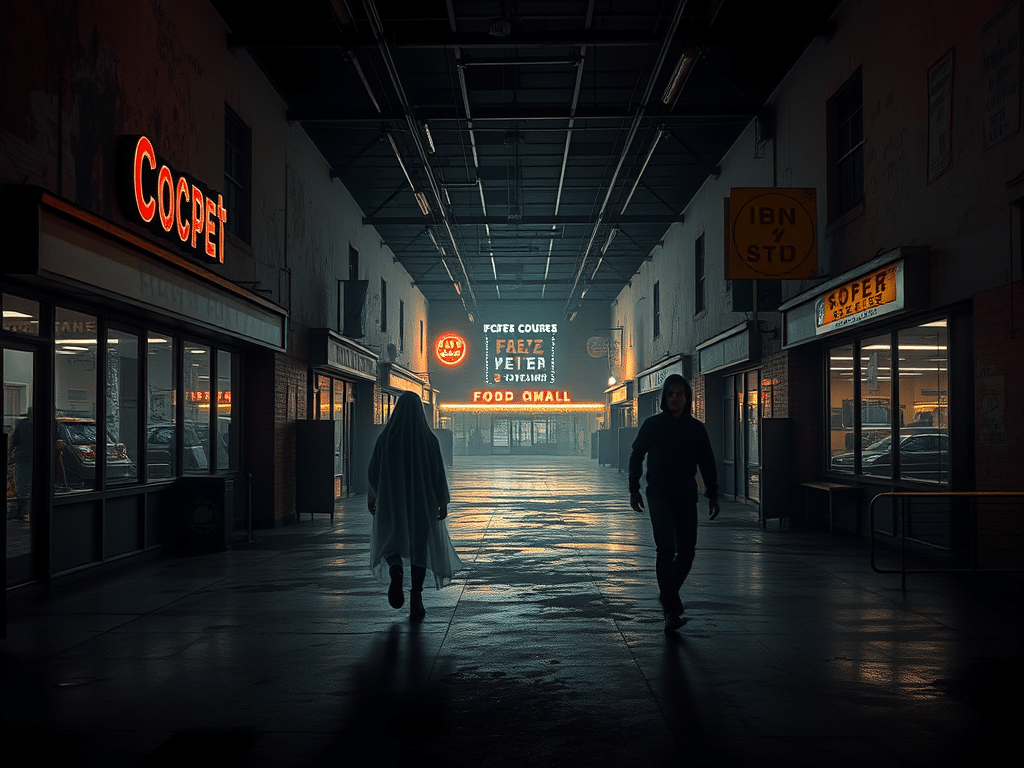
The intersection of ghosts and abandoned malls is an intriguing cultural phenomenon that combines old supernatural beliefs with modern urban decay. As shopping malls across the US fall apart because of changes in how people shop and the economy, these big empty buildings have become excellent places for ghost stories and other paranormal speculation. The picture of ghostly figures walking through darkened food courts and closed stores makes us think of our lost consumerist dreams and our ongoing interest in the unknown.
Overview
Ghosts are thought to be the spirits of the dead who have not yet moved on. People usually say that these beings look like ghosts or shadows that can come and go as they please and that they sometimes repeat certain actions or haunt certain places. Ghosts have been linked to unfinished business, violent deaths, or strong emotional ties to people or places from their past lives in many cultures and throughout history. Some paranormal investigators say that ghosts can show up as cold spots, strange sounds, moving objects, or electromagnetic disturbances that can be found with special tools (Roland, 2022).
Abandoned malls are enormous shopping centers that used to be busy places for people to meet and do business, but now they are mostly or completely empty. These buildings usually have long hallways with empty storefronts, immense atriums with broken skylights, and infrastructure that is slowly being reclaimed by nature through water damage and plant growth. People often leave these places slowly as anchor stores close, foot traffic drops, and the last tenants move out, leaving behind a shell of what used to be a thriving business. When you walk through an empty mall, you can see peeling paint, broken glass, graffiti-covered walls, and creepy remnants of commercial signs advertising sales and deals that have long since been forgotten (Brown, 2023).
Modern folklore and urban legend have given us several specific examples of haunted abandoned malls. The Randall Park Mall in North Randall, Ohio, closed in 2009 and was torn down in 2018. Many people reported seeing ghostly security guards walking through empty hallways and phantom shoppers in the shadows before the mall’s demolition. People said that the spirit of a woman who died in the parking lot of the Rolling Acres Mall in Akron, Ohio, in 2017 haunted the mall. Visitors said they heard footsteps and doors opening on their own. The Dixie Square Mall in Harvey, Illinois, has been closed since 1978 and was torn down in 2012. It became famous not only for being in The Blues Brothers, but also for reports of shadowy figures moving through its graffiti-covered interior and the sounds of ghostly crowds echoing through empty spaces.

Theories
There are a number of theories about why abandoned malls might be places where paranormal activity happens. People who believe in the supernatural say that the strong emotional energy from thousands of visitors every day for decades could cause residual hauntings, which are when past events play back like recordings in the building itself. Some people who study the paranormal think that when people stop doing things in these once-busy places, it creates an energetic vacuum that draws in spiritual beings. Some people say that malls are “liminal” spaces that connect the outside world and commercial areas. Folklore has always linked these kinds of places to supernatural events. Also, people who support these ideas often point to the undesirable things that happen in malls, like crimes, accidents, and deaths, as possible places where restless spirits might attain peace.
Skeptics attribute ghostly events in empty malls to much more mundane explanations. The buildings’ crumbling infrastructure makes many natural sounds, like metal expanding and contracting, water dripping through broken roofs, and wind whistling through broken windows. These sounds can be mistaken for paranormal activity. People are prone to pareidolia, which is seeing patterns in random stimuli that make sense. This phenomenon is why shadows and reflections in dark, empty spaces might look like people. Urban explorers often visit these places at night when they feel both excited and scared. Such emotions can make them more likely to think that normal things are supernatural. Additionally, the popularity of these places as settings for horror movies and paranormal investigation shows may lead to confirmation bias, where visitors expect to see ghosts and therefore see unclear experiences as proof that they are real.
The study of ghosts and deserted malls is a complex and deep one that connects ideas of hauntology, memory, and changes in society. Abandoned malls, which are like modern ruins, have a certain spectrality that combines nostalgia with the creepy remnants of social and economic change. This dynamic fundamentally corresponds with Jacques Derrida’s notion of hauntology, which examines the impact of the past on the present. Vaporwave combines music and visuals that are very much like things from the 1980s and 1990s. It makes you think of spaces like abandoned malls while also criticizing the excesses of capitalism that were common at the time. This theme resonates with how people in Eastern Europe feel about their identity and change (Lovell, 2024).
The eerie feelings these places give you aren’t just memories; they also show how insecure society as a whole is. In neoliberal cities, the shopping mall, usually seen as a place for shopping and relaxing, becomes a scary space that reveals the anxiety of new middle classes as they navigate changing social and economic conditions. The specter represents hidden fears and histories, connecting the mall’s physical space to the mental states of the people who live there (Paunksnis, 2019). This phenomenon indicates that ghosts in these contexts highlight the instability and temporality of modernity, a concept reflected in multiple analyses of the relationship between ruins, collective memory, and identity (Kinossian, 2020).
Engaging with the concept of haunting—whether through physical spaces such as malls or the metaphysical presence of ghosts—provides essential insights into individual perceptions of their environments. The idea of “ghosts” as reminders of historical contexts helps us understand abandoned places better. For example, ghost stories often help people discuss social histories and shared memories that might otherwise stay hidden. Because of this, abandoned malls can be thought of as canvases where the past not only hides but also interacts with the present, giving these spaces a cultural and emotional resonance that speaks to both personal and group traumas (Good, 2019).
Additionally, there exists a significant correlation between the physical deterioration of these retail environments and the psychological aspects of phantoms. Derrida said that ghosts show unresolved histories and societal neglect. The closing of malls shows that consumer society and urban planning are failing on a deeper level. The beauty of decay often makes people feel a mix of loss, nostalgia, and discomfort all at once. These places then become places where we keep remnants—economic, social, and psychological—and they force us to consider what it means to live in a capitalist society that always leaves places behind (Fiddler, 2022).
Impact
Ghost stories about abandoned malls have a cultural impact that goes far beyond just being entertaining. These stories are like modern morality tales that show what happens when people buy too much and how quickly economic growth can end. Combining supernatural elements with the ruins of capitalism creates a modern type of Gothic horror that speaks to our fears of economic decline and urban decay. Photographers, filmmakers, and artists have used abandoned malls as settings for creative works that explore themes of memory, loss, and the passage of time. Ghost stories have added depth to these visual explorations (Houran et al., 2020).
These haunted mall stories also show deeper psychological needs and cultural roles. Ghost stories have always helped people cope with change and loss by giving them a way to tell stories about the loss of familiar places and community gathering spots. For communities that used to spend a lot of time at these malls, stories about the supernatural may be a way to remember these places even as the buildings fall apart. The idea that ghosts still shop, work, or walk around these places shows that people don’t want to believe that a time has really come to an end, which changes abandonment into a different kind of ongoing existence.
Conclusion
The occurrence of abandoned mall hauntings elucidates contemporary society as much as it reflects beliefs in the supernatural. Whether one regards these ghost stories as factual accounts or as metaphorical representations of cultural unease, they unequivocally encapsulate a fundamental aspect of our connection to space, memory, and transformation. As more malls close and fall apart, the stories that people tell about these modern ruins will probably keep changing. New legends will be made about the ghostly remains of our consumer age that future generations will tell. The empty mall, with its ghostly shoppers and security guards, has become a powerful symbol in the myths of the twenty-first century. It haunts our minds long after the last register has closed and the last light has gone out.
References
Brown, M. G. (2023). Ghost in the mall: the affective and hauntological potential of dead mall ruins. Capacious: Journal of Emerging Affect Inquiry, 3(1), 101-120.
Fiddler, M. (2022). Phantom architecture: jeremy bentham’s haunted and haunting panopticon. Incarceration, 3(2). https://doi.org/10.1177/26326663221101571
Good, B. J. (2019). Hauntology: theorizing the spectral in psychological anthropology. Ethos, 47(4), 411-426. https://doi.org/10.1111/etho.12260
Houran, J., Hill, S. A., Haynes, E. D., & Bielski, U. A. (2020). Paranormal tourism: Market study of a novel and interactive approach to space activation and monetization. Cornell Hospitality Quarterly, 61(3), 287-311.
Kinossian, N. (2020). Svalbard’s haunted landscapes. Nordlit, (45). https://doi.org/10.7557/13.5028
Lovell, J. (2024). Vaporwave and hardvapour: alternative temporalities, territorialities and identities after our holiday from history. Popular Music, 43(4), 422-442. https://doi.org/10.1017/s0261143024000515
Paunksnis, Š. (2019). Haunting and uncanny cities of neoliberal india. Dark Fear, Eerie Cities, 62-89. https://doi.org/10.1093/oso/9780199493180.003.0003
Roland, P. (2022). Hauntings: Unexpected True Tales of the Paranormal. Arcturus Publishing.



Leave a Reply