Ectoplasm and Seances: Key Points
-
Séances were ritualized gatherings where mediums claimed to communicate with the dead in darkened rooms, featuring dramatic phenomena like levitations and mysterious substances as evidence of spirits.
-
Ectoplasm was described as a physical substance emanating from mediums’ bodies, appearing as vapors, ribbons, or solid forms that spirits could use to interact with the material world.
-
During the spiritualist movement’s golden age (1850s-1920s), producing ectoplasm became the hallmark of powerful mediumship and essential proof of authentic spiritual contact.
-
Folklore claimed ectoplasm was composed of the medium’s life force and that sudden light exposure could injure or kill them, conveniently discouraging examination.
-
Scientific investigations repeatedly exposed ectoplasm as fraud made from concealed cheesecloth, muslin, or animal parts, with debunkers like Houdini demonstrating the tricks used.
-
Ectoplasm’s cultural impact endures in popular media like Ghostbusters, reflecting deep human needs for comfort regarding death and connection with lost loved ones.

Introduction
The phenomenon of ectoplasm and its striking manifestation in séances epitomize one of the most intriguing segments in the annals of spiritualism and humanity’s yearning to connect with the deceased. In the late 1800s and early 1900s, darkened parlors in Europe and America became stages for elaborate theatrical performances. Mediums asserted their ability to channel spirits from the afterlife, frequently demonstrating their supernatural abilities through the production of strange substances. Spiritualists placed great importance on ectoplasm, a strange substance believed to be supernatural, leading to numerous arguments between believers and skeptics. These arguments still affect how we view the paranormal today.
Overview
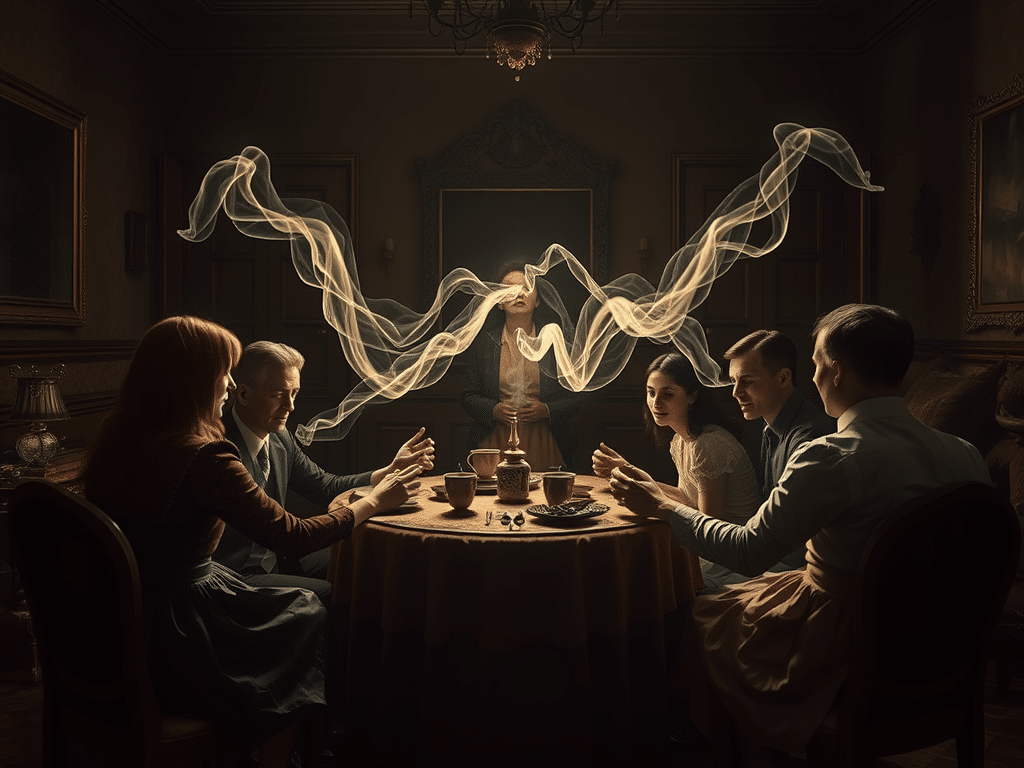
A séance is a planned event where people try to talk to the spirits of the dead. A medium, who says they have special powers to connect the living and the dead, usually leads the séance. Usually, these sessions happened in rooms with low lighting, with the people sitting around a table and often holding hands to make a circle of energy that never broke. The setting was carefully planned to encourage spiritual manifestation, with soft voices, serious music, and a feeling that something otherworldly could happen at any time. Mediums would go into trance states and speak in voices that were thought to belong to dead people. They would also make tables float, make strange knocking sounds, or show physical things as proof that spirits were there.
Spiritualists said that ectoplasm was a physical substance that came out of mediums’ bodies during séances, especially from their mouths, noses, ears, and even their navels. People said that this strange substance was the physical form of spiritual energy, a real link between the material and immaterial worlds that spirits could use to talk to the living. Witnesses said that ectoplasm could take on many different shapes and textures. Occasionally it looked like a thick, cloud-like vapor; other times it looked like gauzy, fabric-like ribbons; and other times it looked like hands, faces, or even whole spirit figures. People said that the substance was very sensitive to light, which is why séances had to be done in almost complete darkness. Mediums said that being exposed to bright light could make the ectoplasm pull back violently, which could hurt or even kill them (Delgado, 2011).
During the spiritualist movement’s golden age, which lasted from the 1850s to the 1920s, ectoplasm played a big role in séances. It was the most important part of physical mediumship. Helen Duncan in Scotland, Marthe Béraud (also known as Eva C.) in France, and the Davenport Brothers in America were all famous mediums who became famous for putting on amazing shows of ectoplasmic manifestations that attracted crowds of curious onlookers and devoted believers. Pictures from this time show mediums apparently giving off long streams of white, gauzy material that take on recognizable shapes. These pictures were widely circulated as proof of life after death. The phenomenon gained such importance in spiritualist practice that the ability to produce ectoplasm was considered a sign of a truly powerful medium. Believers often thought that séances without such physical manifestations were less convincing or real.
Folklore about ectoplasm came from many different cultural and mystical traditions. It mixed old ideas about spirit matter with new pseudoscientific ideas. Some spiritualist groups thought that ectoplasm was made up of the medium’s own life force or vital essence, which the spirit temporarily gave form to. This is why mediums often looked tired or weak after making the substance. People discussed how ectoplasm could manifest objects from the spirit world, such as flowers, jewelry, or mysterious written messages. One particularly dramatic piece of folklore said that if ectoplasm was suddenly grabbed or exposed to light while still coming from the medium’s body, the shock could seriously hurt, make sick, or even kill the medium. This was a convenient explanation that kept people from looking into it too closely. There were also stories of ectoplasm that looked exactly like dead loved ones and was solid enough to hug grieving relatives or write messages in their handwriting. These experiences were compelling and helped believers’ faith in the phenomenon.
Almost as soon as ectoplasm became popular, scientists started to look into it and doubt it. Researchers used more and more advanced methods to test what mediums said. In 1882, the Society for Psychical Research was founded in London. They sent people to séances to watch mediums at work using infrared photography, hidden cameras, and controlled conditions. These investigations consistently demonstrated that the purportedly supernatural ectoplasm was, in reality, fabricated from entirely ordinary materials that mediums had concealed on their persons or hidden within the séance room prior to the event. Investigators found that the strange substance was usually made of cheesecloth, muslin, paper, or even animal parts like sheep’s lung or tripe that had been thrown up or taken from body cavities where they had been hidden (Black, 1922). Harry Houdini, a famous debunker, made it his mission to expose fake mediums. He used his knowledge of stage magic and illusion to show how these effects were made, even writing detailed accounts of the tricks used by the most famous spirit mediums of his time.

Theories
People had many different ideas about what ectoplasm was, from the mystical to the pseudoscientific. This shows how fascinating it was at the time when old spiritual beliefs and new scientific ideas were starting to clash. Some spiritualists said that ectoplasm was a type of protoplasm or living matter that lived in a fourth-dimensional space and could show up in our three-dimensional world when the time was right. Others thought it was made up of psychic energy or bioplasmic emanations from the medium’s aura. These ideas were based on Eastern mystical ideas that were becoming popular in Western esoteric circles. Some researchers suggested that ectoplasm could be a new kind of matter or energy that science hadn’t yet discovered, while wanting to maintain their scientific credibility and remain open to spiritualist ideas, similar to how X-rays and radioactivity were only recently found. These theories largely disintegrated under the scrutiny of evidence, as successive investigations uncovered intentional deception, prompting the scientific community to entirely reject ectoplasm as a mere amalgamation of deception, wishful thinking, and collective delusion (Delgado, 2019).
“Ectoplasm” is a word that scientists and spiritualists have used. Originally, it described cellular structures, but later it was used in spiritualism. Biologically, ectoplasm denotes the external gel-like stratum of cytoplasm in specific protozoa and other cells. Its physical structure, which includes microfilaments and organelles, is important for basic cell functions like movement and shape (Anderson & Beams, 1960; Beams et al., 1959; Gray, 1924). For instance, ectoplasmic specializations can have complicated shapes, like bundles of actin filaments, which are essential for preserving cellular organization (Grove & Vogl, 1989; Muffly et al., 1994).
The spiritualist movement of the late 19th and early 20th centuries, on the other hand, used the word “ectoplasm” to mean a substance that was thought to come out of mediums during séances. This ectoplasm was frequently illustrated in a spectral framework, representing a mode of spiritual manifestation. Critics contend that this interpretation was influenced by societal views of spirits and the supernatural, contextualizing ectoplasmic manifestations in a culturally significant manner (Briefel, 2025; Doyle, 2011). For example, spiritualists likened ectoplasm to delicate textiles or veils, implying a connection between the seen and unseen domains (Briefel, 2025). The reports of ectoplasmic projections during spiritual sessions contained intricate visual depictions intended to persuade witnesses of their veracity (Ioan, 2023).
Despite the lack of evidence for spiritualist ectoplasm, the discussion has prompted scientific and cultural research, leading to new perspectives on the concept. The efforts of spiritualists to capture ectoplasm through photography and public demonstrations align with contemporary interests in visual representation, fostering a legacy that connects scientific exploration and spiritual conviction (Ioan, 2023).
Impact
Ectoplasm has had a profound impact on popular culture that has lasted much longer than the spiritualist movement’s credibility. It has gone from being thought of as a real thing to being a beloved cultural icon. The 1984 movie Ghostbusters made the idea famous by introducing the character Slimer and the phrase “He slimed me!” into the cultural lexicon. The movie’s portrayal of green, gooey ghost residue is now the most well-known image of ectoplasm. This image doesn’t look much like the white, gauzy substance that people said they saw in historical séances, but it caught the public’s imagination and led to many copies in TV shows, video games, and toys for kids. Ectoplasm is now a common sight in horror movies, paranormal investigation shows, and Halloween decorations. It has lost its spiritualist roots but still has ties to ghosts and the supernatural. The idea has also had an effect on modern paranormal investigation. For example, ghost hunters sometimes say they have caught ectoplasmic mist or vapor on camera. However, these are usually explained as moisture, dust particles, or camera artifacts rather than being considered real proof of supernatural activity.
Conclusion
The tale of ectoplasm and séances ultimately elucidates human psychology and cultural history as much as it does the paranormal. During its peak, ectoplasm was widely accepted because it met profound human needs for comfort in the face of death, proof of life after death, and connection with loved ones who had passed away. These needs made people believe odd claims despite growing evidence they were false. The phenomenon arose amidst significant social turmoil, notably the catastrophic casualties of the American Civil War and World War I, during which numerous families urgently sought solace in the belief that their deceased relatives persisted in some capacity. Modern skepticism has thoroughly discredited ectoplasm as a tangible phenomenon; however, its cultural legacy endures, serving as a reminder that the dichotomy between belief and skepticism, as well as hope and deception, constitutes a fundamental aspect of the human experience that continues to influence our comprehension of both the natural and supernatural realms.
References
Black, J. (1922). Ectoplasm and Ectoplasm Fakers. Scientific American, 127(3), 162-162.
Briefel, A. (2025). Dressing the ghost. Ghosts and Things, 151-187. https://doi.org/10.7591/cornell/9781501780264.003.0006
Delgado, L. A. (2011). Bawdy technologies and the birth of ectoplasm. Genders, (54).
Delgado, L. A. (2019). Ectoplasm and Spirits in the Material World. Victorian Review, 45(1), 33-38.
Doyle, A. C. (2011). The history of spiritualism.. https://doi.org/10.1017/cbo9781139059794
Grove, B. D. and Vogl, A. W. (1989). Sertoli cell ectoplasmic specializations: a type of actin-associated adhesion junction?. Journal of Cell Science, 93(2), 309-323. https://doi.org/10.1242/jcs.93.2.309
Ioan, D. (2023). Spectral bodies and superimposition in photography and film. Studia Universitatis Babeş-Bolyai Dramatica, 68(1), 43-70. https://doi.org/10.24193/subbdrama.2023.1.02


Leave a Reply