Haunted Ananuri Fortress: Key Points
-
The paranormal claims at Ananuri Fortress stem from its violent history of feudal conflicts, massacres, and prisoner suffering in its dungeons.
-
Visitors consistently report shadowy figures, sounds of battle, temperature drops, overwhelming dread, equipment malfunctions, and strange photographic anomalies, especially in the dungeons.
-
Modern investigators have recorded strange sounds, unusual heat patterns, and odd electromagnetic readings, with some people saying they have video evidence of ghostly figures.
-
Skeptics attribute reports to natural phenomena like echoes, shadows from low light, psychological suggestion, and equipment interference from stone walls and geology.
-
Scientific theories propose infrasound causing unease, toxic mold inducing hallucinations, and geomagnetic anomalies affecting brain function as alternative explanations.
-
Regardless of origin, Ananuri possesses a unique atmospheric quality that affects most visitors and keeps its violent history alive in imagination.

Introduction
Ananuri Fortress, a striking remnant of Georgia’s medieval past, looms over the Aragvi River. It’s located roughly seventy kilometers north of Tbilisi, a location that adds to its dramatic presence. This architectural marvel has drawn people in for ages, its allure stemming from both its breathtaking design and its historical significance. However, it’s the enduring tales of ghostly encounters that have truly maintained the place’s public interest. The fortress stands as a crossroads, a place where Georgian history, folklore, and whispers of the otherworldly converge. This blend of elements has forged a captivating story, one that still draws visitors and those curious about the unexplained from every corner of the globe.
The Fortress
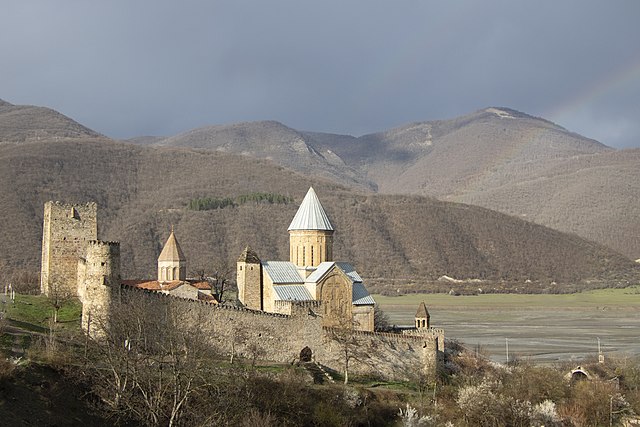
The fortress stands as a striking testament to medieval Georgian military design, its imposing stone walls, watchtowers, and the churches nestled within its defenses all bearing witness to its past. The fortress complex features two castles, their walls linked by a crenellated curtain. The Church of the Mother of God stands out as the most elaborate building, its exterior adorned with detailed stone carvings and crosses. The entire structure functioned as both a castle and the residence of the eristavis, the feudal lords of Aragvi. They were the ones who held sway over the crucial Georgian Military Highway, a vital link between Georgia and Russia. Its commanding position gave the fortress a clear view of the valley and the winding Aragvi River, which flowed below. This advantageous location rendered it nearly impossible to breach throughout its years of use. Stepping through its timeworn gates and into its courtyards, people now find themselves among aged stone buildings. These structures have seen their share of conflicts, political maneuverings, and human stories unfold over the course of more than half a millennium.
The architectural style of Ananuri clearly reflects the characteristics of medieval Georgian fortifications, particularly the use of thick stone walls and strong towers. The complex is a sprawling arrangement of structures. Churches, homes, and formidable bastions all contribute to its significance, marking it as both a center of authority and a place of worship. The Church of the Virgin and the Church of St. George, the fortress’s most important buildings, are known for their elaborate decorations and frescoes, which highlight their cultural importance (Malistani, 2025; Гулiєв, 2021).
Ananuri Fortress, more than a mere military stronghold, stands as a testament to the architectural prowess of its time. The castle’s walls, constructed from stone quarried nearby, were built to endure attacks and offer a strategic edge. The strategically built towers, particularly the two main watchtowers, are designed to provide wide views of the surrounding area. This improves both their defensive and surveillance abilities (Aleksanyan, 2024; Hasanov, 2025).
The churches nestled within the fortress walls, the Church of the Virgin in particular, showcase a blend of architectural influences that developed over many years. The elaborate designs, featuring arched doorways and intricate frescoes, are characteristic of Georgian church architecture from that era. Furthermore, the frescoes are significant because they provide insights into the artistic trends and religious themes of the time in Georgian society (Malistani, 2025; Hasanov, 2025).
Fortress History
The Ananuri Fortress was built in the 16th century, mainly during the time of the Kazbegi dynasty. This dynasty had a significant influence on the region’s government and military. This imposing structure likely functioned as a bastion for the Dukes of Aragvi, a noble lineage that once held sway over the lands nearby. Ananuri’s strategic location, on a rocky outcrop overlooking the Aragvi River, allowed it to control important trade routes and defend against potential attacks (Malistani, 2025).
Ananuri Fortress, over the centuries, has been a silent observer of countless skirmishes and pivotal moments that defined Georgia’s past. It functioned as more than just a military base; it stood as a testament to Georgia’s enduring spirit in the face of outside aggression, weathering assaults from both the Ottoman Empire and Persian armies. The fortress’s role in the unification of Georgia during different historical periods highlights its political importance (Гулієв, 2021; Popa, 2024).
Haunted Fortress
Stories of strange happenings at Ananuri Fortress stretch back hundreds of years. Georgian folklore is rich with tales of ghostly figures and otherworldly events. At twilight, both visitors and those who maintain the site have claimed to glimpse shadowy forms traversing the ramparts. These sightings are especially concentrated around the towers, where sentries once stood their posts. Witnesses have reported hearing the unmistakable sounds of battle—swords clashing, cries of pain—along with hushed conversations in Old Georgian, all echoing through the deserted courtyards when the place was otherwise still. Within the Church of the Mother of God, a number of visitors have described experiencing a profound sadness or a sense of foreboding. These feelings often coincide with abrupt changes in temperature and the unsettling impression of being observed by something unseen. Interestingly, these experiences have been reported consistently across different times and by people from various cultures, even those who didn’t know about the fortress’s reputation for being haunted.
Ananuri’s past is a tapestry woven with threads of violence, treachery, and blood, elements that some say have given rise to its ghostly associations. The fortress bore witness to countless savage battles, a battleground for the feuding Georgian noble houses. The dukes of Aragvi, in particular, and their adversaries, clashed repeatedly within its walls. In 1739, a particularly brutal episode unfolded. The Shamshadini family, locked in a bitter rivalry, launched an assault on Ananuri. They killed the ruling family and seized control of the fortress. However, King Teimuraz II eventually expelled them. The fortress’s dungeons, a grim place, had housed innumerable prisoners throughout the ages. Many of them perished there, their lives extinguished by the brutal realities of their confinement. The weight of these past tragedies, according to paranormal investigators, has left behind what they term “residual energy.” This idea posits that the echoes of traumatic events can, in some way, become etched into the very fabric of a place.
The fortress’s dungeons and lower levels have become hotspots for ghostly tales, with numerous reports of strange happenings in the shadows. Tour guides have noted that their flashlights and other electronic gear inexplicably fail when they enter specific cells. People who have visited the site have reported sensations of unseen hands making contact, or even shoving them, in spots where accounts of torture and executions are documented. Allegedly, photographs snapped within the dungeons have revealed peculiar light orbs, mysterious mists, and what seem to be human-shaped figures in spots where no one was present. Visitors to the fortress, including those with sensitivities and self-identified mediums, have reported encounters with the spirits of both prisoners and soldiers. These individuals have shared specific historical details, insisting they couldn’t possibly have learned them through normal channels.
In the twenty-first century, recent paranormal investigations have documented additional unusual phenomena that are difficult to explain using current scientific methods. Multiple paranormal investigation groups have documented electronic voice phenomena within the fortress. These recordings, they believe, feature voices answering questions posed in Georgian and Russian. Thermal imaging cameras, it is claimed, have picked up heat signatures resembling humans in vacant rooms and hallways. These figures appeared to move on their own, only to disappear without a trace. Investigators have also noted compass errors, strange electromagnetic field readings, and equipment failures that miraculously disappear as soon as they exit specific sections of the fortress. A notable case, often cited, centers on a research team from 2015. They asserted they’d recorded video of a ghostly, semi-transparent figure gliding through a courtyard. The veracity of this footage, however, is still hotly debated.

Theories
Despite these numerous reports, skeptics offer compelling alternative explanations for the paranormal claims associated with Ananuri Fortress. The fortress, with its ancient stone and the way it was built, offers plenty of chances for natural occurrences to be mistaken for something otherworldly. Think echoes, the way the wind moves through, and the settling of the stones themselves, all of which can create strange noises. The power of suggestion is a significant factor. Visitors who expect paranormal experiences are psychologically prepared to interpret unclear sensory information as proof of ghostly encounters. A lot of these sightings happen at dusk, a time when the fading light and long shadows can easily play tricks on the mind. The human eye, in those conditions, is prone to misinterpreting movement and form. The fortress’s imposing stone walls, coupled with hidden underground water and the area’s natural geological quirks, likely explain the electromagnetic disturbances and equipment failures.
Psychological and cultural factors also provide reasonable ways to understand the paranormal stories from Ananuri, without needing to use supernatural explanations. The fortress’s violent history creates a narrative that encourages visitors to interpret ordinary experiences as paranormal, a phenomenon known as confirmation bias. Georgian cultural traditions about spirits and the afterlife likely influence local views and storytelling. These tales are often embellished and expanded upon through repeated retellings over time. The emotional weight of thinking about the suffering that happened here can trigger strong psychological reactions. These reactions might include increased anxiety, a state of being overly alert, and even mild dissociative experiences that seem otherworldly. Moreover, the fortress’s isolated and acoustically unique areas can create sensory deprivation, which sometimes leads to hallucinations or misinterpretations.
Scientists have put forward several theories to explain real anomalous experiences, steering clear of supernatural explanations. The “stone tape theory” suggests that crystals in rocks could somehow record and then replay traumatic events. However, this idea lacks scientific support and contradicts our current understanding of physics. Infrasound, those sound waves that elude our ears, can be produced by the wind interacting with the fortress’s structure. This phenomenon is known to induce a range of unsettling effects, including feelings of anxiety and unease, and, in some cases, even visual hallucinations. Toxic mold and fungal spores, often found in older, moisture-laden structures such as Ananuri, can have neurological consequences when breathed in. This might offer an explanation for certain hallucinatory episodes. Geomagnetic anomalies in the area might influence human brain function, particularly in the temporal lobes, which some researchers suggest are linked to mystical and paranormal experiences.
The ongoing discussion between those who believe and those who doubt continues to influence how Ananuri Fortress is viewed and experienced by its various visitors. For those who embrace the paranormal, the fortress is a real haunted place, a spot where the boundary separating the living from the departed is disturbingly fragile. The consistent reports from different times and cultures, they argue, provide strong evidence that something unusual is happening within these ancient structures. Skeptics argue that the observed consistency in ghost sightings is simply a result of common psychological reactions to suggestive situations, along with the influence of shared cultural ideas about how ghosts are supposed to act and where they are usually found. Despite these differences, both viewpoints agree that Ananuri has a unique atmosphere that strongly affects everyone who visits, regardless of whether they think it’s caused by something supernatural or natural.
Today, Ananuri draws tourists eager to experience its historical importance and admire its architectural splendor, making it a destination for cultural heritage tourism. The fortress is on the UNESCO World Heritage Tentative List, which highlights its importance in the history of Georgia and the surrounding area (Malistani, 2025). This element is frequently highlighted in tourism campaigns (Gamkrelidze et al., 2019).
Conclusion
Ananuri Fortress is a captivating blend of history, architectural prowess, and the enduring human preoccupation with what lies beyond this life. The fortress, regardless of whether the reported paranormal events are caused by genuine supernatural activity, psychological suggestion, natural environmental factors, or a combination of these, has a strong ability to evoke emotional and sensory responses in those who visit. The fortress, a silent witness to Georgia’s stormy medieval era, still echoes with tales of the past. The legends of spirits and spectral visits ensure that the violence of those times remains vivid in the public’s mind. The ongoing visitation of these ancient fortifications and the passage through spaces marked by violence ensures the continuation of the discourse between paranormal conviction and skeptical investigation. Consequently, Ananuri transcends its status as a mere historical site, evolving into a dynamic setting for examining the ways in which individuals make sense of enigmatic occurrences and derive significance from their interactions with the inexplicable.
References
Aleksanyan, T. A. (2024). Medieval fortification of the northeastern region of armenia: a general review. History, Archeology and Ethnography of the Caucasus, 20(2), 384-397. https://doi.org/10.32653/ch202384-397
Gamkrelidze, I., Okrostsvaridze, A., Maisadze, F., Basheleishvili, L., Boichenko, G., & Skhirtladze, I. (2019). Main features of geological structure and geotourism potential of Georgia, the Caucasus. Modern Environmental Science and Engineering, 5(5), 422-442.
Hasanov, E. L. o. (2025). Russian empire archive’s written sources on the medieval historical-architectural heritage of ganja city. Вестник Пермского Университета. История, (2 (69)), 58-66. https://doi.org/10.17072/2219-3111-2025-2-58-66
Munawar Shah Malistani (2025). A study of the historical background of the kalyon fortress. Payam Marafat Journal of Social Sciences, 20(3 & 4), 23-42. https://doi.org/10.64394/jss.v3.4i20.32
Popa, C. I. (2024). Arheologia artei și istoriile unui monument: o pictură inedită de hermann meuselbach (1888) cu turnul cetății din săsciori. Terra Sebus. Acta Musei Sabesiensis, (16), 71-166. https://doi.org/10.63578/terrasebus.2024.03
Гулієв, Ш. (2021). About archaeological research of some medieval fortifications of azerbaijan. Grani, 24(5), 68-75. https://doi.org/10.15421/172151


Leave a Reply