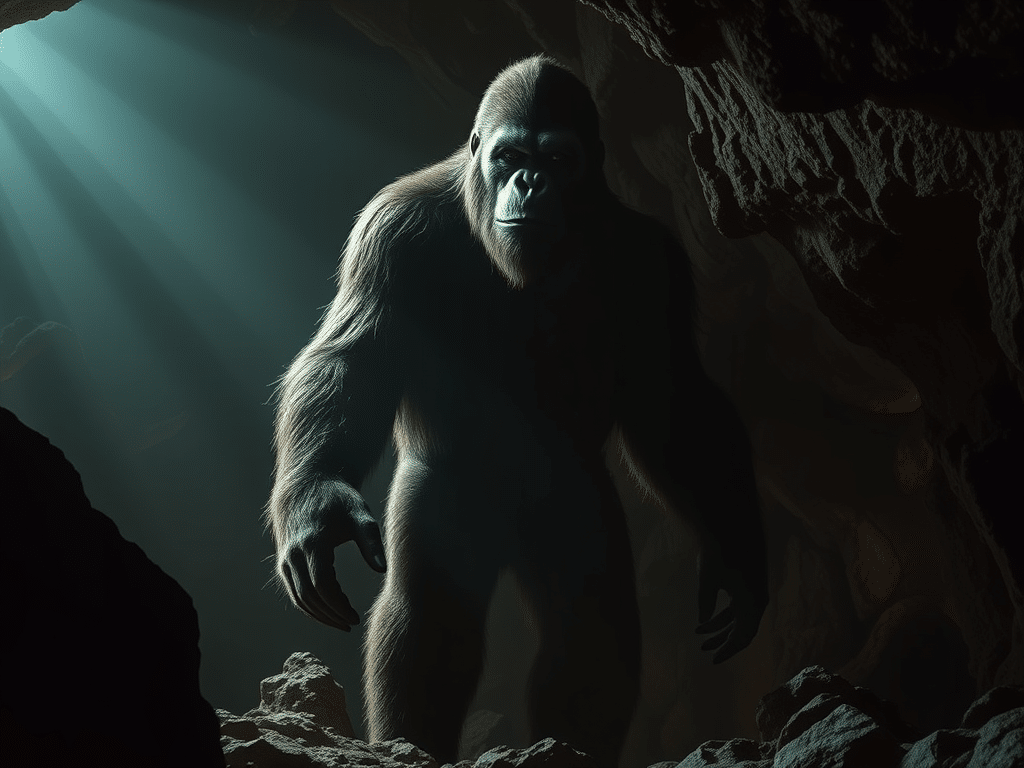
Bigfoot and Caves: Key Points
-
Bigfoot is described as a seven to ten-foot tall, hair-covered bipedal creature with ape-like features, massive feet, and an overwhelming odor, consistently reported across North America despite lack of scientific evidence.
-
Caves have long been associated with paranormal phenomena, serving as locations where mysterious disappearances, equipment malfunctions, and unexplained encounters occur throughout human folklore.
-
Researchers believe cave systems provide ideal shelter for Bigfoot, offering concealment, stable temperatures, and interconnected passages that could explain how these creatures appear and disappear without leaving surface traces.
-
Disturbing reports link Bigfoot and caves to human disappearances, with some witnesses claiming to have seen creatures carrying human forms into cave entrances in wilderness areas.
-
Theories range from Bigfoot being a surviving ancient ape species using caves for shelter to paranormal explanations, while skeptics cite lack of physical evidence and misidentifications of bears.
-
The Bigfoot-cave legend significantly impacts popular culture, tourism, and wilderness conservation, generating economic benefits while maintaining human wonder about the unknown in an increasingly mapped world.

Introduction
The tale of Bigfoot, or Sasquatch, has long held a grip on the American psyche, embodying one of the most persistent enigmas in the study of hidden creatures. This creature, often described as a massive, two-legged, ape-like figure, stands anywhere from seven to ten feet tall and is usually covered in dark hair. Sightings of it have been reported throughout North America, with a concentration of reports coming from the Pacific Northwest. Though the scientific community largely dismisses the idea of Bigfoot, the ongoing stream of reported sightings, footprints, and supposed encounters has ensured the legend’s survival. Witnesses often describe caves and subterranean networks as possible homes or places of concealment for these elusive beings. The overlap between Bigfoot sightings and caves presents a fascinating area of cryptozoological study. It merges the unexplored realms of underground worlds with the enduring mystery surrounding North America’s most well-known cryptid.
Bigfoot
Witnesses often describe Bigfoot as a huge, powerful figure. Its appearance is a jarring mix of human and ape traits, a combination that many find deeply unsettling. Towering above most people, these creatures are described as being completely enveloped in a dense, rough coat of fur. The color of this fur varies, encompassing shades from deep brown to black, with occasional hints of reddish-brown or gray. Witnesses frequently highlight the being’s wide shoulders, its arms, which dangle down to the knees, and a head that is either pointed or conical in shape. This head rests on a thick neck, with little to no visible distinction. The visage is often characterized by a flat plane, a prominent brow ridge, and eyes that, at times, catch the light in a way reminiscent of an animal. The nose, too, is broad, echoing a gorilla’s. The feet, however, are the most striking feature, reportedly measuring an astonishing fifteen to twenty-four inches. Reports frequently describe a powerful, unpleasant smell linked to Bigfoot sightings. Witnesses often liken it to a blend of wet dog, decaying refuse, and the scent of a skunk. Its movement is fluid, a testament to its strength. The creature navigates difficult ground with an unexpected blend of speed and elegance, given its massive proportions.
Bigfoot research is a specific area of study within cryptozoology, which is the general study of creatures that haven’t been proven to exist. Many studies have attempted to connect the many reported Bigfoot sightings with the known habitats of real animals, particularly the American black bear (Ursus americanus). For example, ecological niche modeling has been used by researchers to show that the predicted habitat for Bigfoot is similar to that of the black bear. This suggests that many reported sightings might actually be misidentifications of this known species (Lozier et al., 2009; Aubry et al., 2017; Ladle, 2009). Eyewitness accounts are significantly influenced by psychological biases and pre-existing beliefs. As a result, many people might unintentionally project their ideas about unknown creatures onto animals they already know (Marks et al., 2017).
Bigfoot in Caves
Caves have long been a part of paranormal stories, often seen as places that connect the known world with areas of mystery and danger. Caves have always been linked to spirits, monsters, and strange occurrences. This connection goes back to ancient Greek stories about the underworld, and it continues today with reports of unusual lights, sounds, and beings coming from within caves. Numerous caves are rumored to have strange qualities. Some areas within these caves cause compasses to spin erratically, while electronic devices often fail. Visitors frequently report feeling intensely observed or as though they’re being pursued by unseen entities. Certain cave systems have become infamous for the unexplained disappearances of individuals. Hikers and spelunkers have simply vanished, leaving no clue behind, in passages that had been thoroughly examined previously. The pitch-black void, the solitude, and the sprawling, uncharted passages of countless caves conjure an atmosphere ripe for the imagination, where reason often falters. Tales of warped time, disembodied whispers in the dark, and fleeting glimpses of humanoid shapes that meld into stone have surfaced from caves globally, solidifying their status as centers of the unexplained.
Studies have shown that many ancient civilizations, particularly those in Mesoamerica, considered caves sacred. In the Maya civilization, caves were more than just places to live; they were mainly used as ceremonial sites for spiritual practices. Research indicates that these locations were important in the Mesoamerican worldview, symbolizing the entrance to the underworld and the cycles of life and death (Navarro‐Romero et al., 2024). These viewpoints suggest that caves were important places for connecting with the supernatural. This highlights their significance in rituals meant to connect with ancestors and cosmic forces. Caves served a purpose beyond simple protection; they were seen as places for spiritual connection, which strengthened the link between caves and religious experiences (Navarro‐Romero et al., 2024).
Witness accounts frequently mention a connection between Bigfoot and caves, which has become a significant part of Sasquatch research. Cave systems, according to many researchers, present an ideal refuge for a large, intelligent being intent on evading human interaction. These subterranean environments offer shelter from the weather, a means of remaining hidden, and access to water, which frequently flows through these underground passages. Eyewitness accounts describe sizable, hairy beings either disappearing into cave entrances as the sun sets or appearing at dawn. This behavior hints that these creatures might be using caves for daytime shelter, venturing out to hunt after dark. Cave explorers, in their subterranean wanderings, have stumbled upon what they believe are nesting sites. These consist of substantial depressions, meticulously lined with leaves, moss, and other organic detritus. The cave floors, too, bear witness, with enormous footprints pressed into the softer sediments. The extensive and often interconnected nature of many cave systems could theoretically allow Bigfoot to travel long distances underground. These factors might explain how these creatures seem to appear and disappear across large areas without leaving consistent traces on the surface. Moreover, the stable temperature and humidity in deep caves would create a consistently livable environment. This would allow Bigfoot populations to survive harsh winters, which could otherwise force them into more visible lowland areas.
One of the most unsettling facets of Bigfoot and cave stories centers on claims of abductions or vanishings linked to both. Over the years, countless individuals have disappeared in wooded regions notorious for Bigfoot sightings and sprawling cave networks. In some instances, the missing were last spotted near cave openings or in areas where Sasquatch activity had been documented. David Paulides and others have cataloged hundreds of puzzling vanishings in national parks and remote areas. They’ve observed strange patterns, leading some to wonder if unknown predators or perhaps even intelligent beings are involved. A handful of witnesses have, in rare instances, claimed to have observed Bigfoot-like beings transporting what seemed to be human figures into caves or deep woods. These reports, however, are unsubstantiated and widely debated. Individuals who allege abduction and subsequent release sometimes recount being brought to cave systems, where they encountered groups of these beings. However, these accounts are frequently dismissed, labeled as fabrications, misinterpretations, or psychological phenomena. The psychological distress stemming from cave exploration and purported Bigfoot sightings could potentially generate an optimal environment for fear, thereby precipitating panic, impaired judgment, and potentially fatal consequences for individuals who undertake solitary or inadequately prepared excursions into isolated wilderness regions.

Theories
Various theories have been proposed to explain the connection between Bigfoot and caves, a topic of interest for both those who believe in the creature and researchers who study it as a possible, yet unknown, primate species. One theory suggests that Bigfoot could be a surviving population of Gigantopithecus, an extinct ape species. This species, which lived in Asia, might have crossed the Bering land bridge to North America. The idea is that living in caves helped these creatures survive as humans spread out. Another idea suggests that these beings are a separate branch of human evolution. This species, it is proposed, developed alongside Homo sapiens but chose a more isolated, primitive way of life, using caves like their ancestors did hundreds of thousands of years ago. Some scientists theorize that Bigfoot could be primarily active at night. They might navigate intricate cave systems to travel between areas, staying hidden, much like certain bear species that use caves for shelter but roam far and wide in search of sustenance. Some of the more outlandish theories about Bigfoot dip into the realm of the paranormal. They propose that caves act as gateways to other dimensions, allowing Bigfoot to come and go, which might explain why we find so little concrete proof, even though people claim to see him all the time. Some theories even suggest that Bigfoot’s intelligence is such that they intentionally use caves to hide their deceased, effectively eliminating a key piece of evidence that could confirm their presence.
The phenomenon of Bigfoot sightings can also be examined from a psychological viewpoint. Beliefs in paranormal phenomena, such as Bigfoot, are common in the general public. Research indicates that certain demographic factors, like gender and education, influence these beliefs (Silva, 2023; Silva & Woody, 2022). According to Silva (2023), about 72% of Americans reportedly believe in some form of paranormal activity, highlighting the cultural complexity surrounding these beliefs. These beliefs are often reinforced by media portrayals, such as reality television shows like Finding Bigfoot, which help to normalize these ideas in the public’s understanding (Brewer, 2012).
Scientists are generally skeptical about the existence of Bigfoot, mainly because they haven’t found any physical evidence to support its existence. The absence of a Bigfoot corpse, skeletal remains, or conclusive DNA, after years of investigation, raises eyebrows. Statistically speaking, if a population of sizable primates were indeed thriving in North America, one would expect some tangible proof by now. Numerous reported encounters have been chalked up to mistaken identity, with the most common culprit being bears. When these creatures rise on their hind legs, they can, under certain conditions, cast a shadow that resembles a person, especially in dim light or from afar. Much of the photographic and video evidence, the Patterson-Gimlin film included, is still hotly debated. Critics often suggest that costumes and hoaxes, designed to grab headlines or make money, are responsible. Critics argue that the cave connection is a convenient way to explain the lack of physical evidence, allowing those who believe to keep their views even when there isn’t scientific proof. Furthermore, those who are unconvinced point out that human psychology tends to seek patterns and create myths. This suggests that Bigfoot stories are a modern version of ancient “wild man” myths found in almost every culture, adapted to fit current concerns and fears about nature and the unknown.
Impact
The influence of Bigfoot-cave mythology extends far beyond the field of cryptozoology, affecting popular culture, tourism, and even scientific research in unexpected ways. Small towns throughout the Pacific Northwest and other Bigfoot hotspots have embraced the legend, creating festivals, museums, and guided tours that bring significant revenue to rural economies that might otherwise struggle. The enduring fascination with Bigfoot has fueled a vast array of books, documentaries, TV shows, and movies. This enthusiasm has, in turn, spawned a whole industry devoted to both exploring and captivating audiences with the idea of creatures yet to be found. From a scientific perspective, the search for Bigfoot has occasionally led to real discoveries. Researchers have explored remote areas and cave systems, which have resulted in the identification of new plant, insect, and small animal species. This demonstrates how cryptozoology can indirectly contribute to legitimate biological research. This has, in turn, ignited significant discussions about the preservation of wild places. Numerous Bigfoot enthusiasts, for instance, champion the protection of extensive forested areas and cave networks, believing these environments could harbor undiscovered creatures. Psychologically, the Bigfoot legend serves important cultural functions. It represents humanity’s desire to believe that mysteries still exist in a world that is becoming more known and understood. This legend also suggests that nature still has the power to surprise and humble us.
Caves continue to be associated with paranormal phenomena in contemporary culture, as shown by the many reports of ghost sightings and other supernatural events linked to these places. Current research on how people engage with ghost sightings and paranormal activities suggests a lasting interest in the mystical aspects of caves. Although no specific studies on this phenomenon were found, stories from different cultures suggest that caves are often seen as places where the boundary between the living and the dead is thin, allowing for contact with spirits (Matthews et al., 2010).
Media representations play a crucial role in shaping how the public views Bigfoot. Documentaries and dramatizations create a story about the myth, balancing scientific investigation with sensationalism (Brewer, 2012; Silva, 2023). These portrayals can blur the line between what’s real and what’s made up, leading to a cultural belief that persists even without strong evidence. This interaction between media and public opinion can influence how people understand things. It can also encourage the spread of unverified information within community discussions (Munro, 2023).
Conclusion
The ongoing mystery of Bigfoot and its alleged connection to caves presents a fascinating intersection of folklore, psychology, and the human need for wonder in today’s world. Regardless of whether these beings are considered real entities or cultural products of our shared subconscious, the legend continues to provoke questions about what might still be hidden in the world’s unexplored areas. The caves, with their real mysteries and unexplored depths, add a believable element to the mythology. They offer a logical explanation for how a large creature could stay hidden while also playing on our basic fears of darkness and the unknown. With the relentless march of technology and the ongoing encroachment on wild places, the room for these stories shrinks. Still, the sightings endure. This begs the question: is there a remarkable truth still hidden from us, or does the human mind simply refuse to let go of the things that haunt the dark? The narrative of Bigfoot and subterranean spaces underscores the persistent ambiguity that characterizes the boundary separating the familiar from the unfamiliar. Furthermore, certain enigmas, irrespective of their veracity, fulfill a crucial function in fostering both our sense of awe and our humility when confronted with the immensity of the natural world.
References
Aubry, K. B., Raley, C. M., & McKelvey, K. S. (2017). The importance of data quality for generating reliable distribution models for rare, elusive, and cryptic species. Plos One, 12(6), e0179152. https://doi.org/10.1371/journal.pone.0179152
Brewer, P. R. (2012). The trappings of science. Science Communication, 35(3), 311-333. https://doi.org/10.1177/1075547012454599
Ladle, R. J. (2009). Forecasting extinctions: uncertainties and limitations. Diversity, 1(2), 133-150. https://doi.org/10.3390/d1020133
Lozier, J. D., Aniello, P., & Hickerson, M. J. (2009). Predicting the distribution of sasquatch in western north america: anything goes with ecological niche modelling. Journal of Biogeography, 36(9), 1623-1627. https://doi.org/10.1111/j.1365-2699.2009.02152.x
Marks, C. A., Clark, M., Obendorf, D., Hall, G. P., Soares, I., & Pereira, F. (2017). Trends in anecdotal fox sightings in tasmania accounted for by psychological factors. Conservation Biology, 31(6), 1450-1458. https://doi.org/10.1111/cobi.12944
Matthews, N., Young, S., Parker, D., & Napier, J. (2010). Looking across the hearing line?: exploring young deaf people’s use of web 2.0. M/C Journal, 13(3). https://doi.org/10.5204/mcj.266
Munro, D. (2023). Cults, conspiracies, and fantasies of knowledge. Episteme, 21(3), 949-970. https://doi.org/10.1017/epi.2022.55
Navarro‐Romero, M. T., Muñoz, M. d. L., Krause‐Kyora, B., Cervini‐Silva, J., Alcalá‐Castañeda, E., & David, R. E. (2024). Bioanthropological analysis of human remains from the archaic and classic period discovered in puyil cave, mexico. American Journal of Biological Anthropology, 184(2). https://doi.org/10.1002/ajpa.24903
Silva, T. (2023). Masculinity, femininity, and reported paranormal beliefs. Journal for the Scientific Study of Religion, 62(3), 709-722. https://doi.org/10.1111/jssr.12862
Silva, T. and Woody, A. (2022). Supernatural sociology: americans’ beliefs by race/ethnicity, gender, and education. Socius: Sociological Research for a Dynamic World, 8. https://doi.org/10.1177/23780231221084775



Leave a Reply