Spottsville Monster: Key Points
-
The Spottsville Monster is one of Kentucky’s most enduring cryptozoological mysteries from Henderson County, possessing unique features that distinguish it from other Bigfoot-type entities while remaining debated among believers and skeptics.
-
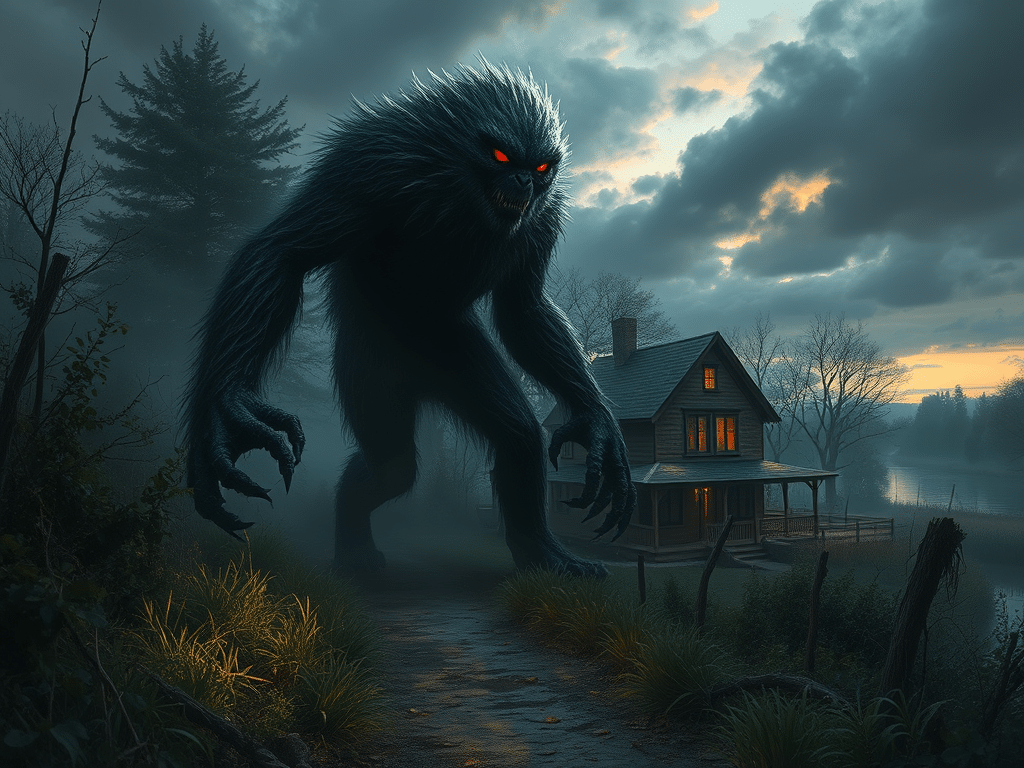
In 1975, the Nunnelly family experienced an eleven-month ordeal with an eight-foot-tall, hairy, red-eyed creature that terrorized their remote farmhouse, ultimately forcing them to abandon their home.
-
A local neighbor encountered the creature in an abandoned barn, where it communicated telepathically, saying, “Don’t be afraid… I will not harm you,” then fled without leaving tracks.
-
Witnesses describe a bipedal creature seven to ten feet tall, covered in dark fur, with glowing red eyes, enormous hands and feet, and an overwhelming smell of decay.
-
The case attracted significant media attention, and while reporting errors inadvertently protected the family’s location, both the Nunnelly children and the helpful neighbor faced relentless public ridicule.
-
Explanations range from misidentified bears to surviving Gigantopithecus populations or interdimensional entities, while the case has shaped local culture and contributed to discussions about undiscovered species.

Introduction
The Spottsville Monster represents one of Kentucky’s most enduring cryptozoological mysteries, a creature that has captivated the imagination of residents and researchers for decades. This enigmatic being, reportedly sighted in the small Henderson County community of Spottsville, has become a significant part of regional folklore and is still generating debate among believers and skeptics alike. While the creature shares characteristics with other reported Bigfoot-type entities across North America, the Spottsville Monster possesses its own unique features and historical context that distinguish it from similar cryptids.
Encountering the Monster
In the small, isolated town of Spottsville, Kentucky, located along the banks of the Green River in Henderson County, one family’s eleven-month ordeal with a mysterious creature in 1975 became one of the most well-documented and disturbing Bigfoot encounters in American cryptozoology. The Nunnelly family moved into a remote farmhouse on Mound Ridge Road, expecting a peaceful rural life where they could raise tobacco, tend gardens, and let their six children play safely in the yard. Instead, they found themselves terrorized by what came to be known as the Spottsville Monster, an eight-foot-tall, hairy, red-eyed creature that would challenge their sense of safety and ultimately force them to abandon their home (DeMello, 2024).
The first signs that something was wrong came with the steady disappearance of chickens, initially attributed to weasels and other common predators. The direct encounters with the creature began one evening around eight o’clock when Rose Nunnelly stepped onto the front porch to call her son Harold and his family over for supper. She looked to her left and saw what she later described as “a giant, hairy shadow at least 8 feet tall standing in the darkness by a nearby shed looking at her” (Nunnelly, n.d.). Her reaction was immediate and visceral: “She screamed like a panther, then ran back inside and locked the door” (Nunnelly, n.d.). The State Police showed up, did a quick search, and found nothing amiss, though they would be back repeatedly as the nightly visits persisted. Officers who came to the scene noticed strange tracks in the snow and reported that the family seemed genuinely shaken by what had happened. Other sightings in the area during that time hinted that the creature had claimed some sort of territory in the rural woods around Spottsville.
The most remarkable encounter happened when the neighbor, seeking refuge from the rain, ducked into a long-abandoned barn, unaware that the creature was already inside. When he turned, he was “staring into a huge, hairy midsection,” and even though he was over six feet tall, “he had to look almost straight up to see the creature’s face” (Nunnelly, n.d.). The visage that met his gaze was “horrible and deeply terrifying,” featuring a short muzzle, long, pointed fangs embedded in both its upper and lower jaws, black skin, and unsettling red eyes that “chilled and frightened him to his very soul” (Nunnelly, n.d.). Then, something unusual for a Bigfoot occurred: “Despite the beast’s appearance, it spoke to him without using its mouth at all, but some sort of mental telepathy and said, ‘Don’t be afraid… I will not harm you.’” (Nunnelly, n.d.). After the creature fled into an open, muddy field, the man searched for tracks but found none.
The Spottsville Monster attracted considerable media attention, which had both positive and negative effects on those involved. Local television news dispatched a camera crew and police sketch artist to the property, and the following day, reporters from the local newspaper, The Gleaner, arrived at the farm. The morning paper called the creature “The Spottsville Monster,” and the article “treated the sighting fairly, despite some misquotes, such as calling the monster ‘green’ and misnaming the name of the road on which the family lived” (Nunnelly, n.d.). These errors, though, helped shield the family from the worst of the attention, as the mistakes “sent the crowds of gun-toting ‘monster hunters’ that descended on Spottsville to everywhere but the correct location” (Nunnelly, n.d.).
The public’s mockery was constant, affecting both the Nunnelly family and the neighbor who had tried to help them. The children were “endlessly taunted at school,” while the neighbor faced harassment “at work in a nearby fire department” (Nunnelly, n.d.). Squatchable (2024) observes that the neighbor, a local firefighter, hunter, and tracker, enjoyed community respect prior to sharing his experiences. The psychological impact was considerable. The neighbor attributed his difficulty in discussing his experiences to a heart attack he had in 1985, which, as he put it, “left him, for a brief time before he was resuscitated, clinically dead” (Nunnelly, n.d.). The case was officially closed when a statement was published in the local newspaper, which “proudly proclaimed the mystery of TSM solved,” prompting “the hoards of monster hunters” to disperse, “leaving only the body of a dog, someone’s family pet shot accidentally by local teens, behind” (Nunnelly, n.d.).
Description
Those who claim to have seen the Spottsville Monster describe a bipedal being, standing between seven and eight feet tall. Its fur is dark and matted, varying from brown to black. Witnesses report a massive, muscular build, with broad shoulders and long arms that reach past its knees, echoing descriptions of great apes. Its face is said to be somewhat human-like yet distinctly animalistic, with a pronounced brow ridge, deep-set eyes that reflect light, and a flat nose. The monster’s hands are described as enormous, with thick fingers capable of leaving impressions in hard surfaces, and its feet measure an estimated fifteen to eighteen inches in length. Perhaps most disturbing to witnesses is the creature’s penetrating stare and the overwhelming smell of decay and musk that reportedly accompanies its presence (Offutt, 2025).
The physical description of the Spottsville Monster shares some characteristics with other Bigfoot reports but also contains unique and disturbing features. The creature was consistently described as being about eight to ten feet tall, with a large, hairy body. Webb (2022) noted that similar creatures reported in the area during this time were called a “10-foot beast” and were said to be “covered with hair” and walk upright. However, the most distinctive and frightening features were its face and eyes, particularly the glowing red eyes, which seemed to have a hypnotic effect.
The Spottsville Monster case shares similarities with other Bigfoot encounters in the region from the same time, but it also has some unique characteristics. The 1970s were marked by a surge in reported creature encounters throughout Kentucky and southern Indiana. Webb (2022) notes that in Pike County, Indiana, “multiple individuals informed the Indiana State Police of having observed a strikingly similar animal,” which was characterized as a “ten-foot-tall creature covered with hair.” Webb (2022) further explains that “a United Press International article concerning the creature achieved the 1970s equivalent of viral status, appearing in newspapers from Canada to South Carolina.” Nevertheless, several characteristics differentiate the Spottsville Monster from conventional Bigfoot accounts, such as its apparent capacity to disappear when fired upon, the presence of telepathic communication, and the precise nature of animal mutilations, which exhibited a complete lack of blood or evidence of scavenging.
The Spottsville Monster, when stacked up against other North American Bigfoot-like beings, presents a familiar picture, though with its quirks. Much like the Sasquatch of the Pacific Northwest, this creature is said to be big, walk on two legs, and be covered in dark hair, hinting at a possible link between sightings in different places. Its aggressive actions, especially the reported attempts to gain entry into people’s homes, seem to echo stories of the Ohio Grassman and some Appalachian wildman encounters, rather than the usually elusive Sasquatch of the western states. The fact that these sightings happened in winter also fits a pattern seen in other cryptid reports, where a lack of food might push these creatures closer to where people live. Conversely, the Spottsville Monster’s comparatively restricted reported range and its apparent concentration within a defined geographic zone set it apart from the more widely dispersed entities documented elsewhere.

Messenger-Inquirer(Owensboro, KY)
Theories
A range of hypotheses has been advanced to account for the Spottsville Monster sightings, spanning from the strictly cryptozoological to the entirely skeptical. Certain theorists suggest that the creature might represent a tangible animal that traversed the Ohio River corridor, subsequently establishing itself within the dense woodlands of western Kentucky. Skeptics, in contrast, contend that the reported sightings can be attributed to the misidentification of familiar fauna, such as bears, especially under conditions of inadequate illumination or among witnesses experiencing heightened fear. Some researchers have suggested that the 1975 encounter may have been influenced by mass hysteria, hoaxing, or the cultural climate of the mid-1970s, when Bigfoot mania was at its peak following numerous high-profile reports and the release of popular documentaries on the subject.
The extraterrestrial or interdimensional hypothesis suggests the creature may possess the ability to shift between dimensions or states of existence, supported by the neighbor’s observation of creatures emerging from “a strange area that looked like ‘heat waves rising from a hot, summer road’” (Nunnelly, n.d.). The biological cryptid hypothesis proposes an unknown species or relict population, though this theory struggles to explain the more paranormal aspects of the encounters. Believers in the creature’s existence suggest it may be a surviving population of Gigantopithecus, an extinct great ape that once inhabited Asia, or possibly an unknown primate species that has managed to avoid scientific documentation. Relic populations frequently serve as a framework for understanding cryptids (Guimont, 2021).
Impact
The Spottsville Monster has significantly shaped the local populace and the wider domain of cryptozoology, thereby affecting both regional cultural identity and tourism. Sightings of the creature have fostered local pride and fascination, with long-term residents disseminating narratives and hypotheses about the entity across successive generations. This enigma has drawn cryptozoologists, amateur investigators, and inquisitive tourists to the vicinity, thereby augmenting regional engagement with unexplained occurrences and local legends.
The Spottsville Monster’s narrative has been preserved through its inclusion in a variety of books, television shows, and documentaries focused on cryptids, thereby ensuring its continued relevance for future investigation and public interest. Furthermore, the case has stimulated discourse concerning wildlife conservation, the potential for undiscovered species, and the necessity of valuing eyewitness accounts while upholding scientific standards in investigative procedures (Offutt, 2025).
Frequently, the Spottsville Monster has been classified alongside other cryptids—entities whose existence is proposed but lacks definitive scientific validation. The fascination with such beings aligns with themes found in folkloric traditions, where the demarcation between myth and empirical reality becomes increasingly indistinct. The scientific community’s response to these entities is characterized by both fascination and doubt; some scholars engage in rigorous study, whereas others consider them to be fictional constructs.
This perspective is also applicable to the examination of literary characters and imaginative stories, which can mirror wider human preoccupations with the enigmatic. Although authors such as J.R.R. Tolkien offer detailed investigations of myth and reality, their works are fundamentally situated within the realm of fantasy, rather than directly addressing cryptids or scientific research pertaining to them. Consequently, the analogy to Tolkien in relation to the Spottsville Monster is less robust, and the evidence linking Tolkien’s writings to current cryptozoological interest is inconclusive (Guimont, 2024).
Conclusion
The Spottsville Monster, a legend that refuses to die, still captivates those drawn to the unexplained. It embodies our enduring fascination with the idea that undiscovered, extraordinary beings might still inhabit our planet. Whether these reports point to a real, unclassified primate, a case of mistaken identity, or simply a good story, the Spottsville Monster has carved out a niche in American cryptozoology. The tale reminds us that even in our thoroughly explored world, there are still places of mystery and awe that defy easy answers, encouraging us to stay curious while also keeping a critical eye. As long as there are wild places and human creativity, creatures like the Spottsville Monster will continue to blur the lines between what we know and what we don’t.
References
DeMello, M. (2024). Bigfoot to Mothman: A Global Encyclopedia of Legendary Beasts and Monsters.
Guimont, E. (2021). Megalodon. M/C Journal, 24(5). https://doi.org/10.5204/mcj.2793
Guimont, E. (2024). J. R. R. Tolkien’s Legendarium as Heterodox Palaeoscience. Interdisciplinary Science Reviews, 49(3-4), 424-437. https://doi.org/10.1177/03080188241260144
Nunnelly, B. (n.d.). The Spottsville Monster. Kentucky Bigfoot. https://www.kentuckybigfoot.com/counties/spottsville_monster.htm
Offutt, J. (2025). Chasing North American Monsters: A Guide to Over 250 Creatures from Greenland to Guatemala. Llewellyn Worldwide.
Squatchable. (2024, August 10). Spotsville Monster: Firefighter’s encounter with 8-foot Bigfoot in Kentucky. https://squatchable.com/article.asp?id=12938
Webb, J. (2022, July 22). A smelly, 10-foot monster hounded Kentucky and Indiana in the 1970s: What was it? Reporter.net. https://www.reporter.net/indiana/features/a-smelly-10-foot-monster-hounded-kentucky-and-indiana-in-the-1970s-what-was-it/article_d5e5d8c8-0789-11ed-a26d-6b8abefe5725.html



Leave a Reply