Hibagon, Japanese Bigfoot: Key Points
-
The Hibagon is Japan’s version of Bigfoot, first reported in 1970 near Mount Hiba, with sightings peaking in the mid-1970s.
-
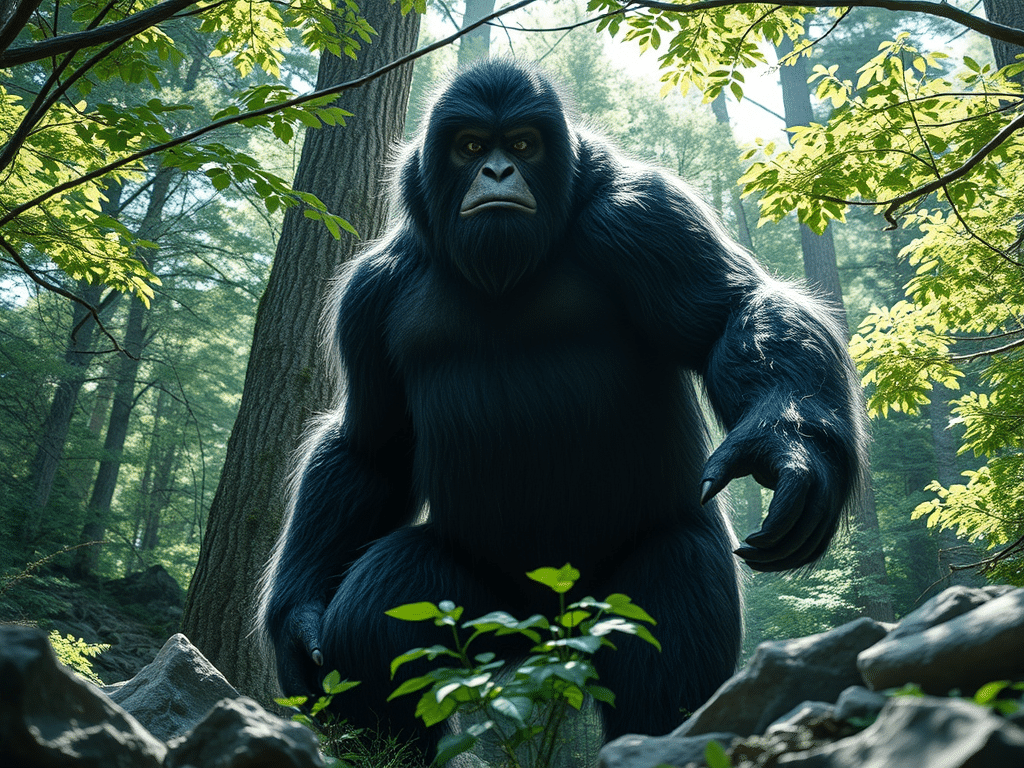
Witnesses describe a five to six-foot tall, hair-covered bipedal creature with a distinctive triangular face and muscular build.
-
The Hibagon shares similarities with Bigfoot but is smaller, has a triangular face, and experienced a concentrated sighting period rather than consistent reports.
-
Theories range from unknown primate species to misidentification of known animals or mass hysteria influenced by Western media.
-
The phenomenon increased tourism in the area by selling Hibagon-themed goods and became an important part of the local culture.
-
The Hibagon serves as a case study for how media, folklore, and eyewitness accounts create cryptozoological narratives.

Introduction
The Hibagon has fascinated both believers and non-believers in cryptozoology since the early 1970s. It is one of Japan’s most mysterious creatures. Often called the “Japanese Bigfoot,” this supposedly ape-like creature has been seen in the hilly areas of Hiroshima Prefecture, especially near Mount Hiba, which is where its name comes from. The Hibagon has some traits in common with the more well-known North American species, but it also has its own unique traits and a culture that makes it stand out among unknown primates. Folklore, eyewitness reports, and modern media all come together to make lasting cryptozoological legends. The phenomenon surrounding this creature shows how these elements work together.
Description
Eyewitness accounts put together by Long (2025) describe the Hibagon as a creature that looks like Bigfoot and is about five feet tall. It has dark hair all over its body and a unique chocolate-brown face. Cryptozoology commonly assembles the creature’s appearance from multiple sighting reports. This is done by putting together details like length, height, color, and head features that were reported by multiple witnesses (Eberhart, 2002). The most recognizable thing about the creature’s appearance is its triangular or inverted triangle-shaped face with deep-set, glaring eyes that are so smart they almost look human. The Hibagon is said to have a broad chest and a muscular build. Its arms are said to hang past its knees, and it is said to walk standing on two legs like a person. Witnesses have consistently reported that the creature emits a foul odor, a trait commonly associated with similar cryptids worldwide (Long, 2025).
Based on how the Hibagon is said to behave, it seems like a shy animal that avoids humans and prefers the dense woods and mountainous areas where it is thought to live. People who have seen the creature say it moves through rough terrain with amazing speed and agility. When seen, it disappears into the bushes. The Hibagon has never been said to be mean to people; most encounters with them end with a short sighting before the creature runs away. The being may be most active at night, but it has also been seen during the day. Witnesses say the creature makes howls, grunts, and screams, unlike any other animal in the area.
A group of students near Mount Hiba in July 1970 reported seeing a strange, ape-like creature, which was the start of modern history for the Hibagon. More than one sighting happened around Mount Hiba in the 1970s. The cryptid’s appearance coincided with the film Half Human, suggesting that culture may have influenced its reports. In the early and middle 1970s, there were many reports in the area. The busiest year was 1974, when dozens of witnesses came forward with their stories. Local newspapers wrote a lot about these reports, and the creature quickly became famous all over Japan, bringing both serious investigators and curious tourists to the area. Sightings became much less common after the mid-1970s, though stories have kept coming in from time to time into the last few decades. Interestingly, the phenomenon also led local governments to promote the creature as a tourist draw. Even though reports of sightings have decreased, Mount Hiba now has souvenirs and images related to the Hibagon.

Bigfoot Comparison
The Hibagon and North American Bigfoot are similar, suggesting they may be different versions of the same species. Both are described as hairy, two-legged animals that stay away from people and live in remote, wooded areas. Reports of both creatures include similar details, like strong bodies, long arms, and foul smells. Despite decades of hunts and investigations, neither has been proven to exist for sure. Both cryptids have been the subject of many myths, media attention, and devoted groups of believers who are still looking for proof that they exist. But the differences between the two are just as important and should be noted in order to fully understand each one.
The differences between Hibagon and Bigfoot highlight significant variations that may arise from distinct cultural contexts or potentially represent two separate unknown species, if they exist. The Hibagon is much smaller than most descriptions of Bigfoot. Most stories put it at five feet, while Bigfoot is usually seven to nine feet tall or taller. The faces are also different. The Hibagon has a chocolate-brown, triangle face, while Bigfoot’s face is usually described as flat or gorilla-like. Hibagon sightings are much more localized, focusing almost entirely on the Mount Hiba area. Bigfoot sightings, on the other hand, happen all over the Pacific Northwest and beyond. The time trend is also entirely unique. Reports of Hibagon sightings peaked dramatically in the early 1970s before going downhill, while reports of Bigfoot sightings have stayed mostly the same across North America for many decades.
Theories
Many theories have been proposed to explain the Hibagon phenomenon, ranging from those that make scientific sense to those that appear improbable. As an example of the methodological approach of cryptozoology, the Hibagon case study shows how to carefully remove myths and wrong identifications from reports while checking the reliability of eyewitness accounts (Eberhart, 2002). Zoologist Richard Freeman was genuinely interested in reading about what people saw in the Hibagon. He carefully thought about different explanations for the sightings and ruled out the idea that the creature was an escaped chimpanzee or macaque, mostly because it was bigger and walked on two legs than any known primates in the area (Falero Folgoso, n.d.). Some experts have looked at the Hibagon as a possible real animal species that looks like a monkey, making up stories based on witness accounts instead of just talking about a mythical creature (Falero Folgoso, n.d.). Other ideas, though, say that the Hibagon might have come about when traditional stereotypes mixed with the modern idea of Bigfoot, which became popular around the world in the middle of the 20th century (Falero Folgoso, n.d.). Some experts have also pointed out that the Hibagon phenomenon happened at the same time that Western media became more popular in Japan. These events could have led to the spread of the Bigfoot idea, which may have changed how people in Japan thought about strange encounters.
The Hibagon is a well-known cryptid ape or monkey that shares traits with other similar animals found around the world, such as the Orang-pendek of Sumatra, the Mandeburung of India, and the Yowie of Australia (Redfern, 2015). This grouping situates the Hibagon within a broader pattern of bipedal primate cryptids observed across various global regions. These similarities could mean that there are undiscovered species all over the world or that people from all societies report seeing similar creatures. Cryptozoology is the study of mythical creatures like the Hibagon. It does this by dividing them into groups, such as giant animals, missing links, and live fossils (Newton, 2009). This organized method connects well-known myths and tales with possible real animals. This system is especially useful in Japan, where there is a long history of cataloging strange creatures from local folklore. The Hibagon is part of a longer cultural and intellectual tradition in Japan that dates back hundreds of years, when Japanese intellectuals organized the study of natural objects and local folklore into scientifically plausible “cryptids.” This procedure was done long before modern Western cryptozoological methods were developed.
Conclusion
The Hibagon tale has effects on the culture, economy, and society of the area where it is said to live, going beyond just people’s interest in an unknown creature. During the height of Hibagon fever, many people traveled to the Mount Hiba area trying to catch a glimpse of the mysterious being. Businesses in the area took advantage of the trend by making souvenirs, goods, and advertising materials with Hibagon themes that continue to draw tourists interested in Japanese folklore and cryptozoology. The story is a unique part of local history that sets the area apart from the rest of Japan. The Hibagon is also a beneficial example for experts looking at how modern media, traditional folklore, and eyewitness accounts work together to make and keep up cryptozoological stories in modern society. Cryptozoology has changed over the years to include more advanced scientific methods in the search for mythical creatures like the Hibagon. These methods include high-tech cameras, forensic analysis, and bioacoustics, which may help identify or study these beings (Long, 202). Traditional methods relied mostly on eyewitness accounts and physical trace evidence. This technological approach is a big change from those methods. It shows how the field is trying to connect folklore and zoology through empirical study.
The Hibagon is still a mysterious figure in the field of cryptozoology. It is a uniquely Japanese take on the worldwide trend of seeing upright primates. There is no doubt that the creature has had an effect on the area and its place in cryptozoological lore, whether it is a new species that hasn’t been found yet, a mistaken identity, or a cultural event with roots in psychology and sociology. The similarities and variations between Bigfoot and Hibagon show how strange things that can’t be explained can show up in different ways in different cultures while still having core traits that point to either a universal archetype or a biological reality that we don’t know about. The Hibagon, like many other cryptids, remains a mystery because there is no solid physical proof to support its existence. Its existence continues to spark interest, debate, and a sense that the natural world may still hold mysteries waiting to be found.
References
Eberhart, G. M. (2002). Mysterious creatures (pp. 1-794). ABC-CLIO.
Falero Folgoso, F. J. (n.d.). La idea de monumento arquitectónico en Japón: aproximación al ornamento como categoría estética transcultural. https://dspace.uib.es
Long, K. (2025). Catching cryptids: The scientific search for mysterious creatures. Hachette UK.
Mullis, J. (2024). From cryptids to kaijū: Exploring heterodox palaeoscience with Godzilla. Interdisciplinary Science Reviews, 49(3-4), 438-451. https://doi.org/10.1080/03080188.2024.2314896
Newton, M. (2009). Hidden animals: A field guide to batsquatch, chupacabra, and other elusive creatures. Bloomsbury Publishing USA.
Redfern, N. (2015). The Bigfoot book: The encyclopedia of Sasquatch, Yeti and cryptid primates. Visible Ink Press.


Leave a Reply