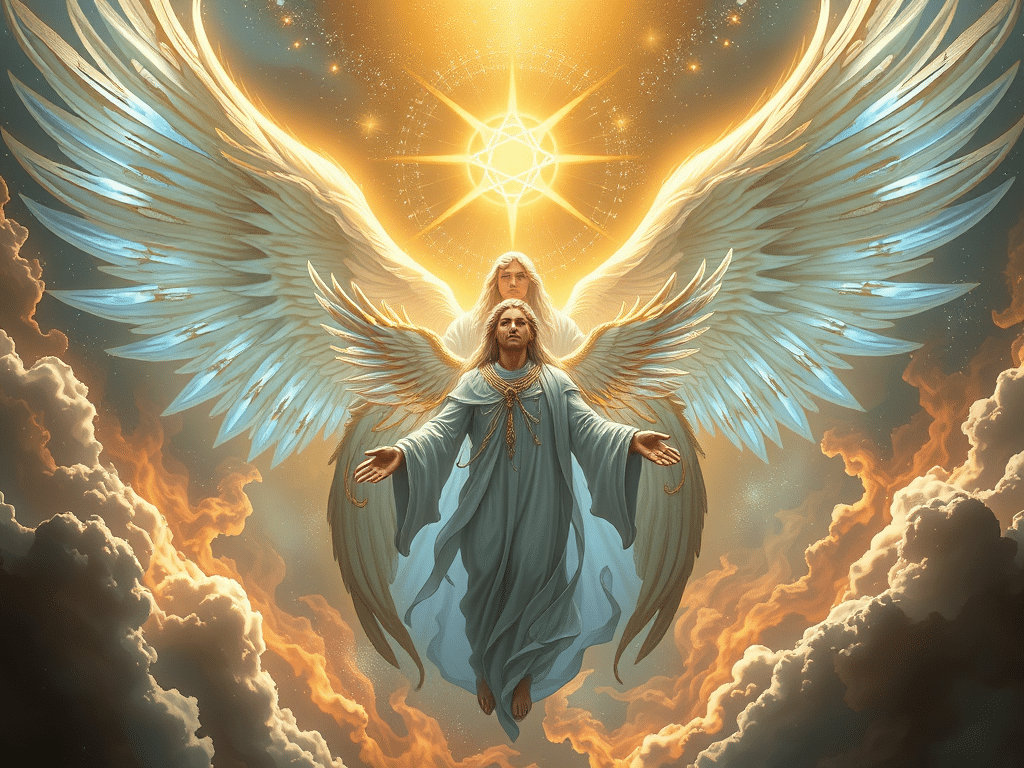
Angels and Zoroastrianism: Key Points
-
Zoroastrianism introduced hierarchical celestial beings like the Amesha Spentas and Yazatas as intermediaries between Ahura Mazda and humanity. This structured angelology and dualistic cosmic warfare influenced later religious traditions.
-
Jewish angelology transformed during the Babylonian exile through Persian contact, introducing named angels and hierarchical organization. Post-exile texts reveal sophisticated angel theology mirroring Zoroastrian patterns.
-
Christianity inherited Jewish angelology and expanded it into elaborate hierarchical systems. Christian concepts of warrior angels and fallen angels reflect Zoroastrian influences.
-
Islamic angelology shows Zoroastrian influence through light-created angels organized in ranks. Persian cultural influence during Islam’s formation facilitated transmission of these concepts.
-
Zoroastrian angelology succeeded by solving divine transcendence problems through celestial intermediaries. Scholarly consensus acknowledges substantial Zoroastrian impact despite some debate.
-
Zoroastrian angelology’s legacy shapes Western assumptions about hierarchical spiritual reality and cosmic warfare. This shows religious traditions developed through creative dialogue.

Relief depicting the Faravahar in the city of Persepolis, which served as the ceremonial capital of the Achaemenid Empire
Introduction
Zoroastrianism, which is one of the oldest monotheistic faiths in the world, has had a huge impact on how people in the West think about angels and how they are organized. The prophet Zoroaster initiated this religion in ancient Persia, approximately between 1500 and 1000 BCE. It brought new ideas to religion that would have a big impact on Judaism, Christianity, and Islam. According to Zoroastrianism, celestial beings serve as intermediaries between God and people. This idea set a model that other religions would use and change. This article looks at how Zoroastrian ideas about angels affected the growth of angel theology in Western religions. It looks at both how these ideas spread historically and what they mean for modern religions today.
Zoroastrianism
Zoroastrianism began in ancient Persia as a dualistic but ultimately monotheistic religion based on Ahura Mazda, who was seen as the ultimate god of truth, light, and goodness. The religion says that the past of the universe is a battle between the forces of good, which are led by Ahura Mazda, and the forces of evil, which are represented by Angra Mainyu or Ahriman. The Zoroastrian religion places a high value on the idea of free will. It says that people have to choose between truth (asha) and lies (druj), which helps good win in the end. The faith stresses living a moral life, keeping rituals pure, and the belief that the dead will rise from the dead at some point, followed by a final judgment and the world being made new. Zoroastrians do things like keep sacred fires going, which represent the divine light and truth, and read prayers from the Avesta, which is their holy book. Zoroastrianism has lost many followers since Islam took over Persia, but its theological innovations have left an indelible mark on world religions, especially through ideas that grew during the Jewish people’s exile in Babylonia and the cultural exchanges that followed.
Zoroastrianism, which was started by the prophet Zoroaster, is based on the idea that the world is split into two parts: the forces of good (represented by Ahura Mazda) and the forces of evil (led by Ahriman). This dualism gives angels and evil spirits different parts in its spiritual structure. Both groups either support or oppose people’s moral decisions (Foltz, 2010; Lateef & Saeed, 2018). The most important ideas in Zoroastrianism are found in its holy books, like the Avesta, which talk about how everything in the world is either good or evil (Latif & Saeed, 2018). In Jewish, Christian, and Islamic beliefs, angels stand for good and are often in line with God’s will, while demons or bad spirits represent the opposite (Foltz, 2010; Lateef & Saeed, 2018; Prochwicz-Studnicka & Mrozek, 2021; Stausberg, 2008).
The Nature and Function of Angels in Western Thought
Modern Western religious thought says that angels are spiritual beings that work as messengers and helpers of God and are placed above humans in a hierarchy. People usually think of these celestial beings as either purely spiritual or able to take on physical form. They are thought to have knowledge and will, but they are under the control of God. In Jewish, Christian, and Islamic beliefs, angels do many things, such as carrying heavenly messages, keeping the universe in order through worship and praise, and protecting those who believe. In these religions, angels are named and have specific jobs to do in the celestial order. For example, Michael, Gabriel, and Raphael are all named archangels. Most stories portray angels as morally perfect beings. However, some legends say that there were angels who turned against God and did evil things. The creation of later angel theology, which includes complex hierarchies and specialized roles, represents an important step forward from earlier, simpler ideas of divine messengers found in ancient Near Eastern religions.
According to Zoroastrian religion, the Amesha Spentas, also known as the “Bounteous Immortals,” are the main heavenly beings who help Ahura Mazda rule the world and fight evil across the universe. The first of these seven beings is Ahura Mazda himself. They stand for abstract divine traits like a good mind, truth, desirable dominion, devotion, wholeness, and immortality. They also protect certain parts of the practical world. According to Zoroastrianism, the Yazatas are higher up in the celestial order than the Amesha Spentas. The Yazatas are many spiritual beings connected to natural events and abstract ideas. They are worshipful and act as messengers between people and the divine. The Fravashis are a different type of spiritual being. They are the guardian spirits or eternal souls of all good beings, alive and dead, and they help fight evil forces. According to Zoroastrian angelology, the heavens are very well organized, with clear roles, responsibilities, and relationships between people in a hierarchy. This is because the religion puts a lot of importance on order in the universe and fighting chaos and evil in a planned way. This organized way of thinking about spiritual beings, with its focus on specific roles and clear levels of authority, would have a huge impact on later religious developments.
The Transmission to Judaism and Christianity
Zoroastrian ideas about angels were mostly brought to Judaism during and after the Babylonian exile in the sixth century BCE, when Jewish leaders had regular contact with Persian religious ideas. Before this time, the Hebrew scriptures don’t say much about divine messages. They just say “messenger of YHWH” without giving them names or explaining their roles. After the exile and while Israel was ruled by the Persians, Jewish texts started to talk about angels in more complex ways, including named angels, hierarchical organization, and specific roles of the heavens that are similar to Zoroastrian ideas. The Book of Daniel, which was written during or after the exile, talks about the archangel Michael as Israel’s guardian angel. This idea is very close to the Zoroastrian idea of Yazatas, who were sent to protect certain groups of people and nations. Later Jewish texts, especially those from the time of the Second Temple and the writings of the first rabbis, created complex angel orders with names, ranks, and duties that are very similar to Zoroastrian models. The idea that angels are organized into classes or choirs, with each choir having a specific job to do in keeping the universe in order and acting as a bridge between the divine and human realms, is very different from earlier Israelite religion and very similar to Zoroastrian ideas.
Ancient Zoroastrian ideas have had a big impact on the way Christians think about angels. A structured hierarchy of heavenly beings was adopted by early Christians. Zoroastrian thought of divine spirits was similar to this idea. Angels are divided into different orders, like Seraphim, Cherubim, and Archangels. This concept is similar to how Zoroastrianism grouped heavenly beings (Haecker, 2020; Srinivas, 2009). Also, Christians saw angels as agents of God and evil spirits as enemies like Ahriman. This distinction is because early Christian texts are full of Zoroastrian dualism (Haecker, 2020; Dontchev, 2020).
Christianity took the idea of angels that Judaism had created with help from Zoroastrianism and built on it. This led to even more complicated hierarchical systems that ruled medieval theology. Early Christian writers, such as Pseudo-Dionysius the Areopagite, organized angel doctrine into a nine-level hierarchy of heavenly beings, divided into three groups called triads. Each group had a specific job to do and was close to God. Even though it is written in Christian theological language, this complex organizational scheme is based on the basic Zoroastrian idea of a structured celestial system that helps the supreme god run the world and make it pure. In the Book of Revelation, Christians talk a lot about angels as soldiers in a cosmic battle between good and evil. This concept is similar to Zoroastrianism, which sees a constant battle between the forces of Ahura Mazda and Angra Mainyu. Zoroastrian ideas of bad spirits, or daevas, who fight against the good creation are similar to the idea of fallen angels, led by Satan, who disobeyed God and now try to corrupt people. In the Middle Ages, Christian angelology became very complex. Theologians like Thomas Aquinas spent a lot of time thinking about questions about the nature, intelligence, and will of angels, all within a framework that ultimately goes back to Zoroastrian changes to celestial theology. The idea that angels are guardians and protectors comes from Zoroastrian beliefs, where divine beings are considered protecting people and the universe (Haecker, 2020). In Christian theology, the idea that angels get involved in people’s lives promotes the ideas of divine justice and righteousness (Haecker, 2020; Stausberg, 2008).

Islamic Angelology and Zoroastrian Influence
Zoroastrianism also had an effect on Islamic angelology, which was passed down through Jewish and pre-Islamic Arabian religious practices. According to the Quran, angels are made of light and are organized into ranks. Each named angel has a specific job in the universe. For example, Gabriel is the angel of revelation and Michael is the angel of war. The idea that angels keep records of people’s actions for the Day of Judgment is similar to Zoroastrianism’s focus on cosmic accounting and the final moral judgment. Persian culture had a big impact on Islamic society, especially in the early days of Islamic theology. These factors made it easier for Zoroastrian ideas about angels to make their way into Muslim thought. Later Islamic philosophers and mystics, particularly within Sufi traditions, developed intricate hierarchies for angels. This shows that they were still interested in ideas about angels that came from ancient Persia. So, Zoroastrian angelology touched all three of the main monotheistic religions in the West. It did this by giving people of different religions a way to think about what angels are and how they work.
In the same way, the idea of angels in Islam comes from ideas that were popular in Zoroastrianism. Angels are considered messengers of Allah and are composed of light in the Islamic faith. This is similar to how Zoroastrians thought about angels (Prochwicz-Studnicka & Mrozek, 2021; AYDAMIROV, 2022). The Qur’an talks about many angels, such as Gabriel (Jibril), whose job is similar to that of the Zoroastrians in that they bring news from God (Prochwicz-Studnicka & Mrozek, 2021; AYDAMIROV, 2022). According to research, some ideas about angels in Islam may have come from earlier religions. For example, the way divine messengers are organized and what their jobs are is similar to Zoroastrianism (Prochwicz-Studnicka & Mrozek, 2021; AYDAMIROV, 2022; Dontchev, 2020). Additionally, the Islamic story of Azrael, the angel of death, is similar to Zoroastrian ideas about a messenger who guides souls after death, which shows how these religious beliefs are linked (Prochwicz-Studnicka & Mrozek, 2021).
Scholarly Theories and Contemporary Debates
Scholars have come up with a number of ideas to try to explain how and why Zoroastrian ideas about angels were so powerful and easy for other religions to use. One popular theory says that Zoroastrianism solved the theological problem of divine transcendence by creating an order of beings that could act as a bridge between the material world and a God who was becoming more distant and transcendent. During the time of exile, Jewish religion developed more general and abstract ideas of God. The Zoroastrian model of celestial intermediaries kept God’s transcendent majesty while allowing God to work in the world. Another theory focuses on how organized angelology can help keep religious authority and cosmic order. According to this theory, people viewed the hierarchical bureaucracies in heaven as legitimate, akin to the political hierarchies of ancient empires on Earth. Zoroastrian dualism, with its clear moral framework of a cosmic battle between good and evil forces, may have appealed to groups that were being oppressed and were looking for religious reasons for their pain and unfair treatment. Some researchers say that Zoroastrian angelology was especially appealing to religious groups that wanted to understand their relationship with God because it combined the psychological appeal of guardian spirits and protective angels with the intellectual satisfaction of a well-organized view of the heavens.
Modern research is still arguing about how much and how Zoroastrian ideas affected Western angelology. Some researchers warn against overstating the case for direct transfer. Those who oppose the impact theory highlight the presence of angel-like figures in pre-Zoroastrian Mesopotamian religions. This suggests that traditions from earlier times in the Near East may have influenced Persian angelology. Other researchers concentrate on the natural growth of angelology in Judaism, Christianity, and Islam, arguing that similar ideas could emerge spontaneously in response to shared theological issues. Religious scholars mostly agree that Zoroastrianism had a big impact, but they say it was creative adaptation, not just borrowing. There is strong evidence that Zoroastrianism significantly influenced other religions, particularly due to the transition from unnamed messengers to named, hierarchically organized celestial beings with specific roles, which occurred during the period when Persian culture was dominant. New discoveries in archaeology and texts help us learn more about these complicated religious and cultural exchanges. These discoveries give us a fuller picture of how ideas spread along ancient trade lines and during imperial conquests.
The mixing of Zoroastrianism’s ideas about angels with those in Islam and Christianity shows a larger trend of religious and cultural spreading. The common themes, like divine messages, moral protection, and the never-ending fight against evil, show a mix of ideas that go beyond different faiths (Prochwicz-Studnicka & Mrozek, 2021; AYDAMIROV, 2022; Dontchev, 2020). Even though these influences are recognized, it is important to keep in mind that not all scholars agree on how much these other religions influenced angelology. Some scholars emphasize the distinct development of angelology within each religion, which may diverge significantly from its Zoroastrian origins (Haecker, 2020; Stausberg, 2008). Angelology from Zoroastrianism has had a lasting impact on Western thought, going beyond specific doctrines to shape basic ideas about how spiritual reality works. Zoroastrian cosmological ideas are reflected in the idea that reality is organized in a hierarchy, with higher levels of being rising from the material world to the final divine transcendence. Zoroastrian dualism provides a big part of the idea that the spiritual war between good and evil is the main force in the history of the universe and that celestial beings are involved. Even today, in the West, which is mostly secular, these old Persian ideas can be seen in art forms that show angels, in religious stories, and in philosophical ideas about what good and evil are. Many different religions still believe in angels, which shows how powerful the original Zoroastrian synthesis was. It combined monotheism with a rich pneumatology that explained many spiritual beings without losing the unity of God. Understanding this historical impact sheds light not only on the growth of angelology but also on how religious ideas spread across cultures, change through reinterpretation, and stay around for thousands of years.
Conclusion
The role that Zoroastrianism played in shaping Western angelology is one of the most important and undervalued examples of how religions from different cultures have affected each other throughout history. In Jewish, Christian, and Islamic beliefs, there are complex hierarchies in the heavens, named archangels with specific jobs, and the idea that angels fight in the heavens. All of these ideas come from an old Persian religious innovation. This transmission happened during certain times in history, like the Babylonian exile and the growth of the Persian empire, but it was successful because Zoroastrian angelology met basic theological needs within monotheistic frameworks. There are many ideas about what causes this effect, ranging from ways to solve the problem of divine separation to psychological needs for spiritual safety and intellectual wants for order in the universe. Scholars are still arguing about the exact scope and mechanisms of this effect, but the overall pattern of Zoroastrian influence on Western religious thought is clear and well-known. By acknowledging this ancient Persian contribution, we can gain insights into the history of religion and be reminded that the world’s major religious traditions have developed not in isolation, but through creative dialogue and reciprocal influence. So, the angels that people in the West think of take Zoroaster’s revolutionary vision with them. This vision has been passed down through cultures and centuries, reinterpreted many times but keeping the basic structure that Zoroaster first described in ancient Persia.
References
AYDAMIROV, G. (2022). ZOROASTRIANISM RELIGION IN AZERBAIJAN AND ITS REFLECTIONS FROM PAST TO PRESENT. New Era Journal of Interdisciplinary Social Studies, 7(13), 21-35. https://doi.org/10.46291/newera.177
Dontchev, G. (2020). The Mounted Angel in Byzantine Art. Visual Studies, 4(3). https://doi.org/10.54664/ieyg5916
Foltz, R. (2010). Zoroastrian Attitudes toward Animals. Society and Animals, 18(4), 367-378. https://doi.org/10.1163/156853010×524325
Haecker, R. (2020). The Book of Angels: Seen and Unseen, StephenMiller, Cambridge Scholars Publishing, 2019 (ISBN 978‐1‐5275‐3434‐6), xiv+179 pp., hb £61.99. Reviews in Religion and Theology, 27(3), 384-386. https://doi.org/10.1111/rirt.13851
Lateef, Z. and Saeed, R. (2018). زرتشت ازم کے شعائر،رسوم اور روایات: اسلامی تناظر میں اجمالی جائزہ. Rahat-Ul-Quloob, 229-250. https://doi.org/10.51411/rahat.2.2.2018.44
Prochwicz-Studnicka, B. and Mrozek, A. (2021). The Motif of the Angel(s) of Death in Islamic Foundational Sources as an Element of Cultural Diffusion. Verbum Vitae, 39(4), 1233-1261. https://doi.org/10.31743/vv.12704
Srinivas, T. (2009). Building Faith: Religious Pluralism, Pedagogical Urbanism, and Governance in the Sathya Sai Sacred City. International Journal of Hindu Studies, 13(3), 301-336. https://doi.org/10.1007/s11407-010-9083-2
Stausberg, M., & Smith, M. S. (2008). Zarathustra and Zoroastrianism. Equinox Publishing. https://doi.org/10.1558/equinox.18455



Leave a Reply