Drow and Racism: Key Points
-
The Drow are dark-skinned elves whose black skin and white hair create a problematic visual association between darkness and evil that echoes real-world racist ideologies.
-
Traditional Drow society is portrayed as monolithically evil, and the few “good” Drow must completely reject their heritage, suggesting their culture lacks positive qualities.
-
Fantasy racism assigns fixed moral alignments to entire species based on biology, denying them individual agency and mirroring real-world deterministic racist frameworks.
-
Drow developed in D&D from the 1970s as a comprehensive evil culture, though recent editions have removed mandatory alignments to address racial essentialism concerns.
-
Drow function as antagonistic “others” representing everything surface societies oppose, serving primarily as enemies rather than complex cultures with valid perspectives.
-
The pattern of linking dark skin with evil across fantasy races reproduces real-world racial hierarchies, and examining this trope encourages more thoughtful, inclusive storytelling.

Introduction
The Drow, or dark elves, have historically been a prominent element in fantasy fiction and tabletop gaming, especially in Dungeons & Dragons, where they were established as a unique race with particular traits that have ignited significant discourse over racial portrayal in fantasy literature. These underground elves are generally depicted as intrinsically malevolent, deceitful, and loyal to a chaotic evil deity, establishing a narrative structure that some critics contend reinforces detrimental racial stereotypes by associating physical appearance with moral integrity. This essay looks at the Drow as a possibly racist idea by examining their looks, behaviors, and how they have changed in fantasy stories, ultimately arguing that their portrayal shows troubling trends of connecting darkness with evil and creating one-dimensional images of whole groups.
The name “Drow” denotes the dark elves inside the Dungeons & Dragons (D&D) fantasy framework. They represent a canonical subrace of elves distinguished by their nocturnal culture, matriarchal society, and affiliations with the malevolent pantheon of the game world, typically shown as devotees of Lolth. This summary looks at existing knowledge regarding Drow in Dungeons & Dragons and contextualizes their representation within wider academic discussions on race, monstrosity, and fantasy realism in gaming and media (Poor, 2012; Berge, 2023), as well as pertinent research on the cultural reception and evolution of D&D (King et al., 2023; Gagné, 2024; Borecky, 2021; Bean & Connell, 2023; French, 2023; Kapitány et al., 2022).
Physical and Behavioral Characteristics
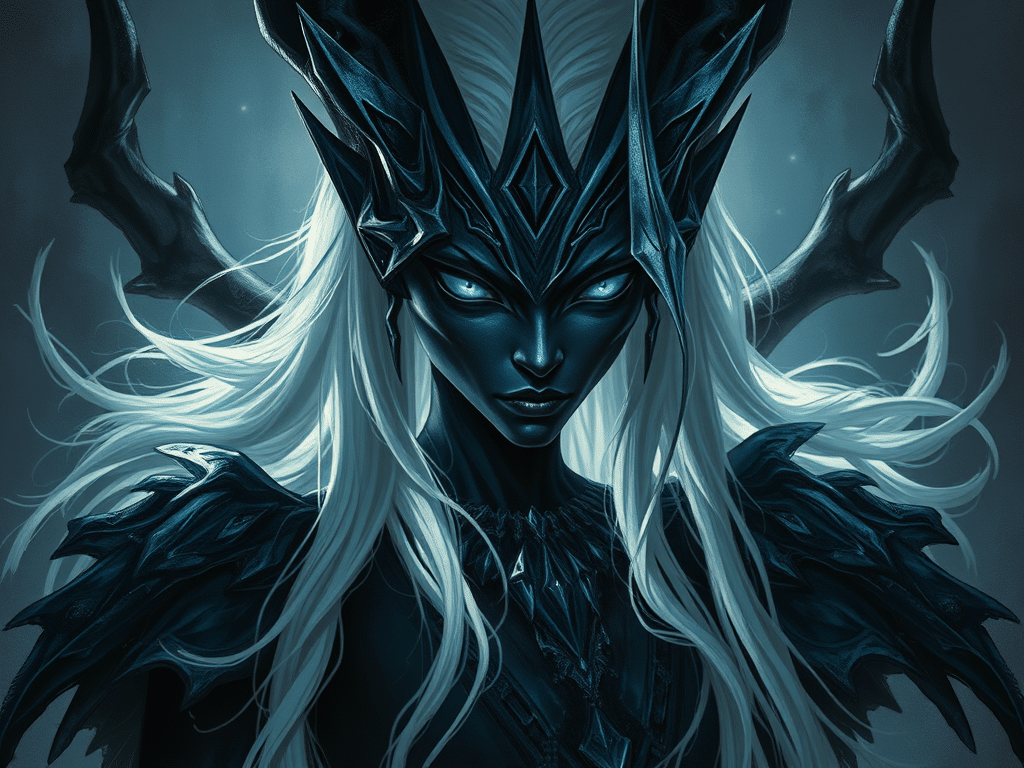
Drow are largely characterized by their dark complexion, which varies from deep black to dark blue or purple hues, providing a noticeable visual contrast with surface elves, who often have pale skin. Their hair is typically shown as dazzling white or pale silver, occasionally appearing as platinum blonde, establishing a striking contrast between dark and light that permeates their entire forms. Drow are distinguished by their red, violet, or occasionally pale eyes that emit an ethereal luminescence, and they exhibit the quintessential elven traits of pointed ears, slim physiques, and fluid motions. This physical description creates an instant visual association, linking skin darkness to their underground habitat and purported malevolence. The ongoing connection between their dark skin and living underground, along with moral decline, creates a look that is closely tied to real-life ideas of darkness and negative qualities.
The behavioral traits ascribed to Drow in conventional fantasy contexts depict them as a uniform culture characterized by malevolence, deceit, and allegiance to wickedness. Drow culture is often described as matriarchal, with merciless priestesses of Lolth, the demon queen of spiders, in charge. These priestesses demand complete loyalty and encourage treachery, murder, and the subjugation of other races. Male Drow are shown as subordinate members of their society, subservient to the authority of female nobles and priestesses, while the civilization is characterized by the prevalence of enslavement, torture, and conspiracies against both surface inhabitants and one another. The society depicts the Drow as inherently hostile to virtue and illumination, regularly engaging in raids, abductions, and the moral degradation of other races. The rare Drow that evades this malevolent paradigm, exemplified by the renowned figure Drizzt Do’Urden, are shown as extraordinary beings compelled to transcend their intrinsic nature while enduring perpetual mistrust from surface inhabitants because of their lineage.
Racism in fantasy literature manifests through the construction of entire species or races that exhibit immutable moral alignments, intrinsic personality traits, and predefined cultural attributes inseparable from their biological essence. In contrast to human societies in fantasy realms, which exhibit cultural, moral, and individual diversity, numerous fantasy races are depicted as homogeneous creatures where biology dictates fate. This paradigm reflects actual racist ideas that ascribe behavioral and moral traits to physical appearance and lineage, fostering a deterministic perspective on identity that negates individual agency and variety. The notion of “always chaotic evil” in gaming systems such as Dungeons & Dragons has faced significant criticism for fostering situations where violence against entire populations is legitimized based on ethnic categorization rather than individual behavior. Fantasy settings frequently neglect to examine the ramifications of developing sentient species with intrinsic moral orientations, instead regarding these classifications as inherent truths of their fictitious realms.
Historical Development and Cultural Context
The evolution of Drow in Dungeons & Dragons mirrors overarching trends in fantasy literature while exposing how artistic decisions can unintentionally embed contentious notions like race and ethics. The Drow were first introduced in the Dungeons & Dragons adventure modules by Gary Gygax in the late 1970s, inspired by several mythical traditions such as the Norse svartálfar, or “black elves,” and Scottish folklore. Nonetheless, the D&D iteration substantially broadened and formalized its attributes, establishing a detailed culture that would exert considerable influence across fantasy fiction. The release of R.A. Salvatore’s novels featuring the Drow ranger Drizzt Do’Urden in the late 1980s and early 1990s popularized Drow in mainstream fantasy; yet, despite efforts to challenge the evil Drow stereotype through the protagonist, they concurrently affirmed the belief that Drow society was inherently malevolent. Over the years, the concept of Drow has been modified and broadened, with the latest editions of Dungeons & Dragons striving to mitigate issues of racial essentialism by eliminating obligatory alignment limitations and promoting more nuanced representations.
The initial creation of D&D established a framework wherein elves, including other subtypes such as Drow, contribute to a broader narrative of good and evil and use non-human characters to examine concepts of morality and power. Research on the history and reception of Dungeons & Dragons emphasizes how the game’s formative years sparked discussions over race, alignment, and the reality of fantasy, which persist in influencing modern views of Drow and other fantastical entities (King et al., 2023; French, 2023). The 50-year history of Dungeons & Dragons, encompassing its legal, cultural, and community aspects, contextualizes the representation and reinterpretation of Drow throughout the years (“Fifty Years of Dungeons & Dragons,” 2024; Peterson, 2021).

Racist Tropes and Theoretical Frameworks
The portrayal of Drow as a racist stereotype functions on various levels, primarily through the linkage of dark complexion with malevolence, brutality, and moral corruption, in juxtaposition to their light-skinned elven counterparts, who are generally characterized as kind or neutral. This establishes a visual and narrative coding in which physical darkness is equated with moral depravity, mirroring real-world associations that have been employed to rationalize discrimination and violence against those with dark skin. The simplistic depiction of Drow civilization as uniformly malevolent undermines the agency and moral intricacy of individual Drow characters, implying that their malevolence is inherent rather than shaped by cultural or personal factors. Moreover, the scarce “good” Drow in fantasy literature are frequently compelled to renounce their whole heritage and cultural identity, so reinforcing the notion that Drow civilization had no intrinsic value and that salvation necessitates total assimilation to surface world ideals. The recurrent depiction of dark-skinned races in fantasy as antagonistic, encompassing Drow, orcs, and other demon types, establishes a pattern that cannot be seen as coincidence or inconsequential.
A persistent theme in the literature is the correlation between non-human monster signifiers and real-world racist signifiers, notably the linkage of Drow with Blackness and the implications of malevolence or peril in numerous portrayals. Examinations of D&D discourse reveal persistent conflicts around race, representation, and the ethical depiction of oppressed people in fantasy contexts, particularly concerning the discourse surrounding Drow in fan forums and official publications (Alberto & Booth, 2024; Berge, 2023). Certain studies contextualize Drow within overarching themes of race and monsters in fantasy media, highlighting that such representations may perpetuate detrimental prejudices if not subjected to critical analysis (Poor, 2012; Berge, 2023). Other studies emphasize that traditional portrayals continue to exert influence in modern performances and media, despite community efforts advocating for more nuanced or varied representations (Gillespie & Crouse, 2012; French, 2023).
Drow serve as “others” in fantasy narratives, embodying traits antithetical to those of the predominantly light-skinned protagonist societies: they inhabit darkness instead of light, adhere to matriarchy rather than patriarchy, venerate malevolent deities instead of benevolent ones, and embrace chaos and cruelty over order and kindness. The process of othering establishes a fundamental dichotomy in which the existence of Drow helps to delineate and affirm the ideals of surface societies by offering a clear contrast that must be opposed or eradicated. The subterranean existence of Drow civilizations situates them below the surface world, establishing a spatial hierarchy that reflects moral hierarchies and promotes concepts of superiority and inferiority. Drow are seldom permitted to embody intricate cultures with legitimate viewpoints, histories, and internal diversity; rather, they act primarily as antagonists whose main narrative role is to menace protagonist societies and ultimately be vanquished. The exotic and perilous characteristics ascribed to Drow culture, including their spider themes, utilization of poison, and purported sensuality and decadence, exemplify patterns of orientalist othering, when foreign cultures are portrayed as both menacing and intriguingly different.
In Dungeons & Dragons, Drow are a unique subrace of elves generally depicted as living underground, characterized by a culture based on matrilineal hierarchy, dark sorcery, and secretive political practices. They are consistently portrayed as antagonists or morally ambiguous characters in numerous campaigns and modules, and their lore has become a focal point in arguments around race, othering, and representation within the game’s fictional realms. This depiction aligns with academic discourse on elves in video and tabletop games, highlighting that dark elves represent racialized “Others” in fantasy culture, frequently embodying exoticism and menace within Western fantasy conventions (Poor, 2012). The comprehensive portrayal of elves in Dragon Age and associated fantasy media enhances the comprehension of the utilization of elf subtypes, especially dark elves, in contemporary fantasy, despite Dragon Age being an independent entity from Dungeons & Dragons (Robertson, 2025).
Diverse academic theories elucidate the mechanisms by which the Drow sustain racist ideas, even within fictional fantasy contexts. The application of critical race theory to fantasy literature demonstrates how speculative fiction can perpetuate racial hierarchies and assumptions, even in narratives involving non-human species, as the symbolic linkages and narrative structures reflect real-world racist frameworks. “Fantasy race essentialism” refers to the tendency in fantasy settings to attribute cultural and behavioral features to biological determinism, rendering them as inherent racial characteristics instead of acquired behaviors, mirroring outdated scientific racism beliefs. Post-colonial theory elucidates how Drow narratives frequently adhere to colonial paradigms, wherein surface dwellers traverse into the Underdark, confronting a “savage” civilization that jeopardizes their existence, thereby rationalizing violence against Drow as essential for survival and the safeguarding of civilization. Certain scholars have utilized Jungian analysis to assert that Drow symbolize shadow archetypes, the darker unconscious facets of the psyche; nevertheless, this interpretation is contingent upon contentious correlations between darkness and adverse psychological conditions. Recent theoretical frameworks underscore the necessity of analyzing creative decisions, questioning why designers and writers opted to depict wicked elves with black skin instead of differentiating them by cultural symbols, attire, or alternative methods unrelated to skin color.
The major motif about Drow is a contradiction between light-skinned “good” elves and their dark-skinned, morally ambiguous counterparts. This reflects enduring literary motifs wherein darker supernatural entities are associated with danger, subversion, or moral divergence. Numerous investigations of race and fantasy contend that these representations establish a racial hierarchy inside fictional realms, which may mirror, reinforce, or challenge actual racial ideas (Dashiell, 2022; Alberto & Booth, 2024). Some scholars regard Drow as a narrative element that reflects racism and offers avenues for critique and subversion in gameplay and storytelling. Critics argue whether Drow represent a mere binary of malevolence or function as a medium for examining power dynamics, oppression, and resistance within gaming cultures (Alberto & Booth, 2024).
Educational and research-focused methodologies regarding gaming communities promote media literacy and critical discourse on race within gaming narratives. These methods prioritize instructing players to identify the correlation between fictional representations and real-world views, while also contemplating inclusive alternatives that avoid perpetuating harm (Ramasubramanian, 2007). The Drow can serve as an exceptional pedagogical instrument.
Conclusion
The conventional depiction of Drow in fantasy literature and gaming embodies a contentious stereotype that embeds racial assumptions by associating dark complexion with intrinsic malevolence, cultural degradation, and the necessity for opposition or redemption through the renunciation of inheritance. Although fantasy settings are fictional and artists may not intend racial connotations, the patterns of depiction still evoke and perpetuate real-world associations that have historically justified prejudice and violence against individuals with dark complexions. The monolithic portrayal of Drow as inherently malevolent, alongside their physical attributes and their function as perilous outsiders residing beneath civilized society, establishes a narrative structure that reflects racist views, irrespective of the author’s aim. The recent evolution in the portrayal of Drow, characterized by a heightened focus on individual variation, cultural complexity, and the elimination of obligatory evil alignments, indicates that fantasy creators are increasingly aware of these matters and striving for more nuanced representations. Ultimately, analyzing the Drow as a racist trope does not aim to denounce fantasy literature in its entirety but rather to foster critical reflection on how even fantastical entities can embody real-world consequences and to advocate for more inclusive and nuanced narratives that do not depend on implicit racial hierarchies.
References
Alberto, M., & Booth, P. (2024). ‘So much for the prattling of sages’: D&D gaming paratexts, Fan(nish) distribution of knowledge, and Drow. Convergence: The International Journal of Research Into New Media Technologies, 31(3), 1118-1138. https://doi.org/10.1177/13548565241310097
Bean, A., & Connell, M. (2023). The rise of the use of TTRPGs and RPGs in therapeutic endeavors. Journal of Psychology and Psychotherapy Research, 10, 1-12. https://doi.org/10.12974/2313-1047.2023.10.01
Berge, P. (2023). The table and the tomb: Positioning trans power and play amid fantasy realism in Dungeons & Dragons. Games and Culture, 20(3), 335-354. https://doi.org/10.1177/15554120231204145
Borecky, A. (2021). Dungeons, dragons, and music. Journal of Sound and Music in Games, 2(1), 46-64. https://doi.org/10.1525/jsmg.2021.2.1.46
Dashiell, S. (2022). Discussions of fantasy characters and demonstrations of a defensive hybridity in gamer masculinity. The Journal of Men’s Studies, 31(1), 25-43. https://doi.org/10.1177/10608265221084017
Fifty years of Dungeons & Dragons. (2024). https://doi.org/10.7551/mitpress/15175.001.0001
French, E. (2023). “We play Dungeons & Dragons!”: How actual play live streams have (re)shaped the D&D gaming community (pp. 203-216). https://doi.org/10.7551/mitpress/14526.003.0020
Gagné, A. (2024). In defense of imagination: Canadian youth culture and the Dungeons & Dragons panic in Canada, 1980–1995. Games and Culture. https://doi.org/10.1177/15554120241276931
Gillespie, G., & Crouse, D. (2012). There and back again. Games and Culture, 7(6), 441-470. https://doi.org/10.1177/1555412012465004
Kapitány, R., Hampejs, T., & Goldstein, T. (2022). Pretensive shared reality: From childhood pretense to adult imaginative play. Frontiers in Psychology, 13. https://doi.org/10.3389/fpsyg.2022.774085
King, M., Dehili, V., & Queen, M. (2023). Introducing Dungeons & Therapy: A tabletop role-playing system for group therapy. Group, 47(3-4), 67-76. https://doi.org/10.1353/grp.2023.a916646
Peterson, J. (2021). Game wizards. https://doi.org/10.7551/mitpress/13472.001.0001
Poor, N. (2012). Digital elves as a racial other in video games. Games and Culture, 7(5), 375-396. https://doi.org/10.1177/1555412012454224
Ramasubramanian, S. (2007). Media-based strategies to reduce racial stereotypes activated by news stories. Journalism & Mass Communication Quarterly, 84(2), 249-264. https://doi.org/10.1177/107769900708400204
Robertson, R. (2025). “In death, sacrifice”. M/C Journal, 28(2). https://doi.org/10.5204/mcj.3156


Leave a Reply