Topaz Dragons: Key Points
-
Topaz dragons are gem dragons with brilliant orange-yellow crystalline scales that inhabit coastal regions and possess aquatic adaptations and psionic abilities.
-
These dragons are intensely solitary and territorial with a cynical, pessimistic worldview, representing true neutral alignment focused on self-interest.
-
Their abilities include a dehydrating breath weapon and psionic powers like telepathy and mind domination, with older dragons controlling water itself.
-
Topaz dragons maintain strained relationships with all other dragon types, viewing metallics as naive and chromatics as predictably evil.
-
First introduced to Dungeons & Dragons in 1983, they evolved through editions, disappeared in the fourth edition, and returned in the fifth edition’s Fizban’s Treasury of Dragons in 2021.
-
Topaz dragons enriched the game by challenging good-versus-evil dynamics and introducing complex philosophical encounters beyond simple combat.

Introduction
Topaz dragons are some of the most interesting and complicated creatures in the world of Dungeons & Dragons. They are a strange blend of psychic might, territorial hostility, and deep contemplation, often exhibiting unique behaviors such as telepathic communication and a strong sense of justice that influences their interactions with other creatures. The scales of these gem dragons are vivid orange-yellow and gleam like the jewel they are named after. They have a special place in the world of dragons and in the greater fantasy. Topaz dragons are different from other dragons, like metallic and chromatic ones, because they have their own way of thinking and special powers, focusing on being neutral and valuing personal freedom instead of following strict rules. Adding them to the game has made the world of dragons more intriguing by letting players and Dungeon Masters engage with creatures that don’t fit the mold of what most people think of when they think of dragons in fantasy settings, thereby enriching gameplay with unique interactions and story possibilities that challenge traditional dragon archetypes.
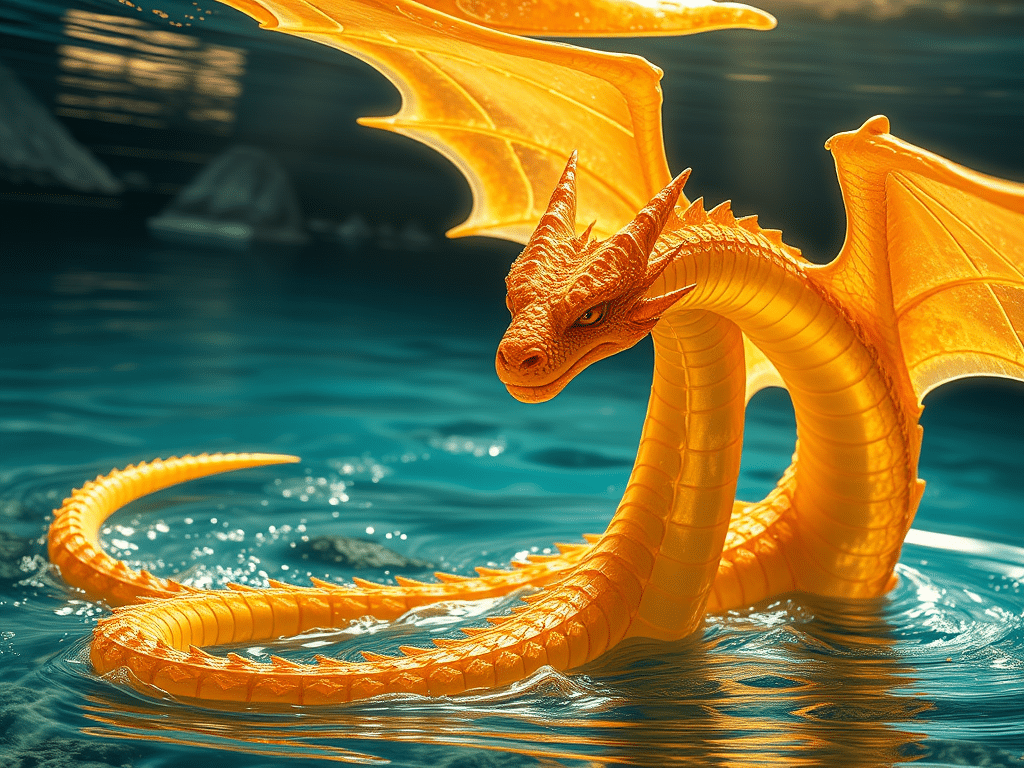
Topaz dragons are medium-sized gem dragons who look a lot like the gem they are named after. Their scales can be dull orange or blazing amber, and they can catch and bend light in ways that are both cool and disturbing to look at. These dragons are thin and snake-like compared to the bulkier chromatic dragons. Their long bodies demonstrate that they can live in water. The glow in their eyes makes me think they are psychic. People often claim that their eyes have a deep, penetrating quality that makes them feel like someone is reading their mind. When light shines through their wings, the membrane often looks clear, displaying complex vein patterns that pulse with barely controlled psionic energy.
Personality and Behavioral Traits
People say that topaz dragons are antisocial and territorial and have a philosophical approach that is very negative. These dragons are quite solitary and think that any beings, including other dragons, could be threats to the kingdoms they have worked so diligently to safeguard. They live along the coast, mostly in caves and islets by the sea, where they can see who comes and goes from a long distance away. Topaz dragons have a very negative view of the universe, reaching to the point of nihilism. They often talk for a long time about how life has no significance and how ambitions that are only temporary are useless. Despite their negative outlook, they are not inherently evil individuals. Instead, they have a real neutral alignment that puts self-interest and honesty above traditional moral standards, often prioritizing their perspectives and desires over societal expectations or ethical considerations. They may talk to someone when they meet them, but they usually do so sarcastically and with a sense of intellectual superiority that can quickly turn angry if they think the other person is being rude or ignorant.

Powers, Abilities, and Combat Capabilities
As both underwater hunters and mental masters, topaz dragons are formidable opponents in both combat and negotiation. Their breath weapon isn’t fire or acid; it’s a massive blast that dries out living things and sucks moisture out of the air. This skill is especially dangerous in their favored coastal settings, where the difference between having a lot of water and abruptly drying out can hurt both the body and the mind. Topaz dragons have natural psychic powers that become stronger as they grow older. These powers include telepathy, the ability to read thoughts, and eventually the ability to control minds and create mental barriers. They swim gracefully and quickly, making them look bigger than they are, and they breathe water like air. Topaz dragons that are older may even control water, raising or lowering the levels to trap or drown intruders. Their spell-like powers are usually divination magic, which shows how much they want to know and control information about their territories and any threats.
Relationships with Other Dragon Types
Topaz dragons and other types of dragons don’t normally get along. They don’t trust each other and sometimes even hate each other. Topaz dragons usually don’t believe that any other type of dragon is stronger or better than them. Metallic dragons, on the other hand, might form alliances, and chromatic dragons develop hierarchical structures based on dominance, which can lead to complex social interactions and power struggles among different dragon types. They think metallic dragons are stupid and full of themselves, and they don’t believe in their concepts of fairness and justice because they think they’re just comfortable lies that ignore the harsh truths of reality. Topaz dragons combine anger and reverence for multicolored dragons. They dislike their unacceptable behavior’s predictability but like their honesty about their desires. Topaz dragons are slightly nicer to other gem dragons because they can relate to them through their telepathic nature and general independence. But they still stay apart and don’t work together too often unless their lives are in jeopardy. This isolation also changes how topaz dragons have sex. They simply convene briefly to have children and then part ways. It appears that parents often prioritize ensuring their children’s survival over other aspects of parenting.
The addition of topaz dragons to the history of Dungeons & Dragons demonstrates how the game has grown over time to include additional kinds of dragons and make them more complex than just metallic and chromatic ones. The original Monster Manual II came out in 1983 and added gem dragons, like topaz dragons. These dragons were neutral and could talk to each other through their minds. This first presentation gave a general idea of topaz dragons as neutral beings that live on the coast and have special powers. But their personalities were still rather simple compared to later incarnations, which would eventually showcase more complex traits and motivations that enriched their character development in subsequent editions. The second edition of Advanced Dungeons & Dragons contributed to the story of gem dragons with a series of supplements that gave them more detailed environments and behaviors, including the particular gloomy outlook that would become a fundamental aspect of topaz dragon identity. When the third edition came out, the rules for psychic powers changed; therefore, topaz dragons gained new stats and powers that fit better with the new system. However, their popularity was not as high as that of their more popular metallic and chromatic counterparts. The fourth edition didn’t pay much attention to jewel dragons; therefore, these creatures weren’t as well-known for a long time, and new players might never see them. Fizban’s Treasury of Dragons, which came out in 2021, brought back jewel dragons in the fifth edition. This book extensively rethought and expanded topaz dragons, giving them a lot of mythology, complicated habits, and mechanics that helped them stand out in the draconic hierarchy.
Topaz dragons have an impact on Dungeons & Dragons that goes beyond what they can do with their powers. They modify how the game thinks about intellect, alignment, and the connection between power and philosophy. Topaz dragons encourage players to consider complex moral systems and the notion that powerful beings may exist outside the conventional good-versus-evil dichotomy, as they are neither purely heroic nor entirely malevolent. Their telepathic skills gave people new ways to use power that made fighting and solving problems more fun, such as through strategic communication and manipulation of opponents’ thoughts and emotions. They pushed for creative uses of power that didn’t just depend on physical strength or traditional magic. Dungeon Masters have been able to create unique encounters with topaz dragons because of their philosophical side, especially their negative view of the universe. Players can avoid conflict by utilizing their minds, which forces them to defend their ideas and goals against smart skepticism. This feature has made role-playing games more fun by illustrating that not every dragon has to be a straightforward friend or foe; they can also be a complex character that makes you think and rethink what you believe.
Conclusion
Topaz dragons are a wonderful illustration of how Dungeons & Dragons has strived to make dragons more than simply the usual sorts. They are weird and familiar at the same time. Because they are strong physically, have psionic powers, and think deeply about philosophy, their interactions can be simple fights or profound moral and intellectual arguments. The journey of topaz dragons through multiple editions shows how the game keeps developing and upgrading its animals, giving old ideas new life while preserving what makes them distinctive. Dungeons & Dragons is continually getting bigger and more popular. Topaz dragons are an example of how designers may construct creatures that are full of potential and make us think, question our assumptions, and remember that even in fantasy realms, the most intriguing people don’t always fit into neat classifications.
References
Advanced Dungeons & Dragons. (1983). Monster Manual II. TSR.
CBR. (n.d.). Dungeons & Dragons: Topaz dragons explained. https://www.cbr.com/dungeons-dragons-topaz-dragons-explained/
Collins, A. W. (1980, May). That’s not in the monster manual! Dragon, 37.
D&D Beyond. (n.d.). Ancient topaz dragon. https://www.dndbeyond.com/monsters/ancient-topaz-dragon
Djverne12. (n.d.). Topaz dragon. World Anvil. https://www.worldanvil.com/w/forgotten-realms-djverne12/a/topaz-dragon-species
Dragon, topaz young adult. (n.d.). Realms Helps. https://www.realmshelps.net/monsters/block/Dragon%2C_Topaz_Young_Adult
DragonVale Wiki. (n.d.). Topaz dragon. Fandom. https://dragonvale.fandom.com/wiki/Topaz_Dragon
Dungeons & Dragons. (2021). Fizban’s Treasury of Dragons. Wizards of the Coast.
Forgotten Realms Wiki. (n.d.-a). Gem dragon. Fandom. https://forgottenrealms.fandom.com/wiki/Gem_dragon
Forgotten Realms Wiki. (n.d.-b). Topaz dragon. Fandom. https://forgottenrealms.fandom.com/wiki/Topaz_dragon
Screen Rant. (n.d.). D&D: Topaz dragons explained – Gem dragons & Fizban’s. https://screenrant.com/dnd-topaz-dragons-explained-gem-dragons-fizban/
Topaz dragon. (n.d.). 5etools. https://5e.tools/bestiary/ancient-topaz-dragon-ftd.html
Wikipedia contributors. (2026, March 2). Dragon (Dungeons & Dragons). In Wikipedia, The Free Encyclopedia. https://en.wikipedia.org/wiki/Dragon_(Dungeons_%26_Dragons)#Topaz_dragon


Leave a Reply