Honey Island Swamp Monster: Key Points
-
The Honey Island Swamp Monster is a cryptid from Louisiana’s Honey Island Swamp near Slidell, first reported in the early 1960s. It has become one of the region’s most enduring cryptozoological mysteries.
-
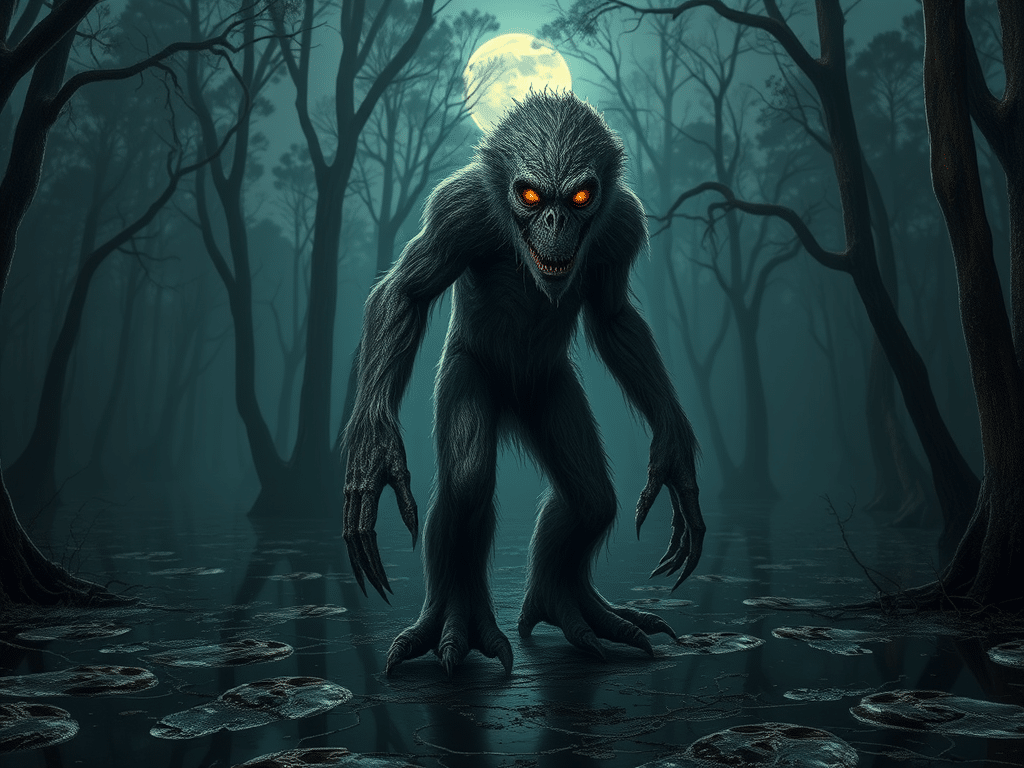
The creature is described as a six- to seven-foot-tall bipedal beast covered in grayish-brown hair with amber eyes. Its most distinctive feature is four-toed, webbed footprints that suggest adaptation to the swampy environment.
-
Witnesses report the monster is nocturnal and solitary, moving stealthily through the swamp while avoiding human contact. The creature produces strange vocalizations like howls and screams that don’t match known animals in the region.
-
The legend began in 1963 when Harlan Ford claimed to discover unusual tracks and observe the creature, documenting his findings with plaster casts and film. Throughout the 1970s and beyond, hunters and locals reported additional sightings that brought wider attention to the mystery.
-
Theories explaining the phenomenon range from misidentified black bears and deliberate hoaxes to unknown primate species. The consistency of witness descriptions across multiple independent accounts lends some credibility, though hard evidence remains limited.
-
The legend has significantly impacted local tourism and culture, with the creature becoming a symbol of Louisiana’s wild mysteries. Swamp tours marketed around the monster contribute to the local economy while the story keeps inspiring media appearances.

Introduction
The Cajun Sasquatch, or the Honey Island Swamp Monster, is one of Louisiana’s oldest cryptozoological mysteries. People in the area and cryptid fans have been fascinated by this monster since the initial sightings were reported in the early 1960s in the thick, dark waters of the Honey Island Swamp near Slidell, Louisiana. The mythology has been around for decades, and it has become a part of the culture of the area. It has led to many investigations, documentaries, and arguments about what might be hiding in the secluded bayous of southeastern Louisiana.
Monsters that live in swamps are a big part of North American folklore and modern legends. They often live in marshy or swampy areas and are the focus of community stories and environmental worries (Bullard, 2023; Puglia, 2023). Authors contend that these legends are adaptive, evolving their traits over generations while remaining rooted in specific geographies such as swamps and bogs (Bullard, 2023). They assert that these legends can embody broader ecological realities (e.g., environmental degradation, land-use conflict) even in the absence of empirical evidence for a physical entity (Puglia, 2023; Mullis, 2024).
Physical Description and Behavioral Characteristics
Witnesses who say they saw the Honey Island Swamp Monster say it was a bipedal monster that stood between six and seven feet tall, with grayish-brown hair, and smelled foul. People say the beast has amber or golden eyes that shine in the dark, making it look strange and otherworldly when seen at night. The tracks left behind are probably the most unique thing about this creature. They reveal four toes instead of the five that are usually associated with Bigfoot, and the webbing between the toes suggests that it has adapted to living in a swampy area. Some people say the creature has a strong, ape-like body with long arms and a big chest, while others say it stands and walks more like a person.
The way this animal acts makes it seem like it is a solitary, nocturnal creature that doesn’t want to be around people. The monster is said to be most active in the early morning and evening, moving silently through the marsh despite its size. People who were there said they heard unusual sounds coming from the bayou, including howls, screams, and guttural growls. These sounds do not resemble any animal that lives in the area. The species appears to be territorial, and some reports say it gets hostile when people get too close or corner it. However, usually, the creature runs away into the thick plants when it sees a person.
Historical Origins and Development of the Legend
In 1963, Harlan Ford, a former air traffic controller, said he saw strange tracks and later saw the Honey Island Marsh Monster itself on multiple trips into the marsh. This is how the modern tale of the monster arose. Ford made plaster molds of footprints and blurry film footage that he said showed the creature moving through the wetlands to prove what he had found. In the 1970s, hunters, fishermen, and villagers who went into the swamp’s more remote parts saw the monster more often. Some people said they saw it swimming through the water or walking along the coast. In the following decades, more people were interested in the legend as cryptozoologists and TV documentary teams looked into the reports. This Louisiana enigma acquired national and international attention.
Investigative journalist Joe Nickell looks at the Honey Island Swamp Monster mythology by going to the site and carefully looking at the evidence. Nickell went to the Louisiana marsh with professional guides and naturalists. Despite being in the area for decades, they had never seen a creature like it. Nickell didn’t find any physical proof during his search. Harlan Ford and Billy Mills, air traffic controllers, first told the story in 1974 when they showed plaster casts of strange four-toed, webbed tracks. They said they had seen a seven-foot-tall, gray-haired creature in 1963, but Nickell says the men were “repeaters” who made multiple convenient discoveries. The investigator contends that the traces do not align with conventional Bigfoot evidence and that the creature corresponds to a broader category of swamp “beastmen” mythology, which serves cultural purposes like campfire stories, cautionary tales to deter individuals from hazardous places, and sources of local notoriety (Nickell, 2001). He says the evidence strongly suggests a hoax because the tracks are easy to fake, the men saw them many times, there is already a lot of swamp monster folklore and fiction, and there have been confirmed hoaxes in the area since then, like the 2000 case where supposed monster hair turned out to be from a horse.

Theoretical Perspectives and Scholarly Analysis
There are many different ideas about what the Honey Island Swamp Monster is, from the scientific to the completely made up. Some scientists think that the sightings might be cases of people mistaking recognized animals for other animals, such as black bears, which were long considered absent from the area but have been seen there in recent years. Some people think the creature could be a remnant population of an unknown primate species or possibly a prehistoric mammal that has learned to live in the swamp ecology. Obviously, many people think this may be a regional Bigfoot cryptid. Skeptics say that hoaxes are possible, especially since some of the most famous evidence comes from just one source. Believers, on the other hand, say that the fact that different witnesses describe the same thing in the same way makes the stories more believable.
Frances Leary’s master’s thesis from 2003 looks at the Honey Island Swamp Monster as both a folk belief and a commercialized phenomenon that has changed over the past 27 years on the 250-acre Honey Island Swamp on the border between Louisiana and Mississippi. The research examines the growing focus of folklorists on the interplay between narrative and belief traditions, especially with tourism and commercialization, using cryptozoological traditions such as Sasquatch and the Giant Squid as illustrative case studies. Leary’s research examines the distinctive characteristics that delineate the Honey Island Swamp Monster tradition, analyzes the contrasting narrative trajectories between folk and commercial traditions, and explores the impact of diverse influences such as academia, media, tourism, and enthusiast communities on the commodified iteration of the legend (Leary, 2003). The thesis examines the explanatory frameworks employed by both adherents and skeptics to elucidate the existence and endurance of this belief tradition. Leary’s thorough study shows how a regional cryptid tale can keep its real folk roots while still being turned into a commercial commodity that is used for tourism and entertainment.
The Jerseyan/Jersey Devil case and other North American monsters are used as examples of how local swamp legends change over time, sometimes making connections to other “paranormal” hotspots and the idea of extraordinary explanations (interdimensional or extraterrestrial) while still being based in folklore (Thadani, 2023; Bullard, 2023). This dual lens—folkloric tradition with openness to unusual hypotheses—helps frame the Honey Island Swamp Monster not only as a “creature” but as a social and cultural phenomenon that symbolizes regional identity and rumor dynamics (Thadani, 2023; Bullard, 2023).
The story of the Honey Island Swamp Monster has had a big effect on more than just cryptozoology; it has also affected tourism, culture, and business in the Slidell area. Many people in Louisiana are proud of the monster because it represents the wild, untamed nature of the marshes and the mysteries that remain in the modern world. Tour firms now offer swamp trips that are particularly marketed around the monster mythology. These trips help the local economy and let guests see the wetlands’ unique biodiversity. The story has led to books, documentaries, and appearances in popular culture, which keeps the legend alive and draws in new fans.
Conclusion
The Honey Island Swamp Monster is still a mystery in American cryptozoology, showing how people are still interested in things that are strange and difficult to explain. It doesn’t matter if the monster is a new species, a case of mistaken identity, or a part of a long-standing folklore tradition. Its effect on the area and its place in cryptid mythology are clear. The mythology will probably live on as long as the Honey Island Swamp stays secluded and enigmatic. This myth will draw both adventurers and doubters to its murky waters in search of answers to one of Louisiana’s most fascinating mysteries.
References
Bubandt, N. (2019). Of wildmen and white men: Cryptozoology and inappropriate/d monsters at the cusp of the Anthropocene. Journal of the Royal Anthropological Institute, 25(2), 223-240. https://doi.org/10.1111/1467-9655.13023
Bullard, E. (2023). North American Monsters: A contemporary legend casebook, edited by David J. Puglia. Journal of Scientific Exploration, 36(4), 816-824. https://doi.org/10.31275/20222723
Foxon, F. (2024). Heuvelmans the heretic and hidden animals. Interdisciplinary Science Reviews, 49(3-4), 332-348. https://doi.org/10.1177/03080188241233107
Leary, F. (2003). The Honey Island Swamp monster: The development and maintenance of a folk and commodified belief tradition [Master’s thesis, Memorial University of Newfoundland]. Scholaris. https://hdl.handle.net/20.500.14783/11988
Mullis, J. (2024). From cryptids to kaijū: Exploring heterodox palaeoscience with Godzilla. Interdisciplinary Science Reviews, 49(3-4), 438-451. https://doi.org/10.1177/03080188241234141
Nickell, J. (2001, July/August). Tracking the swamp monsters. Skeptical Inquirer, 25(4). https://skepticalinquirer.org/2001/07/tracking-the-swamp-monsters/
Puglia, D. (2023). The (mostly) unseen world of cryptids: Legendary monsters in North America. Humanities, 13(1), 1. https://doi.org/10.3390/h13010001
Schembri, E. (2011). Cryptozoology as a pseudoscience: Beasts in transition. Surg Journal, 5(1), 5-10. https://doi.org/10.21083/surg.v5i1.1341
Leave a Reply