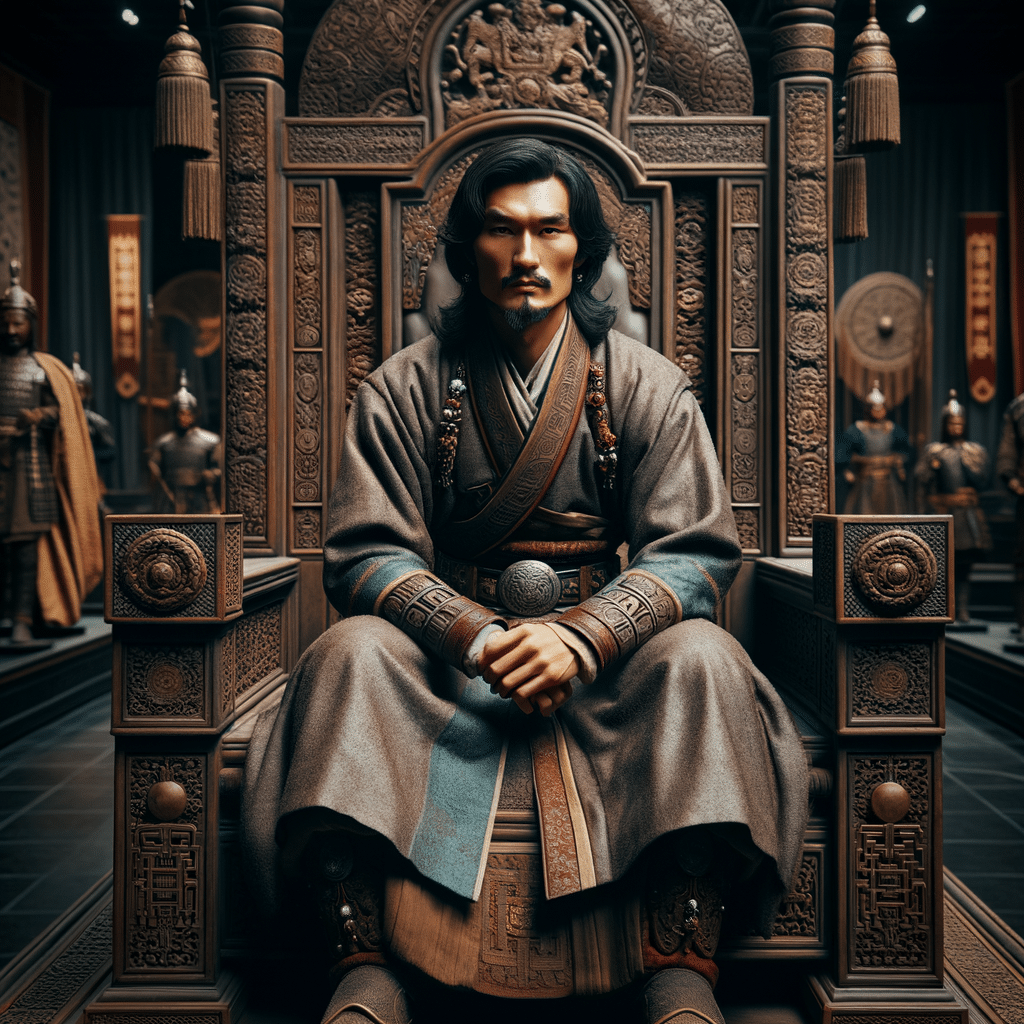
Is the tomb of Genghis Khan full of magical treasures waiting to be found and is there anyway we could eventually find it? This essay will look at these intriguing questions.
Genghis Khan was one of the most formidable rulers and military commanders in history. During his lifetime from 1162 to 1227, he established the largest contiguous land empire in world history stretching from Eastern Europe to the Sea of Japan. Despite his seminal role in shaping Eurasia, the location and contents of Genghis Khan’s tomb remain an enduring historical mystery. This essay will examine Genghis Khan’s rise to power and conquests, theories around his burial site and traditions, as well as speculation on treasures and artifacts that may have been buried with him.
Biography
Genghis Khan, born Temujin, was a member of the Borjigin clan from the northeast Asian steppes located in what is now Mongolia. As a young man in the late 12th century, he started uniting the fractious tribes of Mongolia in a series of alliances and military campaigns. By 1206, Temujin had consolidated power and taken the title Genghis Khan, meaning Universal Ruler. Under his leadership, the Mongolian tribes came together in the unification known as the Great Mongol Nation.
Genghis Khan proved himself a military genius, instituting innovative tactics such as feigned retreat and encirclement. He organized the Mongol army into arbans (groups of 10), companies (100), and tumens (10,000). This decimal system allowed rapid communication and tactical coordination on a large scale across vast swathes of terrain. Between 1206-1227, the Mongol armies led by Genghis Khan went on to conquer most of Eurasia. This included defeating the Western Xia empire in 1209, the Jin dynasty in 1234, the Khwarezmid Empire between 1219-1223, and invading parts of Central Asia, Russia, and Eastern Europe. By his death, the Mongol Empire encompassed over 10 million square miles.
In 1227, while returning from a military campaign in China against the Western Xia, Genghis Khan fell ill and died at age 65 near the Baljuna River in modern-day Zhangjiakou. According to Mongolian tradition, it was imperative for rulers to be buried in secret, unmarked places to prevent graves from being looted or desecrated. Genghis Khan’s funeral cortege toward his burial was accompanied by his loyal general and bodyguard, Chila’un. The procession was sealed with utter secrecy and those attending it were killed to secure the burial site’s anonymity.

Where?
For centuries, Mongolians have held a deep reverence for their legendary leader Genghis Khan, and the belief that his final resting place lies within the breathtaking Khentii Mountains has become an integral part of their cultural heritage. Nestled amidst this majestic landscape is a mysterious and heavily guarded area known as the Forbidden Zone, where locals strongly believe Genghis Khan’s tomb to be concealed.
Recent advancements in satellite technology have provided tantalizing glimpses into this enigmatic region. Analyzing these high-resolution images reveals intriguing outlines of structures camouflaged beneath a lush blanket of foliage. These hidden formations have sparked intense curiosity among researchers and historians alike, fueling speculation about what secrets may lie buried within the confines of this restricted zone.
Despite its alluring appeal to both scholars and adventure-seekers from around the globe, access to the Forbidden Zone has long been prohibited by the Mongolian government. This prohibition stems not only from concerns over preserving their cultural heritage but also due to security sensitivities surrounding Genghis Khan’s possible tomb location.
The significance attached to Genghis Khan in Mongolia cannot be overstated; he is revered as a founding father whose legacy continues to shape their national identity. The potential discovery of his final resting place holds profound implications not just for Mongolia but also for our understanding of history itself.
The prospect of discovering Genghis Khan’s long-lost tomb has captured the imagination of historians, archaeologists, and treasure hunters alike. Speculation runs wild about what treasures and artifacts may lie within its hallowed chambers. As one of history’s most formidable conquerors, it is only fitting that his final resting place would be adorned with riches reflecting his immense power and influence.

Treasure
Among the potential wonders housed within the legendary tomb are gold and silver artifacts, gleaming testaments to Khan’s vast wealth. These precious metals would not only serve as a symbol of his status but also highlight the economic might he wielded during his reign. Envisioning intricately crafted jewelry, ornate weaponry, or perhaps even entire suits of armor fashioned from these lustrous materials ignites excitement among experts envisioning what lies beneath.
Silk burial goods are another intriguing possibility awaiting discovery in Khan’s tomb. Renowned for their mastery in silk production since ancient times, Mongolians held this luxurious fabric in high regard. This delicate textile was often associated with nobility and prestige throughout East Asia, making it an ideal inclusion for a ruler whose name reverberates through history. The anticipation builds as we imagine exquisitely embroidered garments or sumptuous textiles meticulously woven by skilled artisans adorning Genghis Khan’s eternal abode.
The mysterious figure in question has captivated the imagination of many, as the realm of myth and legend intertwines with their story. Mongolian folklore, rooted in profound spiritual beliefs, speaks of this enigmatic individual’s connection to relics or magic items that are believed to possess extraordinary spiritual powers. These artifacts, revered by those who embrace these legends, hold a certain allure that transcends mere material wealth.
Within the rich tapestry of Mongolian folklore, it is rumored that magical shamans played a vital role during the funeral procession of this enigmatic figure. Accompanying the mourners on their solemn journey, these mystics are said to have infused protective spells around the tomb. This was not merely a customary ritual but an act imbued with deep significance – safeguarding and preserving the sacred resting place from any malevolent forces that may seek to disturb its sanctity.
Analysis
Intriguingly enough, such tales continue to be passed down through generations as part of Mongolia’s cultural heritage. The belief in these mystical elements adds another layer of fascination around this already enigmatic persona – one shrouded in mystery yet deeply intertwined with spirituality and potent supernatural forces.
While some skeptics dismiss these stories as mere fairy tales or imaginative embellishments concocted over time, there is no denying their profound impact on local traditions and beliefs. Whether viewed through a lens of skepticism or embraced wholeheartedly as absolute truth, they undeniably contribute to painting a vivid portrait of an individual whose legacy extends far beyond his death.
In recent years Mongolian and foreign archaeologists have conducted limited surveys of the Forbidden Zone using ground-penetrating radar and other non-invasive techniques. In 2021 a Japanese robotics team received permission to fly drones over the area to capture high-resolution imagery. However, direct excavation remains prohibited and the location of Genghis Khan’s final resting place remains one of history’s greatest mysteries.
As anticipation builds regarding what lies hidden within these sacred mountains, questions abound: Will we finally unveil the burial site that has eluded us for centuries? What magical treasures or revelations might be discovered within the depths of these revered mountains? With mounting excitement and curiosity, people around the world eagerly await the moment when we can finally uncover the elusive burial site that has remained shrouded in mystery for centuries. The sheer magnitude of this long-awaited revelation is enough to captivate our collective imagination.
As archaeologists meticulously excavate and researchers painstakingly analyze every artifact, hope intertwines with trepidation. Each discovery brings us closer to unraveling the enigma that has perplexed generations before us. Perhaps precious artifacts crafted by skilled hands lie patiently waiting to be unearthed – ornate jewelry, intricate pottery, or even long-lost manuscripts chronicling stories of a bygone era.
Conclusion
Yet, beyond physical objects lies the prospect of intangible riches. Could we stumble upon ancient wisdom hidden amidst crumbling inscriptions or decipher forgotten languages etched into weathered stone tablets? The knowledge preserved within these hallowed grounds could reshape our understanding of history itself – unveiling new chapters in human civilization and illuminating previously unknown cultural practices.
The anticipation among historians, archaeologists, and enthusiasts alike is palpable as they tirelessly work towards unearthing this unparalleled marvel. It is an endeavor driven not only by intellectual curiosity but also fueled by an innate desire to connect.
References
Ayusheeva, S. T., & Vanchikova, S. S. (2023). Brief history of Mongols. Humanitarian vector, 18(1), 114-122. https://doi.org/10.21209/1996-7853-2023-18-1-114-122
Moradi, A. (2024). The Tomb and treasury of Hülegü Khan. Asian archaeology. Advance online publication. https://doi.org/10.1007/s41826-024-00082-y
Wernke, S. E., et al. (2023). Large-scale, collaborative imagery survey in archaeology: the Geospatial Platform for Andean Culture, History and Archaeology (GeoPACHA). Antiquity, 97(383), 775-790. https://doi.org/10.15184/aqy.2023.177
Youn, S. Y., et al. (2007). Dating the Tavan Tolgoi Site, Mongolia: Burials of the Nobility from Genghis Khan’s Era. Radiocarbon, 49(2), 975-989. https://doi.org/10.1017/s0033822200042570
Zerjal, T., et al. (2003). The Genetic Legacy of the Mongols. The American Journal of Human Genetics, 72(3), 577-589. https://doi.org/10.1086/367774
Casana, J., & Roberts, M. (2023). Utilizing crowdsourcing for archaeological site identification: The quest for the tomb of Genghis Khan. Antiquity, 97(381), 503-517. https://doi.org/10.15184/aqy.2023.96

Leave a Reply