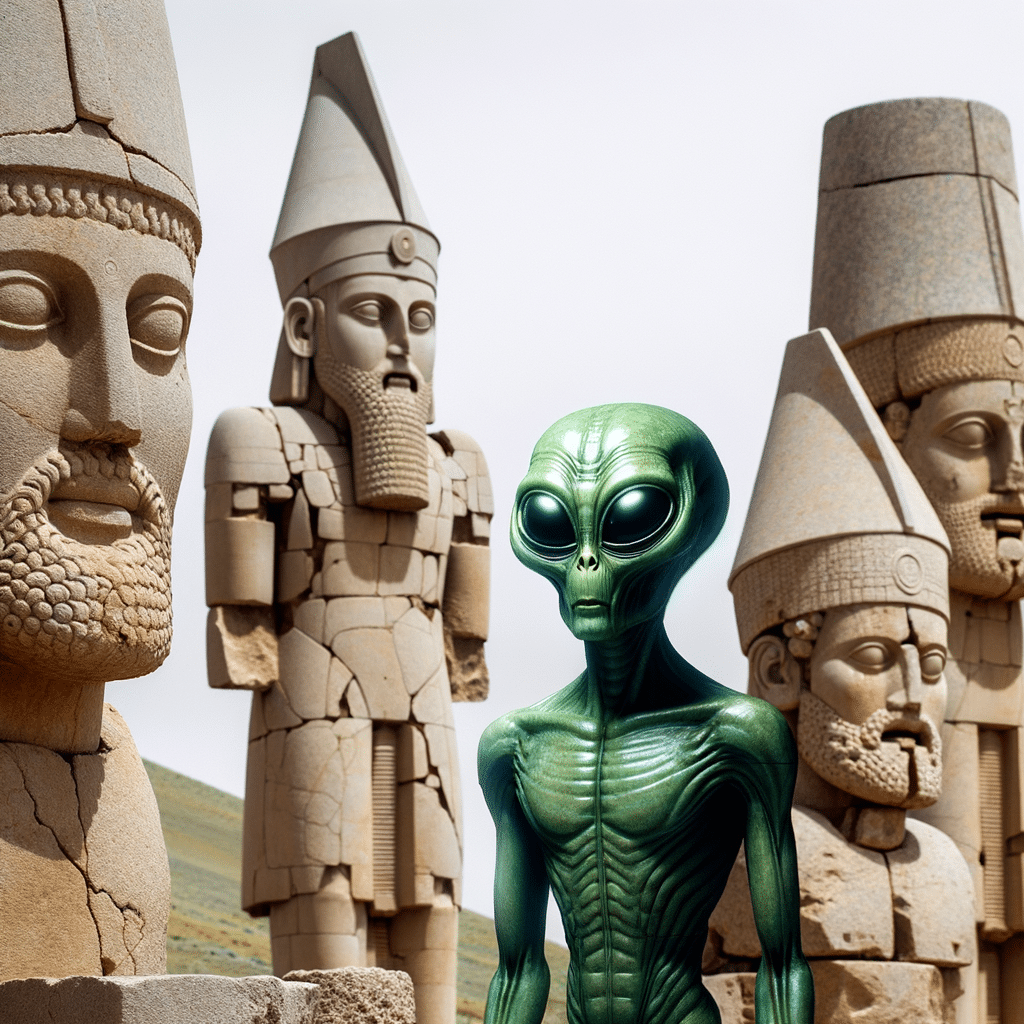
Giant stone heads at the top of Mount Nemrut in southeast Turkey gaze eternally across the ancient landscape, protecting mysteries that have baffled historians and archaeologists for decades. One of archaeology’s most fascinating mysteries is the Nemrut site, a UNESCO World Heritage Site that includes the tomb of King Antiochus I Theos of Commagene and a 50-meter-tall artificial mountain peak topped with limestone statues of ancient gods. From a lost tomb to baffling astronomical alignments, the site is full of mystery.
King Antiochus I built the site in the first century BC as a tribute to his ambitious plans for the Kingdom of Commagene, a buffer state between the Parthian and Roman empires. Antiochus I, whose syncretic belief system combined Persian, Armenian, and Hellenistic traditions, authorized the construction of this grandiose edifice as a tomb and a sacred shrine. The monument’s enormous statues, some of which were once 8 or 9 meters tall, show Antiochus himself with gods like Hercules-Artagnes, Zeus-Oromasdes, and Apollo-Mithras (Özsoy, 2010).

Mysteries of Nemrut
There are still many unanswered questions about the site in spite of intensive archeological research. The location of the actual burial chamber of Antiochus I is arguably the most important unresolved mystery. Although many excavations and contemporary scanning methods have been unable to find the entrance or the room itself, historians are certain that his tomb is located within the man-made mound. The construction of the 50-meter-tall tumulus remains a mystery, particularly considering the technological limitations of the era.
The exact astrological and theological meaning of the monument’s design is another confusing element. The precise nature and intent of the monuments’ alignments with cosmic events are still up for debate. Academics continue to debate whether the site served primarily as a religious sanctuary, an astronomical observatory, a royal mausoleum, or any combination of these uses (Belmonte & García, 2010).
The Nemrut sanctuary exhibits numerous notable astrological alignments, particularly on three crucial dates:
Experts believe that July 14 was King Antiochus I’s coronation and birthday, as the sunrise aligns with the sculptures on the eastern terrace.
December 23: Although it is a little later than the exact solstice date, the sunset coincides with the western terrace, possibly signaling the winter solstice celebration.
March 21 and September 23: It appears that specific alignments with the monument’s terraces indicate the equinoxes.
The site’s lion horoscope, which displays a conjunction of Mars, Mercury, and Jupiter with the constellation Leo, points to more astrological importance. Archaeoastronomers have utilized this arrangement to help date the monument’s construction to between 62 and 61 BC.
Lost Tomb
One of the most fascinating unresolved mysteries in archaeology is the location of Antiochus I’s lost tomb. The tomb is believed to be located somewhere within the 50-meter height of the manmade tumulus, which is a pile of crushed limestone rocks atop the natural mountain peak. Archeological data suggests that the burial chamber should be located near the base of this man-made mound. Despite numerous attempts using modern technologies like electromagnetic scanning, seismic surveys, and ground-penetrating radar, researchers have not found any entrance or chamber with certainty. Researchers have theorized that they purposefully made the tomb nearly impossible to locate (Brijder, 2014).
According to historical accounts, Antiochus I himself provided detailed directions for building the tomb, including references to intricate mechanical systems and safety precautions. The site’s Greek inscription reads, “I have had this tomb-sanctuary built on a foundation that cannot be destroyed.” The design of the tomb is the subject of several theories. It might have an advanced drainage system to prevent water damage. They could purposefully conceal the entrance by creating false passageways or chambers. The tumulus may conceal the actual burial chamber in an unexpected location, possibly even above ground level (Topal, Deniz, & Güçhan, 2015).
There may be several decoy rooms to confound would-be tomb robbers, according to some academics. The numerous tomb robberies that took place during that period, particularly involving royal Hellenistic burials, may have contributed to the challenge of safeguarding the tomb. This could potentially shed light on the complexity of the engineering involved, which continues to elude detection techniques to this day.
Another mystery is the purposeful decapitation of the statues. While some academics argue for the deliberate removal and placement of the heads in their current locations, others attribute this to seismic activity and natural weathering. If such an arrangement is deliberate, its purpose is unknown. Furthermore, the technological know-how needed to construct and move these enormous chunks of limestone to the 2,134-meter mountaintop begs the question of the Commagene kingdom’s engineering prowess.

Aliens and Fringe Theories
Over time, a number of fringe theories have emerged about the site, with some alternative scholars speculating that aliens helped build it. Citing documented electromagnetic abnormalities and strange atmospheric events at the mountain peak, some paranormal enthusiasts assert that the location functions as an old energy center or portal. There are also occasional fringe theories about giants, Atlantis, and Lemuria.
Some organizations widely hold alien beliefs surrounding Mount Nemrut, but these beliefs are based on old astronaut theories that contradict accepted archaeological knowledge. The site’s construction techniques are the main emphasis of proponents of alien involvement, who contend that ancient technology would not have been able to precisely cut and carry enormous chunks of limestone to the 2,134-meter top. Some even propose the use of anti-gravitational technology to lift the enormous stone heads, each weighing several tons, citing the exceptionally clean surfaces of some stone pieces as evidence of sophisticated cutting procedures.
Additionally, the site’s celestial alignments have stoked suspicions about extraterrestrial life. Ancient astronaut theories suggest that the location served as a landing or signaling platform for extraterrestrial craft, as the alignments were too precise for ancient peoples to calculate. Some view the site’s lion horoscope as a star map or navigational aid for extraterrestrial visitors, not as an astronomical landmark. These beliefs frequently link Nemrut to other ancient locations around the planet, suggesting a pattern of alien impact on early civilizations (Von Daniken, 2020).
People who think aliens were involved often point to strange things that were seen at the site, like reports of strange electromagnetic readings around the tumulus and electronic equipment not working properly in some areas. Unverified claims of atmospheric disturbances and odd lights have further reinforced these hypotheses. Some scientists say that certain mathematical ratios in the building match those found at other supposedly alien-linked sites around the world. People often use the tumulus’ perfect circular shape and the geometric accuracy of the statue placement as proof of advanced engineering beyond the capabilities of ancient people.
However, professional historians and archaeologists provide solid evidence to disprove these claims. They point out that many other sites from the same era show that ancient peoples had advanced technical and astronomy expertise. Even though Nemrut’s building methods are amazing, they may be explained by well-known, antiquated procedures that involve ramps, rollers, and enormous labor forces. The mountain’s inherent geological properties explain the alleged electromagnetic abnormalities, and while the astronomical alignments are impressive, their precision is average for ancient observatories of the era. Despite the challenges, established old engineering techniques transported and placed massive stones without the need for extraterrestrial assistance. Even though the site’s many true mysteries still captivate both experts and tourists, these logical answers, backed by historical documents and archeological evidence, offer a more grounded understanding of the site’s creation and significance.
The degradation of the limestone sculptures poses ongoing conservation issues, as they are ancient relics susceptible to weather exposure and temperature changes. Despite contemporary preservation measures, the harsh environment at the summit still affects the site, making ongoing archaeological research and documentation efforts even more urgent.
Conclusion
Mount Nemrut presents a number of unanswered problems to scholars while also serving as a monument to human skill and ambition. The site continues to test our knowledge of ancient capabilities, from the secret tomb of Antiochus I to the intricate technical and astronomical alignments used in its construction. Even though paranormal hypotheses may pique the public’s interest, the true mystery of Nemrut lies in the amazing accomplishments of its ancient builders and the persistent doubts regarding their methods and intentions. This monument on top of a secluded mountain in Turkey continues to be one of archaeology’s most fascinating riddles, connecting the ancient and modern worlds while keeping its most profound truths well hidden.
References
Belmonte, J. A., & García, A. C. G. (2010). Antiochos’s hierothesion at Nemrud Dag revisited: adjusting the date in the light of astronomical evidence. Journal for the History of Astronomy, 41(4), 469-481.
Brijder, H. (2014). Nemrud Dagi: Recent Archaeological Research and Preservation and Restoration Activities in the Tomb Sanctuary on Mount Nemrud. Walter de Gruyter GmbH & Co KG.
Özsoy, M. (2010). Mt. Nemrud (Nemrut) Kommagene (Commagene). Natural Heritage from East to West: Case studies from 6 EU countries, 339-351.
Topal, T., Deniz, B. E., & Güçhan, N. Ş. (2015). Decay of limestone statues at Mount Nemrut (Adiyaman, Turkey). International Journal of Architectural Heritage, 9(3), 244-264.
Von Daniken, E. (2020). War of the Gods: Alien Skulls, Underground Cities, and Fire from the Sky. New Page Books.


Leave a Reply