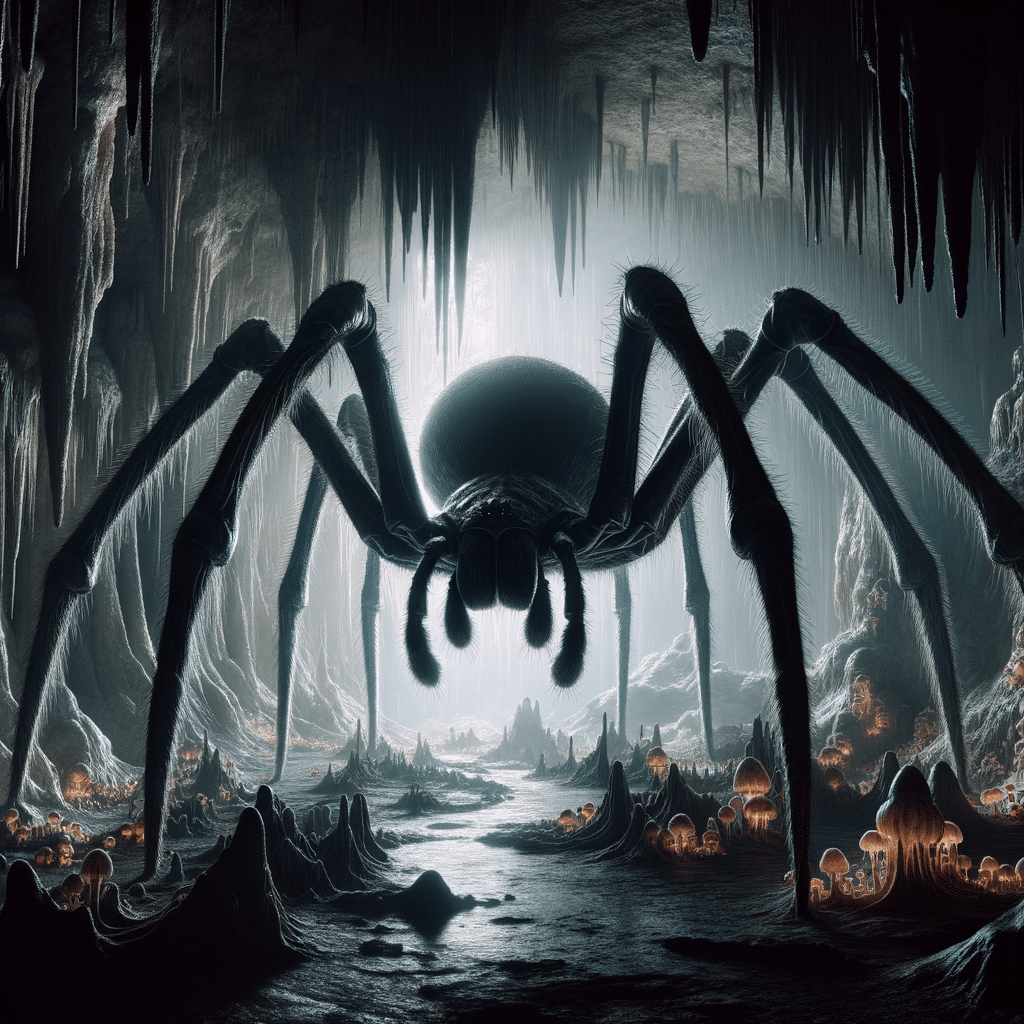
Spiders capture our imagination with their intricate webs and quick, quiet movements. Most spiders are quite small, fitting easily on the palm of a hand. Yet legends and fictional tales from cultures worldwide describe giant spiders the size of dogs, horses, and even bigger.
Giant spiders are a common theme in folklore, mythology, and popular culture, often inciting fear and fascination in equal measure. From the mythical Arachne of Greek folklore to the terrifying Shelob in J.R.R. Tolkien’s Lord of the Rings, these massive arachnids have been woven into the fabric of many stories.
But could such creatures actually exist in reality? This essay will examine the plausibility of giant spiders through analyzing cryptid legends, habitat needs, biological limitations, and popular culture accounts.
Definition
When we talk about giant spiders, we need to clarify what we mean. In real life, the largest spiders by leg-span are the Giant Huntsman spiders, which can reach up to a foot in diameter. However, in the realm of folklore and popular culture, giant spiders often refers to arachnids of monstrous proportions, sometimes as large as houses or even larger. It’s this latter, more fantastical interpretation of giant spiders that this video primarily focuses on.
When picturing a giant spider, one might envision a black widow, tarantula, or other common spider species scaled up to enormous size. Their features would likely remain similar but on a much grander scale – eight long, hairy legs supporting a large oval abdomen and small head with prominent fangs and multiple eyes. Cryptid accounts often describe colors ranging from black to brown, sometimes with markings or stripes. Webs might stretch over 20 feet, anchored between trees and able to entangle large prey. Overall, giant spiders resemble typical spiders in anatomy but magnified dramatically in size.
Folklore
Giant spiders feature in many legends and folklore around the world, often symbolizing danger, deceit, or the uncanny.
In South America, the J’ba Fofi of Congolese legend is said to be a giant spider-like creature that spins intricate, circular webs across game trails to ensnare its prey. Described as having a leg span of four to six feet, J’ba Fofi is feared by locals for its alleged predatory nature towards small animals and, occasionally, humans.
Across the Pacific in Australia, local Aboriginal legends tell of the Dreamtime spider known as the Yara-ma-yha-who. While not exactly a spider, this creature has many spider-like features, including a red body and enormous size.
Asia, too, has its share of giant spider legends. In Laos and Vietnam, stories of the Cong Phung, a massive spider said to dwell in the jungles, have been passed down through generations. Meanwhile, in Japanese folklore, the Jorōgumo is a ghoulish creature capable of changing from a beautiful woman into a giant spider.
These cryptids point to a universal human fascination with spiders large enough to threaten people. Modern sightings continue as well, such as a supposed giant spider web covering a pasture in Missouri. While lacking scientific evidence, the prevalence of giant spider folklore hints at a conceptual fear of spiders breaking size constraints.

Biological Reality
The actual existence of such colossal spiders would necessitate very specific habitat conditions. Spiders are ectothermic, meaning their body temperature is regulated by the external environment. Therefore, a stable, warm environment would be essential for a giant spider to thrive, as it would help to maintain its body temperature. As cold-blooded arachnids, giant spiders would thrive in tropical regions where they can stay warm yet avoid overheating. Dense forests with large anchoring points for webs would provide cover as well as connectivity for movement.
Spiders are also predatory creatures that rely on capturing and consuming live prey. The larger the spider, the larger its prey would need to be. Therefore, a habitat with an abundance of large prey would be essential. Plentiful large prey, such as birds, monkeys, deer or even humans would be necessary to supply the massive food requirements.
A giant spider would also likely require a secluded environment, both to hide from potential threats and to allow it to stalk its prey. Deep forests, caves, or other such secluded environments would likely be ideal. Lastly, isolated areas with few predators would provide the safest dwelling locations. Small territories or easily accessible areas would likely not enable giant spider populations to remain undiscovered. Only very remote tropical forests could potentially house hidden groups of monstrous spiders.
While the idea of giant spiders might be thrilling, it’s important to consider the scientific limitations on their size. The principle of square-cube law states that as a shape grows in size, its volume grows faster than its surface area. In the context of spiders, this means that their bodies would become exponentially heavier with size, but their legs would not become correspondingly stronger. Eventually, a point would be reached where the spider’s legs could no longer support its body weight.
Furthermore, spiders, like all arthropods, have an exoskeleton and breathe through a system known as book lungs or through tracheae, which are tubes that allow air to enter their bodies. As spiders grow larger, these breathing systems become less effective, limiting the amount of oxygen they can intake. This is part of the reason why, during prehistoric times, when Earth’s atmosphere had higher oxygen levels, arthropods were able to grow much larger.
Most entomologists conclude the giant Goliath birdeater of South America represents the maximum size at just under one foot diameter. Significantly larger spiders would lack adequate oxygen supply to all their organs and tissues. However, a hypothetical giant spider with enhanced lung capacity or auxiliary respiratory organs could perhaps overcome this obstacle and reach enormous proportions. So while extreme improbable, giant spiders are not absolutely impossible according to science.
Popular Culture
Despite these scientific constraints, giant spiders have had a significant presence in popular culture, often serving as symbols of fear and revulsion. Their appearances range from classic literature to modern film and video games. Giant spiders frequently appear in popular movies, video games, novels and other media, demonstrating their strong grasp on the public imagination.
J. R. R. Tolkien populated Middle Earth with giant spiders such as Shelob in the Lord of the Rings series. Hagrid’s pet Aragog in the Harry Potter books presented a more sympathetic giant spider. Movies like Tarantula, Kingdom of the Spiders and Eight Legged Freaks center on mutant arachnids terrorizing towns. Video games allow players to battle giant spider bosses in environments from dungeons to radioactive wastelands. Through these pop culture works, giant spiders continue as frightening yet compelling creatures.
Conclusion
In the end, while traces of plausibility exist, giant spiders most likely remain in the realm of myth and fantasy. Their widespread presence as global folklore figures combined with limits on spider anatomy relegate them to cryptid status like Bigfoot. Still, limits can be pushed and nature has created astonishing creatures. The slim possibility remains that in an isolated pocket of rainforest thrives a spider as large as a human. Until an intrepid explorer uncovers such a monster, giant spiders will persist as creatures found only in cultural legends and imaginations. Nonetheless, their enduring appeal hints that the desire to discover giant spiders lives deep in the hearts of arachnophobes and arachnophiles alike.
References
J. K. Rowling. (1998–2007). Harry Potter [Book series]. London, England: Bloomsbury Publishing.
Newell, J. A. (Director). (1955). Tarantula [Film]. Universal Pictures.
Park, J. (Director). (2002). Eight legged freaks [Film]. Warner Bros. Pictures.
Shatner, W. (Actor). (1977). Kingdom of the spiders [Film]. Dimension Pictures.
Tolkien, J. R. R. (1954–1955). The Lord of the Rings [Book series]. London, England: George Allen & Unwin.


Leave a Reply