Beige Lady Ghosts: Key Points
-
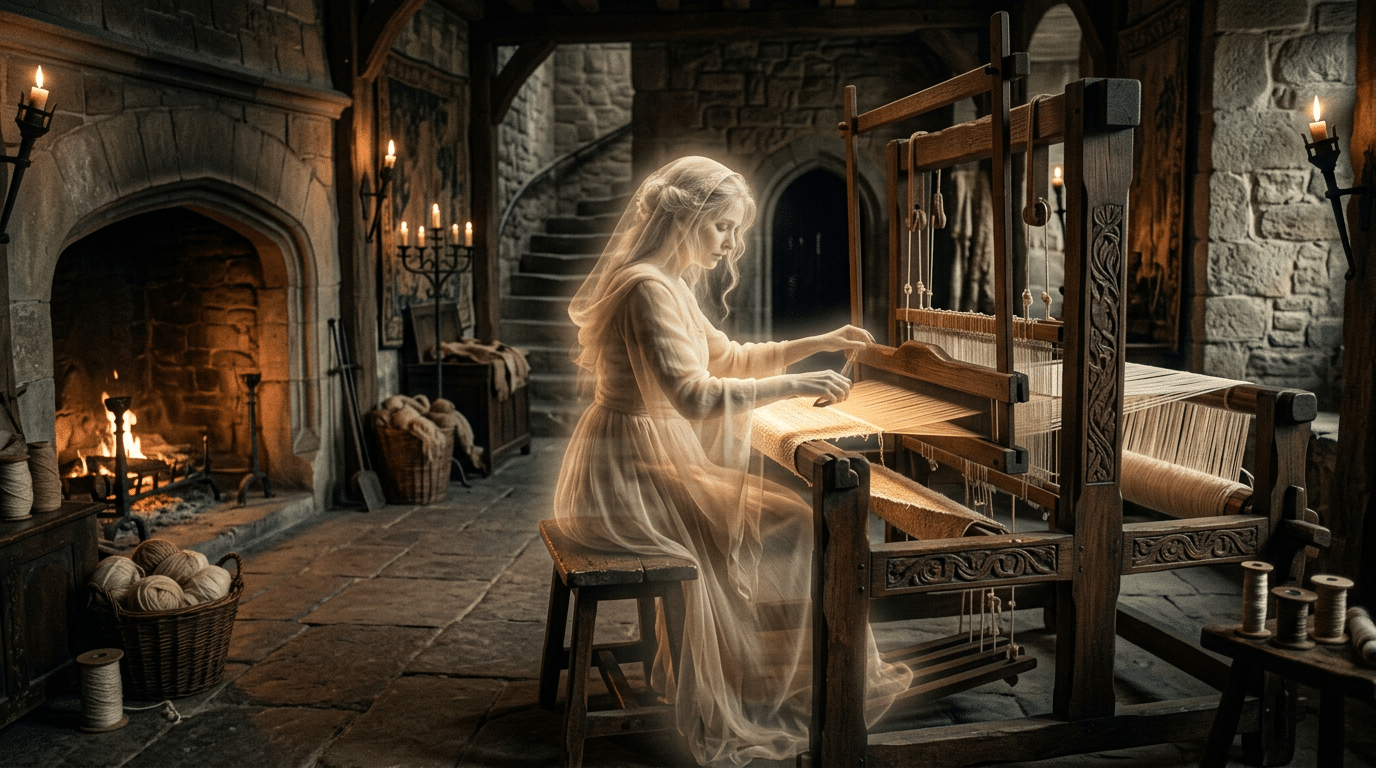
Beige lady ghosts are female apparitions dressed in neutral, earthy-toned clothing that partially blends with their surroundings, existing between visibility and invisibility while evoking melancholy and quiet resignation rather than terror.
-
These apparitions engage in mundane domestic activities like folding laundry or waiting near windows, rarely acknowledging living observers, and they manifest during twilight or overcast days with slow, deliberate movements.
-
The Woman in Beige haunts the Virginian Hotel, eternally waiting for a husband who never arrived by train; in her grief, she threw herself from a third-floor window (“Lady Spirits in All Kinds of Colors,” 2026; “Ghost Month,” 2025), and she remains trapped by hope rather than anger.
-
Theories explaining beige lady ghosts include residual hauntings of emotionally suppressed individuals, psychological misperceptions influenced by environmental conditions, or sociocultural symbols of unacknowledged women’s domestic labor, with the beige coloring potentially representing their status as background figures in life.
-
These apparitions function as lenses on women’s experiences and social history, indexing social memory and gendered space (Franz, 2021; O’Donnell, 2020), and they participate in paranormal tourism and heritage branding across global contexts.
-
Beige lady ghosts have challenged conventional paranormal narratives by highlighting quieter forms of spectral persistence, prompting discussions about whose stories become remembered and inspiring attention to ordinary women’s lives.

Introduction
The brown woman ghost is one of the strangest and least studied types of ghosts in paranormal literature. They bear no resemblance whatsoever to the white lady apparitions that have been unsettling individuals for centuries. You can tell these ghosts apart by how they look: they are gray, brown, or sand-colored. People have seen them in numerous places and eras, but the ones with brighter colors still attract the most attention. The beige lady ghost helps us question what we believe we know about ghosts. It also makes us contemplate what hauntings are, how people’s minds work when they see them, and how different cultures tell ghost stories. This essay will talk about what makes beige woman ghosts unique, look at some famous historical examples, and examine some theories that try to explain why they exist and what they mean.
Characteristics and Manifestations of Beige Lady Apparitions
People often believe that beige lady ghosts are women that wear soft tan and warm taupe colors that are neutral and earthy. They don’t usually wear the long white dresses that are popular in ghost stories. Instead, they typically wear clothes that look like they belong to a middle-class family. Witnesses frequently assert that these entities possess an uncanny ability to integrate into their environment, appearing to exist in a state that is neither fully visible nor utterly missing from our world. People often say that the faces of beige woman ghosts are blurry or difficult to remember, and witnesses have trouble remembering specifics even shortly after an event. People frequently feel sad and resigned when they encounter them, not scared. This suggests that they have a different emotional signature than hauntings that are more violent or dramatic.
Beige lady-like ghosts are frequent in historical or domestic contexts, where hauntings serve as a prism through which to explore women’s lives, actions, and social history. Researchers studying residential hauntings have found that these occurrences often provide insight into social memory, gendered settings, and close connections with material culture. For instance, research on haunted houses and stories about women shows ghosts as beings that move between private and public spaces (Franz, 2021; O’Donnell, 2020). Furthermore, the analysis of female protagonists and spectral entities in domestic narratives demonstrates how ghosts may represent unresolved social injustices and historical grievances within private or heritage contexts, exemplified by the Tredwell mansion and other historic interiors (Franz, 2021). These studies bolster the concept that brown lady apparitions serve as culturally meaningful cues that aid memory retention in familiar environments (Franz, 2021; EL, 2019).
Paranormal study claims that beige woman ghosts are really different from other ghosts because of how they behave. People often see these ghostly figures doing everyday activities around the house, such as folding clothing, sweeping floors, or standing by windows as if they are waiting for someone who will never come. They don’t seem to notice when people are observing them; instead, they seem to be focused on doing the same things over and over or thinking about something that isn’t there. Witnesses say that when brown women ghosts do move, they do so slowly and on purpose. They don’t glide like white lady ghosts or move quickly and jerkily like more hostile spirits. They frequently come out during twilight or on cloudy days, when the light is dim and neutral. This condition could help them show up or make them easier to find.
Historical Case Studies: The Woman in Beige of the Virginian Hotel
One of the saddest stories of women ghosts is “The Woman in Beige” at the Virginian Hotel. In 1911, August Grimm built the Virginian Hotel. This spirit haunts a beautiful place. People thought it was too fancy and out of place for its day, but now the hotel is a historic icon with a sad soul inside. The story of the Beige Lady is one of endless waiting and hopelessness. She was a woman who was waiting for her husband to come home by train, probably for a reunion or their wedding (“Ghost Month,” 2025). He never appeared, and the wife was really concerned and worried about it. She says in “Lady Spirits in All Kinds of Colors” (2026) that she leaped out of a window on the third level in pain and perished.
She is still awake in her white dress, waiting for her husband to come back. “Lady Spirits in All Kinds of Colors” (2026) says that many people have seen her over the years, which makes her one of the hotel’s most well-known ghosts. Her story is terrible because it shows how sad it is to be alone and love someone who doesn’t love you back. These are common themes in many ghost stories about women. Some ghosts of other hues are angry, but the Beige Lady seems stuck because she is not angry but hopeful. This is the saddest curse of all. Her presence in the Virginian Hotel reminds us of the emotional traumas that can keep ghosts tied to certain places on Earth, especially when these traumas involve broken promises and inexplicable desertion (“Ghost Month,” 2025).
Theoretical Frameworks: Psychological, Parapsychological, and Sociological Interpretations
Some ideas about beige lady ghosts come from psychology, while others come from the supernatural. Scientists aren’t sure if these beings are real or just things that mankind has made up. Some parapsychologists think that the beige woman ghosts might be a kind of residual haunting. They think that they are simply psychological records of people whose lives were monotonous, repetitious, and full of masking their feelings. The calm look on their faces shows how calm their lives were on Earth. This idea states that the energy or consciousness of these people left a trace on the environment, which produces a loop that happens again and again when certain things happen. This explanation claims that the beige hue could be caused by the mental impression fading with time, exactly like how pictures and materials lose their color when they are in the light and air.
Some specialists are not so confident about beige lady ghosts. People say that these ghosts are a type of mistaken belief or hallucination that is molded by cultural conceptions about ghosts and where they show up. This hypothesis posits that when our brains encounter perplexing stimuli in dimly lit or emotionally charged environments, they may generate spectral manifestations that align with our subconscious beliefs regarding the nature of hauntings in such contexts. The beige color may just be a function of the lighting and the place where these sightings happen. People may not even realize that they are taking in information about the environment when they see these things. Those who subscribe to this theory believe that homes with beige or neutral-colored walls often host beige lady ghosts. This suggests that the apparitions may arise from faulty pattern recognition.
You can also look into beige lady ghosts from a social analysis perspective. This perspective posits that these ghosts mirror society’s perception of women’s housework and the general disregard for women’s labor. This viewpoint suggests that beige lady ghosts represent all the women throughout history whose lives were dominated by tedious household chores, whose contributions were ignored, and whose identities were concealed by their roles as homemakers. The beige color suggests that they are not getting any love or attention in their lives. They exist in both states simultaneously. This idea posits that individuals may see beige lady ghosts more frequently in locations where women engaged in extensive domestic labor or when women perished while solely performing household duties.
The female ghost image often connects to larger discussions about gendered fear, motherly roles, and the “monstrous feminine,” especially in homes. Studies on the “monstrous feminine” and “gendered hauntings” demonstrate how female ghosts may represent concerns over women’s societal roles, autonomy, and personal boundaries. When we consider the beige woman (Dixon, 2011; Heholt, 2016), it’s like how some mystical myths make women feel both strong and weak.
Beige ladies or other female ghosts, are a part of several paranormal economies around the world. Some examples are tourism, religious or secular traditions, and digital media ecosystems. Research conducted in several regions, including Serbia’s potential for paranormal tourism, Western Georgia’s apparitional discourse, and Chile’s dark media, illustrates how the form and function of these ghosts are culturally constructed and economically influenced. It posits that beige-lady hauntings may evolve to align with local heritage economics while maintaining a distinct female spectral presence (Obradović et al., 2021; Glazier et al., 2025; Santo & Barceló, 2021; Chisholm, 2019).

Cultural Impact and Contemporary Significance in Paranormal Studies
The beige lady ghost has had a small but noticeable effect on both paranormal studies and popular culture. It has changed the way people perceive ghosts and what they should do. These ghosts have helped paranormal investigators think about more than just scary hauntings that attract a lot of attention. They now have to consider the less spectacular and more common issue of spectral persistence. People have discussed whose stories are recounted and remembered, both in life and after death, because of beige lady ghosts. People are starting to think that even our ghost stories indicate how people are biased and how they fit into society. Museums and historical societies are starting to pay more attention to the lives of women who work from home. This tendency stems from the belief that beige woman ghosts symbolize neglected or ignored lives.
There aren’t a lot of beige woman ghosts in popular culture, but there is a small group of people who like them and the occult. They like how quiet they are and how sad their lives are every day. People who seek psychological depth and social commentary over cheap thrills have seen brown lady ghosts in the works. This type of ghost is not like the scary white lady or red lady ghosts that are common in horror movies and stories. The media usually depicts them in a sad and thoughtful way, as icons of people whose lives are limited by social rules and the grief of not realizing their full potential. More and more individuals are interested in beige woman ghosts. This trend might mean that people are starting to care more about and respect normal lives and jobs. These phantom people are shockingly important to modern conversations about work, gender, and memory.
Ghosts and ghost stories are useful for building a brand and teaching individuals how to tell stories. Literature shows that ghost stories help people remember and share history. This observation means that haunted sites are part of a bigger agenda for marketing and learning. There are both old and new works that talk about how museums and historic residences use paranormal happenings to make tourists and students feel something. They often have to achieve a balance between giving people what they want and being historically accurate (Trenter, 2024; Ironside, 2023; Franz, 2022), which can lead to challenges in presenting ghost stories that are both engaging and true to the historical context. Because she is a slightly feminine figure, the beige lady can be like a morally acceptable ghost. Her presence brings to mind a historical story, but it doesn’t provide a clear picture of what happened.
TV shows and other media that talk about the paranormal, like Most Haunted, have been very important in changing how people perceive hauntings and getting people to visit places where ghosts are said to live. Researchers examine the influence of paranormal media on consumers’ perceptions of their connection to historical and cultural monuments amidst continuing discussions about their validity (Edwards, 2019; Dixon, 2011; Ironside, 2024). Edwards (2019) and Ironside (2024) assert that this media-mediated hauntedness alters individuals’ perceptions and interactions with beige-lady ghosts in authentic locations such as castles, heritage houses, and palaces. The media makes it seem normal for beige-lady figures to see a “nondescript” female ghost. People use her as a model to figure out what she stands for because she doesn’t have any particular features.
Paranormal researchers are always coming up with new ways to catch and investigate strange things; thus, the way they look for and record beige lady ghosts varies all the time. Researchers today use thermal imaging, electromagnetic field detectors, and voice recording technology to try to find proof of these ghostly beings, but the results are still not clear and can be understood in many ways. It’s hard to learn about beige lady ghosts because they are quiet and appear unexpectedly. It’s impossible to establish scientifically that they are real because their effects are so minor. You might easily pretend that they are not relevant or that they are just normal stuff.
Conclusion
Beige woman ghosts are distinct from other ghosts because they are part of a type of haunting that focuses on the everyday instead of the exciting and encourages thinking instead of fear. We question what it means to imprint the world and if the energy or essence of a calm life may remain beyond death, since they look and act the same way over and over again. There are real beige lady ghost stories, psychological events, or cultural symbols. They remind us that not all ghosts are scary. The scariest people are often those who blend in and work quietly. Even while the field of paranormal investigation is constantly changing and growing, these silent ghosts may still be able to tell us important things about memory, consciousness, and the weird line between the living and the dead, particularly by revealing how our perceptions of reality can be influenced by unseen forces and the stories we tell ourselves.
References
Chisholm, D. (2019). Review of The spectral Arctic: A history of dreams and ghosts in polar exploration by Shane McCorristine (2018). London: University College London Press. 265 pp. ISBN 978-1-78735-246-9. Polar Research, 38(0). https://doi.org/10.33265/polar.v38.3376
Dixon, D. (2011). Scream: The sound of the monstrous. Cultural Geographies, 18(4), 435-455. https://doi.org/10.1177/1474474011401991
Edwards, A. (2019). “Do the ghosts roam along the corridors here at Ordsall Hall?”: Paranormal media, haunted heritage, and investing historical capital. The Journal of Popular Culture, 52(6), 1312-1333. https://doi.org/10.1111/jpcu.12852
EL, E. (2019). A Freudian analysis of computer séance and fair exchange by Ruth Rendell. Journal of International Social Research, 12(65), 77-83. https://doi.org/10.17719/jisr.2019.3425
Franz, M. (2021). Haunted intimacy: Spectral and vital space within a historic house museum. Museum and Society, 19(3), 382-394. https://doi.org/10.29311/mas.v19i3.3830
Ghost month: The ladies. (2025, October 6). Legends of Windemere. https://legendsofwindemere.com/2025/10/06/ghost-month-the-ladies/
Glazier, J., Mitchell, D., Wipff, Z., & Cochran, N. (2025). Paranormal folklore in Western Georgia: A critical narrative analysis of apparitions. Anthropology of Consciousness, 36(2). https://doi.org/10.1111/anoc.70005
Heholt, R. (2016). Ambivalent ghosts: The manifestation of the supernatural in Ruth Rendell’s fiction. Contemporary Women’s Writing, vpw031. https://doi.org/10.1093/cww/vpw031
Ironside, R. (2023). Death, ghosts, and spiritual tourism: Conceptualizing a dark spiritual experience spectrum for the paranormal market. Journal of Scientific Exploration, 37(4), 586-601. https://doi.org/10.31275/20233227
Ironside, R. (2024). Ghost hunting events and storytelling. Event Management, 28(4), 649-654. https://doi.org/10.3727/152599524×17077053867629
Lady spirits in all kinds of colors. (2026, March 17). The Little House of Horrors. https://thelittlehouseofhorrors.com/lady-spirits-in-all-kinds-of-colors/
O’Donnell, E. (2020). Hauntings of bodies, selves, and houses. Digital Literature Review, 7. https://doi.org/10.33043/dlr.7.0.13-23
Obradović, S., Pivac, Т., Besermenji, S., & Tešin, A. (2021). Possibilities for paranormal tourism development in Serbia. Eastern European Countryside, 27(1), 203-233. https://doi.org/10.12775/eec.2021.008
Santo, D., & Barceló, G. (2021). New media and the digitized paranormal: Instrumentation, affective atmospheres, and the production of history in Chile. Journal of the Royal Anthropological Institute, 27(2), 321-339. https://doi.org/10.1111/1467-9655.13492
Trenter, C. (2024). Haunted Löfstad Palace: Spectacular sensations and educational aids in the wake of castle ghosts. Humanetten, (52), 154-168. https://doi.org/10.15626/hn.20245212
Leave a Reply