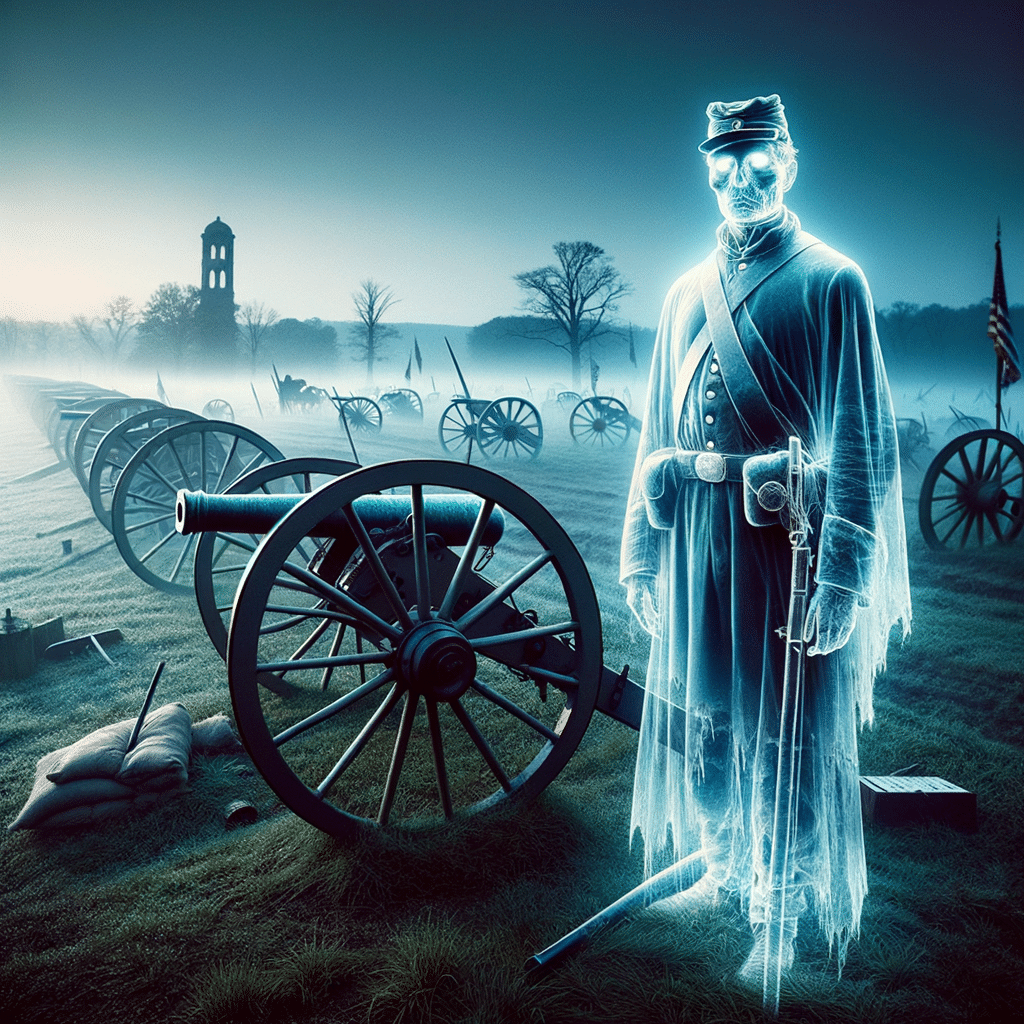
For some, the American Civil War never truly ended. Their souls remain.
The four-year American Civil War, which raged from 1861 to 1865, is still deeply ingrained in the communal consciousness of the country. The horrific events, significant death toll, and profound division throughout the country have given rise to a rich corpus of ethereal folklore that evokes both intrigue and terror. This essay will explore the mythology of Civil War ghosts, elucidating how they embody the memories of one of the most violent periods in American history.
The battlefields, where thousands of lives were suddenly taken, are the most famous locations linked to ghost stories from the Civil War. In addition to their historical significance, places like Gettysburg, Antietam, and Chancellorsville are also rumored to have hauntings.
Gettysburg
One of the most important conflicts in American history, the Battle of Gettysburg, took place from July 1–3, 1863. The fight, which claimed more than 50,000 lives, was a turning moment in the Civil War. Beyond its historical significance, though, is a frightening legacy that has drawn tourists for decades.
The Gettysburg battlefield has inspired many myths. Visitors frequently tell stories of phantom armies marching in formation—ghostly troops that materialize out of thin air and vanish just as quickly. Some claim to have seen ghostly images of General Robert E. Lee galloping across the battlefield, or to have heard the haunting cries of injured men reverberating across the countryside.
These terrifying stories underscore how people impacted by war are never really free from its effects and serve as a constant reminder of the horrific human cost of conflict. It is not unusual for many visitors to Gettysburg National Military Park today to experience anxiety or even hear whispering among themselves as they stroll through these ancient grounds.
Antietam
Not only is the Antietam Battlefield in Maryland a historically significant site, but it is also believed to be the site of paranormal activity. Both personnel and visitors have reported hearing sounds like footsteps or cannon fire, as well as seeing eerie apparitions. Reports indicate that these experiences typically occur during the night, when the battlefield remains quiet and veiled.
“Bloody Lane,” the site of one of the bloodiest engagements of the Civil War, is one location frequently associated with spectral encounters. People have reported seeing uniformed soldiers moving along the lane or standing motionless before disappearing from view.
An old barn that served as a field hospital during the conflict is another location with a reputation for having a ghostly presence. Visitors claim to have felt cold places, heard groans, or even seen visions of injured troops lying in makeshift beds.
Ghosts
The Civil War is not merely a distant memory but rather a persistent ghost that many Southerners feel in their homes and communities. Rumors circulate that soldiers, slaves, and even well-known historical figures like Jefferson Davis haunt numerous structures in the South, ranging from opulent plantation homes to modest country cottages.
The White House of the Confederacy in Richmond, Virginia, is arguably one of the most notorious examples. From 1861 until 1865, President Davis lived in this opulent home as the official residence of the Confederacy. Despite its subsequent renovation and transformation into a museum honoring Confederate history, some guests attest to sensing an unsettling presence while navigating its hallways and chambers.
Some claim to have heard footsteps or ghostly words reverberating through deserted hallways in the middle of the night. Others claim to have seen ghosts dressed in historical attire staring out windows or standing calmly in doorways. One especially unsettling story concerns a woman who, long after Jefferson Davis’s death, claimed to have seen him sitting at his desk in one of the upper rooms!
In Wilmington, North Carolina, the stunning antebellum Bellamy Mansion stands as a somber reminder of the terrible effects the Civil War had on families and communities, in addition to being a symbol of the area’s rich past. Many people in the area have a legend that this historic mansion is still home to the ghosts of Civil War soldiers who died in engagements in and around Wilmington.
These hauntings serve as heartbreaking reminders that war has far-reaching implications beyond battlefields and military strategies, making them more than just eerie folklore. These are the kinds of houses where families who have personally experienced loss can feel the close, domestic repercussions of conflict. The Bellamy Mansion provides a tangible connection to this period in American history, demonstrating the impact of conflict not only on expansive landscapes but also within the homes of departed loved ones.
A chilling reminder of the horrors of slavery that reverberate throughout American history are the ghost stories from the Civil War era. Stories of haunted plantations and the spirits of enslaved people draw attention to the cruel treatment and unfavorable living and working conditions that slaves endured. These tales frequently have a somber undertone, with the ghosts of the oppressed coming back to exact revenge on their oppressors.

Ghost Stories
Not only are these ghost stories terrifying tales, but they serve as a crucial reminder that the scars left by slavery remain incomplete. Racial tensions continue to persist in America even after the Civil War and the abolition of legal servitude. As a result, the spirits that haunt these estates represent both our country’s historical and contemporary racial relations issues.
Ghost stories, according to sociologists and folklorists, are a reflection of a society’s fears, guilt, and unresolved issues. We can interpret the ubiquity of ghost stories during the American Civil War as an expression of the national trauma the country endured. The recurring ghost stories represent the incapacity to fully put the Civil War’s legacy of racial injustice, interregional hostility, and the tragic death toll behind us.
Moreover, the ghost stories from the Civil War provide a feeling of continuity between the past and present. In this way, they act as a kind of historical consciousness, reminding people of the long history behind current socio-political challenges in the United States.
Conclusion
Ghost stories eerily reflect the country’s collective memory of the American Civil War, still regarded as one of the most pivotal periods in American history. These ghost stories depict the war’s aftereffects and capture the chaos, sorrow, and open wounds of this turbulent time. The Civil War’s repercussions will always reverberate in American culture because of the way they continue to pique curiosity about the past, inspire wonder and apprehension, and stir thought.
References
Coleman, C. K. (1998). Ghosts and haunts of the Civil War. Nashville, TN: Rutledge Hill Press.
Coleman, C. K. (2012). The paranormal presidency of Abraham Lincoln. Atglen, PA: Schiffer Publishing.
Nesbitt, M. (n.d.). Ghosts of Gettysburg (Vols. I–VIII). Gettysburg, PA: Self-published.
Ogden, T. (1999). The complete idiot’s guide to ghosts and hauntings. Alpha Books.
Okonowicz, E. (2007). Haunted Maryland: Ghosts and strange phenomena of the Old Line State. Stackpole Books.
Roberts, N. (1992). Civil War ghosts and legends. Columbia, SC: University of South Carolina Press.

Leave a Reply