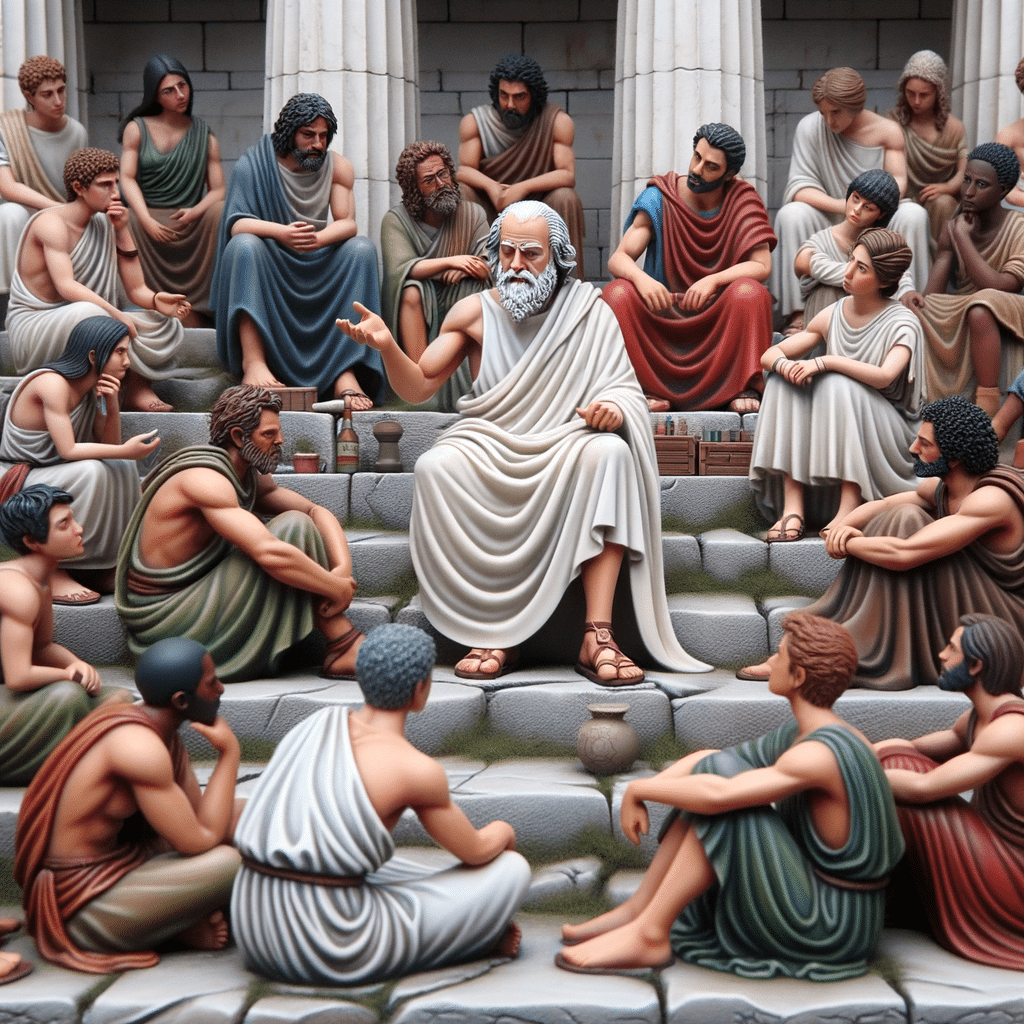
Ghosts were real, according to the ancient Greek philosopher Plato.
Since ancient times, people have been fascinated and divided over the existence and nature of ghosts. The ancient Greek philosopher Plato, who had a keen interest in the subject, articulated some of the oldest known philosophical viewpoints on ghosts in Western thinking. His opinions shed light on early spiritual beliefs and the Greek understanding of ghosts.
Greek Ghosts
The ancient Greek civilization’s mythology and spiritual beliefs placed a high value on belief in ghosts and spirits. These otherworldly entities were more than just mythical animals; they were deeply ingrained in this prehistoric society’s culture.
Hades, a well-known figure in the world of the dead, ruled the underworld. Hades, a god with great strength and control, oversaw a realm where the souls of the dead lived forever.
These spectral beings influenced stories about mortals as well as gods. Legends passed down stories about brave heroes such as Odysseus, who made dangerous trips to speak with the dead. These experiences demonstrated the inherent blurring of life and death boundaries, revealing a connection between mortals and this otherworldly realm.
The most fascinating thing about ghost stories is that the ancient Greeks took them very seriously, viewing them as real, physical visits from the afterlife.
Plato on Ghosts
The renowned Athenian philosopher Plato, who lived in the fifth century BCE, is considered an intellectual titan along with his illustrious pupil Aristotle and his respected mentor Socrates. For millennia, people have revered Plato, and his profound insights have had a lasting impact on the development of thought in Western philosophy.
Plato’s unshakeable belief in the presence of an eternal realm of ideas is fundamental to his philosophical system. He asserts that the genuine source of knowledge and truth is this ethereal realm, which exists outside the boundaries of our physical existence. According to Plato, these ideals or abstract forms stand for a higher realm where ideas like goodness, justice, and beauty exist in their most basic forms.
Plato’s idealism theory closely relates to his belief in an immortal soul that exists beyond simple corporeal existence. According to his theory, every person has a divine essence that endures beyond death and continues its journey into eternity apart from our mortal bodies. This concept aligns with his conviction that humans possess an innate connection to something beyond their physical existence.
A significant portion of Plato’s philosophical discourse revolves around his investigation of dualistic notions, namely spirit vs. matter. He explored issues of human nature and ultimate reality itself in this duality between two opposed realms, one ruled by concrete substances and the other by immaterial thoughts.

In his dialogues, Plato made several references to spirits and life after death, even though he did not publish a whole work about ghosts. Important sources include the Phaedo, which details Socrates’ passing and his outlook on soul immortality. Other dialogues, such as The Republic, Symposium, and Apology, also address ghostly themes through character dialogue.
According to Plato, ghosts are actual creatures that can disclose facts to living people. He did not, however, believe that every ghost sighting was real.
According to Plato, ghosts are the dead’s souls that haven’t fully transitioned into the afterlife. Ghosts remain on Earth because they have unresolved issues or are unable to part with their earthly ties.
Other ideas:
When a ghost manifests as an apparition, it no longer has a physical body but rather a hazy, vaporous shape.
Ghosts frequently have ties to and frequent those locations.
While they can communicate with and manifest before the living, ghosts must work hard to become apparent.
For most living individuals, seeing ghosts is both conceivable and exceedingly difficult. They are better able to see spiritualists and strong mediums.
Ghosts can be anything between wholly tangible and fully immaterial. As a result, they are able to transcend boundaries and space.
Ghosts can occasionally tell the living about past, present, and future happenings because they are aware of them.
Despite not having a physical body, ghosts retain their personalities and desires from their previous lives.
Despite their widespread fear, ghosts aren’t always evil unless they suffered a tainted existence. The majority are kind or impartial.
Plato generally saw ghosts as evidence that the human spirit continues to exist after death.
Plato’s methodical approach to ghosts is a reflection of his larger spiritual theory concerning the dualism of spirit and matter. He offered ghosts as proof of the immortal soul, which helped him justify his belief in life after death. In Plato’s view, ghosts are not scary things but rather sources of instruction. His methodical approach was consistent with his belief that the soul and the afterlife are components of a logical cosmos. Suffering intellectuals contested several of his ghost theories, but Plato provided one of the first cogent philosophical explanations of ghosts in Western philosophy. His works highlight the importance of ghosts in classical Greek society and the effort to comprehend them rationally as opposed to superstitiously.
Conclusion
The systematic concepts that Plato conveyed in these foundational writings about the supernatural nature of ghosts impacted later philosophers and spiritual thinkers. His method was logical rather than instinctive; he saw ghosts as guides rather than as scary entities. Plato’s beliefs attest to his conviction that human awareness endures beyond physical death and that there is a meaningful afterlife.




Leave a Reply